Economy
Local Equities Sink Deeper into Danger Zone by 0.17%
By Modupe Gbadeyanka
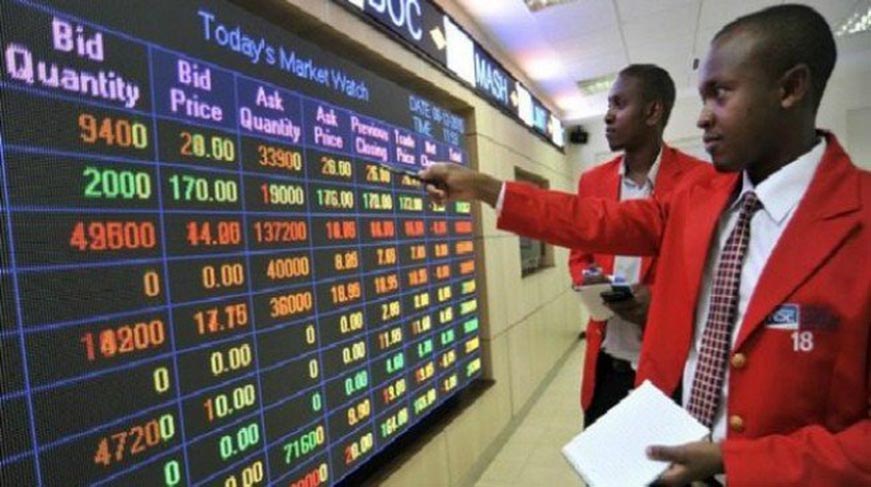
Last Friday, the Nigerian Stock Exchange (NSE) depreciated by 0.17 per cent following sustained profit-taking by investors.
The local equities were under pressure during the session as a result of the poor performance of 12 firms on the exchange as only 10 companies had their share prices closing positive.
Nigerian Breweries led the decliners’ chart after losing 70 kobo to close at N30 per share, while GTBank followed with a 50 kobo loss to settle at N21.50 per share.
Dangote Sugar declined by 20 kobo to close at N12 per share, NEM Insurance lost 6 kobo to end at N2 per share, while UBA depreciated by 5 kobo to finish at N6.15 per share.
On the flip side, Ardova was the highest price gainer, rising by 90 kobo to close at N12.55 per share and was followed by GlaxoSmithKline, which rose by 40 kobo to finish at N4.75 per share.
Oando gained 8 kobo to close at N2.31 per share, NAHCO also grew by 8 kobo to finish at N2.06 per share, while Caverton appreciated by 7 kobo to end at N1.90 per share.
Business Post reports that the activity chart was mixed last Friday as a result of the 49.08 per cent rise in the value of trades and 22.61 per cent and 9.78 per cent decline in the trading volume and number of deals respectively.
A total of 160.5 million stocks worth N1.5 billion were traded in 2,997 deals during the session compared with the 207.4 million shares worth N987.8 million transacted in 3,322 deals in the previous session.
Custodian Investment was the most traded stock last Friday, trading 14.1 million units valued at N67.5 million, with Japaul Oil following with 12.2 million equities worth N2.7 million.
Nigerian Breweries exchanged 11.7 million equities for N349.6 million, Mutual Benefits Assurance sold 11.5 million shares worth N2.3 million, while FBN Holdings transacted 11.3 million stocks for N56.5 million.
An analysis of the sectorial performance last Friday showed that apart from the energy index, which closed 0.62 per cent higher and the industrial goods index, which closed flat, other indices finished in red.
The insurance sector lost 0.87 per cent in the session, while the banking sector depreciated by 0.81 per cent, with the consumer goods index losing 0.51 per cent.
Also, the All-Share Index (ASI) depreciated by 42.54 per cent to 24,287.66 points from 24,330.20 points, while the market capitalisation reduced by N22 billion to N12.670 trillion from N12.692 trillion.
Economy
McNichols, Eterna, Aradel Crash Stock Market by 0.37%
By Dipo Olowookere
The domestic stock market crashed by 0.37 per cent on Thursday as a result of the decline in the price of shares of McNichols, Eterna, Aradel Holdings, and others.
Business Post reports that investor sentiment remained weak after the Nigerian Exchange (NGX) Limited ended the session with 25 price gainers and 31 price losers, indicating a negative market breadth index.
McNichols lost 10.00 per cent to trade at N7.74, ABC Transport slipped by 9.88 per cent to N6.20, Eterna shrank by 9.85 per cent to N29.75, Aradel Holdings depreciated by 9.51 per cent to N1,749.90, and NPF Microfinance Bank contracted by 8.45 per cent to N5.20.
On the flip side, International Energy Insurance gained 10.00 per cent to close at N6.60, Omatek improved by 9.73 per cent to N2.03, Abbey Mortgage Bank surged by 9.68 per cent to N8.50, Cutix expanded by 9.66 per cent to N3.18, and John Holt grew by 7.79 per cent to N14.90.
As for the sectorial performance, the industrial goods and banking indices chalked up 0.54 per cent and 0.31 per cent, respectively. But the energy sector depleted by 4.90 per cent, the insurance counter tumbled by 0.58 per cent, and the consumer goods index slumped by 0.03 per cent.
As a result, the All-Share Index (ASI) dipped by 905.30 points to 242,227.31 points from 243,132.61 points, and the market capitalisation stumbled by N581 billion to N155.359 trillion from N155.940 trillion.
During the session, investors traded 588.5 million equities valued at N27.9 billion in 57,352 deals compared with the 923.0 million equities worth N42.3 billion transacted in 69,332 deals on Wednesday, showing a drop in the trading volume, value, and number of deals by 36.24 per cent, 34.04 per cent, and 17.28 per cent, respectively.
The most active equity yesterday was Access Holdings with 109.7 million units sold for N2.6 billion, FCMB traded 35.6 million units valued at N384.2 million, NGX Group transacted 28.1 million units worth N3.9 billion, Zenith Bank exchanged 26.9 million units for N3.3 billion, and Sterling Holdings recorded a turnover of 22.5 million units worth N176.1 million.
Economy
Naira Slips 0.1% to N1,358/$1 at Official FX Market
By Adedapo Adesanya
A 0.1 per cent or N1,49 loss was recorded by the Nigerian Naira against the United States Dollar in the Nigerian Autonomous Foreign Exchange Market (NAFEX) on Thursday, June 4, closing at N1,358.75/$1 compared with the previous day’s N1,347.26/$1.
In the same vein, the Naira depreciated against the Pound Sterling in the official FX market during the session by N5.39 to trade at N1,828.06/£1 versus Wednesday’s closing rate of N1,822.67/£1, but gained N6.75 against the Euro to sell at N1,574.83/€1 versus the preceding session’s N1,584.39/€1.
At the black market and GTBank FX desk, the local currency traded flat against the Dollar during the session at N1,375/$1 and N1,372/$1, respectively.
Data from the Central Bank of Nigeria (CBN) showed that NFEM interbank FX turnover contracted to $128.117 million in 121 deals on Thursday from $133.731 million the previous day.
On the positive side, Nigeria’s external reserves moved closer to a 2009 high of $50 billion, enhancing analysts’ confidence about the local currency outlook in the second half of 2026.
This improvement has been helped by heightened global uncertainty, which has reduced the incentive for importers and corporates to demand FX, as cautious trade weighs on import needs. Analysts estimate a $40 billion net FX position for the year, a projection anchored in oil windfall gains.
As for the cryptocurrency market, prices extended steep weekly losses as the broader artificial-intelligence trade that has driven global risk assets since 2026 faltered.
The sell-off was led by equity and currency markets, with semiconductor stocks, Asian indexes and several regional currencies sliding in a broad risk-off shift.
Persistent outflows from US spot Bitcoin ETFs and a rare BTC sale by Strategy have removed a key source of support, leaving markets focused on Friday’s US jobs report for clues on Federal Reserve policy and the fate of the AI trade. The most valued coin slipped 3.6 per cent to $61,914.58.
Cardano (ADA) plunged by 17.6 per cent to $0.1630, Solana (SOL) declined by 7.0 per cent to $65.69, Ethereum (ETH) slipped by 6.9 per cent to $1,666.13, Dogecoin (DOGE) went down by 6.5 per cent to $0.8445, and Ripple (XRP) crashed by 6.5 per cent to $1.11.
Further, Binance Coin (BNB) slumped by 4.3 per cent to $581.45, and TRON (TRX) dropped 1.9 per cent to sell at $0.3261, while the US Dollar Tether (USDT) and the US Dollar Coin (USDC) gained 0.01 per cent each to sell at $0.9990 and $0.9998, respectively.
Economy
Brent Settles at $95, WTI at $93 as Middle East Tensions Ease
By Adedapo Adesanya
The price of the crude oil benchmarks moderated by about 3 per cent on Thursday on investor hopes for an end to the United States-Israeli war with Iran that could reopen the Strait of Hormuz, following a ceasefire deal between Israel and Lebanon.
Brent futures lost $2.78 or 2.84 per cent to trade at $95.03 per barrel, while the US West Texas Intermediate (WTI) crude declined by $2.98 or 3.1 per cent to close at $93.04 per barrel.
Israel and Lebanon said they have agreed to implement a ceasefire on Wednesday, raising hopes for a deal between the US and Iran. Iran has made any agreement conditional in part on an end to fighting between Israel and Hezbollah, an Iran-aligned group in Lebanon. However, Israeli strikes in southern Lebanon continued on Thursday.
Iran signalled that there has been “no tangible progress” in the talks with the Americans on a potential deal, while the Israel-Lebanon ceasefire announced by the United States overnight appears shaky.
“No tangible progress has been achieved in the negotiation process,” Iran’s Foreign Minister Abbas Araghchi was quoted as saying by the semi-official Iranian news agency Tasnim.
The US and Iran have been exchanging messages on a framework proposal for a potential agreement for weeks. The oil market has reacted to each signal or hint of a breakthrough with sell-offs that sent Brent Crude prices to below $100 per barrel last week.
Despite the market hopes, the positions of the two sides appear to remain very distant, and a re-opening of the Strait of Hormuz is not imminent.
Earlier this week, Iran targeted civilian infrastructure in Kuwait and Bahrain, and alarms were raised at US military bases in Saudi Arabia, as Iran responded to the Israeli offensive in Lebanon.
The Republican-led US House of Representatives approved a resolution to block President Donald Trump from continuing the war against Iran. To take effect, the resolution would need Senate approval and a two-thirds majority in both chambers to override an almost certain Trump veto.
The Organisation of the Petroleum Exporting Countries (OPEC) expects robust oil demand growth and is not changing its estimate, according to its Secretary General, Haitham Al Ghais, on Thursday.
-
Feature/OPED6 years agoDavos was Different this year
-
Travel/Tourism10 years ago
Lagos Seals Western Lodge Hotel In Ikorodu
-
Showbiz3 years agoEstranged Lover Releases Videos of Empress Njamah Bathing
-
Banking8 years agoSort Codes of GTBank Branches in Nigeria
-
Economy3 years agoSubsidy Removal: CNG at N130 Per Litre Cheaper Than Petrol—IPMAN
-
Banking3 years agoSort Codes of UBA Branches in Nigeria
-
Banking3 years agoFirst Bank Announces Planned Downtime
-
Sports3 years agoHighest Paid Nigerian Footballer – How Much Do Nigerian Footballers Earn