Connect with us

Health

Firm Begins Production of Medical Face Mask in Lagos

Published

on

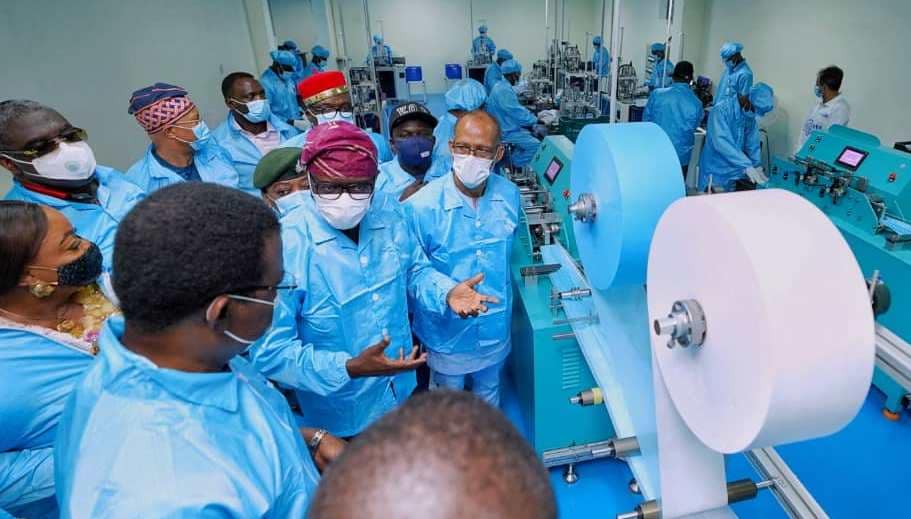
O-Care Medical Face Mask

By Dipo Olowookere

A local company has commenced the production of medical face mask at the Odofin Park Estate in Amuwo Odofin Local Government Area of Lagos State.

The O-Care Medical Face Mask factory was commissioned by the Governor of Lagos State, Mr Babajide Sanwo-Olu on Friday.

The Governor described this development as timely, saying the first indigenous medically graded face mask was in compliance with the World Health Organisation (WHO) standards.

Mr Sanwo-Olu noted that the idea of setting up the factory was necessitated by the shortage of medically treated PPEs experienced in the wake of the outbreak of Coronavirus (COVID-19) pandemic.

According to him, he was personally elated by the development, in that the first indigenous face mask production factory was built in Lagos.

The O-Care Medical Face Mask is a subsidiary of Transgreen Nigeria Limited, a local manufacturer of medical equipment, such as respirator, ventilator, hand gloves and Personal Protective Equipment (PPE).

“I am personally excited to attend this event because Lagos is recording another first for a good cause. The establishment of the first indigenous factory producing certified medical face masks represents the can-do spirit of Nigerians.

“As a government that supports fresh and progressive ideas, we will continue to celebrate and encourage good innovation,” he said.

“Mr Orakpor deserves commendation because he has not let the pandemic affect his investment drive in bringing about new business and products to fit our own environment.

“This is part of the narratives we are pushing as government. We can be the enabler for investors to set up businesses.

“If the wearing of face masks must be accepted as a new normal, we must be able to strategically domesticate solutions that can provide a ready market for our people.

“The opening of the factory is a confirmation of what we stand for as a government. We must be the catalyst to nurture ideas and support business,” Mr Sanwo-Olu, who could not hide his joy, said at the commissioning.

He disclosed that his administration had started to work out modalities for the creation of an economic zone for healthcare delivery to drive more investments to the sector.

According to him, the state government was looking at a long-term loan facility for operators in the health sector to achieve local production of scarce medical equipment and materials.

The Governor hailed the factory owner’s audacity and resilience in investing his capital for the production of medical face mask, which he described as the most sought after product in this period of public health crisis.

To encourage the manufacturer, Mr Sanwo-Olu procured 250,000 pieces of the O-Care face mask from the first production batch, saying the materials would be distributed to medical and emergency workers on the frontline.

In his remarks, the Managing Director of Transgreen Nigeria Limited, Mr Cyprian Orakpo, said the idea of setting up the company was born out of the embarrassing situation the nation found itself with the absence of local manufacturers of medical face masks in the country.

Mr Orakpo said medical PPEs had become objects of national security, especially in the period when there is not a curative vaccine to stop the spread of the ravaging COVID-19 pandemic. He stressed that scarcity of the products could spell doom for the nation if there’s no local manufacturer.

“In this time when the use of medical face mask is highly recommended, we have risen to the occasion to fill the void in medically certified face mask production to contribute our quota in the fight against COVID-19 pandemic and to promote health security in the country,” he said.

The O-Care face mask is developed with three layers that offer substantial protection against dust, airborne viruses and bacteria. Its nose clip provides comfort for breathing and gives low respiratory resistance.

In showing appreciation to the Governor for his support, the owner of the factory donated 30,000 medical face masks to the state government.

Mr Sanwo-Olu ordered that the face masks be donated to secondary school pupils who will be taking their examination from next week.

At the commissioning, an official of the Nigeria Centre for Disease Control (NCDC), Dr Kola Jinadu, who represented the agency’s Director-General, Dr Chikwe Ihekweazu, said the company must be commended for the initiative, which he also described as “timely”.


Dipo Olowookere is a journalist based in Nigeria that has passion for reporting business news stories. At his leisure time, he watches football and supports 3SC of Ibadan. Mr Olowookere can be reached via [email protected]

Click to comment

Leave a Reply

Your email address will not be published. Required fields are marked *

Health

WHO Signals Alarm: DRC’s Ebola Spreading Across Central Africa

Published

on

ebola dr congo

By Kestér Kenn Klomegâh

Health authorities in the Democratic Republic of Congo (DRC) and the Africa Centres for Disease Control and Prevention (Africa CDC) have bitterly complained over their inability to track down new cases of Ebola, which has spread into the Republic of Uganda. An estimated 1,635 Ebola cases have been confirmed, and 127 people have died from the dangerous infectious disease in the DRC.

The Ebola outbreak is increasingly impacting social interaction and people-to-people movements, as scepticism toward the disease appears to accelerate among the population, and cross-border movements are being controlled daily. Alarm was sounded last week as the virus moved into new areas of the DRC. In some instances, patient routinely escapes, and limited contact tracing undermines containment efforts. Contact tracing coverage has plummeted to 56.5 per cent, a sharp decline from the 95 per cent target, Health Ministry officials said.

“We remain committed to supporting affected countries until transmission is stopped. We call on partners and donors to urgently mobilise resources to strengthen the response and save lives,” Jean Kaseya, director general of the Africa Centres for Disease Control and Prevention, said on Sunday.

Shortage of Medical Kits

The World Health Organisation (WHO) reported that the three major laboratories, in South and North Kivu, have run out of Ebola testing kits, as infections continue to rise daily. Teams are working through a large backlog of samples from suspected Ebola patients, many of which were collected several weeks ago, to confirm or rule out the presence of the deadly virus.

In a situation report released earlier this week, the global health agency said the labs in major cities including Bukavu and Goma were awaiting the arrival of reagents–substances ​ required to run the tests–to resume work on the backlog of samples.

“Running out of Ebola testing reagents during an active outbreak is a serious setback,” Dr Krutika Kuppalli, associate professor in the division of infectious diseases at the University of Texas Southwestern and former WHO officer, told The Telegraph.

“Diagnostics are the foundation of outbreak control; if cases cannot be rapidly confirmed, this may lead to delays in isolation, treatment, and contact tracing, which can allow transmission to continue unchecked,” said Dr Kuppalli.

The Race for Vaccines

Vaccine candidates are racing to fill the gap. The Coalition for Epidemic Preparedness Innovations (CEPI)—a multinational nonprofit organisation that finances vaccine development for emerging infectious diseases—has so far prioritised several vaccine candidates for development.

Two are Ervebo-like prototypes aimed at recognising Bundibugyo’s specific blend of glycoproteins, a platform that showed experimental potential years ago. In 2013, an early version of the vaccine protected 100 per cent of monkeys infected with Bundibugyo. However, because most Ebola outbreaks didn’t involve this species, the vaccine didn’t get the investment needed to become licensed. That’s an outcome CEPI aims to remedy with its latest investment.

The International AIDS Vaccine Initiative and Public Health Vaccines are developing the vaccines, which, like Ervebo, also rely on the vesicular stomatitis virus. WHO called this technology the most promising of the candidates.

VSV-based vaccines are front-runners because the weakened version of the virus used to produce them is so good at replicating itself inside humans—including the small chunk of whatever germ it’s been hybridised with—without causing harm. As a result, a single dose typically leads to a strong immune response.

Another candidate, called ChAdOx1, operates using a similar concept: A virus shows the immune system part of a pathogen to generate a protective response. However, it uses an adenovirus that causes colds in chimpanzees—and is also harmless to humans—that University of Oxford scientists modified to keep it from replicating.

There’s also a vaccine candidate based on Moderna’s mRNA science, which was also used to produce the company’s COVID-19 vaccines. This vaccine employs tiny fat bubbles to deliver genetic instructions to cells on how to produce a small part of the Bundibugyo virus. The immune system generates a protective response, and the mRNA degrades quickly without causing lasting changes to cells’ genetic codes.

US-Backed Kenya’s Quarantine Centre

Health Cabinet Secretary Aden Duale has consistently defended the establishment of US-backed health centres in Kenya. The US says it will quarantine citizens exposed to the virus but not showing symptoms in a facility it is building in Kenya, and ‌will not bring them home if they develop symptoms, instead sending them to ​a third country.

The CDC imposed temporary travel bans last month on people who have ​been in the DRC, Uganda, or South Sudan, including ​green card holders, who are typically exempt from such bans. It is also screening Americans travelling from those ‌countries at three US airports. The strategy marks a sharp break ​from past practice as President Donald ​Trump’s administration seeks to keep all cases out of US territory.

There are 13 US treatment centres in a government-funded hospital network for severe infectious diseases ready to handle Ebola patients. Public health experts have, however, called on the government to bring any sick ​Americans home for treatment, and local protests at ‌the Kenya site have led to at least two deaths. A Kenyan court has ordered a halt to the ​construction.

WHO Appeals for International Community Support

In a rapid and comprehensive response to WHO’s appeal to marshal resources for support of Ebola prevention, the United States has provided an additional $38 million. The additional funds brought the total amount committed ‌by the U.S. to more than $200 million in direct funding, the State Department said in an official statement.

CDC model scenarios show that without strong public health interventions, the outbreak of the Bundibugyo strain of Ebola in ​the DRC ​could become as large as, or even larger than, the 2014-2016 West ​Africa outbreak, the agency said.

In modelled scenarios where the ‌isolation of patients is limited, the outbreak could become one of the largest ever documented, said Jason Asher, director of the CDC’s Centre for Forecasting and Outbreak Analytics.

From Addis Ababa, the Africa Centres for Disease Control and Prevention (Africa CDC) also said it had received a €11.5 million renewed commitment from the European Union Commission (EU) to support a stronger preparedness and coordinated response to the Ebola outbreak. Dr Jean Kaseya, Director General, Africa CDC, described the partnership with the European Union as respectful and without any conditionality, a type of partnership the continent needs.

The package is aimed at reinforcing the EU Commission’s support through the Africa CDC emergency response to the Ebola crisis, within the long-standing and comprehensive AU-EU health partnership. This demonstrates the central role of Africa CDC in coordinating the continental response to health emergencies, as well as the EU’s action as the world’s largest humanitarian contributor.

This includes €6.5 million to strengthen the Africa Pathogen Genomics Initiative, to help equip frontline teams, train healthcare workers and improve surveillance through diagnostics and an in-kind contribution of €5 million worth of testing equipment, including rapid diagnostic devices and lab test kits, to be deployed quickly where they are needed most. The EU’s partnership with Africa CDC spanning technical expertise, capacity-building, and policy dialogue continues to play a key role in building resilient health systems.

Ebola epidemic at G7 summit

Amid the horror of the Ebola epidemic, world leaders gathered at the G7 summit in France were urged to find the “political will” to push through the final part of the Pandemic Agreement on Monday. In a joint letter, Brazil’s President Luiz Lula da Silva and WHO chief Dr Tedros Adhanom Ghebreyesus urged leaders gathered on the shores of Lake Geneva to get the “benefits sharing” annex of the deal signed with a “sense of urgency.”

The Pandemic Agreement, which seeks to ensure the world is better prepared for the next global outbreak, was agreed last year but a vital element of it was deferred because of arguments over its wording. It is unclear, and perhaps unlikely, that a truly global agreement on benefits sharing can be reached.

Nevertheless, an agreement between the remaining 192 member states of the WHO is possible and would represent a major step forward. “Every month this annex stays unfinished is a month the world is less ready than it could be, and people are less safe than they deserve to be,” say Mr Lula da Silva and Dr Tedros. “Finalising this Agreement, through a shared commitment to one another, is our collective promise to protect humanity.”

The epidemic, caused by the rare Bundibugyo strain of the virus, for which there ‌is no approved vaccine or ​specific treatment, was declared on May ​15. It has since ​spread across Ituri, North Kivu and South ‌Kivu, regions marked by insecurity, displacement ​and cross-border ​movement.

The Democratic Republic of the Congo (DRC), also known as the DR Congo, is situated in the central African region. With a population of around 124 million people, it shares borders with the Republic of Congo and Angola to the south, the Atlantic Ocean, and the Central African Republic and South Sudan to the north, and also with Uganda, Rwanda, Burundi, and Tanzania (across Lake Tanganyika) to the east, and Zambia and Angola to the south.

Continue Reading

Health

NHIA Says 22 million Nigerians Now Have Health Insurance Coverage

Published

on

National Health Insurance Authority NHIA Health Insurance Coverage

By Adedapo Adesanya

The National Health Insurance Authority (NHIA) says the number of Nigerians enrolled in health insurance has risen to more than 22 million.

The Director-General of NHIA, Mr Kelechi Ohiri, said this resulted from the implementation of the mandatory health insurance, which has gained momentum nationwide.

He said this on Wednesday at the Annual General Meeting of the Nigerian Association of Insurance and Pension Editors (NAIPE) in Lagos.

Mr Ohiri said enrolment had increased to 22.03 million, representing a 35 per cent year-on-year growth, attributing this to stronger collaboration with state social health insurance agencies, ministries, departments and agencies, organised labour, employers, the private sector, and the gradual implementation of the mandatory health insurance provisions of the NHIA Act.

He said that the country had moved beyond policy formulation to delivering measurable improvements in healthcare access, service quality and consumer protection in line with the federal government’s health sector reform agenda.

According to him, Nigeria already has the necessary policies and legislation to achieve Universal Health Coverage, positing that the key challenge was effective implementation.

“The decisive variable is now implementation- consistent, rigorous and accountable execution that converts political commitment into healthcare access for real Nigerians,” he said.

Mr Ohiri said that the transition from the former National Health Insurance Scheme to the NHIA had strengthened regulation, consumer protection, accountability and strategic purchasing, while providing the legal and operational framework for achieving Universal Health Coverage.

He added that improving the experience of enrollees remained central to the Authority’s reform agenda.

According to him, NHIA has strengthened its complaints management system, introduced faster resolution timelines, and intensified compliance monitoring of Health Maintenance Organisations (HMOs) and healthcare providers.

He further added that NHIA had sanctioned facilities that failed to meet the required standards, adding that his organisation had resolved 3,878 complaints, representing an 87 per cent resolution rate, while 95 per cent of the cases were concluded within prescribed timelines.

Mr Ohiri noted that more than N14.2 million had been refunded to enrollees, while non-compliant healthcare facilities had been sanctioned.

He said NHIA had also introduced service standards, including a one-hour treatment commencement target for enrollees requiring urgent care, to improve access to timely and quality healthcare services.

The NHIA boss further disclosed that capitation payments to healthcare providers had been increased by 93 per cent.

He said fee-for-service reimbursements rose by 378 per cent to enable providers to invest more in personnel, equipment and infrastructure.

According to him, 7,592 healthcare facilities have been assessed under the SafeCare quality framework as part of efforts to institutionalise continuous quality improvement across the country.

Mr Ohiri also highlighted interventions targeted at vulnerable groups, including support for more than 48,500 pregnant women, expanded maternal and newborn healthcare services, the Vulnerable Group Fund, and improved access to healthcare for pensioners and retirees.

He said Universal Health Coverage could only be achieved if every Nigerian, regardless of income or location, had access to quality healthcare services.

Continue Reading

Health

SUNU Health Backs NHIA’s One-Hour Authorisation Policy

Published

on

One-Hour Authorisation Policy

By Modupe Gbadeyanka

The new one-hour authorisation response time ultimatum policy introduced by the National Health Insurance Authority (NHIA) has received the full backing of SUNU Health Nigeria Limited.

This policy was introduced by the agency to ensure enrollees get prompt approval codes to access care.

Healthcare service providers have been urged to report any Health Maintenance Organisation (HMO) that violates this initiative through an email, with the HMO in copy and a timestamp attached as evidence of the request. They may proceed to offer services to enrollees thereafter.

Speaking at the company’s second-quarter Providers’ Forum for the Lagos-Ogun region in Lagos recently, the chief executive of SUNU Health, Dr Moyosore Olomola, expressed optimism that this policy would improve healthcare delivery in the country, especially for enrollees, who crave quality service.

At the event themed Improving Quality and Access to Care Through Stronger Provider Network, and held at the Nigerian Institute of Medical Research (NIMR) in Yaba, Lagos, Mr Olomola reaffirmed the HMO’s commitment to operating within legal and operational frameworks to guarantee adequate care for enrollees.

“Access to care and quality of care remain key priorities in our healthcare systems. We know quite well that deliberate collaboration, strategic partnerships, and a shared commitment to excellence are required to achieve these priorities.

“A strong provider network is doubtless the backbone of any effective healthcare system. It ensures that our mutual enrollees receive the right care, at the right time, in the right place, and at the right price,” Mr Olomola, represented at the programme by the organisation’s Chief Operating Officer (COO), Dr Faith Nwachi, stated.

He further assured that SUNU Health would strictly adhere to the one-hour authorisation limit, stressing that this aligns seamlessly with one of the organisation’s core values—promptness and its corporate slogan, Humanity is the centre of our initiatives.

In a bid to further improve access and quality of care, SUNU Health also demonstrated its new operational software and Mobile app, aptly named SUNU Legacy.

Also speaking at the event, the NHIA Lagos State Coordinator (Ikeja), Dr Bethuel-Kasimu Abraham, noted that the forum’s expected outcome is to significantly reduce delays in accessing medical care.

Other key expectations include ensuring continuity of care, improving patient outcomes, and strengthening accountability among HMOs.

Addressing specific pain points faced by enrollees, the NHIA Ogun State Coordinator, Mr Dare Adefeso, acknowledged that the agency had received complaints regarding out-of-stock drugs and the discrimination of enrollees by certain providers.

He affirmed that the NHIA is actively addressing these issues, stressing that moving forward, every facility must ensure enrollees are properly catered to regardless of their status, provided they have an active health insurance plan.

Corroborating the long-standing legacy of SUNU Health, the Ogun State Director of the National Orientation Agency (NOA), Mrs Aishat Tiamiyu, shared that her agency is responsible for public information dissemination and has been enrolled with SUNU Health for over 25 years.

Commending the HMO’s stellar service over two decades, she called for the immediate enrollment of new NOA staff into the scheme.

The Providers’ Forum remains one of the strategic channels employed by SUNU Health to consistently engage healthcare providers, understand their operational challenges, introduce new software updates, and solidify partnerships aimed at fostering premium healthcare delivery across Nigeria.

Continue Reading