General
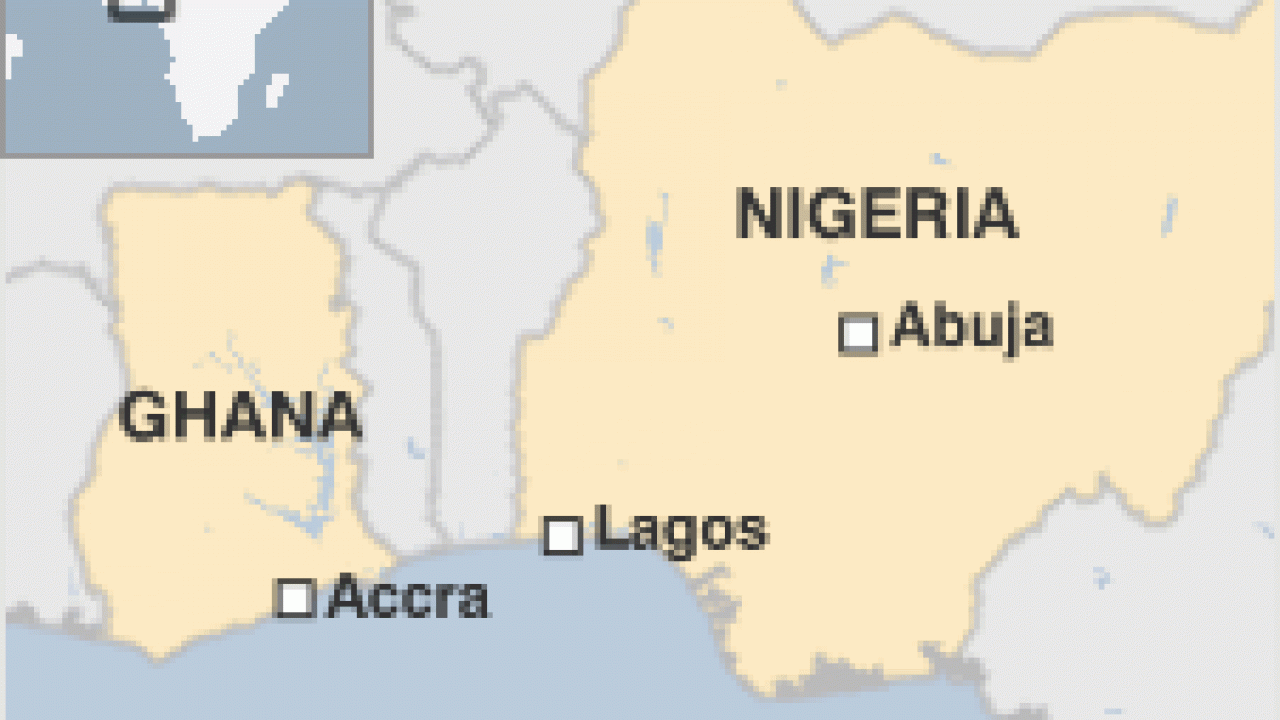
Harassment of Nigerians: FG Gives Ghana Last Warning
By Modupe Gbadeyanka
The incessant harassment of Nigerian citizens in Ghana by locals will no longer be tolerated, the federal government has warned its West African neighbour.
A statement issued in Abuja on Friday by the Minister of Information and Culture, Mr Lai Mohammed, said this warning was given because it was “deeply concerned” by the constant “progressive acts of hostility towards the country by Ghanaian authorities.”
According to the Minister, the government of President Muhammadu Buhari was “urgently considering a number of options aimed at ameliorating the situation.”
He said even though over one million Ghanaians are resident in Nigeria, they are not being subjected to the kind of hostility being meted out to Nigerians in Ghana.
“Also, even though the main reason given for the seizure of federal government property at No. 10, Barnes Road in Accra is the non-renewal of the lease after expiration, the Ghanaian authorities did not give Nigeria the right of first refusal or the notice to renew the lease.
“By contrast, the lease on some of the properties occupied by the Ghanaian Mission in Nigeria has long expired, yet such properties have not been seized.
“Nigeria has time after time demonstrated its fidelity to the long cordial relations with Ghana. But indications, especially in recent times, are that Nigeria’s stance is now being taken for granted and its citizens being made targets of harassment and objects of ridicule.
“This will no longer be tolerated under any guise.
“In the meantime, the federal government wishes to appeal to its citizens resident in Ghana to remain law-abiding and avoid engaging in self-help, despite their ordeal,” the Information Minister said.
In the statement, Mr Mohammed said the federal government has been documenting the acts of hostility towards Nigeria and Nigerians by the Ghanaian authorities.
He named one of them as the seizure of the Nigerian Mission’s property, which the Nigerian government has used as diplomatic premises for almost 50 years, saying the action was a “serious breach of the Vienna Convention.”
He also said the Ghanaian government was aggressive towards Nigerians and even deported about 825 Nigerians between January 2018 and February 2019.
“Over 300 Nigerians shops were locked for four months in Kumasi in 2018; over 600 Nigerian shops were locked in 2019 and, currently, over 250 Nigerians shops have been locked.
“Residency Permit requirements, for which the Ghana Immigration Service has placed huge fees, far higher than the fees charged by the Nigerian Immigration Service. These include the compulsory non-citizen ID card ($120, and $60 for yearly renewal); medical examinations, including for COVID-19 which is newly-introduced (about $120), and payment for a residency permit ($400 compared to the N7,000 being paid by Ghanaians for residency card in Nigeria.
“Outrageous stipulations in the Ghana Investment Promotion Centre Act. When the Act was initially promulgated in 1994, a foreigner is required to invest at least $300,000 by way of equity capital and also employ 10 Ghanaians. This Act has now been amended twice, with the 2018 GIPC Act raising the minimum capital base for foreign-owned businesses to $1 million. Though targeted at foreigners, it seems GIPC’s definition of foreigners is Nigerians. The GIPC Act also negates the ECOWAS Protocol.
“Media war against Nigerians in Ghana. The negative reportage of issues concerning Nigerians resident in Ghana by the Ghanaian media is fuelling an emerging xenophobic attitude towards Nigerian traders and Nigerians in general. The immediate fallout is the incessant harassment and arrest of Nigerian traders and closure of their shops.
“Harsh and openly-biased judicial trial and pronouncement of indiscriminately-long jail terms for convicted Nigerians. There are currently over 200 Nigerians in the Nsawam Maximum prison in Ghana alone,” the Minister said.
General
INEC Declares Adeleke Winner of 2026 Osun Governorship Election
By Adedapo Adesanya
The Independent National Electoral Commission (INEC) on Sunday, August 16, 2026, declared the incumbent Governor of Osun State, Mr Ademola Adeleke, winner of the 2026 governorship election held a day earlier.
Mr Adeleke, who contested under the Accord Party, defeated his closest challenger, the All Progressives Congress (APC) candidate, Mr Bola Oyebamiji, to secure a second term in office.
The governor polled 511,067 votes, while Mr Oyebamiji scored 444,815 votes, giving Mr Adeleke a winning margin of 66,252 votes.
The African Democratic Congress (ADC) candidate, Mr Najeem Folasayo Salaam, came a distant third with 17,180 votes.
Mr Salaam had entered the election as one of the candidates expected to potentially emerge as a third force, particularly following the backing he received from former Osun Governor and former Minister of Interior, Mr Rauf Aregbesola.
However, that expectation did not translate into the numbers needed to seriously challenge the two leading candidates.
Mr Adeleke’s victory means he becomes only the third governor in Osun State’s history to win a second term through an election.
He joins Mr Olagunsoye Oyinlola and Mr Aregbesola in the state’s political history, although Mr Oyinlola’s tenure was later cut short following a court decision that nullified his election over irregularities.
Mr Aregbesola subsequently succeeded Oyinlola and went on to secure a second term, completing eight years in office.
Mr Adeleke’s re-election comes after a fiercely contested campaign marked by intense competition and reported violence from competing parties.
Despite those challenges, the governor consolidated his support across the state and secured a decisive victory over the APC candidate, extending his administration for another four years in the southwest states.
General
Five Transmission Towers Collapse Along Ikot Abasi–Eket 132kV Line
By Modupe Gbadeyanka
The Transmission Company of Nigeria (TCN) has confirmed the collapse of five transmission towers along the Ikot Abasi–Eket 132kV Double Circuit Transmission Line.
This was attributed to severe acts of vandalism, as TCN disclosed that the structure collapsed after vandals removed critical structural bracing members.
The affected towers were N9, J4, N10, N11 and N12, the organisation said in a statement on Friday.
It explained that the extensive damage was discovered during a routine joint line patrol conducted on August 9, 2026, by TCN linesmen.
Further inspection revealed that structural members from seven additional towers along the same transmission corridor had also been removed and stolen. The towers, J3, N8, N13, N14, N15, N18 and N19, are now structurally compromised and pose a risk of further collapse.
TCN condemned this act of sabotage and reiterated its commitment to working hard to maintain a robust and reliable national grid.
The statement said that to mitigate the impact on electricity supply, the network has been reconfigured to prioritise supply to Ekim transmission station, leaving Ibom Power as the only station without supply.
TCN said it is mobilising an urgent intervention to complete the reconstruction of the affected sections of the line, with security agencies also notified to aid investigations and prevent further acts of vandalism along the line route.
General
Abbas Warns Against Delay in Implementing New Ports Regulatory Act
By Adedapo Adesanya
The Speaker of the House of Representatives, Mr Tajudeen Abbas, has urged all relevant government agencies to promptly initiate actions for the full implementation of the Nigerian Ports Economic Regulatory Agency Act, 2026, following its signing into law by President Bola Tinubu.
The bill, sponsored by Speaker Abbas, was aimed at repealing the Nigerian Shippers’ Council Act, Cap. N133, Laws of the Federation of Nigeria, 2004, and establish the Nigerian Ports Economic Regulatory Agency to ensure effective economic regulation of Nigerian ports while safeguarding the interests of shippers, service providers, and users of regulated port services. With the President’s assent, it has now been enacted as an Act of Parliament.
The legislation represents one of the landmark achievements of the 10th National Assembly. It reflects the Speaker’s commitment to legislative excellence, institutional reform, and sustainable economic growth, according to a press statement by the Special Adviser on Media and Publicity to the Speaker, Mr Musa Krishi.
The bill underwent a rigorous and inclusive legislative process, including extensive stakeholder consultations and a public hearing. It was passed by both Chambers of the National Assembly and subsequently assented to by the President.
The Act provides a robust legal and institutional framework to ensure effective economic regulation of Nigerian ports by fostering transparency, competitiveness, and efficiency in port operations; protecting the rights and interests of shippers, service providers, and other port users; and aligning Nigeria’s port regulatory system with global best practices, thereby enhancing the ease and cost-effectiveness of doing business.
Despite receiving presidential assent, the Act has yet to be fully operationalised.
He warned that any further delay would undermine the legislative intent of the reform, prolong the exposure of port users to arbitrary charges and operational inefficiencies, and deny the nation the anticipated benefits of increased revenue, improved trade facilitation, and stronger investor confidence in the marine and blue economy sector.
The Speaker urged the Federal Ministry of Marine and Blue Economy, in collaboration with all relevant Ministries, Departments and Agencies (MDAs) of the federal government, to take the necessary administrative, institutional, and financial measures for the prompt implementation of the Act.
He said this should include the formal transition to, as well as operational empowerment of, the Nigerian Ports Economic Regulatory Agency to discharge its statutory mandate effectively.
The full implementation of the Act is critical to unlocking the economic potential of Nigeria’s ports, reducing the cost of doing business, strengthening trade competitiveness, and positioning Nigeria as the leading maritime and logistics hub in West and Central Africa.
The statement noted that the Speaker reaffirmed the 10th House’s commitment to exercising the necessary legislative oversight to ensure this landmark legislation, along with others assented to by the President, is fully implemented and achieves its intended goals for the benefit of the Nigerian people.