Connect with us

General

Harassment of Nigerians: FG Gives Ghana Last Warning

Published

on

Nigeria and Ghana

By Modupe Gbadeyanka

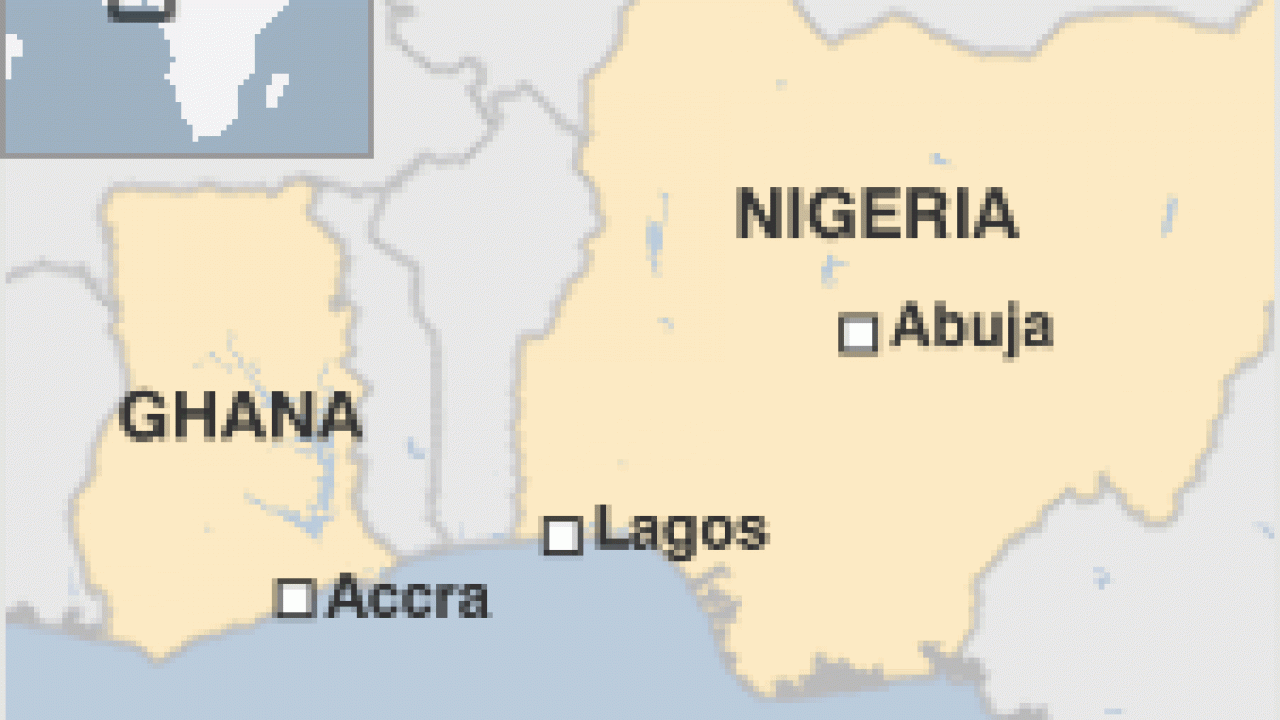
The incessant harassment of Nigerian citizens in Ghana by locals will no longer be tolerated, the federal government has warned its West African neighbour.

A statement issued in Abuja on Friday by the Minister of Information and Culture, Mr Lai Mohammed, said this warning was given because it was “deeply concerned” by the constant “progressive acts of hostility towards the country by Ghanaian authorities.”

According to the Minister, the government of President Muhammadu Buhari was “urgently considering a number of options aimed at ameliorating the situation.”

He said even though over one million Ghanaians are resident in Nigeria, they are not being subjected to the kind of hostility being meted out to Nigerians in Ghana.

“Also, even though the main reason given for the seizure of federal government property at ‪No. 10, Barnes Road in Accra is the non-renewal of the lease after expiration, the Ghanaian authorities did not give Nigeria the right of first refusal or the notice to renew the lease.

“By contrast, the lease on some of the properties occupied by the Ghanaian Mission in Nigeria has long expired, yet such properties have not been seized.

“Nigeria has time after time demonstrated its fidelity to the long cordial relations with Ghana. But indications, especially in recent times, are that Nigeria’s stance is now being taken for granted and its citizens being made targets of harassment and objects of ridicule.

“This will no longer be tolerated under any guise.

“In the meantime, the federal government wishes to appeal to its citizens resident in Ghana to remain law-abiding and avoid engaging in self-help, despite their ordeal,” the Information Minister said.

In the statement, Mr Mohammed said the federal government has been documenting the acts of hostility towards Nigeria and Nigerians by the Ghanaian authorities.

He named one of them as the seizure of the Nigerian Mission’s property, which the Nigerian government has used as diplomatic premises for almost 50 years, saying the action was a “serious breach of the Vienna Convention.”

He also said the Ghanaian government was aggressive towards Nigerians and even deported about 825 Nigerians between January 2018 and February 2019.

“Over 300 Nigerians shops were locked for four months in Kumasi in 2018; over 600 Nigerian shops were locked in 2019 and, currently, over 250 Nigerians shops have been locked.

“Residency Permit requirements, for which the Ghana Immigration Service has placed huge fees, far higher than the fees charged by the Nigerian Immigration Service. These include the compulsory non-citizen ID card ($120, and $60 for yearly renewal); medical examinations, including for COVID-19 which is newly-introduced (about $120), and payment for a residency permit ($400 compared to the N7,000 being paid by Ghanaians for residency card in Nigeria.

“Outrageous stipulations in the Ghana Investment Promotion Centre Act. When the Act was initially promulgated in 1994, a foreigner is required to invest at least $300,000 by way of equity capital and also employ 10 Ghanaians. This Act has now been amended twice, with the 2018 GIPC Act raising the minimum capital base for foreign-owned businesses to $1 million. Though targeted at foreigners, it seems GIPC’s definition of foreigners is Nigerians. The GIPC Act also negates the ECOWAS Protocol.

“Media war against Nigerians in Ghana. The negative reportage of issues concerning Nigerians resident in Ghana by the Ghanaian media is fuelling an emerging xenophobic attitude towards Nigerian traders and Nigerians in general. The immediate fallout is the incessant harassment and arrest of Nigerian traders and closure of their shops.

“Harsh and openly-biased judicial trial and pronouncement of indiscriminately-long jail terms for convicted Nigerians. There are currently over 200 Nigerians in the Nsawam Maximum prison in Ghana alone,” the Minister said.


Modupe Gbadeyanka is a fast-rising journalist with Business Post Nigeria. Her passion for journalism is amazing. She is willing to learn more with a view to becoming one of the best pen-pushers in Nigeria. Her role models are the duo of CNN's Richard Quest and Christiane Amanpour.

Click to comment

Leave a Reply

Your email address will not be published. Required fields are marked *

General

Petrol Prices in Nigeria Rise 22.55% in March 2026 on Hormuz Closure

Published

on

petrol consumption nigeria

By Adedapo Adesanya

The National Bureau of Statistics (NBS) has said that the average retail price of a litre of Premium Motor Spirit (PMS), otherwise known as petrol, rose by 22.55 per cent or N237.07 per litre to N1,288.54 in March 2026 from N1,051.47 in February.

In the Premium Motor Spirit (Petrol) Price Watch for March released on Tuesday, the NBS said on a year-on-year basis, the average retail price of fuel also increased by 2.13 per cent from N1,261.65 recorded in March 2025.

This surge in fuel prices could be linked to global disruptions brought on by the US-Israel war on Iran, which triggered the closure of the Strait of Hormuz and sent prices of crude oil above $100 per barrel.

While the country was not heavily hit by the impact, it felt the ripple effect of crude prices increasing, particularly as Dangote Refinery imported crude from other markets to cover for local feedstock shortfalls.

The data noted that by state, Anambra recorded the highest average retail price of N1,441.22 per litre, followed by Sokoto at N1,377.55 and Borno at N1,375.16.

However, the price was cheapest in Lagos at N1,162.71, followed by Ogun at N1,169.78 and Kaduna state at N1,193.40.

By zone, it was most expensive in the North East at N1,336.50 last month, while the South-West recorded the lowest at N1,232.46.

A look at the Diesel Price Watch Report for March showed that the average retail price paid by users rose by 16.05 per cent on a month-on-month basis to N1,648.08 per litre from N1,420.17 per litre a month earlier.

“On state profiles analysis, the highest average price of diesel in March was recorded in Ebonyi at N2,262.29 per litre, followed by Akwa Ibom at N1,895.72 and Osun at N1,872.15.

“On the other hand, the lowest price was recorded in Kogi at N1,383.40 per litre, followed by Katsina State at N1,438.25 and Enugu at N1,480.06,” parts of the report said.

Continue Reading

General

Datti Baba-Ahmed Dumps Labour Party, Joins PRP

Published

on

datti baba-ahmed

By Modupe Gbadeyanka

The vice-presidential candidate of the Labour Party (LP) in the 2023 general elections, Mr Datti Baba-Ahmed, has left the party to join the Peoples Redemption Party (PRP).

Speaking on Channels Television’s Politics Today, the politician said he’s no longer interested in the way the Labour Party was being run.

He disclosed that there is no more peace in the political party he flew its flag in the last general elections because of greed.

He accused the ruling All Progressives Congress (APC) of destabilising opposition political parties to ensure President Bola Tinubu does not have a credible opponent in the 2027 presidential poll.

“What the Labour Party stood for is not the same now. We have a government of today which is interested in destroying other political parties,” he said.

“I am leaving the Labour Party tomorrow (today) by 12 midnight,” Mr Baba-Ahmed said when asked about his plans for next year.

I am leaving the Labour Party [at] midnight, and I am joining PRP. PRP is the new destination. PRP is the one with a history. It’s about 75 years old,” he further stated.

He further said, “When there was real peace in the Labour Party, someone was redeployed to the Labour Party and because of the antecedents of the person, [I don’t see things getting better].

PRP, a progressive Nigerian political party, was established in 1978 by Mallam Aminu Kano. It is rooted in social democratic principles and populist ideology, often focusing on the empowerment of the talakawa (common people).

Its current National Chairman, according to data obtained from the website of the Independent National Electoral Commission (INEC), is Mr Falalu Bello, while the National Secretary is Mr Babatunde F. Alli.

PRP Data INEC

Continue Reading

General

We Prioritised Personal Pension Plan, Others for Robust Pension System— PenCom

Published

on

Personal Pension Plan PenCom DG

By Modupe Gbadeyanka

The Director General of the National Pension Commission (PenCom), Ms Omolola Oloworaran, has highlighted strategies deployed by her organisation to ensure pension coverage is deepened in Nigeria.

Speaking at the ISSA Technical Seminar in Abuja recently, she said the steps taken were to build a more inclusive, transparent, and responsive pension system, where communication serves not just as information, but as a bridge to trust, accessibility, and sustained industry growth.

According to her, the Contributory Pension Scheme (CPS) has, over more than two decades, built a strong institutional foundation, but true inclusion goes beyond coverage to require trust and clear communication.

For this reason, PenCom has prioritised the Personal Pension Plan, strengthened stakeholder engagement, and invested in digital channels that reach contributors in accessible and relatable ways, she stated.

Ms Oloworaran further stressed that, “Effective communication is not a soft complement to regulation; it is a core instrument of coverage expansion, compliance, and public confidence.

“Every circular we issue, every benefit we pay, and every reform we introduce ultimately succeeds or fails on whether our members can understand it and act on it.”

The ISSA Technical Seminar, themed Improving Inclusivity and Accessibility of Social Security Services Through Effective Communication, was organised in collaboration with the International Social Security Association (ISSA).

It brought together key stakeholders across West Africa to advance dialogue on strengthening social security systems through clearer, more inclusive engagement.

Continue Reading

Trending