Economy
AfCFTA Requires Financing for Successful Implementation—Osinbajo
By Modupe Gbadeyanka
If the Africa Continental Free Trade Area (AfCFTA) agreement is to be successful, then countries on the continent must ensure the initiative is well-financed.
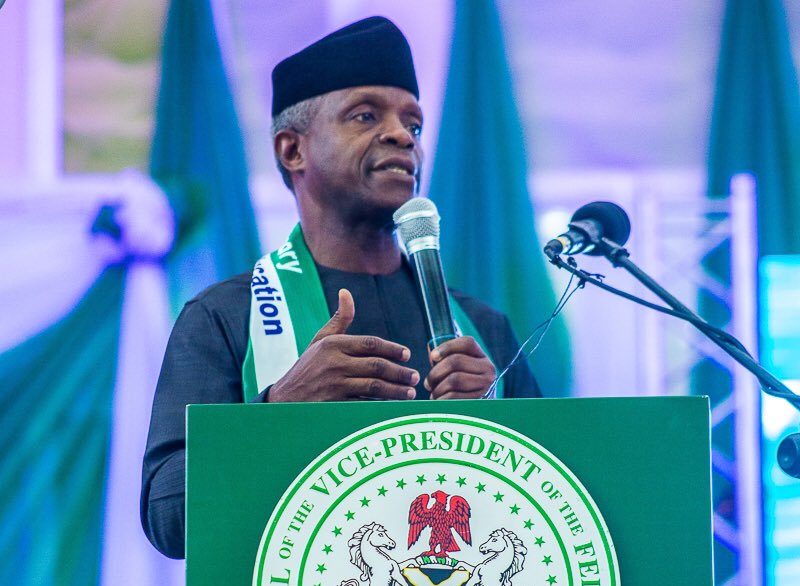
This was the view of Nigeria’s Vice President, Mr Yemi Osinbajo, when he spoke at the 61st annual conference of the Nigerian Economic Society (NES), which had the theme African Continental Free Trade Area (AfCFTA) in Post COVID-19 Era: What Next for Nigeria?”
“Successful implementation of the AfCFTA requires financing to address various implementation challenges and to promote arrangements in support of integration.
“For instance, in addition to making up for potential losses of tariff revenues, African countries will face implementation costs, including undertaking reforms, establishing new trade-related bodies, improving and upgrading existing facilities.
“Finding the resources to undertake these activities at a time like this when we lack fiscal space will, of course, prove to be very difficult for Nigeria and other African countries.
Our economists should accordingly help to come up with innovative financing solutions for our economies,” the Vice President said at the event, which was held virtually.
The AfCFTA deal, which was earlier slated to become operational on July 1, 2020, was moved to January 1, 2021, due to the COVID-19 pandemic.
Speaking on the global health crisis, the Vice President said “indeed, one thing that has become clear from our experiences of the last few months is the need for a vibrant and successful AfCFTA.
‘The pandemic has exposed our dependence on commodity exports to other parts of the world and on the import of manufactured goods from them.
“As at 2017, intra-Africa trade in goods was $135 billion, which was just about 15 per cent of Africa’s total trade. This is in sharp contrast to trade in other regions, which is as high as 70 per cent in the European Union and 60 per cent in Asia.
“The imposition of export bans, including on food items by some countries and the disruption of global supply chains at the height of the pandemic, showed just how exposed and vulnerable African countries are because of limited productive capacity and a lack of regional value chains,” Mr Osinbajo said.
But the Vice President wants African nations to use the AfCFTA to overcome the economic fragmentation of the continent by bringing the regional economic blocs together in a common arrangement.
According to him, African countries should look to negotiating trade treaties with other parts of the world on the basis of AfCFTA rather than through arbitrarily designed regional blocs, warning African countries not to “allow themselves to be lured into arrangements which do not serve their long-term development objectives.”
Speaking further about how the agreement can bolster trade and development on the continent, the Vice President said, “we must, of course, continue to bear in mind, especially here in Nigeria that the AfCFTA is not a magic wand that automatically brings about growth and prosperity.”
“The reality is that if care is not taken, trade liberalization can expose the Nigerian economy to unfair competition and sharp trade practices, with adverse consequences for our producers who might have to close down their businesses, and for our workers who would then lose their jobs.”
“If the AfCFTA is to achieve the desired objectives, then it is also very important that Nigeria should push for the implementation of complementary programmes and protocols, including the protocol on the free movement of persons, the pan-African payments system and other sectoral programmes,” he said.
In her remarks, the president of NES, Prof. Sarah Anyanwu, commended both President Muhammadu Buhari and the Vice President, describing Mr Osinbajo as “a friend of our society, because he understands economic development.”
Economy
Oyedele Eyes Fiscal Discipline, Investor-friendly Environment, Fair Taxation
By Aduragbemi Omiyale
Mr Taiwo Oyedele has set some goals he intends to achieve as Nigeria’s Minister of Finance and Coordinating Minister of the Economy.
While taking over from his predecessor, Mr Wale Edun, on Thursday, the tax expert assured that he has no plans to overturn some of the reforms already put in place by the former occupier of the seat.
In a message on Friday, he emphasised that, “Our immediate task is to consolidate these gains, deepen ongoing reforms, and ensure they translate into tangible benefits for all Nigerians.”
He promised to ensure fiscal discipline by embracing transparent and prudent management of public resources, while also harmonising revenue administration, broadening the tax base, reducing the burden on the vulnerable population, and supporting economic growth.
Mr Oyedele further said his other strategic priorities include creating a predictable and investor-friendly environment anchored on policy coherence, consistency, and clarity; and aligning efforts across all tiers and institutions to maximise policy impact.
He also said efforts would be made to deepen collaboration with the private sector and other key stakeholders for data-driven policy design, co-implementation, and feedback for continuous improvement.
According to him, “Good policy design alone is not enough; success will be defined by execution. We are committed to disciplined implementation, accountability, and measurable results.”
“I look forward to working with colleagues across government, the private sector, and all Nigerians as we move from reform to result, accelerate growth and build a more stable, inclusive, and prosperous economy,” he stated.
Economy
NASD Bourse Edges Up 0.23% as NSI Nears 3,970 Points
By Adedapo Adesanya
The NASD Over-the-Counter (OTC) Securities Exchange further appreciated by 0.23 per cent on Thursday, April 23, with the Unlisted Security Index (NSI) adding 8.99 points to close at 3,969.96 points against the previous day’s 3,968 points.
The rise in the share price of Central Securities Clearing System (CSCS) Plc by N2.86 to N69.34 per unit from N66.48 per unit raised the market capitalisation of the NASD bourse by N5.38 billion to N2.380 trillion from N2.375 trillion.
Yesterday, there were two price losers, led by Food Concepts Plc, which lost 29 Kobo to sell at N2.65 per share versus N2.94 per share, while UBN Property Plc dipped by 22 Kobo to N2.03 per unit from N2.25 per unit.
During the session, the volume of securities traded declined by 97.9 per cent to 451,522 units from 21.5 million units on Wednesday, the value of securities depreciated by 52.32 per cent to N23.6 million from N49.5 million, and the number of deals depreciated by 3.6 per cent to 27 deals from 28 deals.
At the close of business, Great Nigeria Insurance (GNI) Plc remained the most active stock by value on a year-to-date basis with 3.4 billion units valued at N8.4 billion, followed by CSCS Plc with 59.5 million units exchanged for N4.0 billion, and Okitipupa Plc with 27.8 million units traded for N1.9 billion.
GNI Plc also closed the day as the most traded stock by volume on a year-to-date basis with 3.4 billion units worth N8.4 billion, trailed by Resourcery Plc with 1.1 billion units transacted for N415.7 million, and Infrastructure Guarantee Credit Plc with 400 million units sold for N1.2 billion.
Economy
Naira Weakens to N1,353/$ at Official Market
By Adedapo Adesanya
Fresh foreign exchange (forex) demand pressure saw the Naira depreciate against the United States Dollar in the Nigerian Autonomous Foreign Exchange Market (NAFEX) on Thursday, April 22, by N5.46 or 0.4 per cent to trade at N1,353.91/$1 compared with the preceding day’s value of N1,348.45/$1.
It was the same outcome for the local currency in the official market after it depreciated against the Pound Sterling by N4.13 to close at N1,825.88/£1, in contrast to the preceding session’s N1,821.75/£1, and against the Euro, it dropped 72 Kobo to finish at N1,582.72/€1 versus N1,582.00/€1.
But the Nigerian Naira appreciated against the US Dollar at the GTBank FX desk by N2 during the session to quote at N1,361/$1 compared with Wednesday’s closing price of N1,361/$1, and at the parallel market, it closed flat at N1,375/$1.
FX Pressure came as data showed that NFEM interbank turnover was N28.117 million, lower than the N66.084 million recorded the previous day.
Concerns over liquidity pressures, policy transparency, and confidence in Nigeria’s FX market continue to grip the market while the country’s foreign reserve declines further, even as the Central Bank of Nigeria (CBN) recently said that the recent decline in Nigeria’s external reserves should not be a cause for concern.
Global developments also played a significant role, as rising geopolitical tensions boosted demand for the US Dollar, further weakening emerging market currencies, including the Naira.
As for the cryptocurrency market, there was a mixed outcome as traders reacted to rising geopolitical tensions from the Iran war and fresh inflation data from Japan.
Japanese inflation ticked higher in March, stoking expectations that the Bank of Japan may soon signal rate hikes, which could strengthen the yen and unsettle global risk assets.
The Iran conflict has disrupted oil flows through the Strait of Hormuz, raising energy costs and inflation risks worldwide and potentially complicating efforts by the Federal Reserve to cut interest rates.
Ethereum (ETH) declined by 1.8 per cent to $2,316.53, Bitcoin (BTC) lost 0.6 per cent to sell at $77,935.53, Solana (SOL) fell by 0.5 per cent to $85.67, and Binance Coin (BNB) dropped 0.4 per cent to sell for $634.85.
However, Dogecoin (DOGE) appreciated by 1.4 per cent to $0.0976, Ripple (XRP) grew by 0.7 per cent to $1.43, Cardano (ADA) expanded by 0.6 per cent to $0.2493, and TRON (TRX) improved by 0.2 per cent to $0.3279, while the US Dollar Tether (USDT) and the US Dollar Coin (USDC) traded flat at $1.00 each.
-
Feature/OPED6 years agoDavos was Different this year
-
Travel/Tourism10 years ago
Lagos Seals Western Lodge Hotel In Ikorodu
-
Showbiz3 years agoEstranged Lover Releases Videos of Empress Njamah Bathing
-
Banking8 years agoSort Codes of GTBank Branches in Nigeria
-
Economy3 years agoSubsidy Removal: CNG at N130 Per Litre Cheaper Than Petrol—IPMAN
-
Banking3 years agoSort Codes of UBA Branches in Nigeria
-
Banking3 years agoFirst Bank Announces Planned Downtime
-
Sports3 years agoHighest Paid Nigerian Footballer – How Much Do Nigerian Footballers Earn