Connect with us

General

Latest Update on Gas Explosion at Iju Ishaga Lagos

Published

on

Iju Ishaga gas explosion

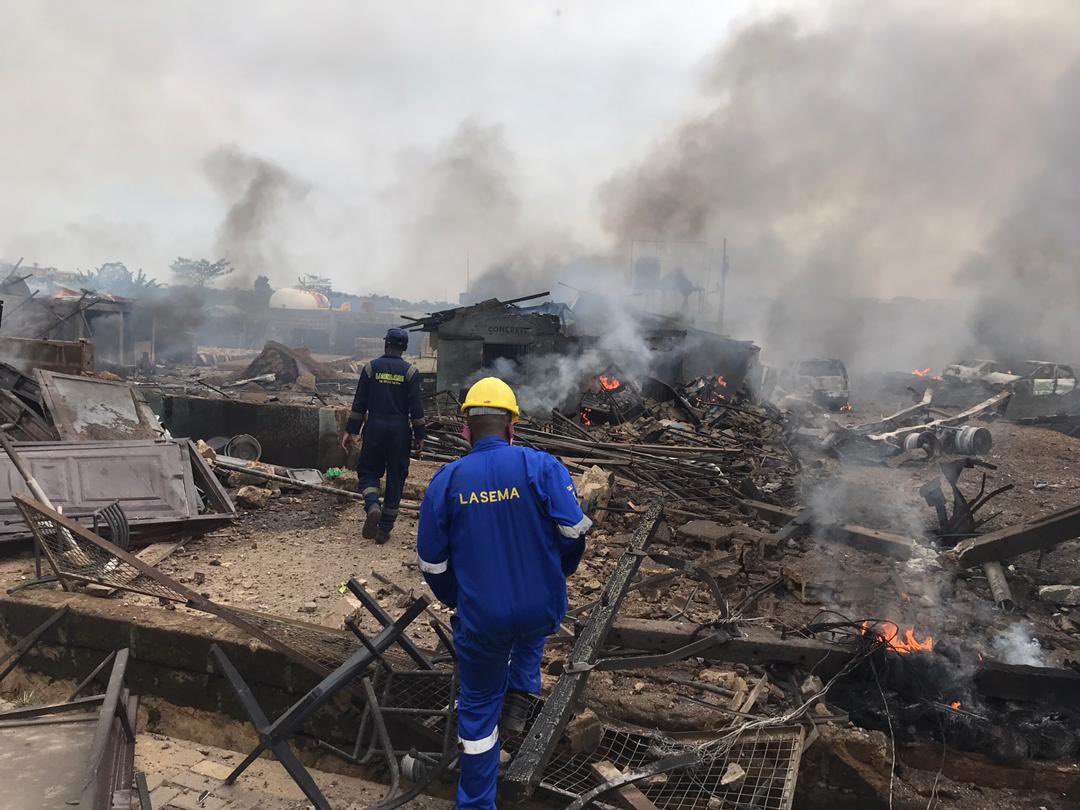
A while ago, Business Post reported a story of an explosion at Iju-Ishaga under the Ifako Ijaiye Local Government Area of Lagos State.

We have now received more updates on the unfortunate incident, which has caused panic in the area and its environs, including Akute, Fagba and others.

It was gathered that the explosion, which precisely occurred at Cele Bus stop, Iju Ishaga on Thursday afternoon, was allegedly caused by a truck conveying gasoline.

This was confirmed by the Lagos State Emergency Management Agency (LASEMA) through a situation report of the event signed by Mr Olufemi Oke-Osanyintolu, DG/CEO of the agency.

LASEMA noted that “On the arrival of the Tiger Squad, Alausa Secretariat at the scene, it was discovered that there was a gas explosion at the aforementioned address. Further investigation gathered revealed that an unknown truck conveying gasoline had a lone accident and exploded.”

Business Post gathered that the impact of the explosion caused severe damages to some adjoining buildings and vehicles, which were burnt.

In terms of human casualty, there were no deaths recorded but several persons were believed to have been injured and have been taken to the nearest hospital for treatment.

The inferno has been combated by the combined efforts of LASEMA Responders and Fire Team, LASG Fire Service, Nigeria Police Force and NSCDC.


Adedapo Adesanya is a journalist, polymath, and connoisseur of everything art. When he is not writing, he has his nose buried in one of the many books or articles he has bookmarked or simply listening to good music with a bottle of beer or wine. He supports the greatest club in the world, Manchester United F.C.

1 Comment

Leave a Reply

Your email address will not be published. Required fields are marked *

General

Insecurity Affecting Operations, Revenue Generation—Nigeria Customs

Published

on

Nigeria Customs Service

By Adedapo Adesanya

The Nigeria Customs Service (NCS) says the prevailing insecurity in parts of the country is negatively affecting its operations and revenue generation.

The Assistant Comptroller-General of Customs and Zonal Coordinator, Zone B, Mrs Nsikak Umoh, disclosed this in Minna while inspecting the Niger/Kogi Area Command Headquarters and engaging with vehicle importers on the operational challenges confronting the command.

Mrs Umoh said insecurity was not peculiar to the Niger/Kogi Area Command, but affected several Customs formations across the North-West, including Sokoto, Kebbi, Katsina and Zamfara states.

“The security challenge is not peculiar to only Niger/Kogi Area Command. The whole of North-West comprising Sokoto, Kebbi, Katsina and Zamfara States, which are all under my command, are facing the same security challenge,” she said.

According to her, the security situation had exposed customs personnel to increasing threats, with some officers killed or injured in the course of performing their duties, adding that the development had forced some commands to scale down their operations or adopt more cautious approaches, thereby affecting revenue collection.

Mrs Umoh explained that the service was encouraging its officers to adopt intelligence-led operations to minimise risks while ensuring that legitimate Customs duties continued.

“But we are trying our best to encourage them to use an intelligence-based operating system to do their job, and that is why in most of the commands, we have a reduction in revenue collections,” she added.

The ACG also expressed concern over the impact of insecurity on the physical and psychological wellbeing of Customs personnel, noting that some officers had developed health complications, including hypertension, due to fear and stress associated with their duties.

Despite the security challenges, Umoh said the Niger/Kogi Area Command had continued to perform strongly in revenue generation, disclosing that the command had surpassed its monthly revenue target of N17 million, generating more than N200 million as of August 12.

She commended the officers and stakeholders in the command for sustaining revenue collection despite the difficult operating environment.

Continue Reading

General

EFCC Recovers N115bn NDDC Levies From Defaulting Oil Firms

Published

on

NDDC board

By Adedapo Adesanya

The Economic and Financial Crimes Commission (EFCC) has recovered more than N115 billion in statutory levies owed to the Niger Delta Development Commission (NDDC) by defaulting oil companies between 2021 and 2023.

The recovery comprises N76.883 billion and $81.076 million, according to an EFCC representative, Mr Francis Oka-Phillips Usani, who disclosed the figures before the Senate Committee on Public Accounts on Wednesday.

Mr Usani spoke while the committee was investigating the 2021–2023 Oil and Gas Sector Audit Report of the Nigeria Extractive Industries Transparency Initiative (NEITI).

He said the EFCC investigated 43 oil companies over outstanding three per cent statutory levies payable to the NDDC.

According to him, 24 of the companies operating in the Niger Delta were found to have outstanding liabilities of N76,883,705,907.17 and $81,076,655, while the remaining 19 companies were cleared of any outstanding liability.

“At the commencement of the investigation, EFCC invited 43 oil companies, out of which 24 operating within the Niger Delta were found to have outstanding liabilities in the sums of N76,883,705,907.17 and $81,076,655.00, while the remaining 19 other oil companies were given a clean bill of health,” Mr Usani said.

The agent explained that following the investigation and pressure mounted by the commission, some of the affected companies paid their outstanding liabilities directly to the NDDC.

He said the direct payments amounted to N6.709 billion and $16.994 million.

Mr Usani further disclosed that of the funds recovered by the EFCC on behalf of the NDDC, N73.373 billion and $67.070 million had so far been released to the commission, noting that the balance of N3.510 billion and $14.005 million remained in the EFCC’s recovery account.

He, however, stated that the commission was also mindful of other possible outstanding statutory obligations and taxes payable to the federal government.

Continue Reading

General

Lokpobiri Urges Prioritisation of Domestic Energy Needs Over International Obligations

Published

on

Heineken Lokpobiri oil fields dispute

By Adedapo Adesanya

The Minister of State for Petroleum Resources (Oil), Mr Heineken Lokpobiri, has stressed the need for Nigeria to prioritise its domestic energy needs before fulfilling international obligations, as the federal government intensifies efforts to strengthen energy security and promote greater transparency in the petroleum market.

Mr Lokpobiri stated this in his goodwill message at the West Africa Refined Fuel Market Conference 2026, themed Funding West Africa Infrastructure and Distribution to Create a Transparent Market for Regional Price Benchmarks.

The minister said the country’s energy security strategy must begin with fulfilling its obligations to Nigerians, stressing that the ongoing deregulation of the downstream petroleum sector had created a framework for greater participation and accountability among industry stakeholders.

According to him, energy security starts with fulfilling “our domestic obligations before extending to international obligations.”

He said the conference provided an opportunity not only to discuss sustainable pricing mechanisms but also to showcase investment opportunities and competitive advantages in Nigeria’s and Africa’s midstream and downstream petroleum sectors.

Mr Lokpobiri said the federal government remained committed to creating a conducive environment for investment in the petroleum industry, particularly as Nigeria seeks to increase refining capacity and improve fuel distribution.

“Under President Bola Ahmed Tinubu, Nigeria continues to implement measures and initiatives designed to unlock the full potential of the petroleum sector,” he said.

He identified increased refining capacity, efficient distribution infrastructure, transparent pricing and stronger regional integration as critical to building a competitive West African refined-fuel market.

The minister said improved infrastructure and market transparency would also help establish reliable regional price benchmarks and strengthen confidence among investors and other industry participants.

He added that Nigeria, as a major player in the global energy market, had an important role to play in developing an integrated West African petroleum market and positioning the continent to compete more effectively in global energy trade.

The conference brought together stakeholders in the petroleum industry to examine financing, infrastructure, distribution and pricing mechanisms for the refined-fuel market across West Africa.

Continue Reading