

General
Full Text Of Buhari’s Controversial Press Briefing In Germany

By Dipo Olowookere
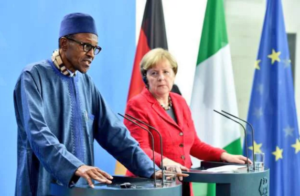
Last week, President Muhammadu Buhari travelled to Germany on an official visit. During the trip, he addressed the media in Berlin alongside his host, Angela Merkel, the Chancellor of Germany.
After his address, questions were received from newsmen at the event and Mr Buhari was asked to react to an interview his wife, Mrs Aisha Buhari, granted the BBC, where she claimed a cabal had taken over her husband’s government.
Mr Buhari gave a response that has set the cyber space on fire since then and even caused his host in Germany to abruptly end the briefing.
Business Post Nigeria has got hold of what Mr Buhari actually said during the press briefing and it is reproduced below:
I am very grateful to you for this invitation. The Germans have always been concerned about Nigeria. This is very welcome, and we are grateful for it.
They invited me here during the G7 presidency. They asked me to provide the G7 with a report on the security situation in Nigeria, but above all in the region. I have done this very much and I have submitted a report to the G7.
I have mentioned on this occasion that Boko Haram has been considerably restricted in its possibilities. 14 of 177 local regions are still left where they actually have an influence, where they actually hold something like a caliphate.
But there is no real power that they have over any of our communal, regional authorities. In the meantime, they have, of course, concentrated on schools, mosques and markets in their attacks. But this possibility to carry out such attacks is also largely taken away.
We received economic and humanitarian aid from the Federal Republic of Germany. In this way, Nigeria has been enabled to expel terrorists from these areas.
The second point is the economy. We are very grateful for the fact that we have been offered training opportunities. There are about 100 German companies operating in Nigeria – most of them in the manufacturing sector. This means that the Nigerians have not only jobs, but also training opportunities. For this we are very grateful.
The new security problem that has emerged is, above all, that there have been acts of sabotage against institutions of the oil industry in the Niger Delta. I have already submitted a detailed report to the German Government, and this will continue.
We will say what we need for help, for example, information of a message service type or other, but also ways to provide us with equipment. With the leadership of the militants in the Niger Delta, with the traditional institutions there, we are currently talking. But oil companies, which have been operating in Nigeria for more than 30 years, must of course also participate in this dialogue.
As far as the economy is concerned, it is this year that we have had a lot of rain in Nigeria and we expect a very good crop so that the problems with the food imports will not be so great. We will not be so dependent on it. In a few months we will be able to create food security and even export food. Most of the foods that we have imported were, for example, wheat, maize and rice. I think in about 18 months we will be self-sufficient in this area.
As for the girls from Chibok, you have probably learned that 21 of these girls have been released. But still 100 of these girls are somewhere in the area around Lake Chad, Cameroon, Niger or Nigeria. Where they are, we do not know exactly. We have been able to free these 21 girls. We hope that we can provide it with the appropriate information to find even more and to find out. We are very grateful to the United Nations who have participated in the mission of saving these girls. But please do not forget that the whole thing takes place against the background of terrorism in Nigeria. Thousands of Nigerians have been killed by Boko Haram. There are 1.5 to 2 million people who are internally displaced and have to live in camps for internally displaced persons. At least 60 percent of them are women and children. 60 percent of these children are orphans who do not know their parents and do not know where they come from. This is a great concern for my government, which we must face. We must, of course, provide the appropriate infrastructure, especially in education and health, so that these children and displaced persons can return to their region, their city, their village and live a normal life. That is why we are very grateful for the support given by the German government. We hope for further support whenever we need it and ask for it.
Thank you very much.
Question and answer time
I come from Nigerian television. Federal Chancellor, Mr Buhari has devoted himself to combating corruption. One option he pursues is to retrieve funds outside the country. What do you do to help him? As you have said, you appreciate him.
Merkel: I appreciate him very much. We will, if he has hints, follow these instructions, of course. In all that the President has to say to Germany, we will, of course, look to help him work against corruption.
In addition, our finance minister has worked very hard to ensure the international exchange of information is compulsory. This means that in the future, it will be much harder to deal with such corrupt business. As countries, we will also work much more closely with banks to pursue all traces.
I have a question to the President. In the context of the migration crisis, the importance of re-transferring the foreign Nigerians is always written and reported. How important are these retransferments for the Nigerian economy?
Your woman has today given an interview in which she said she does not support you in the 2019 re-election if you do not transform your government. Maybe you can comment on that. Are you ready to meet your wife’s demands?
Buhari: I do not know exactly which party my wife belongs to. Actually, she belongs to my kitchen, my living room and also to the other rooms in my house. It is not easy to deal with the opposition, with those who were not with one in the election campaign. I hope that my wife will remember that I was 12 years in the field, that I have tried three times to win. The fourth time I was successful. The first three times I was in Nigeria’s highest court. So I would say that I know better about all this.
I think I know better than the members of the opposition. After all, my efforts had been successful. It is not so easy to satisfy everyone, the entire opposition of Nigeria and all parties there. They all want to be at the government, of course.
Perhaps I may briefly tell you what we have inherited.
From 1999 to 2014, Nigeria averaged 2.1 million barrels of oil per day at a price of $100. Then we had less than 40. It must also be said that the production by the actions of militants has reduced by half. This means that Nigeria has inherited a huge problem. You certainly know that 27 of the 36 states could not pay salaries to their employees. That is, there were very serious economic problems, problems of security, business, corruption, problems we try to resolve to the best of our knowledge.
I told you what the problem was with Boko Haram. We almost succeeded in preventing them from dominating somewhere in Nigeria. As far as the economy is concerned, we have now concentrated on agriculture. We ask you to invest primarily in the mineral sector, in the field of mineral resources.
In the Niger Delta, too, we have turned to the militant leadership and the people they support locally. We have approached the oil companies, which have been operating in the country for a long time, more than 30 years, and know the whole environment, including the local people. We want to negotiate with them, so that there will be a truce.
The government has the ability and the ability to cope with these people, just as we have come to terms with Boko Haram. But it is in the interest of Nigeria and all regions of Nigeria that we solve these issues through dialogue, as a much more civilized way of dealing with each other.
Your country has opened its doors to a large number of refugees from other countries, with a great deal of insecurity and a great deal of poverty. But this is now a problem for you. How can you prevent such a destabilization from happening to you and also in Nigeria?
Merkel: Firstly, we must, of course, be politically committed to peace and security. This is very difficult, for example, in Syria or Iraq. We are therefore all the more pleased that much has already been achieved in the fight against terrorism in Nigeria and at Lake Chad.
People who do not really live peacefully have big problems, of course. But there are also the economic problems. We have said in Germany that we want to give protection to many who have come to us because of war and expulsion. This is why the rate of recognition in legal proceedings is very high, for example, for people from Syria and Iraq. But for people coming from Nigeria, the recognition rate is only 8 percent. That is, we must assume that many come for economic reasons. We can understand that. But we must then say that in order to provide humanitarian protection to those who really flee before the war, we must return to those who do not have a right of residence in Germany.
This is what the European Commission is talking about. We also talked today about how we can do this and send out the signal at the same time: We want to put the smugglers and the traffickers the craft. But we also want to help people who are in need in Nigeria. That is why we want to offer those who do not go on the illegal path, for vocational training, for training, for the acquisition of skills, so that they have a better chance of achieving a good future for themselves. Then this is good for both sides.
There can be no business about corruption, illegal trafficking, arms trafficking, drug trafficking – all of which are connected – and states are destabilized, but we are working together as states, so that the people of Nigeria have some of it and at the same time the signal “Those who do not have a right of residence in Germany – 92 per cent of the people from Nigeria who come to us – have to return” to stop the illegality.
You said you had talked about the problem of return. Have you received any commitments, or do you intend to conclude a regular return contract with Nigeria?
Just a quick glance into the next week: Are you confident that a meeting in Normandy will be held here in Berlin?
Merkel: As for the next week, I cannot say that yet, because I have to wait and see what messages I get from the now ongoing conversations on the workbene. We keep this open, but we have not yet reached the decision.
On your first question: the negotiations with the European Commission are only starting in October. That is, we have not made specific arrangements today. But I have, of course, said that Germany supports these negotiations by the European Commission, and that in return, both on the basis of the Valletta agreement, we can use both European and German resources, especially to promote legal opportunities for vocational training that illegality can be combated. But we have not discussed details yet.
Courtesy TAZ
Related articles across the web



