Economy
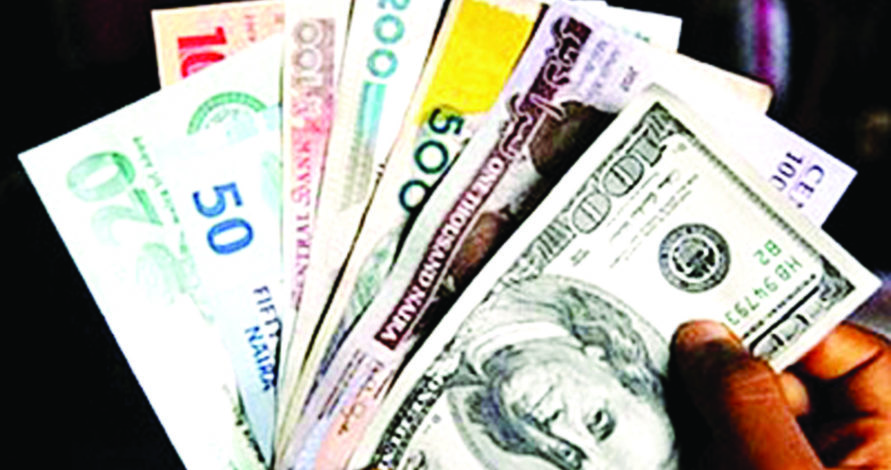
Naira Falls to N410/$1 at I&E, N478/$1 at Parallel Market
By Ahmed Rahma, Adedapo Adesanya
The Naira posted a new low at the Investors and Exporters (I&E) window of the foreign exchange (forex) market on Friday.
At the market segment, the local currency depreciated against the United States Dollar by 0.54 per cent or N2.20 to close at N410/$1 in contrast to N407.80/$1 it finished on Thursday.
Business Post reports that at the session, there was a slight rise in the demand for FX, 5.9 per cent or $3.72 million as transactions worth $66.41 million were executed in contrast to the $62.69 million recorded a day earlier, according to data from the FMDQ Securities Exchange.
At the unregulated segment of the forex market yesterday, the black market, the local currency lost N1 against the greenback to trade at N478/$1 versus the previously traded rate of N477/$1.
The local currency also depreciated against the Euro at the parallel market by N2 to sell for N577/€1 compared to N575/€1 of the preceding day but traded flat against the Pound Sterling at N655/£1.
At the interbank segment of the market, the domestic currency traded flat against the Dollar as the Central Bank of Nigeria (CBN) still auctioned the currency at N379/$1 to commercial banks.
Furthermore, the Nigerian Naira retained its previous value against the American currency at the Bureaux De Change (BDC) window on Friday at N395/$1.
Meanwhile, at the cryptocurrency market, five of the seven tokens tracked by Business Post on trading and tracking platform, Quidax, further recorded growth.
The frontrunner digital coin, Bitcoin (BTC), saw its value skyrocket further by 11.9 per cent to trade at N29,664,467; Ethereum recorded a 1.4 per cent gain to sell at N1,099,999 while Dash (DASH) coursed 9.1 per cent to sell at N185,390, with Ripple (XRP) rising by 5.0 per cent to trade at N309.99 and Tron (TRX) growing by 23.7 per cent to sell at N37.88.
On the loser’s chart, the US Dollar Tether (USDT) took a 7.4 per cent axing to sell for N504.88, while Litecoin (LTC) depreciated by 0.6 per cent to trade at N128,015.
Economy
Investors Lose N73bn as Bears Tighten Grip on Stock Exchange
By Dipo Olowookere
The bears consolidated their dominance on the Nigerian Exchange (NGX) Limited on Wednesday, inflicting an additional 0.09 per cent cut on the market.
At midweek, the market capitalisation of the domestic stock exchange went down by N73 billion to N124.754 trillion from the preceding day’s N124.827 trillion, and the All-Share Index (ASI) slipped by 114.32 points to 194,370.20 points from 194,484.52 points.
A look at the sectoral performance showed that only the consumer goods index closed in green, gaining 1.19 per cent due to buying pressure.
However, sustained profit-taking weakened the insurance space by 3.79 per cent, the banking index slumped by 2.07 per cent, the energy counter went down by 0.24 per cent, and the industrial goods sector shrank by 0.22 per cent.
Business Post reports that 25 equities ended on the gainers’ chart, and 54 equities finished on the losers’ table, representing a negative market breadth index and weak investor sentiment.
RT Briscoe lost 10.00 per cent to sell for N10.35, ABC Transport crashed by 10.00 per cent to N6.75, SAHCO depreciated by 9.98 per cent to N139.35, Haldane McCall gave up 9.93 per cent to trade at N3.99, and Vitafoam Nigeria decreased by 9.93 per cent to N112.50.
Conversely, Jaiz Bank gained 9.95 per cent to settle at N14.03, Okomu Oil appreciated by 9.93 per cent to N1,765.00, Trans-nationwide Express chalked up 9.77 per cent to close at N2.36, Fortis Global Insurance moved up by 9.72 per cent to 79 Kobo, and Champion Breweries rose by 5.39 per cent to N17.60.
Yesterday, 1.4 billion shares worth N46.2 billion were transacted in 70,222 deals compared with the 1.1 billion shares valued at N53.4 billion traded in 72,218 deals a day earlier, implying a rise in the trading volume by 27.27 per cent, and a decline in the trading value and number of deals by 13.48 per cent and 2.76 per cent, respectively.
Fortis Global Insurance ended the session as the busiest stock after trading 193.7 million units for N152.7 million, Zenith Bank transacted 120.7 million units worth N11.1 billion, Japaul exchanged 114.8 million units valued at N407.0 million, Ellah Lakes sold 98.4 million units worth N999.2 million, and Access Holdings traded 63.1 million units valued at N1.7 billion.
Economy
Naira Extends Losing Streak, Falls to N1,356/$1 at NAFEX
By Adedapo Adesanya
A 74 Kobo or 0.05 per cent decline was recorded by the Naira against the United States Dollar in the Nigerian Autonomous Foreign Exchange Market (NAFEX) on Wednesday, February 25, trading at N1,356.11/$1 compared with the N1,355.37/$1 it was traded on Tuesday.
The Nigerian currency also further depreciated against the Pound Sterling during the session in the official market by N6.70 to settle at N1,834.96/£1 versus the preceding day’s rate of N1,828.26/£1, and against the Euro, it tumbled by N4.94 to quote at N1,598.59/€1 compared with the previous session’s N1,596.36/€1.
In the same vein, the Nigerian Naira lost N6 against the Dollar at the GTBank forex desk to close at N1,367/$1, in contrast to N1,361/$1 it was exchanged a day earlier, and in the parallel market, it traded flat at N1,365/$1.
The continuation of the decline of the local currency has been tied to the Central Bank of Nigeria (CBN) buying US Dollars from the market to slow the rapid rise of the Naira.
The apex bank bought about $189.80 million to reduce excess Dollar supply and control how fast the Naira was gaining value.
The monetary policy committee (MPC) of the CBN on Tuesday reduced interest rates by 50 basis points to 26.50 per cent from 27 per cent after inflation eased in January 2026, a move analysts say is the best not to unsettle FX market, especially the Foreign Portfolio Investors (FPI_ inflows which have anchored much of the recent supply and weakened the recently restored monetary credibility.
“The 50bps move therefore provides a clear directional signal while still keeping overall monetary conditions restrictive, indicating the start of a shallow, data-dependent easing cycle rather than a radical shift to accommodative policy,” said Mr Kayode Akindele, CEO, Coronation Capital and Head, Coronation Research in an email.
As for the cryptocurrency market, benchmarked tokens rebounded in double digits, driven by bearish positioning and thin liquidity rather than by clear fundamental catalysts, with Cardano (ADA) growing by 16.2 per cent to $0.3015, and Solana (SOL) appreciating by 12.3 per cent to $88.66.
Further, Ethereum (ETH) surged 11.9 per cent to $2,076.66, Litecoin (LTC) expanded by 11.5 per cent to $57.15, Dogecoin (DOGE) rose by 11.5 per cent to $0.1025, Binance Coin (BNB) advanced by 7.6 per cent to $629.76, Ripple (XRP) jumped 7.2 per cent to $1.45, and Bitcoin (BTC) added 6.4 per cent to sell for $68,136.72, while the US Dollar Tether (USDT) and the US Dollar Coin (USDC) remained unchanged at $1.00 apiece.
Economy
Oil Prices Stabilise as US Crude Build Counters Supply Disruption Threat
By Adedapo Adesanya
Oil prices settled largely unchanged on Wednesday amid a build in American crude stockpile and the threat to oil supply from potential military conflict between the US and Iran.
Brent futures chalked up 8 cents to trade at $70.85 a barrel, while the US West Texas Intermediate (WTI) futures settled lost 21 cents to close at $65.42 per barrel.
Crude oil inventories in the US increased by 16 million barrels during the week ending February 20, according to new data from the US Energy Information Administration (EIA) released on Wednesday.
The decrease brings commercial stockpiles to 435.8 million barrels according to government data, which is still 3% below the five-year average for this time of year.
The EIA’s data release follows figures by the American Petroleum Institute (API) that were released a day earlier, which reported that crude oil inventories rose by a massive 11.4 million barrels in the period.
The market continued to weigh the possibility extended conflict could disrupt supplies from Iran, the third-biggest crude producer in the Organisation of the Petroleum Exporting Countries (OPEC) and other countries in the Middle East.
US President Donald Trump verbally attacked Iran, saying he would not allow a country he described as the world’s biggest sponsor of terrorism to have a nuclear weapon.
This comes as US envoys are due to meet an Iranian delegation for a third round of talks on Thursday in Geneva, Switzerland.
Reuters reported that OPEC+ is considering raising its oil output by 137,000 barrels per day for April to end a three-month pause in production increases. This is as the group prepares for peak summer demand and tensions between the US and Iran boost prices.
Eight OPEC+ producers – Saudi Arabia, Russia, the United Arab Emirates, Kazakhstan, Kuwait, Iraq, Algeria and Oman – meet on March 1.
An increase of 137,000 barrels per day for April would be the same as those agreed for December, November and October last year.
In a separate development, Saudi Arabia has activated a plan for a short-term oil output and export surge in case a US strike on Iran disrupts flows from the Middle East, said two sources familiar with the Saudi plan.
Tariff uncertainty also further worried investors after President Trump’s temporary global tariff of 10 per cent took effect on Tuesday after the Supreme Court’s sweeping ruling last week. He later said the levy would be 15 per cent, but it was unclear when and if it would apply.
-
Feature/OPED6 years agoDavos was Different this year
-
Travel/Tourism10 years ago
Lagos Seals Western Lodge Hotel In Ikorodu
-
Showbiz3 years agoEstranged Lover Releases Videos of Empress Njamah Bathing
-
Banking8 years agoSort Codes of GTBank Branches in Nigeria
-
Economy3 years agoSubsidy Removal: CNG at N130 Per Litre Cheaper Than Petrol—IPMAN
-
Banking3 years agoSort Codes of UBA Branches in Nigeria
-
Banking3 years agoFirst Bank Announces Planned Downtime
-
Sports3 years agoHighest Paid Nigerian Footballer – How Much Do Nigerian Footballers Earn