Economy
UBA Explains Real Reason for Lower Dividend Payout
By Dipo Olowookere
That the dividend payout of United Bank for Africa (UBA) Plc for the 2020 fiscal year was cut is no longer news, but the rationale behind the decision will interest shareholders.
A few days ago, the tier-one lender announced its financial performance last year and the key performance indicators recorded improvements, including the gross earnings and profits.
However, the cash reward given to investor was lowered by over 50 per cent as the board recommended a dividend of 35 kobo, lower than the 80 kobo paid for the 2019 fiscal year.
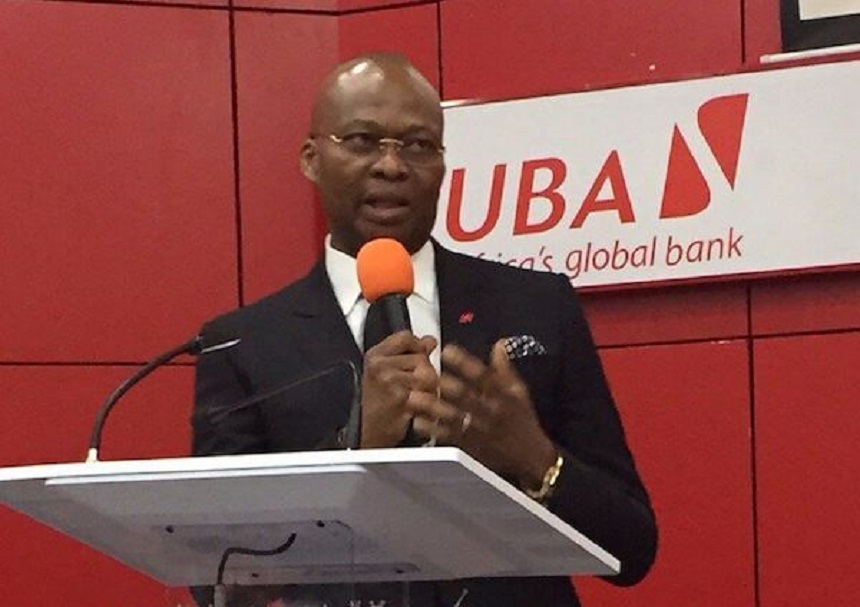
Many investors were not happy about this development and at an analyst call held in Lagos to discuss the results, the Group Managing Director/CEO of UBA, Mr Kennedy Uzoka, explained why the action was taken.
According to him, the fear of any unforeseen circumstances in the future was one of the reasons for the conservative dividend payout this year and the need to deliver better performance.
“Yes, we did not pay a dividend expected from us and this was deliberate because we are building for the future as no one knows what might happen,” he said (referencing the disruption caused to the business environment last year by COVID-19).
The respected banker informed the participants of the call, including Business Post, that, “We have done 73 years as one of the oldest and agile franchises on our continent.
“We have experience in running businesses not just in Nigeria but all over the continent and the world.
“We have seen different challenges and we have experienced many things, and as they say, experience is the best teacher. So we decided to take a conservative stance on dividend payout.”
“What this means is that we have decided to strengthen our capacity to weather any unforeseen development that will come out.
“We have done our stimulation to determine the kind of capacity we want to base on a crystal clear focus of our goals.
“We know exactly what we want to achieve in the current year and in the mid-term and we decided to make sure that we build the right capacity,” Mr Uzoka explained.
However, he expressed optimism that things would get better as the team was working tirelessly to deliver value to shareholders of the company.
“The future looks very promising because we are working very hard to remain a leading operator in Nigeria and on the continent,” he said.
According to him, last year, UBA had a guidance of 25 per cent in deposit growth but “we achieved 48.1 per cent and in 2021, we are looking at a growth of 50 per cent.”
Economy
Russia’s Lukoil Agrees to Sell International Assets in Nigeria, Others to Carlyle
By Adedapo Adesanya
US sanctioned Russian oil giant Lukoil, will sell its foreign assets, including those in Nigeria and five other countries, to the US investment firm, The Carlyle Group.
According to an announcement on Thursday, Lukoil reached an agreement with the US investment firm on the sale of Lukoil International GmbH, the holding company that owns the group’s non-Russian international assets.
These foreign assets include shares in oil fields and refineries across the globe, including in Iraq, Azerbaijan, Egypt, the United Arab Emirates (UAE), Nigeria, and Mexico.
The sale follows the US sanctions on Lukoil and Rosneft, “as a result of Russia’s lack of serious commitment to a peace process to end the war in Ukraine.”
The Donald Trump administration in October 2025 had carried out the decision to put pressure on Russia’s state finances, adding the country’s two largest oil producers, Lukoil and Rosneft, to its blacklist of sanctioned entities. The US had initially given the oil firm one month to sell the holdings before gradually extending it as negotiations dragged on.
Lukoil had announced that same month that it would sell all of its international assets, initiating a formal process to receive bids from potential buyers.
After months of negotiations with potential buyers and one preliminary agreement with Gunvor blocked by the US Treasury, which described the trading group as “the Kremlin’s puppet”, it has now signed an agreement to sell Lukoil International GmbH to Carlyle.
Companies working with the sanctioned firms risk secondary sanctions that would deny them access to US banks, traders, transporters, and insurers.
The agreement is not exclusive and is subject to conditions such as the procurement of necessary regulatory approvals, including permission from the US Department of the Treasury’s Office of Foreign Assets Control (OFAC) for the transaction with Carlyle.
Carlyle said that the agreement “has been structured to be fully compliant” with US Treasury policies and that it was “conditional upon Carlyle’s due diligence and regulatory approvals”.
Prior to the Carlyle news, other US oil and gas supermajors Chevron and ExxonMobil, and International Holding Company (IHC) of Abu Dhabi expressed interest to the US Treasury to potentially acquire Lukoil’s international assets.
The sale would further dent Russian economy which has been struggling because of its war in Ukraine and Western sanctions have increased inflation and slowed economic growth. In 2025, the country’s oil and gas revenues, which make up about a quarter of government income and help fund the war, fell to their lowest level in five years.
Economy
Eyesan Assures Investors of Transparency, Merit in Oil Licensing Bid
By Adedapo Adesanya
The chief executive of the Nigerian Upstream Petroleum Regulatory Commission (NUPRC), Mrs Oritsemeyiwa Eyesan, has assured investors of a transparent, merit-based and competitive process for Nigeria’s 2025 oil and gas licensing round.
Mrs Eyesan, gave the assurance on Wednesday while speaking at a Pre-Bid Webinar organised by the commission, noting that only applicants with strong technical, financial credentials, professionalism and credible plans would proceed to the critical stage of the bidding process.
The NUPRC in December 1, 2025 inaugurated Nigeria’s 2025 Licensing Bid Round, offering 50 oil and gas blocks across frontier, onshore, shallow water, and deepwater terrains for potential investors.
The basins included Niger Delta basin, with 35 blocks, Benin (Frontier) with three blocks, Anambra (Frontier), with four blocks, Benue (Frontier), with four blocks and Chad (Frontier) with four blocks on offer.
Mrs Eyesan explained that the licensing process would follow five stages: Registration and pre-qualification, data acquisition, technical bid submission, evaluation, and a commercial bid conference, with only bidders that meet strong technical and financial criteria progressing.
The NUPRC executive said the 2025 Licensing Round represented a deliberate effort by Nigeria to reposition its upstream petroleum sector for long-term investment, transparency, and value creation, amid increasing global competition for capital.
She said that energy security and supply resilience had become key global economic and geopolitical priorities, while investment capital was increasingly selective and disciplined.
“Our national priority is clear: to attract capital, grow reserves, and improve production in a responsible and sustainable manner.
“A structured and transparent licensing round is essential to achieving these objectives.
“The NUPRC is legally mandated to conduct licensing rounds in a periodic, open, transparent, and fully competitive manner and the entire 2025 process will be governed strictly by published rules,” she said.
The official further revealed that, with the approval of President Bola Tinubu, signature bonuses for the 2025 round have been set within a range designed to lower entry barriers and prioritise technical capability, credible work programmes, financial strength, and speed to production.
She emphasised that the bid process will fully comply with the Petroleum Industry Act (PIA) and remain open to public and institutional scrutiny through the Nigeria Extractive Industries Transparency Initiative (NEITI) and other oversight agencies.
Economy
Afriland Properties, Three Others Weaken NASD Exchange by 0.06%
By Adedapo Adesanya
Four price losers weakened the NASD Over-the-Counter (OTC) Securities Exchange by 0.06 per cent on Wednesday, January 28.
The decliners were led by Afriland Properties Plc, which lost N1.53 to close at N14.50 per share compared with the previous day’s N16.03 per share, Geo-Fluids Plc dropped 50 Kobo to end at N6.35 per unit versus Tuesday’s price of N6.85 per unit, Central Securities Clearing System (CSCS) Plc declined by 35 Kobo to N40.15 per share from N40.50 per share, and Food Concepts Plc decreased by 28 Kobo to sell at N2.72 per unit versus N3.00 per unit.
As a result, the market capitalisation of the bourse went down by N1.3 billion to N2.173 trillion from the N2.174 trillion it ended a day earlier, and the NASD Unlisted Security Index (NSI) fell by 2.17 points to 3,632.56 points from Tuesday’s 3,634.73 points.
In the midst of the profit-taking, some securities witnessed bargain-hunting, with Nipco Plc gaining N22.00 to close at N242.00 per share versus N220.00 per share of the previous session, FrieslandCampina Wamco Nigeria Plc improved by N4.00 to N68.00 per unit from N64.00 per unit, and Acorn Petroleum Plc added 8 Kobo to finish at N1.38 per share versus N1.30 per share.
At midweek, the volume of securities transacted by the market participants surged by 259.9 per cent to 4.7 million units from 1.3 million units, but the value of securities went down by 8.6 per cent to N52.4 million from N57.3 million and the number of deals shrank by 15.8 per cent to 32 deals from 38 deals.
CSCS Plc remained the most traded stock by value (year-to-date) with 15.3 million units exchanged for N622.4 million, followed by FrieslandCampina Wamco Nigeria Plc with 1.6 million units valued at N108.4 million, and Geo-Fluids Plc with 8.9 million units worth N60.3 million.
CSCS Plc was also the most traded stock by volume (year-to-date) with 15.3 million units sold for N622.4 million, followed by Geo-Fluids Plc with 8.9 million units exchanged for N60.3 million, and Mass Telecom Innovation Plc with 8.4 million units traded for N3.4 million.
-
Feature/OPED6 years agoDavos was Different this year
-
Travel/Tourism9 years ago
Lagos Seals Western Lodge Hotel In Ikorodu
-
Showbiz3 years agoEstranged Lover Releases Videos of Empress Njamah Bathing
-
Banking8 years agoSort Codes of GTBank Branches in Nigeria
-
Economy3 years agoSubsidy Removal: CNG at N130 Per Litre Cheaper Than Petrol—IPMAN
-
Banking3 years agoSort Codes of UBA Branches in Nigeria
-
Banking3 years agoFirst Bank Announces Planned Downtime
-
Sports3 years agoHighest Paid Nigerian Footballer – How Much Do Nigerian Footballers Earn