Connect with us

Banking

Access Bank Buoys Digital Payments for SMEs With SwiftPay

Published

on

SwiftPay by Access

By Modupe Gbadeyanka

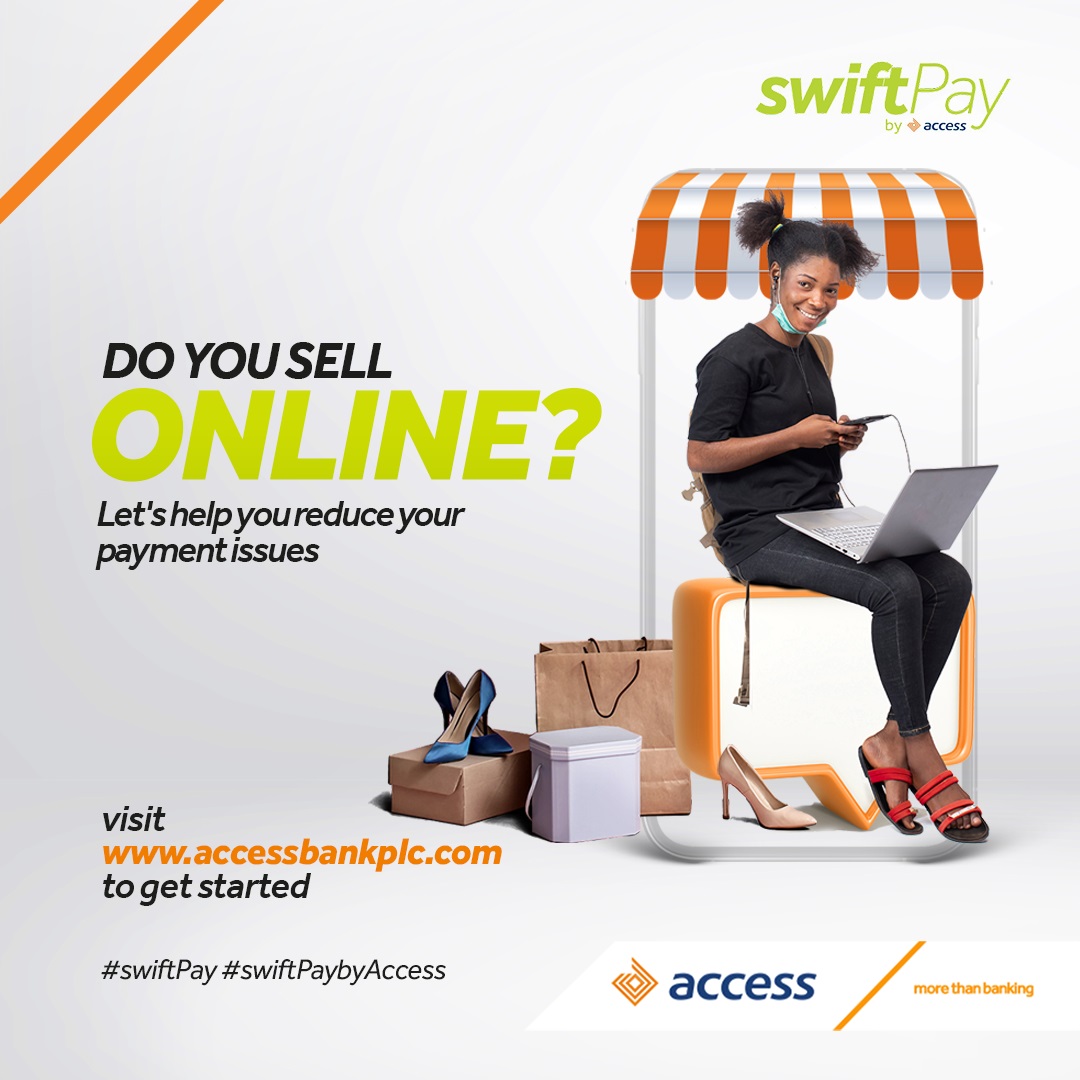
A digital payment service that facilitates the receipt of business payments called SwiftPay has been introduced by Access Bank Plc.

The platform was designed to boost the facilitation of payments between SME and retail customers in the digital space by enabling customers to make quick, easy and secure digital payments on social media platforms to merchants.

“SwiftPay is free and the processing charge is discounted up to 15 per cent to ensure merchants keep most of their earnings.

“In recent times, e-commerce has been challenged with the rise in fraud on social media, we have ensured that every merchant registered on SwiftPay carries a ‘verified by access’ stamp to authenticate the page giving customers confidence when they transact.

“We have been focused on providing solutions targeted at boosting the economy because we believe it is our responsibility to contribute to the stimulation of economic growth.

“With the launch of SwiftPay by Access, we are renewing our commitment to providing the much-needed technical support to our SMEs,” the Group Head of Emerging Businesses at Access Bank Plc, Mrs Ayodele Olojede, said at the unveiling of the new product in Lagos.

She also explained that the lockdown experienced in 2020 as a result of the COVID-19 pandemic resulted in less in-person interactions and less in-person payment options.

According to her, statistics from a survey carried out post-lockdown showed that MSMEs were impacted by cash flow, revenue and sales while adding that the impact of the pandemic made more apparent the lack of infrastructure and access to digital resources for small businesses.

“This is why Access Bank introduced SwiftPay to support the digital transition and growth of SME businesses.

“This product is part of the bank’s commitment to supporting SMEs to meet their business objectives despite the times.

“The new service comes in form of a payment link that can be hosted on merchants’ social media pages and sent to anyone to pay and conclude business transactions.

“It is easy and takes less than 5 minutes for interested merchants to sign up as it is convenient and time-saving for everyone,” she said.


Modupe Gbadeyanka is a fast-rising journalist with Business Post Nigeria. Her passion for journalism is amazing. She is willing to learn more with a view to becoming one of the best pen-pushers in Nigeria. Her role models are the duo of CNN's Richard Quest and Christiane Amanpour.

Advertisement
1 Comment

Leave a Reply

Your email address will not be published. Required fields are marked *

Banking

Public Offer: Sterling Holdco Allots 13.812 billion Shares to 18,276 Shareholders

Published

on

Sterling Holdco

By Aduragbemi Omiyale

Sterling Financial Holdings Company Plc has allotted shares from its public offer of 2025 to investors with valid applications.

The allotment follows the earlier receipt of final approval from the Central Bank of Nigeria (CBN) and the recent clearance by the Securities and Exchange Commission (SEC).

In September 2025, the financial institution offered for sale about 12,581,000,000 ordinary shares of 50 kobo each at N7.00 per share in public offer.

However, the exercise received wide participation from the investing public, with the company getting 18,280 applications for 16,839,524,401 ordinary shares valued at approximately N117.88 billion.

Following a thorough verification process, valid applications were received from 18,276 shareholders for a total of 13,812,239,000 ordinary shares, representing a subscription level of 109.79 per cent and reflecting sustained confidence in Sterling Holdco’s strategic direction, governance, and long-term growth prospects.

The firm approached the capital market for additional funds for the recapitalisation of its two flagship subsidiaries, Sterling Bank and The Alternative Bank.

The capital injection will support the commencement of full operations and contribute to the group’s revenue diversification objectives.

In line with the guidelines set out in the offer prospectus, Sterling Holdco confirmed that all valid applications will be allotted in full. Every investor who complied with the terms of the offer will receive all the shares for which they applied.

A very small number of applications were not processed or were partially rejected due to non-compliance with the offer terms, including duplicate payments and failure to meet the minimum subscription requirement of 1,000 units or its multiples, as stipulated in the offer documents.

The group ensures a seamless post-offer process, with refunds for excess or rejected applications, along with applicable interest, to be remitted via Real Time Gross Settlement or NIBSS Electronic Funds Transfer directly to the bank accounts detailed in the application forms.

Simultaneously, the electronic allotment of shares has be credited to successful shareholders’ accounts with the Central Securities Clearing System (CSCS) on February 17, and for applicants who do not currently have CSCS accounts, their allotted shares will be temporarily held in a registrar-managed pool account pending the submission of their completed account opening documentation to Pace Registrars Limited, after which the shares will be transferred to their personal CSCS accounts.

Continue Reading

Banking

CBN Governor Seeks Coordinated Digital Payment Reforms

Published

on

Yemi Cardoso Coordinated Digital Payment Reforms

By Modupe Gbadeyanka

To drive inclusive growth, strengthen financial stability, and deepen global financial integration across developing economies, there must be coordinated reforms in digital cross-border payments.

This was the submission of the Governor of the Central Bank of Nigeria (CBN), Mr Olayemi Cardoso, at the G‑24 Technical Group Meetings in Abuja on Thursday, February 19, 2026.

According to him, high remittance costs, settlement delays, fragmented systems, and heavy compliance burdens still limit the participation of households and Micro, Small and Medium Enterprises (MSMEs) in global trade.

The central banker emphasised that efficient payment systems are essential for economic inclusion, highlighting that global remittance corridors still incur average costs above 6 per cent, with settlement delays of several days, excluding millions from modern economic activity.

Mr Cardoso cautioned that while digital payments present significant opportunities, they also carry risks such as currency substitution, weakened monetary transmission, increased FX volatility, capital-flow pressures, and regulatory fragmentation.

The G-24 TGM 2026, themed Mobilising finance for sustainable, inclusive, and job-rich transformation, convened global financial stakeholders to advance the modernisation of finance in support of emerging and developing economies.

The CBN chief reaffirmed Nigeria’s commitment to working with G-24 members, the IMF, the World Bank Group, and other partners to build a more inclusive, resilient, and development-oriented global financial architecture.

“We have strengthened our AML/CFT frameworks in line with FATF guidelines, requiring strict dual-screening of cross-border transactions to mitigate risks.

“To deepen regional integration, the CBN introduced simplified KYC/AML requirements for low-value cross-border transactions to encourage broader participation in PAPSS, easing processes for Nigerian SMEs and enabling faster intra-African trade payments.

“We have also embraced fintech innovation through our Regulatory Sandbox, allowing payment-focused fintechs to test secure, instant cross-border solutions under close CBN supervision,” he disclosed.

Coordinated Digital Payment Reforms

Continue Reading

Banking

Unity Bank, Providus Bank Merger Awaits Final Court Approval

Published

on

unity bank providus bank

By Modupe Gbadeyanka

The merger and business combination between Unity Bank Plc and Providus Bank Limited remains firmly on course, a statement from one of the parties disclosed.

According to Unity Bank, there is no iota of truth in reports in certain sections of the media suggesting that the merger process had stalled, as the transaction remains firmly on track.

It was disclosed that the necessary regulatory steps have been completed, but only a few other steps to finalise the transaction, especially the final court sanction.

There had been speculations that both lenders may not meet the new minimum capital requirement of the Central Bank of Nigeria (CBN) before the March 31, 2026, deadline.

However, it was noted that the combined capital base of Unity Bank and Providus Bank exceeds N200 billion, which is the minimum requirement to retain a national banking licence under the CBN’s recapitalisation framework.

When completed, the Unity-Providus merger is expected to deliver a stronger, more competitive, and customer-centric financial institution — one with the scale, innovation, and reach to redefine the retail and SME banking landscape in Nigeria.

“The merger with Providus Bank significantly enhances our capital base, operational capacity, and strategic positioning.

“We are confident that the combined institution will be better equipped to support economic growth and deliver innovative financial solutions across Nigeria,” the chief executive of Unity Bank, Mr Ebenezer Kolawole, stated.

Recall that a few months ago, shareholders authorised the merger between the two entities at Court-Ordered Meetings. They also adopted the scheme of merger at their respective Extraordinary General Meetings (EGMs) in September 2025,

The central bank also backed the merger, with a pivotal financial accommodation to support the transaction. The merger also received a further boost with a “no objection” nod from the Securities and Exchange Commission (SEC).

The regulatory approvals form part of broader efforts to strengthen the resilience of Nigeria’s banking system, reinforce capital adequacy across the sector, and mitigate potential systemic risks.

The development positions the combined entity among the 21 banks that have satisfied the apex bank’s new capital threshold for national banking operations.

Continue Reading

Trending