Connect with us

General

Eko Atlantic City to Have Over 200,000 Trees—Developer

Published

on

Eko Atlantic City

By Modupe Gbadeyanka

The developer and planner of the famous Eko Atlantic City in Lagos State, South Energyx Nigeria Limited, has said the city would be environmentally friendly.

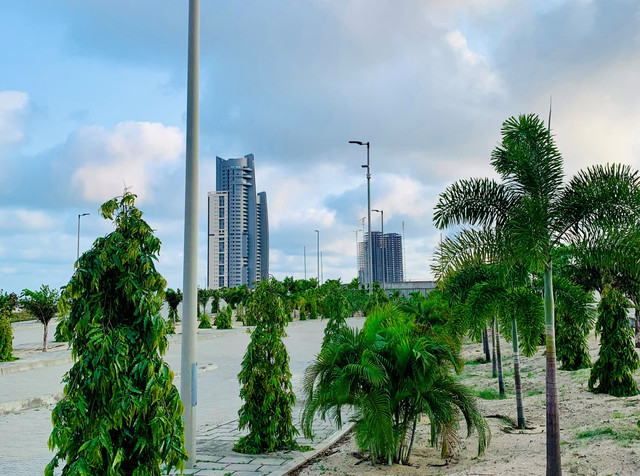
According to him, this would be achieved by planting more than 200,000 trees of different varieties and sizes across the city, while the area would boast of energy-efficient building materials where possible as well as well-planned roads and infrastructure.

“Alongside our commitment to planting trees, developers in the city are currently looking to implement solar power for their buildings which will increase the use of renewable energy in the city.

“We are also constantly looking out for the latest technologies and techniques to further improve energy and resource efficiency within the city.

“Some of these include smart buildings, efficient energy storage, and smart monitoring. We believe that we will achieve greater levels of energy efficiency as the city continues to develop,” the Vice Chairman of Eko Atlantic, Mrs Ronald Chagoury Jr, said in commemoration of the 2021 Earth Day.

In a statement, South Energyx Nigeria at least 30 varieties of trees and plants are grown in the company’s 45,000 sqm nursery in Eko Akete, which are then transplanted to Eko Atlantic City once they are ready.

The firm assured that all roads in the city are lined with trees and shrubs, providing cleaner air and improving environmental quality.

The streets are also lined with LED streetlights which consume considerably less energy than regular sodium lamps. This way, the city’s developers balance both the need for quality infrastructure and environmental preservation, it further said.

Recall that in January 2020, Alpha1, the first office tower in the city, became the first building to be EDGE-certified by the International Finance Corporation, a member of the World Bank Group.

EDGE stands for Excellence in Design for Greater Efficiency. It is issued to developers and buildings that have identified the most cost-effective ways to reduce energy use, water use and embodied energy in materials. Research shows that green buildings use up to 30 per cent less energy than conventional buildings.

In line with this green commitment, the roads in Eko Atlantic City are built with concrete blocks instead of asphalt. Because of their light colour, the concrete blocks absorb less heat from the sun when compared to asphalt. This lowers the overall core temperature of the city.

Eko Atlantic City also has roundabouts instead of four-way intersections. Studies show that roundabouts ensure safer and more efficient traffic flow.

Also vital to traffic management is the city’s prohibition of street parking by providing basement parking for several developments. This ultimately reduces the number of cars on the road and minimises carbon emission from idle vehicles in traffic.

Upon completion, Eko Atlantic City will be home to approximately 300,000 residents and 250,000 commuters, who will also enjoy environmentally-friendly means of transportation as the technology continues to develop.

With its Green City Commitment, Eko Atlantic sets the environmental standard for new emerging cities worldwide and contributes to a cleaner, healthier, and more environmentally friendly Lagos.


Modupe Gbadeyanka is a fast-rising journalist with Business Post Nigeria. Her passion for journalism is amazing. She is willing to learn more with a view to becoming one of the best pen-pushers in Nigeria. Her role models are the duo of CNN's Richard Quest and Christiane Amanpour.

Click to comment

Leave a Reply

Your email address will not be published. Required fields are marked *

General

EFCC Admits Freezing Osun Bank Account, Alleges N11bn Embezzlement

Published

on

EFCC Real Estate Agents

By Modupe Gbadeyanka

The Economic and Financial Crimes Commission (EFCC) has explained why it initiated a move to freeze the bank account of the Osun State government.

Earlier on Wednesday, the Governor of Osun State, Mr Ademola Adeleke, claimed that the anti-money laundering agency asked one of its bankers, First Bank, not to release funds to the state government.

According to the Governor, this was part of the strategies to frustrate his administration ahead of the August 15, 2026, governorship election in the state.

Reacting to the issue on Wednesday night, the EFCC, in a statement, said it has been investigating the state government since March 2026 over an alleged “fraudulent handling of Ecology Funds, Intervention Funds and Federal Account Allocation Committee (FAAC) account to the tune of N11.0 billion.

The organisation noted that some officials of the state government, especially the Accountant General of the State, have had interview sessions with investigators of the EFCC.

“These ongoing investigations of the state government would not have warranted any placement of Post No Debit order on its account but for the precipitate and unwarranted movement of funds from the accounts to different suspicious accounts since August 2, 2026.

“The commission noticed huge transfers of funds into different corporate entities and had to swiftly halt the trend by freezing the accounts from which such heavy funds are being moved,” parts of the statement said.

In the disclosure, the agency noted that its preventive mandate is a public-inclined framework of safeguarding public funds, assets and resources, stressing that it cannot “watch idly while a state government’s account is being pillaged.”

“While the commission is fully aware of the impending governorship election in Osun State, it has a responsibility to act in defence of the sanctity of the funds of the state. It will be uncharitable for the commission to allow an excuse of an upcoming election to fold its arms to perform its legally-assigned functions,” it pointed out.

The EFCC disclosed that it is “keeping watch over the finances of other states like Osun State. Many of these states are on the investigative radar of the commission to ensure accountability and probity. The commission has always pointed out that it is non-partisan and non-sectarian but always working in the overall interests of Nigerians. The Osun State government account was frozen to save public funds from being looted.”

The organisation urged the public “to ignore false narratives and deliberate demonisation of the works of the EFCC. The interests of all Nigerians are greater and will always be protected by the commission.”

Continue Reading

General

NMDPRA Launches App to Track Fuel Consumption Across Filling Stations

Published

on

fuel consumption

By Adedapo Adesanya

The Nigerian Midstream and Downstream Petroleum Regulatory Authority (NMDPRA) has launched a mobile application designed to monitor fuel consumption patterns in real time across retail outlets nationwide.

The NMDPRA, established under the Petroleum Industry Act (PIA) 2021, is responsible for the technical and commercial regulation of Nigeria’s midstream and downstream petroleum operations. The deployment of the mobile application aligns with the authority’s broader efforts to leverage technology to improve regulatory compliance and strengthen accountability.

The pilot phase of the project began on August 1 in Abuja and its six Area Councils, the authority said in a statement published on X.

As part of the rollout, the Executive Director for Distribution Systems, Storage and Retailing Infrastructure (DSSRI), Mr Ogbugo Ukoha, led a team alongside officials from the Abuja Regional Office to assess the readiness and operational performance of the digital platform at participating retail outlets.

According to the NMDPRA, the application captures inventory and compliance data in real time, enabling regulators to monitor fuel distribution more effectively while improving operational efficiency across the sector.

The authority said the platform would generate reliable, data-driven insights to support evidence-based decision-making, strengthen national energy security planning and enhance transparency in the downstream petroleum industry.

It added that the initiative is expected to provide significant value to government, investors, operators and other stakeholders by improving access to accurate fuel consumption and compliance data.

Nigeria’s downstream petroleum sector has undergone significant changes since the deregulation of the petrol market and the removal of fuel subsidies, with regulators placing greater emphasis on data-driven supervision to ensure product availability, prevent supply disruptions and discourage sharp regional disparities in distribution.

Continue Reading

General

Onafriq, Privy to Build Regulated Stablecoin Infrastructure for B2Bs

Published

on

Onafriq Privy

By Modupe Gbadeyanka

No doubt, moving money among African markets remains a slow, fragmented process that relies on multiple intermediaries and prolonged settlement cycles.

To solve this issue and drive the development of stablecoin-enabled payment services for businesses across the continent, Onafriq has joined forces with a leading stablecoin infrastructure provider, Privy.

The collaboration will enable Onafriq to create and manage embedded digital asset solutions for its partners and, in time, institutional clients where regulation allows. The initial phase focuses on cross-chain stablecoin transfers and treasury and settlement workflows, creating the foundation for future cross-border payment and liquidity solutions.

Integrating Privy’s secure infrastructure enables Onafriq to build the capabilities required to support a new generation of efficient digital payment services for banks, fintechs, and mobile money operators.

This partnership is a key component of Onafriq’s broader strategy to modernise pan-African payment infrastructure, enabling secure multi-modal wallets and more efficient movement of value across the continent.

The outcome will support a range of future institutional use cases, including stablecoin-enabled settlement, treasury management and liquidity services, as it reflects Onafriq’s commitment to driving Africa’s digital transformation agenda by investing in technologies that make financial services more efficient, connected and accessible.

It was gathered that Onafriq selected Privy for its enterprise-grade infrastructure to enable the seamless integration of digital asset wallet capabilities into its products, subject to regulatory approval, and deliver a simple user experience while abstracting the complexity of blockchain technology.

“At Onafriq, we keep investing in technology that makes payments faster and more accessible. Privy gives us a building block for faster settlement and better liquidity management. As demand for digital asset services grows, our goal is to ensure Africa’s payment ecosystem benefits securely and in line with regulatory frameworks,” the Group Chief Product and Innovation Officer at Onafriq,” Mr Luke Kyohere, said.

The chief executive of Privy, Mr Henri Stern, said, “Stablecoins will play an increasingly important role in the future of global payments, but real-world adoption depends on infrastructure that is secure, scalable and simple to implement. Working with Onafriq allows us to help build that foundation across Africa and beyond.”

Continue Reading