Connect with us

General

Eko Atlantic City to Have Over 200,000 Trees—Developer

Published

on

Eko Atlantic City

By Modupe Gbadeyanka

The developer and planner of the famous Eko Atlantic City in Lagos State, South Energyx Nigeria Limited, has said the city would be environmentally friendly.

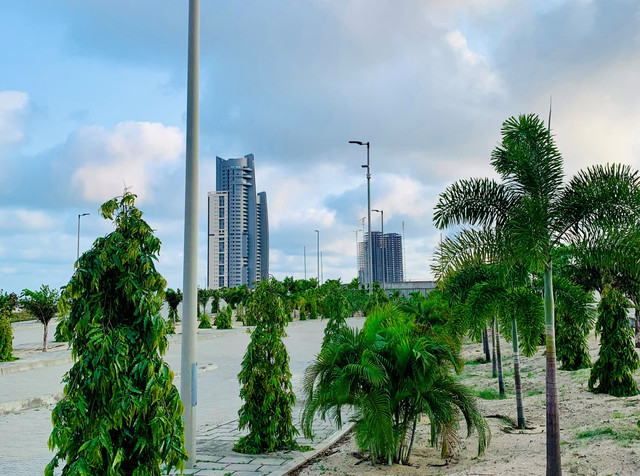
According to him, this would be achieved by planting more than 200,000 trees of different varieties and sizes across the city, while the area would boast of energy-efficient building materials where possible as well as well-planned roads and infrastructure.

“Alongside our commitment to planting trees, developers in the city are currently looking to implement solar power for their buildings which will increase the use of renewable energy in the city.

“We are also constantly looking out for the latest technologies and techniques to further improve energy and resource efficiency within the city.

“Some of these include smart buildings, efficient energy storage, and smart monitoring. We believe that we will achieve greater levels of energy efficiency as the city continues to develop,” the Vice Chairman of Eko Atlantic, Mrs Ronald Chagoury Jr, said in commemoration of the 2021 Earth Day.

In a statement, South Energyx Nigeria at least 30 varieties of trees and plants are grown in the company’s 45,000 sqm nursery in Eko Akete, which are then transplanted to Eko Atlantic City once they are ready.

The firm assured that all roads in the city are lined with trees and shrubs, providing cleaner air and improving environmental quality.

The streets are also lined with LED streetlights which consume considerably less energy than regular sodium lamps. This way, the city’s developers balance both the need for quality infrastructure and environmental preservation, it further said.

Recall that in January 2020, Alpha1, the first office tower in the city, became the first building to be EDGE-certified by the International Finance Corporation, a member of the World Bank Group.

EDGE stands for Excellence in Design for Greater Efficiency. It is issued to developers and buildings that have identified the most cost-effective ways to reduce energy use, water use and embodied energy in materials. Research shows that green buildings use up to 30 per cent less energy than conventional buildings.

In line with this green commitment, the roads in Eko Atlantic City are built with concrete blocks instead of asphalt. Because of their light colour, the concrete blocks absorb less heat from the sun when compared to asphalt. This lowers the overall core temperature of the city.

Eko Atlantic City also has roundabouts instead of four-way intersections. Studies show that roundabouts ensure safer and more efficient traffic flow.

Also vital to traffic management is the city’s prohibition of street parking by providing basement parking for several developments. This ultimately reduces the number of cars on the road and minimises carbon emission from idle vehicles in traffic.

Upon completion, Eko Atlantic City will be home to approximately 300,000 residents and 250,000 commuters, who will also enjoy environmentally-friendly means of transportation as the technology continues to develop.

With its Green City Commitment, Eko Atlantic sets the environmental standard for new emerging cities worldwide and contributes to a cleaner, healthier, and more environmentally friendly Lagos.


Modupe Gbadeyanka is a fast-rising journalist with Business Post Nigeria. Her passion for journalism is amazing. She is willing to learn more with a view to becoming one of the best pen-pushers in Nigeria. Her role models are the duo of CNN's Richard Quest and Christiane Amanpour.

Click to comment

Leave a Reply

Your email address will not be published. Required fields are marked *

General

DisCos Collect N196bn in March, Miss N50bn of Billed Revenue

Published

on

Electricity Subsidy Q1 2024

By Adedapo Adesanya

Nigeria’s electricity distribution companies (DisCos) generated N196.13 billion in revenue in March 2026, despite billing customers a total of N246.43 billion during the month, according to the latest commercial performance report released by the Nigerian Electricity Regulatory Commission (NERC).

The figure represents a slight decline from the N196.68 billion collected in February, highlighting persistent challenges in revenue recovery across the power distribution segment, even as energy supplied to the grid continued to improve.

NERC’s March 2026 fact sheet showed that electricity billing rose by 1.71 per cent from N242.29 billion recorded in February, reflecting increased energy deliveries and customer charges. However, collection efficiency declined to 79.59 per cent from 81.17 per cent in the previous month, indicating that a significant portion of billed revenue remained uncollected.

The regulator disclosed that DisCos received 293.76 million kilowatt-hours of electricity during the review period, representing a 6.02 per cent increase compared to February. The development suggests a modest improvement in power availability across the distribution network.

Despite the increase in energy supplied, revenue recovery remains uneven across the industry. NERC reported that the average approved tariff for March stood at N124.30 per kilowatt-hour, while actual collections averaged ₦100.75 per kilowatt-hour, resulting in an overall revenue recovery efficiency of 81.05 per cent.

Among the eleven DisCos, Ikeja Electric emerged as the strongest performer, posting a revenue recovery efficiency of 99.30 per cent. Eko Electricity Distribution Company followed with 95.73 per cent, while Benin DisCo recorded 85.18 per cent.

At the lower end of the performance table, Kaduna Electric recorded the weakest recovery rate at 35.65 per cent. Jos DisCo and Yola DisCo also struggled, achieving recovery efficiencies of 53.53 per cent and 58.58 per cent, respectively.

Ikeja Electric also led in collection efficiency with 96.38 per cent, ahead of Benin DisCo at 90.97 per cent and Eko DisCo at 87.68 per cent. Kaduna, Jos and Yola remained the poorest performers in this category, underlining the persistent commercial and operational challenges facing power distributors in parts of northern Nigeria.

In terms of billing efficiency, Eko DisCo ranked first with 92.30 per cent, followed by Port Harcourt DisCo at 90.36 per cent and Ikeja Electric at 87.76 per cent. Yola DisCo recorded the lowest billing efficiency at 58.68 per cent.

The latest figures underscore the mixed realities within Nigeria’s power sector. While electricity supply and customer billing continue to improve, revenue collection remains a major obstacle to the financial sustainability of the industry.

Analysts note that stronger metering penetration, improved customer confidence, reduction in energy theft and more efficient collection systems will be critical if DisCos are to close the widening gap between electricity supplied, billed revenue and actual collections.

The March performance report comes as regulators and industry stakeholders intensify efforts to strengthen the commercial viability of the electricity market, attract fresh investment and improve service delivery across the country.

Continue Reading

General

Interswitch Adopts Temenos Platform to Deliver Banking Services to African Lenders

Published

on

Interswitch

By Adedapo Adesanya

Interswitch has entered into a partnership with Geneva-headquartered banking software provider Temenos to offer managed banking services to financial institutions across the continent, deepening its push into banking technology.

The partnership will see Interswitch adopt Temenos’ banking technology across core banking, digital banking, payments, wealth management, and financial crime management.

This will enable the firm to provide cloud-hosted and on-premises managed services to lenders on the continent. The service will initially target Nigeria, Ghana, Côte d’Ivoire, Kenya, and other African markets.

“This is a pivotal moment for Interswitch as we accelerate our expansion beyond payments and reimagine digital banking for Africa,” Mr Jonah Adams, managing director for Digital Infrastructure and Managed Services at Interswitch, said in a statement.

By combining Temenos’ software with its existing footprint across the continent, Interswitch is positioning itself as a technology partner that can help banks upgrade critical systems without having to manage the complexity of large-scale technology deployments.

“By adopting Temenos’ cloud-native, composable platform, Interswitch gains the flexibility and scalability to accelerate its next phase of growth and deliver banking services that meet the needs of African markets,” Mr Adams added.

For Temenos, the deal strengthens its presence in Africa through a partner with deep relationships across the banking sector. It lost one of its banking customers, Sterling Bank, in 2024 after the tier-2 Nigerian bank switched to SEABaaS, a new custom-built core banking application.

“Interswitch is an important new customer and partner for Temenos in Africa,” said Mr William Moroney, Chief Revenue Officer at Temenos. “Interswitch’s strong presence across the continent also extends our reach and further strengthens our ecosystem and partner network.”

Founded in 2002, Interswitch built its reputation as one of Africa’s largest payments companies through products such as Quickteller and Verve, its domestic card scheme.

Continue Reading

General

TGI Group, Wilmar to Form $12bn West Africa Food Giant in Major Merger

Published

on

tgi group Wilmar

By Adedapo Adesanya

Tropical General Investments (TGI) Group and Singapore-based Wilmar International have agreed to combine their Nigeria and Republic of Benin operations into a 50:50 joint venture aimed at building a dominant integrated food and agribusiness platform across West Africa, targeting a market estimated at $12 billion.

The proposed merger will consolidate operations across several value chains, including agriculture, oil palm plantations, edible oils, edible nuts, rice, food manufacturing, and distribution, creating one of the region’s largest end-to-end food production and supply chains.

Under the arrangement, both firms will integrate their complementary strengths, with Wilmar contributing global expertise in palm oil, speciality fats, and large-scale agribusiness operations, while TGI brings established local manufacturing capacity, consumer brands, and an extensive distribution network across Nigeria and neighbouring markets.

Chairman and Chief Executive Officer of Wilmar International, Mr Kuok Hong, said the partnership would enhance both firms’ ability to serve Africa’s expanding consumer base, describing Nigeria and Benin as strategic growth markets.

“For more than four decades, TGI Group has built a leading position in Nigerian food manufacturing and distribution. This partnership will leverage Wilmar’s global scale and expertise as well as TGI’s local knowledge to deliver innovative food solutions across Africa,” added TGI Group founder and chairman, Mr Cornelis Vink.

On his part, Vice Chairman of TGI Group, Mr Farouk Gumel, said the deal reflects confidence in Nigeria’s long-term economic prospects, adding that it would deepen domestic value addition, strengthen food security, support smallholder farmers, and create jobs.

Adding his input, Wilmar’s Africa Head, Mr Santosh Pillai, described the transaction as a strategic fit, noting that the combined entity would have the scale, local insight, and operational depth needed to better serve consumers in the region.

The companies said the transaction is expected to be completed in the 2026 financial year, subject to regulatory approvals and other customary conditions.

Continue Reading

Trending