Economy
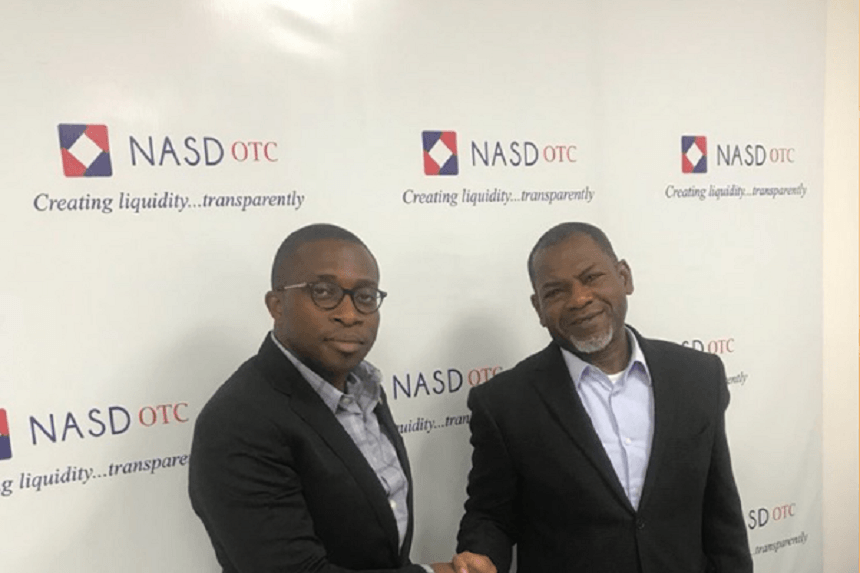
NGX, CSCS Retain Bulls at NASD OTC Exchange
By Adedapo Adesanya
The bulls remained on the floor of the NASD Over-the-Counter (OTC) Securities Exchange on Friday courtesy of the positive price movements by Nigerian Exchange (NGX) Group Plc and Central Securities Clearing Systems (CSCS) Plc.
For the fifth straight session, the stock price of NGX Group rose and this time by 6.1 per cent or N1.75 to close at N30.26 per share compared to N28.51 per share it closed on Thursday.
For CSCS Plc, it gained 10 kobo or 0.6 per cent to close the session at N16.75 per share in contrast to N16.65 per share it finished at the previous session.
The gains reported by the duo expanded the market capitalisation of the NASD OTC Exchange by 0.9 per cent or N500 million to close the day at N561.46 billion versus N560.96 billion of the earlier session.
Also, the NASD Unlisted Security Index (NSI) rose by 0.9 per cent or 0.7 points to wrap the closing session for the week and month at 789.89 points compared with 789.19 points of the previous session.
However, there was another drop in the volume of securities traded at the bourse yesterday by investors by 24.6 per cent as only 9.8 million units of stocks were transacted as against the 13.1 million units of stocks of the previous trading day.
Also, There was a decline in the value of shares traded yesterday by 20.6 per cent as securities worth N297.8 million exchanged hands versus Thursday’s N372.8 million.
In addition, the number of deals executed on Friday went down by 24.3 per cent as only 53 deals were carried out compared with the 70 deals recorded a day earlier.
NGX Group accounted for 48 deals, CSCS Plc accounted for two deals, same as Afriland Properties Plc, while the Niger Delta Exploration and Production (NDEP) Plc recorded one deal.
At the close transactions, NGX Group was the most active stock by volume (year-to-date) with the sale of 128.4 million units worth N2.9 billion. CSCS Plc was in second place with 25.6 million units worth N391.6 million, while UBN Property Plc held the third position with 21.9 million units of its shares worth N24.6 million.
In terms of the most traded stock by value (year-to-date), NGX Group also closed on top of the chart for trading 128.4 million units valued at N2.9 billion. It is followed by NDEP Plc with 2.3 million units valued at N704 million and FrieslandCampina WAMCO Plc with 4.2 million units valued at N524.6 million.
Economy
Customs Street Rallies 0.06% Amid Weak Investor Sentiment
By Dipo Olowookere
A marginal 0.06 per cent was recorded by Customs Street at the close of business on Wednesday, extending the dominance of the bulls for another trading session.
The uptick printed by the Nigerian Exchange (NGX) Limited was despite weak investor sentiment after reporting 30 price gainers and 36 price losers, representing a positive market breadth index.
Livestock Feeds gained 10.00 per cent to close at N9.35, Deap Capital expanded by 9.86 per cent to N5.35, Abbey Mortgage Bank appreciated by 9.78 per cent to N12.35, Vitafoam grew by 8.25 per cent to N210.00, and FTN Cocoa chalked up 6.54 per cent to finish at N9.45.
On the flip side, Neimeth lost 10.00 per cent to trade at N9.00, International Energy Insurance slipped by 9.92 per cent to N7.90, John Holt shrank by 9.73 per cent to N13.45, Union Homes REIT declined by 8.56 per cent to N70.00, and eTranzact went down by 8.06 per cent to N16.55.
Though activity level contracted yesterday, it remained on the high side, as market participants transacted 1.2 billion equities worth N38.8 billion in 54,193 deals compared with the 1.3 billion equities valued at N57.9 billion traded in 59,956 deals on Tuesday, indicating a shortfall in the trading volume, value, and number of deals by 7.69 per cent, 32.99 per cent, and 9.61 per cent, respectively.
Sterling Holdings sold 565.3 million shares valued at N4.5 billion to emerge as the busiest during the session. FCMB transacted 122.1 million equities for N1.5 billion, Access Holdings sold 49.5 million stocks worth N1.3 billion, Jaiz Bank exchanged 34.9 million shares valued at N313.8 million, and Universal Insurance traded 32.4 million stocks worth N35.6 million.
Business Post reports that the banking and industrial goods sectors respectively lost 0.79 per cent and 0.09 per cent yesterday as a result of profit-taking.
However, the consumer goods index rose 0.42 per cent, the energy counter increased by 0.14 per cent, and the insurance segment improved by 0.03 per cent due to bargain-hunting.
As a result, the All-Share Index (ASI) went up by 154.59 points to 244,852.21 points from 244,697.62 points, and the market capitalisation soared by N99 billion to N157.043 trillion from N156.944 trillion.
Economy
Chilla Entertainment Injects N2bn into Zichis Agro Allied Industries
By Aduragbemi Omiyale
A strategic non-equity capital of N2 billion has been pumped into one of Nigeria’s emerging integrated agribusiness companies, Zichis Agro Allied Industries Plc.
Chilla Entertainment is one of the promoters of Zichis. The capital injection reaffirms the investor’s confidence in the company’s vision, growth prospects, and long-term value creation strategy.
In a note to the Nigerian Exchange (NGX) Limited, the funds will be a long-term liability in the company’s balance sheet to be redeemed at a future date in terms of debt conversion to equity during a public offer or rights issues.
It is designed to transform Zichis into one of Nigeria’s leading agro-industrial enterprises with a fully integrated value chain spanning feed production, poultry farming, palm cultivation, and agro-processing.
The newly injected capital will primarily be deployed towards expanding the firm’s operational capacity and strengthening its working capital position.
Key areas of investment include a significant increase in poultry production capacity, strengthening of the company’s integrated livestock value chain, and enhancement of operational efficiency and output levels.
In addition, the N2 billion would be used to increase the procurement of raw materials to support higher production volumes, grow the supply chain for the organisation’s feed mill operations, and position the business to meet growing demand within Nigeria’s livestock and poultry sectors.
Also, Zichis will accelerate the cultivation of its newly acquired 2,000-acre agricultural land in Ogun State to significantly increase its agricultural asset base and future revenue-generating capacity.
Zichis is strategically positioning itself to capitalise on these opportunities through its diversified agribusiness model, expanding production footprint, and disciplined execution strategy.
The endgame is to enhance shareholder value, expand operational capacity, build sustainable competitive advantages, and deliver long-term returns to investors.
Recently, the board and management visited the Nigerian Institute for Oil Palm Research (NIFOR) in Edo State for a strategic partnership on the acquisition of high-yield oil palm seedlings and the implementation of modern cultivation techniques across its expanding palm estate.
This collaboration is expected to enhance productivity, improve long-term yields, and support the company’s objective of becoming a major participant in Nigeria’s growing palm oil value chain.
Zichis reaffirmed its commitment to maintaining the highest standards of corporate governance, transparency, accountability, and regulatory compliance.
Economy
Nigerian Manufacturers Caution on Hasty Ban on Textile Imports
By Adedapo Adesanya
The Manufacturers Association of Nigeria (MAN) has called for stakeholder engagement over the Senate’s request for a ban on the import of textile materials.
The Director-General of the association, Mr Segun Ajayi-Kadir, said such a policy without proper engagement will only lead to failure.
“I want to appeal to the National Assembly: let us not go down this route the same way again. The failure of policy in Nigeria has principally been due to a lack of stakeholder engagement. You cannot shave a man’s head in his absence,” he said on Channels TV breakfast show on Wednesday.
“We pass resolutions, introduce policies, and enact laws that do not substantially reflect what is happening on the ground. That is why well-intentioned moves fail to achieve their objectives.
“We need stakeholder engagement. We need to bring all the existing textile industries to the table and ask them, ‘When, how, and where can you scale?’ We have an idea of the national demand, and we know the reasons why they are operating below 30 per cent of installed capacity. The question is, does the government have the political will to do what it takes to help them deliver?”
On Tuesday, the Senate asked the federal government to ban the importation of textile materials in a bid to boost local production and revive the country’s struggling textile industry.
It urged the federal government, through the Ministries of Agriculture and Trade and Investment, to take urgent steps to resuscitate textile manufacturing across the country, particularly along the Kaduna-Kano industrial corridor, citing its potential to create jobs and address rising youth unemployment and insecurity.
Mr Ajayi-Kadir said the country can meet its textile needs, but believes revival of the industry has to go beyond “passing” resolutions.
“It needs to be actively supported by measures that we have consistently recommended but have not yet been implemented,” the MAN chief said.
“For instance, are we going to enforce the patronage of made-in-Nigeria textiles within the government? When the National Assembly passed this resolution, how many of them were wearing made-in-Nigeria garments? If you look closer, how many of us are driving cars assembled in Nigeria?
“If you legislate a ban on textile imports, it must go hand-in-hand with the diligent implementation of Executive Order 003 and a ‘Nigeria First’ mindset. Are we going to enforce it from the Presidency to the National Assembly, the military, uniformed agencies, and even schools? Are we ready to enforce a ‘Nigeria Day’ where everyone is obliged to wear what is made in Nigeria?
“Is the government going to do its bit? Are we going to reject textile, garment, or uniform items in the budget unless they show a direct connection to local production? Are we going to muster what it takes to effectively implement the 30 per cent Common External Tariff (CET) on imports from third countries? Are we going to secure our borders so that the ban does not come to nought?
“A major conversation needs to take place for us to be serious about enforcing an import ban. It is not just by fiat,” he said on the show.
-
Feature/OPED6 years agoDavos was Different this year
-
Travel/Tourism10 years ago
Lagos Seals Western Lodge Hotel In Ikorodu
-
Showbiz3 years agoEstranged Lover Releases Videos of Empress Njamah Bathing
-
Banking8 years agoSort Codes of GTBank Branches in Nigeria
-
Economy3 years agoSubsidy Removal: CNG at N130 Per Litre Cheaper Than Petrol—IPMAN
-
Banking3 years agoSort Codes of UBA Branches in Nigeria
-
Banking3 years agoFirst Bank Announces Planned Downtime
-
Sports3 years agoHighest Paid Nigerian Footballer – How Much Do Nigerian Footballers Earn