Connect with us

Economy

China’s Latest Crypto Ban Send Cryptocurrency Market Crashing

Published

on

Crypto Market

By Adedapo Adesanya

China has banned financial institutions and payment companies from providing services related to cryptocurrency transactions and warned investors against speculative crypto trading.

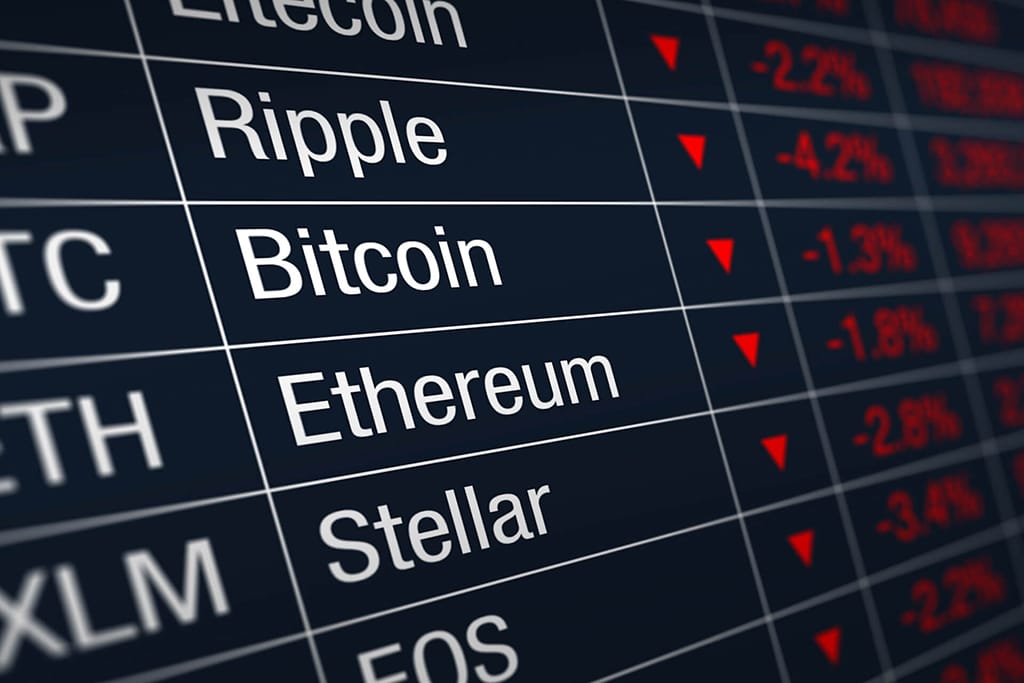
The move has seen several coins on the digital currency market dip further in the bearish territory.

As at the time of this report, all seven benchmarked cryptocurrencies tracked by Business Post were trading in the negative territory.

The value of Bitcoin (BTC) has plunged by 24.8 per cent to trade at N17,599,261.57; Ethereum (ETH) has depreciated by 23.7 per cent to sell at N1,360,194.85; Ripple (XRP) has lost 15.4 per cent to sell N677.20; while Dash (DASH) has dropped 15.7 per cent to N127,000.00.

Also, the Litecoin (LTC) has declined by 10.7 per cent to trade at N130,000.00; Tron (TRX) has depreciated by 15.0 per cent to sell at N50.98, while the US Dollar Tether (USDT) has fallen by 0.9 per cent to sell for N506.49.

Under the ban, institutions including banks and online payments channels, must not offer clients any service involving cryptocurrencies, such as registration, trading, clearing and settlement.

Through its regulatory agencies – the National Internet Finance Association of China, the China Banking Association and the Payment and Clearing Association of China – the world’s second-largest economy said, “Recently, cryptocurrency prices have skyrocketed and plummeted, and speculative trading of cryptocurrency has rebounded, seriously infringing on the safety of people’s property and disrupting the normal economic and financial order.”

The statement also highlighted the risks of cryptocurrency trading, saying virtual currencies “are not supported by real value”, their prices are easily manipulated, and trading contracts are not protected by Chinese law.

The newly announced ban means crypto exchanges won’t be able to support initial coin offerings but individuals will still be able to hold cryptocurrencies.

The move would not be the Asian giant’s first move against digital currency as it had clamped down on trading in 2017 and 2019.


Adedapo Adesanya is a journalist, polymath, and connoisseur of everything art. When he is not writing, he has his nose buried in one of the many books or articles he has bookmarked or simply listening to good music with a bottle of beer or wine. He supports the greatest club in the world, Manchester United F.C.

Click to comment

Leave a Reply

Your email address will not be published. Required fields are marked *

Economy

Dangote Refinery Targets $5bn in Landmark IPO Due in October

Published

on

Dangote Refinery Crude Supply to Local Refineries

By Adedapo Adesanya

Dangote Petroleum Refinery is preparing to raise about $5 billion through an initial public offering (IPO) expected to conclude in October, in what could become the largest stock market listing in Africa’s history.

The company has already submitted an initial application to the Securities and Exchange Commission (SEC), with approval expected in the coming weeks. Once authorised, the refinery is expected to release its prospectus in September ahead of the public offer.

The primary listing will be on the Nigerian Exchange (NGX) Limited, although investors across Africa are expected to participate through structured investment instruments rather than a dual listing.

The proceeds will be used to expand the capacity of the 700,000-barrels-per-day refinery in Lagos and possibly support plans to replicate the project in Kenya as Dangote seeks to deepen Africa’s energy independence.

The proposed IPO comes after the refinery benefited from increased demand for refined products during the recent Iran conflict, supplying jet fuel across Africa and into Western Europe as global shortages disrupted markets.

As per Reuters, stock exchanges in South Africa, Kenya, Egypt, Ghana and Rwanda have held discussions with advisers to the transaction as interest in the offering continues to build across the continent.

Kenya alone could account for as much as $500 million of the targeted capital raise, driven largely by demand from institutional investors, including pension funds, the publication reported.

While the company is targeting a $5 billion raise, the final amount will depend on the outcome of the SEC’s review. If achieved, the offering would represent more than four per cent of the Nigerian Exchange’s current market capitalisation.

The IPO follows a $2.5 billion private placement completed last month, in which a six per cent stake in the refinery was sold, implying a valuation of about $40 billion.

That valuation, however, would place the refinery well above several listed global refining companies. Turkey’s Tupras, which operates a similar combined refining capacity across four facilities, has a market value of roughly $12 billion, while US-listed HF Sinclair, with a comparable processing capacity, is valued at around $16 billion.

Although the NGX generally requires companies on its main board to maintain a minimum free float of 20 per cent, there have been exceptions. Dangote Cement, for instance, currently has a free float of just over 12 per cent.

The publication also reported that investors outside Nigeria are likely to gain exposure through instruments such as global depositary receipts or exchange-traded products linked to the Nigerian-listed shares, rather than through a cross-listing on other African exchanges.

The founder of the 700,000-barrels-per-day capacity plant, Mr Aliko Dangote, said in April that the refinery aims to increase production capacity to 1.4 million barrels per day.

Mr Dangote is also pursuing plans to build another refinery in Lamu along Kenya’s coast in partnership with other East African governments, although it remains unclear whether part of the IPO proceeds will be allocated to that project valued at an estimated $17 billion.

Continue Reading

Economy

NASD OTC Exchange Appreciates 0.89%

Published

on

NASD OTC securities exchange

By Adedapo Adesanya

The NASD Over-the-Counter (OTC) Securities Exchange rallied by 0.89 per cent on Tuesday, August 4 amid renewed buying interest in unlisted stocks.

During the session, the market capitalisation added N24.07 billion to end at N2.739 trillion compared with Tuesday’s N2.715 trillion, while the NASD Security Index (NSI) gained 40.11 points to quote at 4,563.96 points compared with the preceding day’s 4,523.85 points.

The NASD OTC Exchange ended the trading session with two price losers and three gainers, led by Central Securities Clearing System (CSCS) Plc, which chalked up N7.80 to close at N119.80 per unit versus the previous session’s N112.00 per unit. Afriland Properties Plc increased its value by N1.27 to N23.95 per share from N22.68 per share, and Nitrox Industrial Gases Plc expanded by N1.15 to N21.15 per unit from N20.00 per unit.

On the flip side, FrieslandCampina Wamco Nigeria Plc slid by N8.64 to sell at N144.00 per share compared with the previous day’s N152.64 per share, and 11 Plc dipped by 1 Kobo to end at N225.00 per unit, in contrast to Monday’s closing price of N225.01 per unit.

Tuesday’s trading data showed that the volume of securities rose by 9.0 per cent to 1.6 million units from 1.5 million units, and the number of deals climbed by 6.5 per cent to 33 deals from 31 deals, while the value of securities dropped by 26.9 per cent to N47.6 million from N65.2 million.

At the close of trades, Great Nigeria Insurance (GNI) Plc remained the most traded stock by value on a year-to-date with 3.4 billion units worth N8.4 billion, followed by Infrastructure Credit Guarantee (Infracredit) Plc with 2.3 billion units valued at N6.5 billion, and CSCS Plc with 76.9 million units exchanged for N5.5 billion.

GNI Plc also closed the session as the most traded stock by volume on a year-to-date with 3.4 billion units transacted for N8.4 billion, followed by Infracredit Plc with 2.3 billion units sold for N6.5 billion, and Resourcery Plc with 1.1 billion units transacted for N415.7 million.

Continue Reading

Economy

Nigerian Stocks Shed 0.38 per cent as Sell-Offs Persist

Published

on

nigerian stocks

By Dipo Olowookere

A 0.38 per cent loss was suffered by Nigerian stocks on Tuesday on the back of continued selling pressure from investors embarking on profit-taking.

Data from the Nigerian Exchange (NGX) Limited showed that the contraction was influenced by the 1.78 per cent decline recorded by the insurance sector, the 0.24 per cent slip printed by the consumer goods index, and the 0.09 per cent drop posted by the energy space, offsetting the 0.75 per cent growth achieved by the banking sector and the 0.21 per cent growth recorded by the industrial goods segment.

Investor sentiment was weak during the trading day, as the bourse ended with 13 price gainers and 40 price losers, representing a negative market breadth index.

LivingTrust Mortgage depreciated by 10.00 per cent to N3.42, Multiverse also shed 10.00 per cent to N22.95, McNichols dropped 9.92 per cent to N5.45, Thomas Wyatt dipped by 9.87 per cent to N3.56, and Eterna lost 8.57 per cent to trade at N33.00.

On the flip side, AVA Capital improved by 9.94 per cent to N9.95, Livestock Feeds expanded by 9.71 per cent to N8.65, Neimeth increased by 8.43 per cent to N9.00, AIICO gained 3.47 per cent to settle at N4.18, and Oando grew by 3.30 per cent to N36.00.

A total of 1.6 billion equities valued at N28.7 billion exchanged hands in 54,160 deals yesterday versus the 923.0 million equities worth N37.9 billion traded in 72,544 deals on Monday, indicating a 73.35 per cent surge in the trading volume, a 24.27 per cent decline in the trading value, and a 25.34 per cent slip in the number of deals.

The busiest stock was Japaul, which transacted 904.4 million units for N2.7 billion. Sterling Holdings sold 54.0 million units valued at N431.9 million, FCMB exchanged 49.5 million units worth N545.9 million, Chams traded 44.9 million units for N199.2 million, and Neimeth sold 42.4 million units worth N327.8 million.

Business Post reports that the All-Share Index (ASI) gave up 927.70 points to 244,802.83 points from 245,730.53 points, and the market capitalisation receded by N599 billion to N158.016 trillion from N158.615 trillion.

Continue Reading