Connect with us

Economy

Nigerian Exchange Closes Flat Amid Mixed Sentiments

Published

on

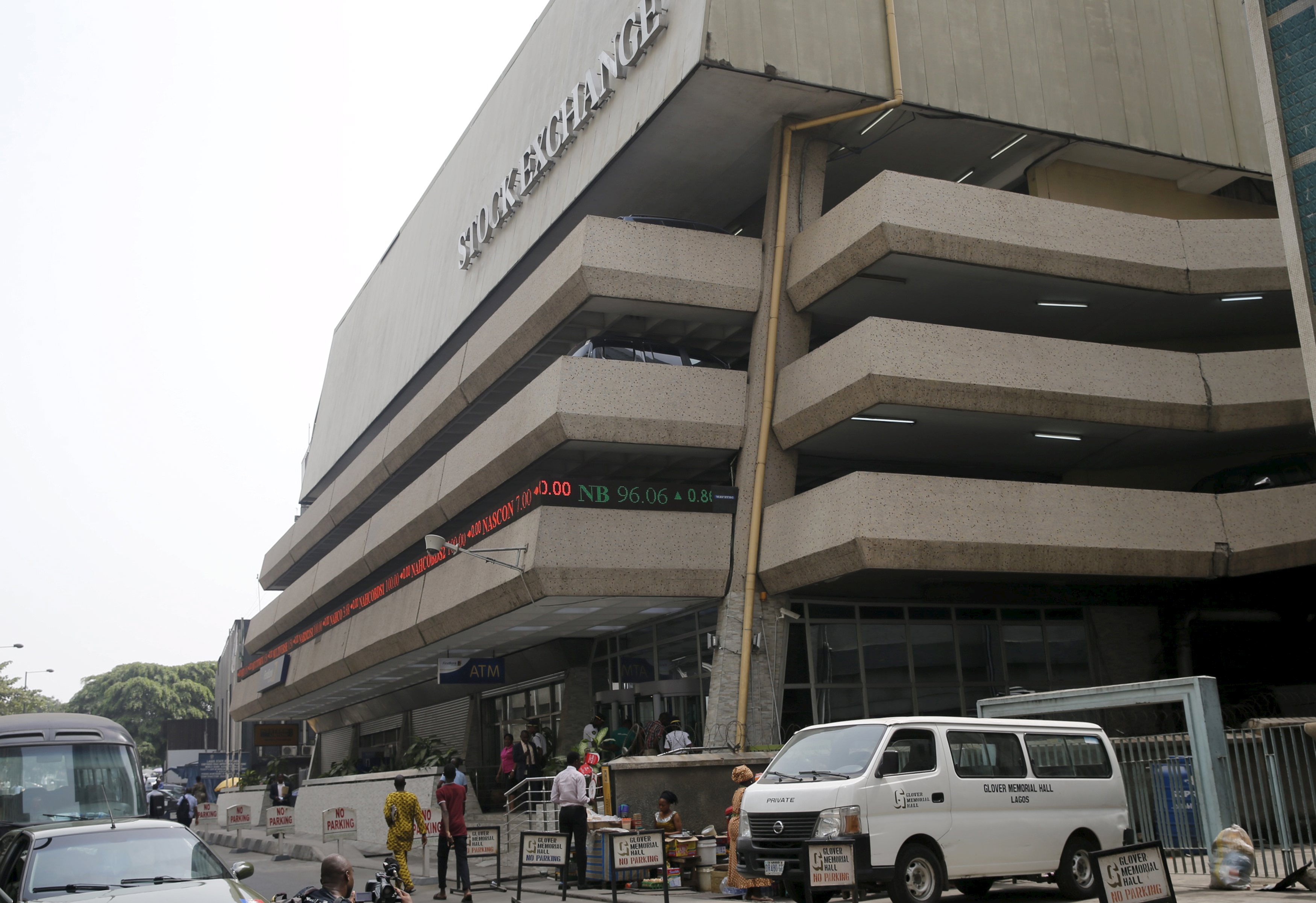
Customs Street Nigerian Stock Exchange

By Dipo Olowookere

The stock market in Nigeria was flat on Tuesday as investors decided to embark on cautious trading with a mix of profit-taking and bargain hunting.

Business Post observed that investors cherrypicked some stocks trading at cheap prices in the banking and consumer goods sectors, leading the duo to close higher by 0.37 per cent and 0.31 per cent respectively.

However, energy and insurance counters came under selling pressure, causing them to depreciate by 0.04 per cent and 0.01 per cent respectively, while the industrial goods index was in stalemate.

At the close of transactions, the benchmark market indicators, the All-Share Index (ASI) and the market capitalisation were barely unchanged.

The NGX Index closed at 37,857.24 points compared with the previous 37,857.89 points, while the market cap finished at N19.724 trillion in contrast to N19.725 trillion of the preceding session.

The activity level was mixed yesterday as the trading volume increased by 5.36 per cent to 197.3 million units from 187.2 million units, while the trading value decreased by 33.54 per cent to N1.9 billion from N2.9 billion, with the number of deals dropping 11.20 per cent to 3,567 deals from 4,017 deals.

Wema Bank was the darling of stock traders at the Nigerian exchange as it transacted 37.2 million units valued at N28.1 million. GTCO traded 27.9 million shares worth N823.2 million, UPDC transacted 13.9 million stocks worth N19.6 million, Fidelity Bank exchanged 12.2 million equities for N28.4 million, while UBA traded 9.6 million shares valued at N72.2 million.

On the price movement chart, there were 17 price gainers at the close of transactions on Tuesday and 13 price losers.

The highest price gainer was NCR Nigeria, which added 9.64 per cent to its share price to settle at N2.73 and was followed by Wema Bank, which gained 9.46 per cent to trade at 81 kobo.

FTN Cocoa appreciated by 8.33 per cent to trade at 39 kobo, NPF Microfinance Bank rose by 6.87 per cent to N1.71, while Lasaco Assurance grew by 6.67 per cent to N1.60.

Conversely, the highest price loser of the session was Ikeja Hotel, which depreciated by 9.09 per cent to sell for N1.40 and then trailed by Custodian Investment, which lost 6.15 per cent to trade at N6.10.

Japaul depreciated by 5.66 per cent to 50 kobo, Mutual Benefits Assurance went down by 4.76 per cent to 40 kobo, while FBN Holdings dropped 4.00 per cent to quote at N7.20.


Dipo Olowookere is a journalist based in Nigeria that has passion for reporting business news stories. At his leisure time, he watches football and supports 3SC of Ibadan. Mr Olowookere can be reached via [email protected]

Advertisement
Click to comment

Leave a Reply

Your email address will not be published. Required fields are marked *

Economy

NECA DG Warns of Growing Pressure on Businesses, Households

Published

on

NECA Adewale Smatt-Oyerinde

By Aduragbemi Omiyale

The Director General of the Nigeria Employers’ Consultative Association (NECA), Mr Adewale-Smatt Oyerinde, has run to the rooftop to warn of the negative impact of rising crude oil prices on businesses and households in the country.

In a statement on Monday, he said the Middle East crisis was pushing up domestic energy costs, placing pressure on businesses and eroding the purchasing power of citizens, warning that without urgent intervention, the situation could escalate.

According to him, fuel prices have risen sharply in recent days, with petrol exceeding N1,300 per litre in some locations and diesel approaching N1,800 per litre, reflecting the impact of global oil price movements.

He stressed that energy costs sit at the heart of Nigeria’s economy, and energy is the engine of production and distribution, noting that businesses, particularly in manufacturing, agriculture, and logistics, are already under significant pressure. “What we are witnessing is Nigeria’s oil paradox. Rising crude oil prices are pushing up domestic energy costs, squeezing businesses and worsening the cost of living for citizens.

“Once fuel prices rise, the effects are immediate and widespread: transport costs increase, food prices rise, and the overall cost of doing business escalates.

“For many firms that rely on diesel for operations, current price levels are becoming increasingly difficult to sustain. Profit margins are shrinking, and businesses are being forced to either pass on costs or scale down operations,” Mr Oyerinde stated.

The NECA DG further noted that global oil prices have surged amid geopolitical tensions, with Brent crude rising above $110 per barrel, intensifying cost pressures across energy markets.

He clarified that while the Middle East conflict has contributed to the rise in oil prices, the impact is exposing deeper structural weaknesses, underinvestment, weak infrastructure, and inefficiencies in Nigeria’s energy value chain.

“This situation is not only driven by external factors, but it is also reflecting ongoing constraints within the energy value chain, including supply inefficiencies and infrastructure limitations,” he disclosed.

“The government must act swiftly to ease supply constraints, stabilise prices, and provide targeted relief to critical sectors, he declared, emphasising that, “If this trend continues unchecked, we risk business closures, job losses, and a deeper cost-of-living crisis.”

On the long-term outlook, Mr Oyerinde emphasised the need for structural reforms. Nigeria’s resilience will not be determined by oil prices, but by how effectively we manage them. This is a moment to strengthen institutions, improve transparency, and invest in sustainable energy solutions.

He concluded with a caution that if properly managed, “this could strengthen our economy. If not, the gains from rising oil prices will be completely eroded by inflation and economic hardship.”

Continue Reading

Economy

NAICOM Rules Out Extension of July 31 Recapitalisation Deadline

Published

on

NAICOM

By Adedapo Adesanya

The National Insurance Commission (NAICOM) has stressed that it has no intention of extending the deadline of the ongoing insurance recapitalisation exercise fixed for July 31, 2026.

The Commissioner for Insurance, Mr Olusegun Omosehin, at a high-level media briefing in Lagos, emphasised that “The 31 July deadline is sacrosanct.”

Mr Omosehin rationalised that NAICOM said it was not worried by the sluggishness of some underwriting companies towards the exercise.

“It is embedded in the law, and as a regulator, we do not have the powers to alter a date set by an Act of the National Assembly,” he explained, noting that the timeline is a statutory requirement under the Nigeria Insurance Industry Reform Act of 2025.

“We would not be drawn into a last-minute rush or entertain pleas for extensions,” Mr Omosehin warned, adding that any adjustment to the schedule would require a formal amendment of the Act by the National Assembly and subsequent presidential assent, a path he stated the commission is not prepared to take.

He further noted that while 20 insurance companies have officially stepped forward to begin their capital verification process, the level of urgency across the board does not match the requirements of the law.

“We want a stronger, more resilient industry that can support Nigeria’s target of a $1tn economy,” the Commissioner added, stressing that the ultimate goal is not just capital but the capability to underwrite large risks and protect policyholders.

“Capital alone is not the goal; it is about the capability to underwrite large risks,” he reiterated, while urging operators who may lack the “stand-alone stamina” to meet the new requirements to consider mergers and acquisitions immediately rather than waiting.

“We warn against ‘emergency marriages’ concluded at the eleventh hour, as such ad hoc arrangements often lead to lingering liabilities and post-merger integration crises,” Mr Omosehin said.

The NAICOM chief also confirmed that the regulator is currently scanning all operating firms and will soon make the results of this regulatory assessment public.

While re-emphasising the July 31 deadline, he warned that all funds raised must be deposited in designated escrow accounts.

Continue Reading

Economy

BudgIT Raises Alarm Over Poor Transparency in Nigeria’s Local Government Budgets

Published

on

BudgIT 40-year bonds

By Adedapo Adesanya

Governance transparency platform, BudgIT, has expressed worry that only 10 states provided publicly accessible budget information for their Local Government Areas (LGAs).

The report, titled The Missing Tier: Mapping Local Government Budget Transparency in Nigeria, found that while six states offer partial or outdated disclosures, as many as 18 states do not publish any LGA budget data at all.

Despite the existence of these budgets at council secretariats nationwide, BudgIT noted that access remains largely restricted, particularly online.

“For most of Nigeria’s 774 local governments, those budgets are not publicly accessible online,” the report stated.

Among the states assessed, Ekiti emerged as the top performer, with a comprehensive system that includes detailed, up-to-date budget documentation for its councils.

Other states identified as making LGA budget information available include Ebonyi, Osun, Kebbi, Kogi, Enugu, Kaduna and Yobe.

However, the report cautioned that even among these states, data quality remains inconsistent, with several budgets either incomplete, outdated, or poorly structured.

BudgIT highlighted notable examples of improved accountability practices.

Ekiti State, for instance, publishes individual 2026 budgets for all its LGAs and LCDAs, accompanied by signed documents, consultation records, and standardised financial templates.

Cross River State also stood out for releasing individual council budgets, audited accounts, and quarterly performance reports.

Similarly, Borno State was commended for maintaining a consolidated 2025 budget alongside supporting financial documents, suggesting a structured and functional reporting system.

The report identified six states with limited transparency, providing only fragmented or outdated information.

Kano State, for example, publishes quarterly performance reports but lacks full-year approved budgets.

In Imo State, no LGA budgets were found, although a financial statement from the Accountant-General was available.

Ondo State reportedly released documents for only a portion of its LGAs, while Anambra published an appropriation law without detailed breakdowns. Ogun State, meanwhile, only provided data for 2024.

BudgIT further disclosed that a large number of states fail entirely to make LGA budgets public.

These include Abia, Adamawa, Akwa Ibom, Bauchi, Bayelsa, Benue, Delta, Edo, Gombe, Jigawa, Katsina, Lagos, Nasarawa, Niger, Oyo, Plateau, Rivers, Sokoto, Taraba, and Zamfara.

According to the organisation, the issue is not the absence of budget documents but the lack of public access to them.

“Yet for most of Nigeria’s 774 local governments, those budgets are not publicly accessible online,” the civic tech firm said.

BudgIT stressed that improving transparency at the local government level does not require complex reforms but rather a deliberate policy decision.

“Since state governments already publish their own budgets online, extending the same standard to local councils is neither complex nor costly; it is a matter of institutional choice,” the organisation said.

It added, “This choice is a critical one; Nigeria’s post-1999 experience with democracy has not had Local Governments with significant autonomy. Be that as it may, LGAs still have the opportunity to make public what they budget, what they spend and what they earn.”

Highlighting the benefits of openness, the report noted that transparency enables citizens to track public spending and hold officials accountable.

“Where they are withheld, accountability stops at the state level, leaving the tier closest to citizens financially opaque,” BudgIT said.

Continue Reading

Trending