Connect with us

Health

WHO Trains Health Workers In Borno State

Published

on

health-workers-in-borno

By Dipo Olowookere

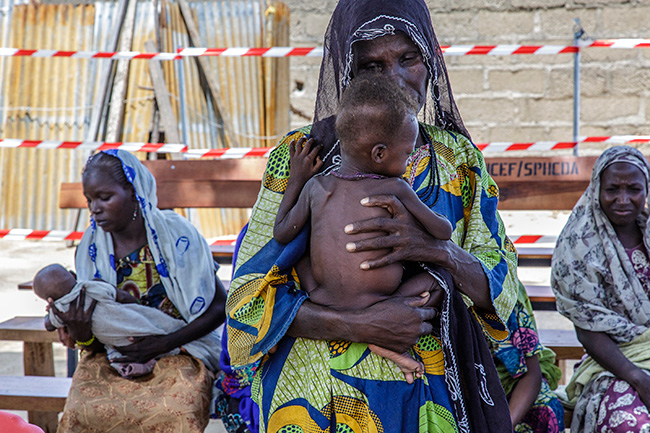
Health workers in Borno State have been trained by the World Health Organization (WHO) to provide lifesaving services.

WHO partnered with the Borno State Ministry of Health through the scaling-up Hard-to-Reach programme (HTR) to train 36 health workers as part of teams to serve people in prioritized difficult to access areas in six local government areas of the state.

According to Dr Abubakar Hassan, Permanent Secretary, Borno State Ministry of Health (SMoH), the 36 trained health workers will constitute six HTR teams and be deployed to Dikwa, Mafa, Kukawa, Gwoza, Mongunu and Ngala LGAs to provide primary care outreach services to 748,991 population in need (PiN) and 289,612 children under five years of age.

“In a state faced with internal conflict and where access to internally displaced persons’(IDPs) and host communities is limited, ensuring that people have life-saving health services can be challenging,” Dr Hassan posited.

He noted that the programme “will boost basic health service delivery for the communities in the face of shortage of health workers, most of whom fled for safety during the heat of crisis while others were either abducted or killed,” Dr Hassan added.

The teams will be deployed to provide primary health care minimum service package that includes: routine immunization, deworming, vitamin A supplementation, nutrition screening and management of malnourished children, antenatal services and counselling for pregnant and nursing mothers on breastfeeding, care of sick children and key hygiene household practices, as well as treatment for minor illnesses and providing assistance for home-based delivery. The services will boost existing services currently provided by the HTR teams.

WHO country office in Nigeria is supporting the Federal Ministry Health to address issues of health inequities in underserved, recently liberated communities of Borno where polio immunity is low and health needs high”, Dr Rex Mpazanje, the acting WHO Country Representative observed.

He explained further that “though access for HTR teams is difficult and risky, the continued cooperation between the state ministry of health with the Civilian Joint Taskforce, the military, local communities, non-governmental organizations and United Nations agencies has made it possible to deliver essential health services to populations that are not reachable through fixed health services delivery points,”

Furthermore, Dr Mpazanje added, “the biggest challenge that WHO and other partners face in supporting the SMoH to deliver life-saving health services throughout the state is that of insecurity but the organization and partners remain keen on ensuring that all people in north-eastern Nigeria are reached with basic integrated health services including vaccination.”

HTR teams comprise six health workers trained to deliver outreach basic primary health care services to populations living in difficult to access areas or among the underserved populations. WHO has until now been supporting 18 HTR teams to provide outreach health services to internally displaced or host populations’ hard-to-reach locations five times per week. With this training, the number of HTR teams supported by WHO will now increase to 24.

The HTR programme owes its success to strong commitment by the government of Borno state, and the strong partnership in existence with other health partners. The expansion of the project is in sync with objectives of WHO’s polio and humanitarian programmes of increasing vaccination coverage and saving lives in an acute humanitarian health emergency.


Dipo Olowookere is a journalist based in Nigeria that has passion for reporting business news stories. At his leisure time, he watches football and supports 3SC of Ibadan. Mr Olowookere can be reached via [email protected]

Click to comment

Leave a Reply

Your email address will not be published. Required fields are marked *

Health

Tinubu Chooses Obi Adigwe Coordinator of Health Tech Data Analytics Office

Published

on

obi adigwe

By Modupe Gbadeyanka

Dr Obi Adigwe has been appointed as the pioneer National Coordinator of the National Health Technology and Data Analytics Office (NHTDAO).

The body was created by the Ministry of Health under the approval of President Bola Tinubu.

NHTDAO will be domiciled in the Office of the Coordinating Minister of Health and Social Welfare, a statement on Friday by the Special Adviser to the President on Information and Strategy, Mr Bayo Onanuga, stated.

The agency will serve as a meta-level national platform for coordinating the country’s digital-health agenda. It will reinforce, not replace, the existing statutory functions of relevant departments and agencies, it was emphasised.

The organisation will also harmonise and empower the public and private institutions across the health system, set the standards that connect them, and operationalise the National Digital Health Architecture, approved by the National Council on Health in November 2025.

It was stated that President Tinubu expects NHTDAO to accelerate Nigeria’s transition to a secure, interoperable and data-driven health system that improves outcomes for all citizens.

Mr Adigwe, as Director General of the National Institute for Pharmaceutical Research and Development, has leveraged science to catalyse interventions in artificial intelligence, translational research, and technology transfer.

He coordinated major projects, including the ¥300m Nanotechnology grant and the AFREXIMBank grant for Africa’s first API Training Facility. He led the roadmap development that underpinned an €18 million EU grant, the largest in Africa for the thematic area. During the last pandemic, Adigwe globally showcased African science by undertaking the world’s first analysis to debunk claims about the Covid Organics preparation.

The Office’s Steering Committee, which provides strategic direction and oversight, comprises:

  • Professor Muhammad Ali Pate, Coordinating Minister of Health and Social Welfare (Co-chair)
  • Mr Olaniyi Yusuf, Chairman of the Nigerian Economic Summit Group (Co-chair)
  • Dr Iziaq Adekunle Salako, Minister of State for Health and Social Welfare (Alternate Co-chair)
  • Ms Kachollom Daju, Permanent Secretary, Federal Ministry of Health and Social Welfare
  • Mr Idris Alubankudi Saliu, Special Adviser to the President on Technology and Digital Economy
  • Dr Muntaqa Umar-Sadiq, National Coordinator, SWAp Coordination Office
  • Dr Abdu Mukhtar, National Coordinator, Presidential Initiative to Unlock Healthcare Value Chain
  • Dr Muyi Aina, Executive Director, National Primary Health Care Development Agency
  • Dr Kelechi Ohiri, Director General, National Health Insurance Authority
  • Director, Health Planning, Research and Statistics, Ministry of Health and Social Welfare
  • National Information Technology Development Agency Representative
  • Six representatives of the State Commissioners of Health, one from each of the six geopolitical zones
  • Pharm Hamza Buhari, Stakeholder representing Industry and Community.
Continue Reading

Health

Lagos Commences Screening of Newborns for Sickle Cell Disease

Published

on

sickle cell disease screening Lagos

By Modupe Gbadeyanka

The Lagos State government has kicked off an initiative to ensure that every newborn is screened for Sickle Cell Disease within 48 to 72 hours after birth using a simple heel-prick test.

It was gathered that babies identified as being at risk will immediately be placed on preventive care while awaiting confirmatory testing.

The Head of the Haematology Department at the Alimosho General Hospital, Dr Olubukola Orolu, revealed that an estimated 150,000 babies are born annually with Sickle Cell Disease in Nigeria, giving the country one of the highest SCD burdens globally.

She, however, applauded the Lagos State Government and the Clinton Health Access Initiative (CHAI) for introducing the state-wide newborn screening programme, describing it as a major step towards reducing childhood deaths associated with the disease.

The commencement of this scheme coincides with the 2026 World Sickle Cell Day, themed Young Voices Rising for Sickle Cell Disease – Closing the Survival Gap: Equity in Sickle Cell Disease.

It highlights the importance of listening to the experiences and aspirations of young people living with Sickle Cell Disease.

Mrs Orolu noted that SCD warriors are increasingly breaking barriers as advocates, leaders, students and change-makers, adding that their voices have continued to reshape the narrative through advocacy for equitable, patient-centred healthcare, self-care and experience sharing.

She, therefore, called for equal access to quality healthcare, survival opportunities and dignity for everyone living with Sickle Cell Disease.

Also commenting, the chief executive of Alimosho General Hospital, Dr Akinyele Akinlade, described Sickle Cell Disease as an inherited blood disorder that is not contagious, noting that individuals living with the condition are more susceptible to infections.

He advised SCD warriors to stay well hydrated, avoid stress, and protect themselves from extreme cold or heat, as these are common triggers of sickle cell crises, adding that these preventive measures can significantly reduce the frequency and severity of crises.

One of the participants, Ms Borokini Zainab, an SCD warrior and student nurse, expressed appreciation to the organisers for the enlightenment programme.

Sharing her personal journey, she spoke about the challenges of balancing recurrent pain crises with her academic pursuits and personal life. Despite moments of frustration, she encouraged fellow warriors not to lose hope.

“Don’t let sickle cell put you down. Be encouraged from within. Don’t let your dreams be shattered because of this,” she said, adding that her personal experience with Sickle Cell Disease inspired her to pursue a career in nursing so she could support others living with the condition.

Continue Reading

Health

Evon Labs Unveils Health-Tech Incubation Initiative HealthX Catalyst

Published

on

Evon Labs Isioma Udeozo HealthX Catalyst

By Aduragbemi Omiyale

A 12-week health-tech incubation programme tailored for early-stage founders in Nigeria has been introduced by an innovation and venture-building platform, Evon Labs.

This initiative, known as HealthX Catalyst, will help participants to create scalable, investable solutions for Africa’s urgent healthcare issues.

The programme is underway, with 12 selected founders nearing the final weeks of intensive incubation, ending with a Demo Day on June 24, 2026, at the UNDP innovation centre in Lagos, where the small business owners will present their solutions to an audience of investors, healthcare leaders, development organisations, and technology partners.

The initiative selects early-stage healthcare founders and immerses them in a structured 12-week development process. Throughout this period, participants receive personalised and group mentorship from seasoned professionals across the healthcare, technology, and business sectors.

They also receive structured support for startup development, including refining business models, developing value propositions, and validating markets.

Additionally, participants gain access to a network of healthcare practitioners, sector experts, and industry leaders, along with targeted investment-readiness assistance to prepare them to engage with investors and strategic partners after the programme.

The result is a cohort of founders who move through the programme not simply with a refined pitch, but with a validated business model, a stronger professional network, and a clear pathway to growth.

To accelerate the most promising solutions beyond the programme, monetary grants will be awarded to the top three founders to support product development, pilot implementation, market validation, and early-stage scaling.

It was learned that HealthX Catalyst was developed in response to a structural gap in the African health-tech ecosystem.

Across the continent, a growing number of entrepreneurs are building solutions to healthcare problems from access and diagnostics to service delivery and health data infrastructure. Yet many of these early-stage ideas fail to progress beyond concept, not for lack of vision, but for lack of structured support: mentorship, startup development frameworks, industry access, and early-stage funding pathways. HealthX Catalyst was built to provide exactly that.

“Africa does not have a shortage of healthcare innovators. What it has lacked is the infrastructure to turn its ideas into sustainable businesses. HealthX Catalyst is that infrastructure, a serious, structured programme designed to take founders from early-stage ideas to investable startups.

“What we are seeing from this first cohort is exactly what we set out to create: founders who are not just building products, but building businesses that can scale and create lasting impact,” the founder of Evon Labs, Ms Isioma Udeozo, said of the unveiling of HealthX Catalyst.

The partners of the programme are the United Nations Development Programme (UNDP), Odua Investment Company Limited (OICL), Washington University of St Louis, Missouri, Lagos State Employment Trust Fund (LSETF), and Brooks Insights.

Continue Reading

Trending