Connect with us

Health

WHO Trains Health Workers In Borno State

Published

on

health-workers-in-borno

By Dipo Olowookere

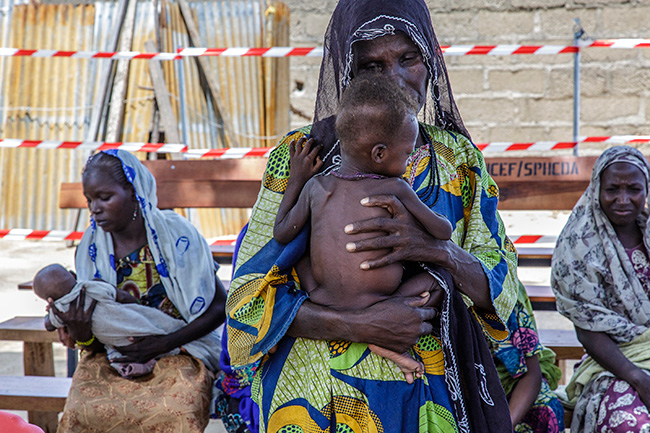
Health workers in Borno State have been trained by the World Health Organization (WHO) to provide lifesaving services.

WHO partnered with the Borno State Ministry of Health through the scaling-up Hard-to-Reach programme (HTR) to train 36 health workers as part of teams to serve people in prioritized difficult to access areas in six local government areas of the state.

According to Dr Abubakar Hassan, Permanent Secretary, Borno State Ministry of Health (SMoH), the 36 trained health workers will constitute six HTR teams and be deployed to Dikwa, Mafa, Kukawa, Gwoza, Mongunu and Ngala LGAs to provide primary care outreach services to 748,991 population in need (PiN) and 289,612 children under five years of age.

“In a state faced with internal conflict and where access to internally displaced persons’(IDPs) and host communities is limited, ensuring that people have life-saving health services can be challenging,” Dr Hassan posited.

He noted that the programme “will boost basic health service delivery for the communities in the face of shortage of health workers, most of whom fled for safety during the heat of crisis while others were either abducted or killed,” Dr Hassan added.

The teams will be deployed to provide primary health care minimum service package that includes: routine immunization, deworming, vitamin A supplementation, nutrition screening and management of malnourished children, antenatal services and counselling for pregnant and nursing mothers on breastfeeding, care of sick children and key hygiene household practices, as well as treatment for minor illnesses and providing assistance for home-based delivery. The services will boost existing services currently provided by the HTR teams.

WHO country office in Nigeria is supporting the Federal Ministry Health to address issues of health inequities in underserved, recently liberated communities of Borno where polio immunity is low and health needs high”, Dr Rex Mpazanje, the acting WHO Country Representative observed.

He explained further that “though access for HTR teams is difficult and risky, the continued cooperation between the state ministry of health with the Civilian Joint Taskforce, the military, local communities, non-governmental organizations and United Nations agencies has made it possible to deliver essential health services to populations that are not reachable through fixed health services delivery points,”

Furthermore, Dr Mpazanje added, “the biggest challenge that WHO and other partners face in supporting the SMoH to deliver life-saving health services throughout the state is that of insecurity but the organization and partners remain keen on ensuring that all people in north-eastern Nigeria are reached with basic integrated health services including vaccination.”

HTR teams comprise six health workers trained to deliver outreach basic primary health care services to populations living in difficult to access areas or among the underserved populations. WHO has until now been supporting 18 HTR teams to provide outreach health services to internally displaced or host populations’ hard-to-reach locations five times per week. With this training, the number of HTR teams supported by WHO will now increase to 24.

The HTR programme owes its success to strong commitment by the government of Borno state, and the strong partnership in existence with other health partners. The expansion of the project is in sync with objectives of WHO’s polio and humanitarian programmes of increasing vaccination coverage and saving lives in an acute humanitarian health emergency.


Dipo Olowookere is a journalist based in Nigeria that has passion for reporting business news stories. At his leisure time, he watches football and supports 3SC of Ibadan. Mr Olowookere can be reached via [email protected]

Click to comment

Leave a Reply

Your email address will not be published. Required fields are marked *

Health

NHIA Says 22 million Nigerians Now Have Health Insurance Coverage

Published

on

National Health Insurance Authority NHIA Health Insurance Coverage

By Adedapo Adesanya

The National Health Insurance Authority (NHIA) says the number of Nigerians enrolled in health insurance has risen to more than 22 million.

The Director-General of NHIA, Mr Kelechi Ohiri, said this resulted from the implementation of the mandatory health insurance, which has gained momentum nationwide.

He said this on Wednesday at the Annual General Meeting of the Nigerian Association of Insurance and Pension Editors (NAIPE) in Lagos.

Mr Ohiri said enrolment had increased to 22.03 million, representing a 35 per cent year-on-year growth, attributing this to stronger collaboration with state social health insurance agencies, ministries, departments and agencies, organised labour, employers, the private sector, and the gradual implementation of the mandatory health insurance provisions of the NHIA Act.

He said that the country had moved beyond policy formulation to delivering measurable improvements in healthcare access, service quality and consumer protection in line with the federal government’s health sector reform agenda.

According to him, Nigeria already has the necessary policies and legislation to achieve Universal Health Coverage, positing that the key challenge was effective implementation.

“The decisive variable is now implementation- consistent, rigorous and accountable execution that converts political commitment into healthcare access for real Nigerians,” he said.

Mr Ohiri said that the transition from the former National Health Insurance Scheme to the NHIA had strengthened regulation, consumer protection, accountability and strategic purchasing, while providing the legal and operational framework for achieving Universal Health Coverage.

He added that improving the experience of enrollees remained central to the Authority’s reform agenda.

According to him, NHIA has strengthened its complaints management system, introduced faster resolution timelines, and intensified compliance monitoring of Health Maintenance Organisations (HMOs) and healthcare providers.

He further added that NHIA had sanctioned facilities that failed to meet the required standards, adding that his organisation had resolved 3,878 complaints, representing an 87 per cent resolution rate, while 95 per cent of the cases were concluded within prescribed timelines.

Mr Ohiri noted that more than N14.2 million had been refunded to enrollees, while non-compliant healthcare facilities had been sanctioned.

He said NHIA had also introduced service standards, including a one-hour treatment commencement target for enrollees requiring urgent care, to improve access to timely and quality healthcare services.

The NHIA boss further disclosed that capitation payments to healthcare providers had been increased by 93 per cent.

He said fee-for-service reimbursements rose by 378 per cent to enable providers to invest more in personnel, equipment and infrastructure.

According to him, 7,592 healthcare facilities have been assessed under the SafeCare quality framework as part of efforts to institutionalise continuous quality improvement across the country.

Mr Ohiri also highlighted interventions targeted at vulnerable groups, including support for more than 48,500 pregnant women, expanded maternal and newborn healthcare services, the Vulnerable Group Fund, and improved access to healthcare for pensioners and retirees.

He said Universal Health Coverage could only be achieved if every Nigerian, regardless of income or location, had access to quality healthcare services.

Continue Reading

Health

SUNU Health Backs NHIA’s One-Hour Authorisation Policy

Published

on

One-Hour Authorisation Policy

By Modupe Gbadeyanka

The new one-hour authorisation response time ultimatum policy introduced by the National Health Insurance Authority (NHIA) has received the full backing of SUNU Health Nigeria Limited.

This policy was introduced by the agency to ensure enrollees get prompt approval codes to access care.

Healthcare service providers have been urged to report any Health Maintenance Organisation (HMO) that violates this initiative through an email, with the HMO in copy and a timestamp attached as evidence of the request. They may proceed to offer services to enrollees thereafter.

Speaking at the company’s second-quarter Providers’ Forum for the Lagos-Ogun region in Lagos recently, the chief executive of SUNU Health, Dr Moyosore Olomola, expressed optimism that this policy would improve healthcare delivery in the country, especially for enrollees, who crave quality service.

At the event themed Improving Quality and Access to Care Through Stronger Provider Network, and held at the Nigerian Institute of Medical Research (NIMR) in Yaba, Lagos, Mr Olomola reaffirmed the HMO’s commitment to operating within legal and operational frameworks to guarantee adequate care for enrollees.

“Access to care and quality of care remain key priorities in our healthcare systems. We know quite well that deliberate collaboration, strategic partnerships, and a shared commitment to excellence are required to achieve these priorities.

“A strong provider network is doubtless the backbone of any effective healthcare system. It ensures that our mutual enrollees receive the right care, at the right time, in the right place, and at the right price,” Mr Olomola, represented at the programme by the organisation’s Chief Operating Officer (COO), Dr Faith Nwachi, stated.

He further assured that SUNU Health would strictly adhere to the one-hour authorisation limit, stressing that this aligns seamlessly with one of the organisation’s core values—promptness and its corporate slogan, Humanity is the centre of our initiatives.

In a bid to further improve access and quality of care, SUNU Health also demonstrated its new operational software and Mobile app, aptly named SUNU Legacy.

Also speaking at the event, the NHIA Lagos State Coordinator (Ikeja), Dr Bethuel-Kasimu Abraham, noted that the forum’s expected outcome is to significantly reduce delays in accessing medical care.

Other key expectations include ensuring continuity of care, improving patient outcomes, and strengthening accountability among HMOs.

Addressing specific pain points faced by enrollees, the NHIA Ogun State Coordinator, Mr Dare Adefeso, acknowledged that the agency had received complaints regarding out-of-stock drugs and the discrimination of enrollees by certain providers.

He affirmed that the NHIA is actively addressing these issues, stressing that moving forward, every facility must ensure enrollees are properly catered to regardless of their status, provided they have an active health insurance plan.

Corroborating the long-standing legacy of SUNU Health, the Ogun State Director of the National Orientation Agency (NOA), Mrs Aishat Tiamiyu, shared that her agency is responsible for public information dissemination and has been enrolled with SUNU Health for over 25 years.

Commending the HMO’s stellar service over two decades, she called for the immediate enrollment of new NOA staff into the scheme.

The Providers’ Forum remains one of the strategic channels employed by SUNU Health to consistently engage healthcare providers, understand their operational challenges, introduce new software updates, and solidify partnerships aimed at fostering premium healthcare delivery across Nigeria.

Continue Reading

Health

NAFDAC Announces Recall of WAP Sensual Enhancement Capsules

Published

on

WAP Sensual Enhancement Capsules

By Aduragbemi Omiyale

The National Agency for Food and Drug Administration and Control (NAFDAC) has announced the recall of a sexual enhancement product known as WAP Sensual Enhancement Capsules.

In a statement on Monday, the Nigerian agency disclosed that the recall is due to “undeclared pharmaceutical ingredients” in the product, whose country of origin is unknown, but is marketed and distributed online in the US through eBay.

It was emphasised that the recall is being “voluntarily” made by the manufacturer, Best Supplements Best Prices Company.

The detection of the undeclared pharmaceutical ingredients was made by the US Food and Drug Administration (FDA).

Laboratory analysis by the US FDA revealed that the product contained undeclared sildenafil, tadalafil, and flibanserin, which were not mentioned on the product label. Such substances may include phosphodiesterase type-5 (PDE-5) inhibitors or related compounds commonly used for the treatment of erectile dysfunction, the statement by NAFDAC stated.

Sildenafil and tadalafil are ingredients in FDA-approved prescription drugs used to treat erectile dysfunction.

It was noted that these undeclared ingredients may interact with nitrates found in some prescription drugs, such as nitroglycerin, and may lower blood pressure to dangerous levels. Consumers with diabetes, high blood pressure, high cholesterol, or heart disease often take nitrates.

Flibanserin is the active ingredient in an FDA-approved prescription drug used to treat low sexual desire in women. Flibanserin can cause drowsiness, sedation, dangerously low blood pressure, and fainting, especially when combined with alcohol.

Consumers have been encouraged to report compromised products (medicines or medical devices) to the nearest NAFDAC office, call 0800-162-3322, or send an email to sf******@********ov.ng.

Continue Reading