Connect with us

General

Nigeria’s GBS Market at $286.8m, S/Africa at $4.7bn, Egypt at $4bn

Published

on

Africa GBS Market Report global business services

By Modupe Gbadeyanka

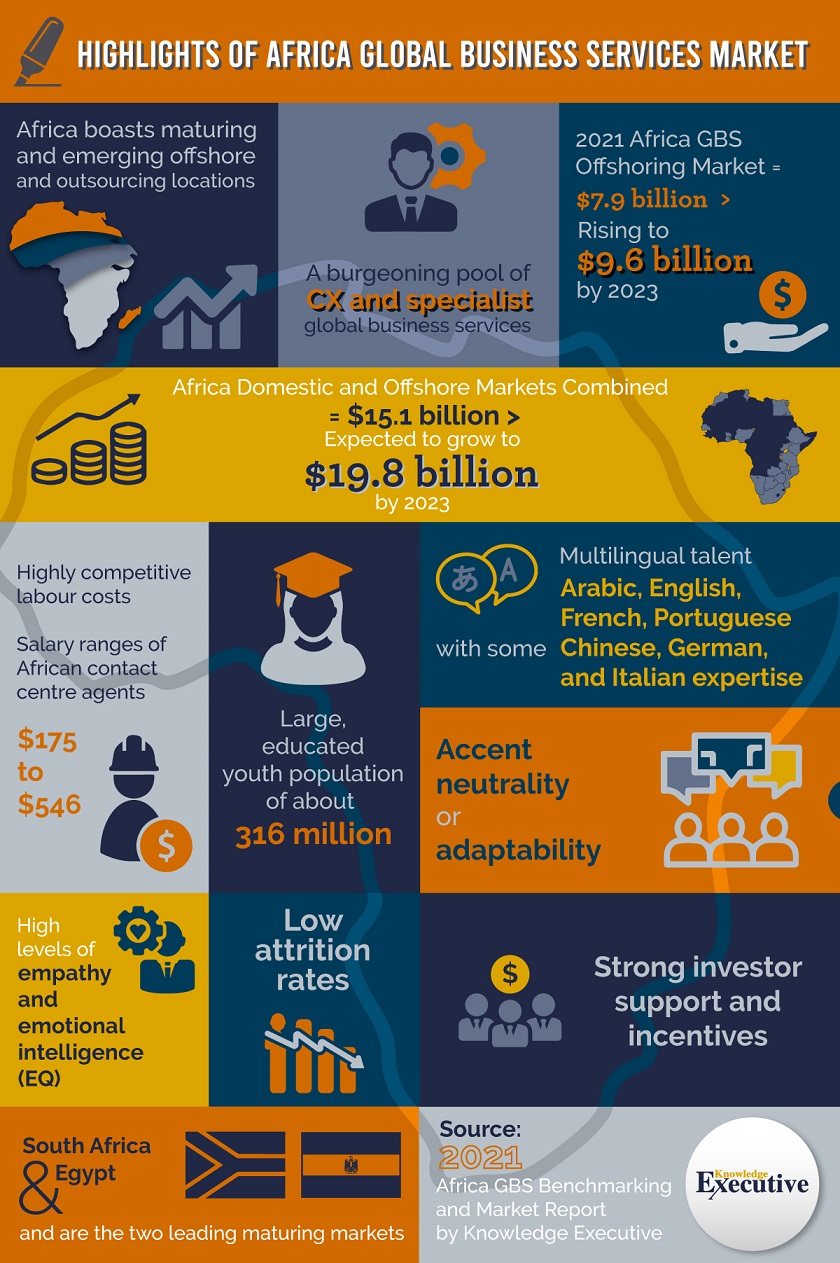
There are strong indications that in 2023, the global business services (GBS) market in Africa will worth $19.8 billion, higher than the current value, $15.1 billion.

According to the 2021 Africa GBS Benchmarking and Market Report by Knowledge Executive, the African continent will play a major part in the sector in the future because of its vast labour.

In the report, it was stated that business process outsourcing (BPO) and information technology outsourcing (ITO) are at the forefront of Africa’s rapid growth rates.

This growth, it said, is bolstered by multiple factors, including improved economic governance, relative political stability, an abundance of educated youth within the continent’s labour pool, comparatively lower salary and labour costs, in addition to focused efforts from African policymakers to support this crucial sector.

The report stated that the past year has accelerated outsourcing adoption to reduce costs and maintain revenue across the globe – and Africa has emerged as a significant beneficiary.

It was disclosed that the continent was in the developing stage of the GBS lifecycle, but already showing signs of global competitiveness and rapid maturity.

According to the report, South Africa is the continent’s largest GBS player by market share (domestic and international), valued at an estimated $4.7 billion.

The local sector employs over 261,082 domestic and international service workers from the country’s sizeable English-speaking workforce with competencies across most outsourcing services, including digitally-enabled contact centres and customer experience lifecycle management services. Surveyed enterprise executives rated the country best for contact centre voice, back-office processing and customer administration service delivery.

Egypt has the second largest domestic and international GBS market share on the continent, valued at $4 billion (excluding IT services).

The country offers a highly-skilled, multilingual, diverse talent pool, with competitive labour costs and the second-largest youth population in Africa (36.3 million citizens aged between 18-35 years). The native Arabic language also opens Egypt to the Arabic market of 300 million consumers.

Africa’s largest economy by GDP ($448 billion), Nigeria, boasts a well-established ICT sector – the largest on the continent.

This feature serves as an excellent foundation for developing the country’s GBS market, which is already valued at an estimated $286.8 million and employing approximately 16,540 workers.

Coupled with a focus on sector-specific skills and education, the country stands poised to take advantage of the largest population of English speakers in Africa and the highest number of youths aged between 18-35 years in Africa (53 million).

Smaller nations are also capitalising on this increasing international demand. Rwanda is an emerging GBS market with a large population of English and French speakers able to service English and Francophone countries. It offers reliable and advanced communications infrastructure with 95% LTE network coverage.

Botswana is another emerging GBS location. The country boasts macroeconomic stability and offers attractive investment incentives and a growing pool of educated, English-speaking workers.

Senegal has become a popular French alternative market for BPO services. Ghana boasts a scalable pool of English-speaking and computer literate talent and a growing youth population. Zimbabwe has bold GBS development plans based on its highly educated talent pool for niche services.

Investing and buying on the continent continues to be a venture filled with potential and undiscovered returns. And as more international businesses look to do so, insights such as those gleaned from the Africa GBS Benchmarking and Market Report will be invaluable in making informed decisions on outsourcing, co-sourcing or expansion.

The report said it got its findings from interviews with over 140 global enterprise executives from North America and European organisations that outsource, or plan to outsource, to Africa.

In addition, profiling surveys were conducted on over 500 GBS service providers and delivery centres across 19 African countries. These markets represent a mix of mature, emerging and nascent GBS locations in Africa that now serve as key locations for global and local investors and buyers.


Modupe Gbadeyanka is a fast-rising journalist with Business Post Nigeria. Her passion for journalism is amazing. She is willing to learn more with a view to becoming one of the best pen-pushers in Nigeria. Her role models are the duo of CNN's Richard Quest and Christiane Amanpour.

Advertisement
Click to comment

Leave a Reply

Your email address will not be published. Required fields are marked *

General

QNET’s Global Reach in 100+ Countries: What International Access Means for Local Distributors

Published

on

QNET

Global scale means market access and international supply chains. For individual distributors in direct selling, it can shape everything from product availability to income stability and long-term opportunity.

QNET, the multinational wellness and lifestyle direct selling company, positions its business model around that idea: connecting locally based independent distributors to an international operating platform. With activity spanning more than 100 countries, the company sits within a direct selling industry that, according to the World Federation of Direct Selling Associations (WFDSA), has stabilized after several relatively volatile post-pandemic years.

Global Reach Within a Stabilizing Industry

The WFDSA’s latest global report estimates worldwide direct selling retail sales at roughly $163.9 billion in 2024, essentially flat year over year. That flat performance, however, masks gradual improvement beneath the surface. Nearly half of reporting markets showed growth in 2024, and average market growth rates rebounded to positive territory.

The report estimates more than 104 million independent sales representatives globally in 2024, a figure that has remained largely stable year over year.

This stabilization sets a backdrop for companies like QNET. A global footprint is no longer about rapid expansion alone; it is increasingly tied to resilience: operating across regions with different economic cycles, consumer behaviors, and growth trajectories.

For distributors, this matters because opportunities extend beyond individual effort. They are often shaped by the health of the company’s broader channel and product reach.

A Platform Designed for Distributed Entrepreneurship

QNET’s model centers on local execution supported by centralized infrastructure. Products—ranging from nutritional supplements and wellness devices to home and lifestyle solutions—are sold through the company’s proprietary e-commerce platform. Independent distributors do not manage warehouses, shipment logistics, or customer service systems.

As Ramya Chandrasekaran, who heads communications at QNET, explained in a recent interview, the company views direct selling as a form of accessible “micro-entrepreneurship.” The idea is to reduce the operational burden typically associated with starting a business, allowing distributors to focus on product education, customer relationships, and market development.

Why Global Scale Changes the Distributor Equation

One practical benefit of international reach is product continuity. WFDSA data shows that wellness products account for roughly 29% of global direct selling sales, making it the largest category worldwide. In the Asia-Pacific region, the largest direct selling region by sales, wellness represents more than 40% of total category share.

QNET’s emphasis on wellness and lifestyle products places distributors in line with the strongest demand segments globally. Instead of relying on narrow local trends, distributors operate within product categories that have shown consistent global interest.

International scale also supports consistency in training, compensation structures, and digital tools. Distributors in different countries access identical back-end systems, tracking referrals, commissions, and orders through the same platform. This standardization reduces friction and uncertainty, particularly for individuals operating in markets where informal commerce is common.

Workforce Shifts

The WFDSA’s report highlights notable shifts in the global direct selling workforce. Women continue to make up more than 70% of participants worldwide, and representation among individuals aged 35 to 54 remains the largest cohort.

Independent Distributors increasingly value flexibility, long-term viability, and support systems that allow them to operate sustainably rather than aggressively scale. QNET’s emphasis on digital access, centralized operations, and gradual business building reflects those priorities.

For many participants, especially those balancing work with caregiving or other responsibilities, direct selling infrastructure offers a way to stay engaged at their own pace.

Training, Exposure, and Cross-Market Learning

QNET’s international conventions and training programs connect distributors across regions, creating informal networks for peer learning. Events that draw participants from dozens of countries expose distributors to varied approaches to sales, customer engagement, and market adaptation.

This mirrors one of WFDSA’s broader conclusions: direct selling increasingly functions as a global learning ecosystem, with companies providing tools and education that help individuals navigate uncertain economic conditions.

For distributors, exposure to cross-border experiences can recalibrate expectations, reinforcing that success often comes from steady engagement rather than rapid recruitment or short-term activity.

International Access, Interpreted Locally

Despite its global scale, QNET’s business ultimately plays out in local communities. Distributors adapt messaging around wellness, home quality, and lifestyle enhancement to cultural norms and household priorities. The international platform provides reach and structure, but relevance is built locally.

That balance, global systems supporting local relationships, defines much of modern direct selling. The WFDSA describes the industry not as a single growth story, but as a framework that can scale proportionally with economic conditions across regions.

For QNET distributors, international presence does not guarantee income or uniform outcomes. What it offers is access: to resilient product categories, standardized systems, training resources, and a global marketplace that extends beyond any single region. For local distributors navigating today’s uncertain global economic environment, that is an important foundation to maintain.

Continue Reading

General

FCCPC Unseals Ikeja Electric Headquarters

Published

on

Ikeja Electric

By Adedapo Adesanya

The Federal Competition and Consumer Protection Commission (FCCPC) has unsealed the headquarters of Ikeja Electric Plc in the Lagos State capital after a week under lock and key.

According to a statement on Friday, the electricity distribution company committed to a binding undertaking to comply with the remedial process following consumer rights violations.

The statement signed by Mr Ondaje Ijagwu, Director of Corporate Affairs at the commission, Ikeja Electric undertook to resolve all consumer complaints referred to it by the FCCPC within agreed timelines

The headquarters was earlier sealed on December 11, 2025, because Ikeja Electric allegedly failed to comply with a directive by the Nigerian Electricity Regulatory Commission (NERC) to unbundle a Maximum Demand account into 20 individual accounts for a customer who had been without power for over two and half years.

The FCCPC noted that following the resolution, any breach of the undertaking would expose it to renewed and escalated enforcement action under the Federal Competition and Consumer Protection Act.

Reacting, the Executive Vice Chairman and Chief Executive Officer of the FCCPC, Mr Tunji Bello, said the Commission’s intervention was necessary to enforce the provisions of the FCCPA (2018).

“Our responsibility is to ensure that consumers are treated fairly and that service providers comply with lawful decisions and directives. Enforcement is not an end in itself. Where compliance is achieved and credible commitments are made, the Commission will respond appropriately,” he said.

Clarifying further, Mr Bello said the outcome reflects the commission’s balanced approach to regulation.

“We intervene decisively where consumer harm persists, and we de-escalate where enforceable compliance is secured. What remains constant is our duty to protect consumers and uphold regulatory accountability,” he said.

Continue Reading

General

All On’s Clean Energy Access Transforms Over One Million Lives

Published

on

All On

By Modupe Gbadeyanka

The decision by a leading impact investment company focused on expanding clean energy access, All On, to support over 50 clean energy businesses and provide grants and technical assistance to more than 80 enterprises in Nigeria is already yielding positive results.

This is because the organisation’s Impact Evaluation Report indicated that more than one million lives have been transformed through clean energy access.

The report covered from 2018 t0 2024 and it was discovered that the interventions of All On enabled the connection of over 230,000 households, businesses, and public facilities to reliable energy solutions, while strengthening the operational capacity of energy providers and improving affordability and service reliability for end users.

Prior to the commencement of All On’s operations in 2016, nearly half of Nigeria’s population lacked access to electricity, and the sector faced an estimated 92 per cent annual funding gap.

In response, the group adopted a bold, risk-tolerant strategy—deploying catalytic capital, innovative financing instruments, and ecosystem-building initiatives to unlock private sector participation and drive progress toward universal energy access.

Central to these achievements is All On’s holistic support model, which combines rigorous, tailored due diligence, deep sector expertise, and active ecosystem engagement.

This approach has positioned All On as a trusted partner capable of delivering both commercial viability and systemic impact.

Flagship initiatives such as the Demand Aggregation for Renewable Technology (DART) programme have further amplified results by reducing procurement costs for supported businesses by up to 50 per cent, enabling developers to scale faster and pass cost savings on to consumers due to access to reliable, affordable, and sustainable energy solutions.

In the report, it was revealed that half of supported households reported improved air quality, enhanced safety, and reduced noise pollution, contributing to better health outcomes and improved quality of life, alongside measurable environmental benefits.

“This report confirms that our approach is delivering real results. By combining patient capital, technical assistance, and ecosystem support, we are enabling scalable and sustainable energy solutions for Nigeria’s unserved and underserved communities,” the chief executive of All On, Ms Caroline Eboumbou.

The company plans plans to scale proven models, strengthen local capacity, and expand its reach—particularly in underserved regions such as the Niger Delta.

“While the progress to date is encouraging, our work is far from done. As we look toward 2030, we remain committed to deepening our impact and creating even more meaningful connections across Nigeria,” Ms Eboumbou added.

Continue Reading

Trending