Connect with us

Economy

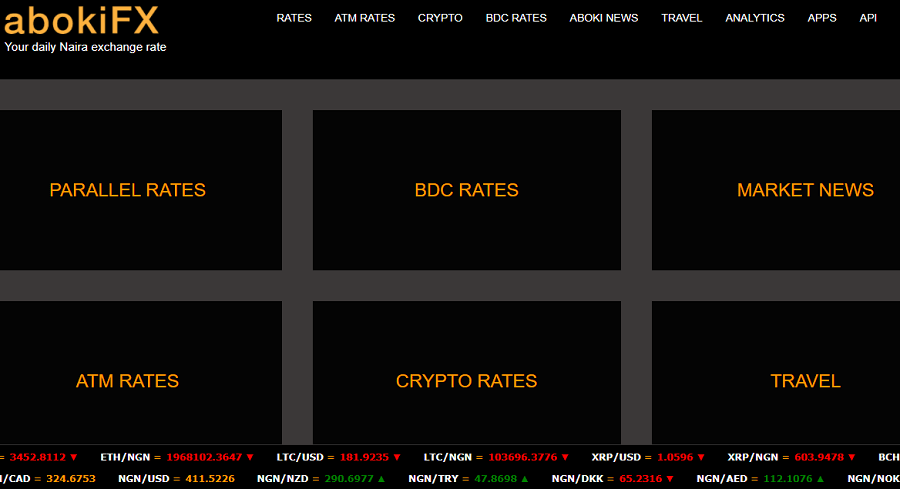
AbokiFX Suspends Parallel Market Exchange Rate Updates

Published

on

AbokiFX Suspends

By Dipo Olowookere

The popular website that tracks the exchange rate of the Naira to the major foreign currencies, AbokiFX, has announced the suspension of its updates pending when it gets a “better clarity” of the allegation of FX manipulations levelled against it by the Central Bank of Nigeria (CBN).

Governor of the CBN, Mr Godwin Emefiele, had insinuated on Friday that the platform was responsible for the recent fall of the local currency at the parallel market.

Mr Emefiele said it had been monitoring activities of the website for the past two years, alleging that its owner, Mr Oniwinde Olusegun Adedotun, was trading forex and manipulating figures to cause panic in the financial system, vowing to ensure he is prosecuted.

But in a statement issued on Friday, the platform said, “We do not trade FX neither (sic) do we have the power to manipulate the rates as we DO NOT CREATE the rates.”

It stressed that, “We ONLY publish what we source on the streets of Lagos, hence the phrase, Lagos Parallel Rates.”

AbokiFX explained that, “The rates sourced are carefully collated, reviewed and a mean rate is published from the data pool. This explains our three daily updates – * Morning, ** Midday, ***Evening.”

“Sometimes, rates come in late but we have to wait for the full set of rates before they are published, to prevent volatility of rates,” it further noted in the statement.

The website said, for now, it will not publish the parallel market rates but will keep updating its news and crypto rates sections until further notice.

“We sincerely hope this suspension will lead to the Naira appreciation from next week,” it stated, adding that, “With our decision to temporarily suspend online rate publication, we are aware that there will be limited visibility of parallel rates information, which will impact decision making for many.”

Below is the unedited statement from the firm;

AbokiFX has taken the decision today, the 17th of September 2021, to temporarily suspend rate updates on all our platforms, until we get better clarity of the situation.

Final rates have been posted this evening but the abokiFX news section and the Crypt° rates section will still be active.

WHO WE ARE

abokiFX was established in 2014 as a research and information service company, to conduct market research and gather data on the parallel market rates.

We also wanted to provide some transparency around the parallel market with the availability of information technology.

abokiFX purely provides benchmark parallel rate information which helps guide our users in almost 200 countries across the world.

abokiFX does NOT TRADE FX, which we have always maintained in our emails and social media platforms.

We do not Trade FX neither do we have the power to manipulate the rates as we DO NOT CREATE the rates.

We are the only entity in Nigeria that has a full set of parallel rates, right from our inception in 2014 when the exchange rate was trading at N166 to Sl.

We collated data for years before we started publishing, as we realised the demand increased for our historical data.

To most users of our platforms, we are just a parallel rates board but to many institutions, ranging frorn IVY league universities, to global businesses and research centres, we area keysource of data, especially, historical data (almost a decade’s worth of data on parallel rates).

Companies use our data for their internal and external audits as well as planning and budgeting.

We ONLY publish what we source on the streets of Lagos, hence the phrase, Lagos Parallel Rates. The rates sourced are carefully collated, reviewed and a mean rate is published from the data pool. This explains our three daily updates – * Morning, ** Midday, ***Evening.

Sometimes, rates come in late but we have to wait for the full set of rates before they are published, to prevent volatility of rates.

None of our data source providers know who we are or what their rates are being used for. This is to avoid any manipulation of rates.

Our staff have a daily routine of going to the market to gather rates, as all the BDCs in the country have their rates clearly displayed on their rates board and parallel market rate dealers give the information away freely.

All we do is collate all that information and display it on all our platforms daily.

REPLAY OF 2017 vs 2021

In 2017, Nigeria experienced an FX crises and the Naira depreciated to over N500/$1. abokiFX was accused of manipulating the parallel market rates.

Once liquidity was injected, the Naira appreciated and we published the appreciation which is basically what we do.

2021 has seen a similar scenario with the naira depreciating and we have published what we have been given, which has led some to believe we are manipulating the market. Yet no one can complain about our rates deviating +/- 2% from the parallel market rates when they patronise the dealers in the rnarket.

If we do not create the rates, how then can we control the rates. Our only sources of income have been our API and advert sales.

ALLEGATIONS AGAINST OUR DIRECTOR

All allegations against our director are yet to be confirrned but we at abokiFX DO NOT trade FX neither do we manipulate parallel rnarket rates.

Outside the media allegation, we have not received any communication from any government body and our accounts are not closed as stipulated in the media.

WAY FORWARD

abokiFX is fully functional BUT we will not be publishing any form of rates on our platforms for now. We sincerely hope this suspension will lead to the Naira appreciation from next week. With our decision to temporarily suspend online rate publication, we are aware that there will be limited visibility of parallel rates information which will impact decision making for rnany.


Dipo Olowookere is a journalist based in Nigeria that has passion for reporting business news stories. At his leisure time, he watches football and supports 3SC of Ibadan. Mr Olowookere can be reached via [email protected]

Advertisement
Click to comment

Leave a Reply

Your email address will not be published. Required fields are marked *

Economy

Naira Crashes to N1,378/$1 as FX Demand Outpaces Supply

Published

on

naira street value

By Adedapo Adesanya

The gradual fall of the Naira against the United States Dollar continued on Monday after it further lost N14.63 or 1.07 per cent to close at N1,378.02/$1 compared with the N1,363.39/$1 it was traded at last Friday at the Nigerian Autonomous Foreign Exchange Market (NAFEX). This was due to an insufficient supply of FX to meet the demand of customers at the currency market.

The Nigerian currency also depreciated against the Pound Sterling in the same market segment during the session by N9.65 to trade at N1,846.14/£1 compared with the previous trading day’s rate of N1,836.49/£1, and declined against the Euro by N3.76 to settle at N1,612.98/€1 versus the preceding session’s N1,609.22/€1.

In the same vein, the Nigerian Naira tumbled against the greenback in the black market yesterday by N5 to quote at N1,375/$1, in contrast to the previous value of N1,370/$1, as forex demand pressure gradually mounts.

The Central Bank of Nigeria (CBN) sold $200 million to boost the supply side and moderate demand pressures. For February, the CBN operated on both sides of the market, selling $225 million and purchasing $261.80 million. However, as FX demand continued to outpace available supply, pressure mounted further in the market.

Meanwhile, the research subsidiary of Coronation Merchant Bank said FX liquidity improved significantly last week. Total FX inflows into the official window rose to $1.07 billion from $648.20 million in the prior week.

Analysts maintain that the exchange rate is still trading within its projected N1,350 to N1,450 per Dollar band, dismissing panic concerns.

Meanwhile, the cryptocurrency market was bullish on Monday after macro shocks triggered repositioning across markets, and digital currencies benefited as some investors rotated back into risk.

After weeks of US military buildup and deadlocked nuclear diplomacy, the war with Iran increases the danger of a wider regional confrontation in a strategically vital economic corridor, adding to the risk gains for the market.

Ethereum (ETH) gained 5.5 per cent to trade at $2,050.07, Solana (SOL) appreciated by 5.2 per cent to $87.76, Bitcoin (BTC) added 4.9 per cent to sell for $69,322.35, Binance Coin (BNB) rose 3.2 per cent to $637.94, and Litecoin (LTC) expanded by 3.0 per cent to $52.39.

Further, Ripple (XRP) jumped 2.9 per cent to $1.40, Cardano (ADA) improved by 2.1 per cent to $0.2801, and Dogecoin (DOGE) increased by 1.9 per cent to $0.0946, while the US Dollar Tether (USDT) and the US Dollar Coin (USDC) remained unchanged at $1.00 apiece.

Continue Reading

Economy

Oil Prices Surge as Strait of Hormuz Traffic Freezes Amid Iran-Israel Row

Published

on

crude oil prices

By Adedapo Adesanya

Oil prices surged 8 per cent on Monday as Israel and US strikes on Iran and retaliation by the Islamic Republic forced shutdowns of oil and gas facilities across the Middle East and disrupted shipping in the crucial Strait of Hormuz.

Brent crude rose 8.7 per cent or $6.36 to trade at $79.23 per barrel, while the US West Texas Intermediate (WTI) crude expanded by $7.8 per cent or 5.27 per cent to $72.29 per barrel.

Oil’s surge on the restart of trading after the weekend, however, was smaller than expected. On Sunday, some analysts had predicted oil would open above $90 a barrel and closer to $100.

The widening Iranian conflict is disrupting oil flows to several Asian countries as vessels are bottled up within the Middle East Gulf, and crude and transport costs are rising.

US President Donald Trump signalled the US-Israel military assault could continue for weeks, which could mean a prolonged disruption of traffic through the Strait of Hormuz, through which around 20 per cent of global oil output and a similar share of liquefied natural gas transits via ships from Middle East producers.

On Monday, Saudi Arabia shut its biggest domestic oil refinery ​after a drone strike. Qatar halted production of liquefied natural gas, and state-owned QatarEnergy was set to declare force majeure on LNG shipments.

The widening Iran conflict also left 150 ships stranded at anchor around the Strait of Hormuz after a seafarer was killed and at least three tankers were damaged.

The disruptions highlight the risks to Asia, the world’s biggest oil-consuming region, which sources 60 per cent of its oil from Middle Eastern producers. For instance, an extended disruption of the Strait would push oil prices higher and could cause supply shortages to China and India, the world’s biggest and third-biggest oil importers, forcing countries to tap stockpiles and reducing refinery operations.

In the view of the International Energy Agency (IEA) and other analysts, the oil market is well supplied with additions to supply from producers such as the United States, Guyana and the Organisation of the Petroleum Exporting Countries and its allies (OPEC+) expected to outpace global demand this year.

Eight members of OPEC+ agreed on Sunday to raise oil output by 206,000 barrels per ​day in April.

Continue Reading

Economy

Dangote Taps Vetiva, Others for $20bn Refinery NGX Listing

Published

on

Fifth Crude Cargo Dangote Refinery

By Adedapo Adesanya

The Dangote Group has appointed Stanbic IBTC Capital, Vetiva Capital Management, and First Capital as lead issuing houses and financial advisers for its planned listing of its $20 billion Dangote Petroleum Refinery and Petrochemicals on the Nigerian Exchange (NGX) Limited in the coming months.

According to reports, which cited sources familiar with the matter, the listing could mark Africa’s largest equity offering, with plans to float 5-10 per cent of the refinery at a debut valuation of $40-50 billion. This could potentially boost the Nigerian main bourse’s market cap past N200 trillion from the current almost N125 trillion.

Stanbic IBTC, part of Standard Bank, will handle international book-building and foreign investor outreach, while Vetiva, with prior Dangote listing experience, focuses on local retail and regulations.

Late last month, the chairman of Dangote Group, Mr Aliko Dangote, said that within the next five months, Nigerians should be able to purchase shares of the refining subsidiary of his conglomerate.

The Lagos-based refinery is the largest single-train refinery in the world with 650,000 barrels per day refining capacity. There are efforts to boost the capacity to 1.4 million barrels per day soon.

“Nigerians too will have an opportunity in the next, maybe a maximum of four to five months. There will actually be an opportunity to buy the shares,” he said during a tour of the facility by the chief executive of the Nigerian National Petroleum Company (NNPC) Limited, Mr Bayo Ojulari, alongside members of the company’s executive management.

The facility, which is now operating at full capacity, a world-record milestone for a single-train refinery, comes after the completion of an intensive performance testing on the refinery’s Crude Distillation Unit and Motor Spirit production block.

The refinery is now positioned to supply up to 75 million litres of petrol daily to the domestic market, an increase from the 45 million – 50 million litres delivered during the recent festive period.

The development can reshape Nigeria’s energy landscape and reduce the country’s longstanding dependence on imported refined products while positioning the country as a net exporter to West African markets.

Yet, the refinery faces difficulty securing adequate crude oil supplies from Nigerian producers, forcing it to import feedstock from the US, Brazil, Angola, and other countries.

Continue Reading

Trending