Connect with us

Economy

Airtel Africa Shoots Index to 43,246.87 points, Market Cap to N22.569trn

Published

on

NSE market capitalisation stock value

By Dipo Olowookere

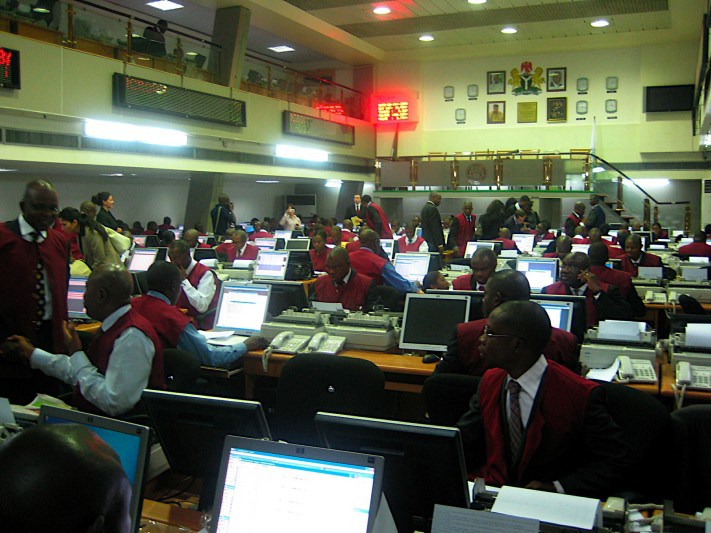
The Nigerian Exchange (NGX) Limited appreciated by 2.93 per cent on Monday on the back of significant gain by the shares of Airtel Africa, MTN Nigeria, Unilever Nigeria and others.

This raised the All-Share Index (ASI) of the exchange higher by 1,232.37 points to 43,246.87 points from 42,014.50 points and jerked the market capitalisation higher by N643 billion to N22.569 trillion from N21.926 trillion.

Airtel Africa was the best-performing stock yesterday with a growth of 10.00 per cent to trade at N858.00, followed by Red Star Express, which grew by 9.94 per cent to finish at N3.43.

Cutix appreciated by 9.91 per cent to sell for N6.21, MTN Nigeria improved by 9.62 per cent to settle at N192.50, while Unilever Nigeria gained 9.36 per cent to quote at N14.60.

On the other side, Conoil was the worst-performing stock as it shed 9.80 per cent to sell at N23.00, CWG fell by 9.73 per cent to trade at N1.02, Custodian Investment went down by 9.47 per cent to close at N7.65, Honeywell Flour depreciated by 9.07 per cent to N3.31, while Africa Prudential declined by 4.72 per cent to N6.05.

At the close of business, Business Post observed that the investor sentiment was weak despite the significant growth posted yesterday as there were 26 price losers and 18 price gainers.

This was reflected in the performance of the five key sectors of the exchange as only two closed green (consumer goods at 0.25 per cent and industrial goods at 0.13 per cent).

The insurance sector lost 1.43 per cent, the energy counter depreciated by 0.57 per cent, while the banking space went down by 0.09 per cent.

Sterling Bank was the most traded stock at the exchange on Monday and this was because of the cross deal it recorded. A total of 81.2 million shares of the company worth N121.9 million were transacted.

UAC Nigeria exchanged 67.3 million stocks worth N706.4 million, FBN Holdings transacted 42.2 million shares valued at N473.5 million, Zenith Bank traded 32.6 million equities valued at N797.4 million, while Transcorp sold 21.0 million equities for N21.6 million.

In all, a total of 443.6 million stocks worth N5.1 billion were traded by investors in 5,233 deals yesterday as against the 277.0 million stocks worth N2.4 billion traded last Friday in 3,524 deals, indicating an increase in the trading volume, value and number of deals by 60.12 per cent, 111.87 per cent and 48.50 per cent respectively.


Dipo Olowookere is a journalist based in Nigeria that has passion for reporting business news stories. At his leisure time, he watches football and supports 3SC of Ibadan. Mr Olowookere can be reached via [email protected]

Economy

Dangote Refinery Denies Importing Petrol, Diesel into Nigeria

Published

on

Dangote refinery import petrol

By Modupe Gbadeyanka

Dangote Petroleum Refinery and Petrochemicals has described reports making the rounds that it was importing finished petroleum products like premium motor spirit (PMS), otherwise known as petrol, diesel, and others into Nigeria as false and misleading.

In a chat with newsmen on Wednesday, the company clarified that what it brought into the country were merely intermediate or semi‑processed materials, which it emphasized is a standard practice within the global refining industry.

Intermediate materials—such as naphtha, straight‑run gas oil, vacuum gas oil (VGO), reformate, alkylate and isomerate—serve as feedstock for additional refining into finished fuels like petrol and diesel, as well as petrochemicals.

The chief executive of the facility, Mr David Bird, told journalists in Lagos that as a state‑of‑the‑art and large‑scale merchant refinery, DPRP refines crude oil and processes intermediate feedstocks into premium petroleum products and petrochemicals that meet the highest international standards, noting that this practice does not amount to importing finished petroleum products.

Mr Bird highlighted that Dangote Refinery operates using a European and Asian merchant refinery model, which integrates advanced refining, blending and trading systems designed to meet modern quality and environmental benchmarks.

“DPRP produces high‑quality fuels aligned with international environmental and health standards. Our gasoline is lead‑free and MMT‑free with 50 parts per million sulphur, while our diesel meets ultra‑low sulphur specifications. These standards help reduce emissions, protect engines, and safeguard public health,” the chief executive stated.

Mr Bird reaffirmed that the Dangote Refinery supplies only fully refined, market‑ready products, adding that semi‑finished fuels are unsuitable for vehicles and are therefore not released into the Nigerian market. Samples of both intermediate feedstocks and fully refined products were displayed to journalists during the briefing.

He further noted that the refinery was established to end years of exposure to substandard fuel in Nigeria by providing products that meet stringent global standards, adding that DPRP’s products are now exported to international markets, highlighting their quality and competitiveness.

The refinery chief stressed the company’s commitment to transparency in its operations and engagements with regulators, urging the media to help properly educate the public on the clear distinction between intermediate products and finished fuel.

“It is unfortunate that some individuals are deliberately spreading misleading narratives about a refinery that has transformed Nigeria and the West African region from a dumping ground for substandard fuels into a hub for high‑quality products,” he said, adding that the refinery’s flexible design allows it to process a diverse mix of crude oils and intermediate feedstocks into premium finished fuels.

Mr Bird assured Nigerians of sustained product availability, noting that the refinery has contributed significantly to easing fuel scarcity, stabilising the naira, and reducing pressure on foreign exchange.

On his part, the Chief Brand and Communications Officer of Dangote Industries Limited, Mr Anthony Chiejina, urged journalists to be precise in their choice of terminology, warning that inaccurate reporting could misinform the public and create unnecessary panic.

Continue Reading

Economy

Nigeria to Overtake Algeria as Africa’s Third-Largest Economy in 2026—IMF

Published

on

Nigeria Economy challenges

By Adedapo Adesanya

Nigeria is projected to move from being the become the third-largest economy in Africa in 2026 from the fourth position it clinched last year, according to data from the International Monetary Fund (IMF).

In the IMF’s World Economic Outlook (October 2025 edition), accessed via its datamapper, it was indicated that Nigeria’s gross domestic product (GDP) at current prices stood at about $285 billion in 2025, placing it behind South Africa, Egypt and Algeria.

South Africa topped the African ranking with a GDP of about $426 billion, followed by Egypt at $349 billion, and Algeria ranked third with $288 billion.

However, the IMF forecasts that Nigeria will overtake Algeria in 2026 as economic output rebounds, driven by higher oil production, improved foreign exchange liquidity and the impact of ongoing economic reforms.

According to the IMF’s projections, Nigeria’s GDP is expected to rise to $334 billion, putting it ahead of Algeria ($284 billion) and making it Africa’s third-largest economy, behind South Africa ($443 billion) and Egypt ($399 billion).

The lender’s outlook reflects expectations that recent reforms, including petrol subsidy removal, exchange-rate liberalisation and fiscal adjustments, will support medium-term growth, despite short-term inflationary pressures.

Africa’s largest economy’s position has shifted in recent years amid currency devaluations, rebasing exercises and macroeconomic headwinds across major economies on the continent. Nigeria in 2024 lost its status as Africa’s largest economy and dropped to fourth place after a series of Naira devaluations and wider reforms.

However, these appear to have brought about macro reliefs in the near term. On January 19, the IMF reviewed its forecast for Nigeria’s economic growth rate upward to 4.4 per cent in 2026. The Bretton Woods organisation revised the rate upward from its initial projection of 4.2 percent.

Prior to that, on January 13, the World Bank also increased its projection for Nigeria’s economic growth rate for 2026 to 4.4 percent from the 3.7 percent forecast in June 2025.

The federal government expects the Nigerian economy to grow by 4.68 per cent in 2026, supported by easing inflation, improved foreign exchange stability and continued fiscal reforms.

According to the Minister of Finance and Coordinating Minister of the Economy, Mr Wale Edun, the country’s inflation, which peaked above 33 per cent in 2024, declined to 15.15 per cent by December 2025, adding that foreign exchange volatility has eased, with the Naira trading below N1,500 to the Dollar, while external reserves rose to $46 billion.

He added that GDP growth averaged 3.78 per cent by the third quarter of 2025, with 27 sectors recording expansion.

Continue Reading

Economy

Lafarge to Expand Sagamu, Ashaka Cement Plants to 5.5MT Per Annum

Published

on

lafarge.jpg

By Aduragbemi Omiyale

One of the leading cement firms, Lafarge Africa Plc, has confirmed plans to expand its plants in Gombe and Ogun States to about 5.5 million metric tonnes per annum.

In a notice to the Nigerian Exchange (NGX) on Wednesday, the company said it was strengthening local cement production with the expansion of its Sagamu Cement Plant in Ogun State and Ashaka Cement Plant in Gombe State.

It noted that the upon completion of the expansion projects, the production capacity of the Ashaka Cement in Gombe State would rise to 2 MT per annum, while the Sagamu facility would increase to 3.5 MT per annum.

The two new plants, the statement disclosed, would be dry plants with preheater kilns, vertical raw mills and roller presses for cement mills to make them energy efficient.

The disclosure signed by the company secretary, Adewunmi Alode, further revealed that the plants are expected to improve product availability and enhance Lafarge Africa’s ability to serve customers efficiently across key markets.

This expansion is coming after the announcement made last year that Huaxin Building Materials Group’s had acquired 83.81 per cent of Lafarge Africa and demonstrates their commitment to Nigeria’s infrastructural development.

The chief executive of Lafarge Africa, Mr Lolu Alade-Akinyemi, stated that the expansion projects reflect the company’s long-term confidence in Nigeria’s growth potential and are aimed at supporting Nigeria’s infrastructure and construction needs.

He explained that the project goes beyond capacity growth to deliver operational and sustainability benefits but also supports value creation for our customers and shareholders while contributing to economic activity and job creation across our host communities and the wider construction ecosystem.

“The expansion of our plants is a strategic investment that reinforces Lafarge Africa’s role in supporting national development. By increasing capacity at our flagship plants, we are strengthening our supply chain, improving our responsiveness to market demand, and positioning the business to better support critical sectors such as housing, commercial construction, and infrastructure.

“It enables us to integrate modern production technologies that enhance efficiency, reliability, and environmental performance, in line with our commitment to responsible operations,” Mr Alade-Akinyemi, stated.

Continue Reading

Trending