Connect with us

Economy

Olam to Deliver 200,000 tons of Wheat Worth $70m by 2030

Published

on

tons of Wheat

By Modupe Gbadeyanka

Over 200,000 tons of wheat worth $70 million would be delivered by 2030 by Olam, a leading agribusiness conglomerate and parent company of Crown Flour Mill Limited (CFM).

This goal would be achieved by engaging/training about 50,000 farmers, Dr Filippo Bassi, the project scientist/senior scientist at the International Centre for Agricultural Research in Dry Areas (ICARDA) has disclosed.

Olam explained that it is chasing this target in a bid to stimulate higher wheat production in Nigeria.

“Olam has been encouraging innovation on a larger scale. We focus on charting novel, innovative paths that tick all the boxes in terms of providing suitable seed varieties, developing refined management processes and implementing trendy agronomic practices in the local wheat value chain.

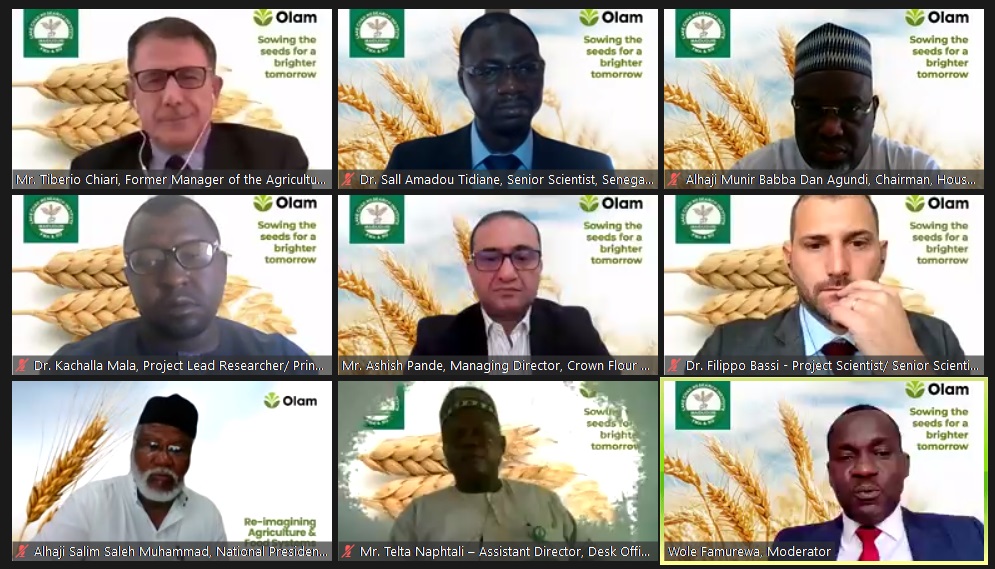
“This is in addition to working with and training smallholder wheat farmers while committing the right financial resources into the value chain developmental agenda,” the Managing Director of Crown Flour Mills, Mr Ashish Pande, said at the second Olam Green Land Webinar Series.

At the event, which took place on Wednesday, November 24, 2021, and themed Rethinking Wheat Farming in Nigeria: Seeds, Research, Partnerships, Mr Pande stated that “Bridging the huge wheat production gap in the country is a journey.

“This stakeholder engagement is a step in the right direction. The deep investment we are making into developing suitable seed varieties for the Nigerian topography and utilizing a community-based seed enterprise will manifest in outright development of the wheat farming sector in years to come.”

The CFM MD said that Olam’s bold investment of N300 million into seed research and the introduction of a novel community-based seed enterprise that utilizes the capacity of women smallholder farmer cooperatives have a strong implication on the livelihoods of the farming communities and the agenda of the Federal Government in terms of employment generation, attainment of food production self-sufficiency and food security within a couple of decades.

Tiberio Chiari, a durum wheat expert and former Head of the Italian Cooperation in Ethiopia, who was the keynote speaker at the webinar, highlighted the advantage of working with smallholder farmer cooperatives in developing the wheat value chain.

Citing Ethiopia as a case study, Chiari said, “There is an economy of scale in dealing with farmers’ cooperatives instead of working with individual farmers, and stakeholders have a key role in ensuring the effective management of the process for optimum impact.”

He said quality control, suitable seed varieties, good management processes, high smallholder farmer engagement, rigorous grain bulking facilities, availability of investment funds, integrity, among others, are key drivers of success when pivoting to a community-based seed enterprise methodology.

Dr Sall Amadou Tidiane, a senior scientist at the Senegalese Institute for Agricultural Research (ISRA), provided a narrative of the Senegalese wheat value chain. He said by adopting a peer-to-peer seed enterprise methodology, the country grew from zero wheat production in 2017 to have 2,000 farmers cultivating wheat successfully in 2021.

He revealed that utilizing the deep capacity of female local smallholder farmers will spread the impact of the new high-yielding seed varieties.

Dr Kachalla Kyari Mala, the project’s lead researcher/principal research officer, Lake Chad Research Institute (LCRI), also a key technical partner on the project, highlighted farmers’ low level of familiarity with the best agronomic practices as one of the factors responsible for their low productivity.

He said, “Engaging farmers right at the conception stages of a major seed development methodology up to the harvest stages will help them become conversant with the best management and agronomic practices.”


Modupe Gbadeyanka is a fast-rising journalist with Business Post Nigeria. Her passion for journalism is amazing. She is willing to learn more with a view to becoming one of the best pen-pushers in Nigeria. Her role models are the duo of CNN's Richard Quest and Christiane Amanpour.

Economy

NRS Launches Unified Tax ID System

Published

on

tax guidelines

By Adedapo Adesanya

The Nigeria Revenue Service (NRS) has unveiled a unified Taxpayer Identification (Tax ID) system for all taxable persons across the country as part of efforts to strengthen tax administration and improve transparency.

The agency announced the development in a public notice issued jointly with the Joint Revenue Board (JRB) on Monday.

According to the notice, the initiative is backed by Sections 6, 7, and 8 of the Nigeria Tax Administration Act, 2025, which mandate every taxable person in Nigeria to obtain a Tax ID, in a wider move to expand the country’s tax base.

The NRS said the new framework is designed to create a centralised and harmonised taxpayer database that would enhance interactions between taxpayers and revenue authorities at both federal and sub-national levels.

“The Tax ID will serve as a single, unified identity for all taxpayers, enabling seamless interaction with tax authorities at both federal and sub-national levels. It is designed to consolidate taxpayer records, eliminate duplication, and ensure more efficient management of tax-related information,” the agency stated.

The revenue agency explained that the new system would simplify tax compliance procedures, including taxpayer registration, filing of returns, and payment processes.

According to the NRS, the framework is also expected to improve accountability and reduce leakages in tax collection by creating better visibility and tracking of taxpayer information nationwide.

“The initiative will simplify tax compliance processes, including registration, tax filing, and payment procedures. The system will improve transparency by enabling better visibility and tracking of taxpayer records while reducing leakages and improving accountability in tax collection. The framework will also harmonise taxpayer information across all levels of government,” the notice added.

The agency further disclosed that the new Tax ID system would replace the existing Tax Identification Number (TIN) Validation API currently used by Ministries, Departments and Agencies (MDAs), financial institutions, and other organisations for taxpayer verification.

Continue Reading

Economy

OTC Securities Exchange Falls 1.31% as Key Stocks Decline

Published

on

NASD OTC securities exchange

By Adedapo Adesanya

Three bellwether stocks weakened the NASD Over-the-Counter (OTC) Securities Exchange by 1.31 per cent on Monday, May 18.

This brought the NASD Unlisted Security Index (NSI) by 54.71 points to 4,133.70 points from 4,188.41 points, and shrank the market capitalisation by N32.73 billion to N2.473 trillion from N2.506 trillion.

Yesterday, FrieslandCampina Wamco Plc contracted by N12.45 to sell at N146.55 per share compared with last Friday’s closing price of N159.00 per share, Central Securities and Clearing System (CSCS) Plc declined by N2.34 to N70.00 per unit from N72.34  per unit, and NASD Plc lost 50 Kobo to trade at N34.50 per share versus N35.00 per share.

The trio overpowered the N5.56 gained Newrest Asl Plc. This stock ended the trading session at N61.15 per unit, in contrast to the previous session’s N55.59 per unit.

During the trading day, the volume of securities traded by investors slid by 56.1 per cent to 514,142 units from 1.2 million units, and the value of securities dropped 29.8 per cent to close at N17.4 million versus N29.8 million, while the number of deals jumped 12.5 per cent to 27 deals from 24 deals.

Great Nigeria Insurance (GNI) Plc remained the most traded stock by value on a year-to-date basis, with 3.4 billion units sold for N8.4 billion, followed by CSCS Plc with 60.8 million units exchanged for N4.1 billion, and Okitipupa Plc with 27.9 million units traded for N1.9 billion.

GNI Plc also ended the day as the most traded stock by volume on a year-to-date basis with 3.4 billion units worth N8.4 billion, trailed by Resourcery Plc with 1.1 billion units valued at N415.7 million, and Infrastructure Guarantee Credit Plc with 400 million units transacted for N1.2 billion.

Continue Reading

Economy

FX Pressure Pushes Naira Lower to N1,373/$1 at Official Market

Published

on

naira official market

By Adedapo Adesanya

It was a horrible day for the Nigerian Naira in the different segments of the foreign exchange (FX) market on Monday, May 15, as its value further weakened against the United States Dollar.

In the black market window, the Naira lost N5 against the Dollar yesterday to sell for N1,390/$1 compared with the previous value of N1,385/$1, but at the GTBank forex counter, it remained unchanged at N1,383/$1.

In the Nigerian Autonomous Foreign Exchange Market (NAFEX), the Nigerian currency depreciated against the greenback by N2.66 or 0.19 per cent to sell for N1,373.70/$1 compared to last Friday’s rate of N1,371.04/$1.

Equally, it fell against the Pound Sterling in the same market segment by N9.05 to trade at N1,839.66/£1 versus N1,830.61/£1, and lost N5.42 on the Euro to close at  N1,600.49/€1 versus N1,595.07/€1.

The performance of the local currency during the session indicates early worries despite all signals pointing to stability, amid improved  Dollar sales by the Central Bank of Nigeria (CBN), with steady, higher oil receipts to bolster the nation’s reserves.

Activity at the market showed that turnover rose 57.3 per cent to $76.29 million on Monday from $48.49 million posted on Friday.

Over the weekend, S&P raised Nigeria’s credit ratings for the first time since 2012 and highlighted improved FX market liquidity and $10 billion turnover recorded in April 2026 as one of the major gains of the CBN-led FX reforms.

The agency said the liberalisation of the exchange rate has bolstered access to foreign currency and enabled a market-driven exchange-rate environment while supporting investor and consumer confidence.

Meanwhile, the cryptocurrency market was bullish on Monday as investors monitored developments in the Iran conflict and weighed the impact of surging oil prices on inflation and US interest-rate expectations.

Ethereum (ETH) gained 0.7 per cent to trade at $2,134.10, Cardano (ADA) rose by 0.6 per cent to $0.2515, Solana (SOL) expanded by 0.3 per cent to $85.11, Binance Coin (BNB) jumped 0.2 per cent to $643.29, TRON (TRX) increased by 0.03 per cent to $0.3565, and Bitcoin (BTC) advanced by 0.02 per cent to $76,912.12.

On the flip side, Dogecoin (DOGE) slid by 1.5 per cent to $0.1044, and Ripple (XRP) decreased by 0.5 per cent to $1.38, while the US Dollar Tether (USDT) and the US Dollar Coin (USDC) traded flat at $1.00 apiece.

Continue Reading

Trending