Connect with us

General

Bill to Stop Annual Rents in FCT Passes Second Reading at Senate

Published

on

senate-scrapped-ncc-nominee

By Modupe Gbadeyanka

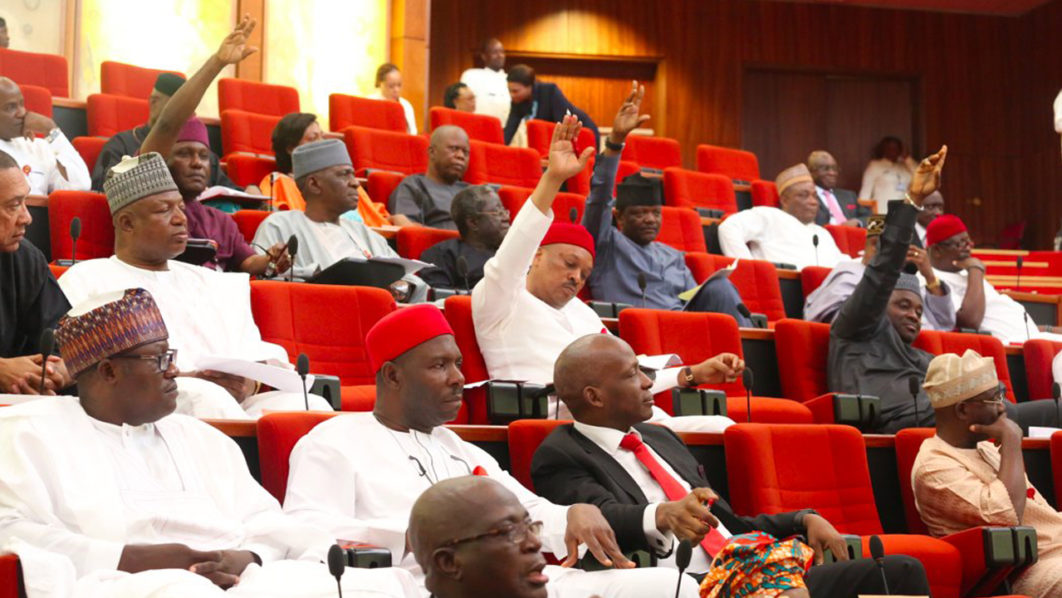
A bill to regulate payment mode for rents in the Federal Capital Territory (FCT) Abuja on Tuesday scaled the second reading at the Senate.

The upper chamber of the National Assembly wants to make it illegal for property owners to collect annual rents from tenants but on a monthly basis.

The sponsor of the bill tagged A Bill for the Regulation of Advanced Rent on Residential Apartments, Office Space, Mr Smart Adeyemi, argued that it would make life less stressful for residents of the city.

He explained that the bill seeks to regulate the mode of payment of rent on residential apartments, office space, rooms and accommodation in the FCT.

“If passed, this bill will improve the well-being and standard of living of residents and minimise corruption and immorality emanating from the oppressive tenancy system in the Federal Capital Territory.

“This bill will make life less stressful and less painful for the majority of the down-trodden and low-income earners in the Federal Territory,” Mr Adeyemi said.

He explained further that due to the global economic recession, life has become very challenging and almost unbearable for the low-income earners despite the huge palliative measures by the federal government through the N-POWER traders money.

He noted that in the FCT, landlords demand between one to three years of advanced rent, a situation which he pointed  “automatically adds a huge burden on the masses, subsequently giving rise to desperation and corruption.”

The lawmaker lamented that the “tenancy system has continuously impoverished Nigerians who are salaried employees that can only pay rent after haven received their first remuneration.”

“This tenancy system is un-African, unIslamic and indeed unbiblical,” he added, expressing concerns that many residents of the FCT are finding it difficult to cope with huge rent payment, adding that, “many houses built within the city centre for such purposes are empty.”

He said that yearly tenancy has continued to breed corruption, moral decadence and huge inequality as low-income earners cannot afford to continually pay their rent.

According to him, some tenants now engage in corrupt practices, immorality, and even criminal acts to meet the pressing need for shelter.

He underscored the need for Legislation aimed towards justice, fairness, equity and improved standard of living.

He noted that in the FCT, a single one-room apartment ranges from N1 million to N2 million within the city, noting that in the satellite towns such as Kubwa, Nyanya, Kuje, Lugbe, rents are still not affordable for the common man as it ranges from N350,000 to N500,000.

He stated that the bill, therefore, seeks to reduce advance payment for new tenants to three months and, thereafter, proceed with the monthly payment scheme.

“It also seeks to protect low-income earners from any form of oppression by homeowners.

“The bill also seeks to provide a window for legal action for any form of oppression.

“Importantly, it will also serve as a safety net for Landlords against erring tenants,” he added.

Contributing to the debate, Mr Aliyu Sabi Abdullahi, while supporting the bill, described the piece of legislation as “people-centred.”

He said, “The truth is out there, many residents in the FCT are groaning under this very difficult system where people are expected to pay house rent in advance.

“With the policy where the government has withdrawn participation in providing official quarters with demonetization, we are all aware, young Nigerians who are gaining employment within the precinct of the FCT for example, majority of them are actually in the outskirts.

“This is because it is extremely difficult for most of these young Nigerians to get the quantum of money that represents two years rent.

“[And] so, Mr President, I think we are doing the right thing if we look at the intendment of this bill.

“If there is a good system as this, where on a monthly basis as the man receives his salary, he is making payment for what he has consumed,  I think it will be a very good and welfare-oriented system, one that is friendly to those that do not have.”

The Deputy Senate President, Mr Ovie Omo-Agege, who presided over the plenary, described the bill as “popular” owing to the number of Nigerians who have shown interest in it.

However, Mr Chimaroke Nnamani, the only lawmaker in the chamber who spoke against the bill, argued the issue of rent payment should be driven by market forces.

“The issue of rental payment, either in advance or instalments is purely economical and should be driven by market forces.

“Such market forces as availability of land, cost of building materials and income.

“If the government wants to ameliorate the sufferings of the masses, the government can go into housing schemes, mortgage schemes, housing credit facilities, not control the business of private individuals in an emerging African democracy.

“I, therefore, oppose, and oppose vigorously this bill”, he said.

Senators, however, voted overwhelmingly in support of the bill when the Deputy Senate President put the question for it to be read a second time.

The bill was subsequently referred by Mr Omo-Agege to the Committee on Housing and Urban Development for further inputs.

The committee was given four weeks to report back to the Senate in plenary.

Modupe Gbadeyanka is a fast-rising journalist with Business Post Nigeria. Her passion for journalism is amazing. She is willing to learn more with a view to becoming one of the best pen-pushers in Nigeria. Her role models are the duo of CNN's Richard Quest and Christiane Amanpour.

General

4th South Africa Focus Week Begins in Lagos to Strengthen Bilateral Ties

Published

on

South Africa Focus Week

By Adedapo Adesanya

The South African Consulate General in Lagos, in partnership with Brand South Africa and the Development Bank of Southern Africa (DBSA), is hosting the 4th edition of the South Africa Focus Week in Lagos, Nigeria, from April 22 – 26, 2026.

The annual platform continues to grow as a strategic initiative aimed at fostering social cohesion between South Africans and Nigerians while positioning South Africa as a preferred destination for business, tourism, and education. Since its inception in 2023, South Africa Focus Week has attracted over 1,500 participants, bringing together stakeholders from across sectors, including trade and investment, arts and culture, tourism, aviation, and the culinary industry.

The 2026 edition holds particular significance as it coincides with the 30th anniversary of South Africa’s democratic Constitution, enacted in 1996, as well as 32 years of unbroken diplomatic relations between South Africa and Nigeria, established in February 1994. These milestones underscore the enduring partnership between the two nations, rooted in shared history and strengthened through formal agreements and ongoing collaboration.

The 2025 economic relationship between South Africa and Nigeria reflects a strategically significant, multi-dimensional partnership anchored in trade, energy security, investment flows, and strong institutional cooperation. While bilateral trade remains structurally imbalanced – with South Africa exporting US$468.48 million and importing $1.69 billion, resulting in a $1.22 billion deficit – this dynamic is largely driven by South Africa’s reliance on Nigerian crude oil, positioning the relationship as one of strategic interdependence rather than imbalance alone.

This partnership is further elevated by the relative economic weight of both countries. According to IMF projections, South Africa’s economy is valued at approximately $443.6 billion, while Nigeria’s stands at around $334.3 billion in nominal terms for 2026. As two of the largest economies on the continent, their bilateral engagement constitutes a central axis of African economic activity, with disproportionate influence on the success of continental integration efforts.

Beyond trade, the relationship is reinforced by deep two-way investment linkages. South African firms -including MTN Group, Shoprite, and Standard Bank – maintain a strong presence in Nigeria, while Nigerian companies such as Access Bank and Paystack have established a growing footprint in South Africa. Although investment flows are asymmetrical and some Nigerian firms have faced operational challenges, these exchanges reflect an emerging bi-directional economic corridor that extends beyond goods trade into services, finance, and digital innovation.

Aligned with Brand South Africa’s mandate to build the country’s global reputation and competitiveness, the week-long programme will convene leaders from government, business, civil society, academia, and the media. Discussions will focus on leveraging the African Continental Free Trade Area (AfCFTA) as a tool for market access and global positioning, with Nigeria serving as a key focal point.

The South Africa Focus Week has features a series of high-level engagements and cultural activities designed to deepen economic ties and promote collaboration: South Africa–Nigeria Infrastructure Investment Conference (April 22, 2026) which was held under the theme South Africa–Nigeria Partnership: Unlocking Infrastructure Opportunities,” the conference will bring together key stakeholders in infrastructure development to explore collaborative projects in road, rail, and transportation systems.

The forum also examined the role of Public–Private Partnerships (PPPs) and facilitated discussions on project financing and implementation with institutions such as the DBSA and Nigeria’s Infrastructure Concession Regulatory Commission (ICRC).

This was followed by the 2nd Economic Diplomacy Roundtable (Thursday, April 23, 2026), which was hosted in partnership with MTN Nigeria under the theme Role of Technology in Infrastructure Development, the roundtable will convene senior government officials, private sector leaders, and industry experts to identify investment opportunities and strengthen strategic partnerships.

Friday, April 24, was for Arts and Culture Experience, which is a dedicated cultural day will showcase Lagos’ creative spaces and features a panel discussion on South Africa’s arts, film, music, and culture. The programme includes a South African film screening, engagements with filmmakers, and a networking reception aimed at fostering collaboration between the creative industries of both countries.

The event continues on Thursday, April 25, with Freedom Day Celebration and Closing Ceremony. This commemorative event will celebrate 30 years of South Africa’s Constitution, 32 years of freedom and democracy, and the enduring diplomatic relations between South Africa and Nigeria. The ceremony will also provide an opportunity to reflect on outcomes from the week and outline future areas of cooperation.

The celebration forms part of Brand South Africa’s Global South Africans Programme, which recognises and connects South Africans in the diaspora as ambassadors of the nation’s values and identity.

The week climaxes with the 4th edition of the South Africa Golf Tournament at Ikoyi Golf Club on Saturday, April 26, 2026, which will be done in partnership with Crossflex International.

According to a statement, the event aims to strengthen people-to-people relations through sports diplomacy, bringing together South African and Nigerian golfers in a spirit of camaraderie and collaboration.

Continue Reading

General

EFCC Arrests Ex-Skye Bank Chair Tunde Ayeni Over Alleged Diverted Loans

Published

on

tunde ayeni

By Modupe Gbadeyanka

The former chairman of the defunct Skye Bank Plc, Mr Tunde Ayeni, has been apprehended by the Economic and Financial Crimes Commission (EFCC).

Spokesperson of the anti-money laundering agency, Mr Dele Oyewale, confirmed the arrest of the businessman on Friday but declined to provide further details, according to TheCable.

Mr Ayeni was accused of diverting the N36.5 billion and $30 million loans from Polaris Bank Limited to companies with which he has links.

He was alleged to have obtained the credit facilities for marine security, electricity distribution, and real estate projects, but moved them to telecom investments tied to NITEL/MTEL assets via a NATCOM account.

After the Central Bank of Nigeria (CBN) revoked the operating licence of Skye Bank in 2018, it nationalised it to Polaris Bank.

The EFCC has been looking into the alleged diversion of funds by Mr Ayeni, resulting in his arrest in Abuja on Thursday, April 23, 2026.

He is being grilled over the matter and would be arraigned in court once the investigation is concluded.

This is not the first time Mr Ayeni has been nabbed and probed by the EFCC, as this happened a few months after his bank lost its licence.

The then acting spokesman for the EFCC, Mr Tony Orilade, said Mr Ayeni was quizzed by detectives over issues related to fraud and embezzlement allegedly committed by him when he was Chairman of the bank a few years ago.

Continue Reading

General

Customs, Police Commence Tighter Security at Ports to Protect Oil Trade

Published

on

nigeria customs police

By Adedapo Adesanya

The Nigeria Customs Service (NCS) and the Nigeria Police have begun securing the country’s maritime corridor as part of critical moves to safeguard oil and gas trade flows through the nation’s ports.
This follows a recent strategic engagement between the Ibeto Seaport and Terminals Command of Customs and the Eastern Port Police Command in Port Harcourt, where both agencies reaffirmed their commitment to joint operations.
Customs Area Controller, Mr Usman Yahaya, described inter-agency cooperation as essential to protecting critical economic infrastructure.
“This visit is timely and highly appreciated. It reflects the importance of sustained cooperation among agencies entrusted with the security of our nation and the protection of critical economic assets,” he said.
Mr Yahaya stressed that collaboration between Customs and Police remains central to maintaining order and preventing criminal activities within port environments.
“Customs and the Police share common responsibilities in safeguarding the port environment. Synergy remains the cornerstone for achieving our collective mandate,” he added.
He further assured continued support for the Police Command to enhance operational effectiveness.
“Customs Area Controller Usman Yahaya (sitting, right) and Commissioner of Police Shuaibu Audu (sitting, left) with other Customs and Police personnel

“We are fully committed to working with the new Commissioner of Police and giving all necessary support towards the successful discharge of his responsibilities.”

On his part, the Commissioner of Police, Eastern Port Command, Mr Shuaibu Audu, said the visit was aimed at strengthening existing ties between both agencies.
“My presence here today is to reinforce the cordial relationship between the Nigeria Police Force and the Nigeria Customs Service. No organisation can function effectively in isolation,” he said.
Mr Audu emphasised the strategic importance of ports to Nigeria’s economy, particularly in the energy sector.
“Our ports are strategic national assets, and we must work together to keep them secure,” he stated. “Synergy among security agencies is essential to addressing emerging threats.”
Continue Reading

Trending