Connect with us

Auto

Mixed Reactions Over Nigeria’s Ban on Importation of Accidented Vehicles

Published

on

import accidented cars nigeria

By Modupe Gbadeyanka

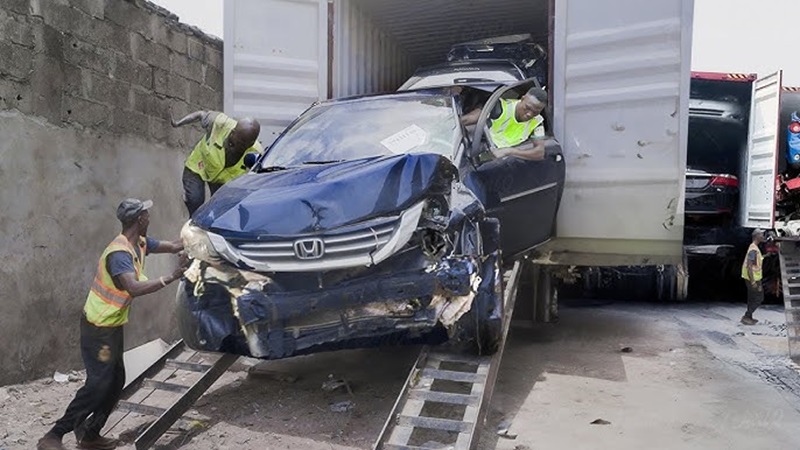
Reactions have continued to trail the decision of the federal government to stop the importation of accidented vehicles into Nigeria by car dealers and others.

On Tuesday, the government declared that it would no longer accept the importation of vehicles without prior certification, noting that it was worried at the influx of substandard automobiles into the country.

The Minister of State for Industry, Trade, and Investment, Mr John Enoh, said the no certification, no entry policy tagged the Standard Organisation of Nigeria–National Automotive Design and Development Council Vehicle Conformity Assessment Programme was now fully implemented with immediate effect, noting that any vehicle that fails to meet the requirements would be denied entry into the country.

“I want to clarify again that this is not a proposal or a pilot. This has become government policy and takes immediate effect upon commencement,” he declared at a meeting in Abuja, stressing that vehicles coming into the nation must obtain pre-shipment certification.

“So, the endorsement integrates vehicle safety into Nigeria’s economic policy framework. It aligns fiscal instruments, foreign exchange import financing, and revenue systems with safety and standards objectives.

“It also strengthens the long-standing work of the Standard Organisation of Nigeria and NADDC within a coordinated whole-of-government approach.

“I think that with effect from the commencement of this SON-NADDC VehCAP, all new and used vehicles and automotive products entering Nigeria must obtain pre-shipment certification on that VehCAP before form M approval, before customs valuation, before power processing, before import clearance, and before market entry,” he stated.

“No vehicle or automotive product shall be imported, cleared, registered or licensed without valid certification. Any non-compliant import shall be subject to refusal of clearance, seizure, or sanctions under applicable laws,” he added.

Mr Enoh disclosed that, “We did not arrive here by accident. Too many Nigerians have died from accidents caused by vehicles that fell short of required standards. Nigeria deserves better, and this government is determined to deliver better.”

While he admitted that some Nigerians may not be able to afford new vehicles, the government cannot fold its arms and allow its citizens to die because of substandard cars.

“I think that without taking an extreme position, we must find a middle ground. There are economic challenges, there is purchasing power, and there is also the capacity of local assemblers to meet demand.

“But at the very minimum, if we adhere strictly to existing regulations, such as limits on the age of imported vehicles, our problem will not be nearly as bad as it is,” he said.

“A vehicle that is non-compliant at the federal level must not be registered at the state level. For the FCCPC, you are expected to treat VehCAP certification as a baseline for consumer protection enforcement for vehicles. State governments, because we run a federation with federal units, state governments are expected to align vehicle registration systems with VehCAP requirements. Most importantly, let me acknowledge the very profound role that was played by the Minister of Finance and Coordinating Minister of the Economy, Wale Edun, for approving the VehCAP initiative,” he warned.

While some Nigerians applaud this initiative, others believe citizens would be exploited by government officials and make the price of fairly used cars more expensive. Some dealers have been accused of bringing in accidented cars, refurbishing them and selling to unsuspecting customers at exorbitant prices.


Modupe Gbadeyanka is a fast-rising journalist with Business Post Nigeria. Her passion for journalism is amazing. She is willing to learn more with a view to becoming one of the best pen-pushers in Nigeria. Her role models are the duo of CNN's Richard Quest and Christiane Amanpour.

Click to comment

Leave a Reply

Your email address will not be published. Required fields are marked *

Auto

Senate Passes Bill to Sanction Trading, Preaching in Buses

Published

on

trading inside buses

By Modupe Gbadeyanka

A bill aimed at prohibiting hawking, trading or preaching inside commercial vehicles in Nigeria has been passed by the Senate.

The bill known as the Federal Road Safety Corps (Amendment) Bill, 2026, imposes fines between N50,000 and N100,000 for violations if assented to by the President.

The piece of legislation was passed by the red chamber of the National Assembly on Thursday and should later be transmitted to President Bola Tinubu for assent.

Members of the upper chamber of the parliament explained that the law was amended to discourage distractions in commercial vehicles and improve the safety of commuters.

In addition, motorists who fail to cooperate with officials of the Federal Road Safety Corps (FRSC) during roadside breath tests conducted on reasonable suspicion are liable to fines or imprisonment or both.

Lawmakers noted that this was to improve compliance with road safety regulations and reduce road crashes, as fines for driving under the influence of alcohol or intoxicating drugs were raised to N100,000 from N5,000, with the risk of spending two years behind bars.

It was also proposed that disobedience to traffic lights, road signs, pavement markings and other traffic control devices will now attract N100,000, while the fine for speed limit violations is now N100,000, with reckless driving now a fine of N100,000 or two years’ imprisonment.

Continue Reading

Auto

Company Gets Ultimatum to Stop Indiscriminate Truck Parking on Aina Obembe Road Baruwa

Published

on

Aina Obembe Road traffic agbaje

By Dipo Olowookere

Residents and motorists plying the Aina Obembe Road in Baruwa, Ipaja, Lagos, may soon heave a sigh of relief as the excruciating traffic gridlock being experienced in the area both day and night may soon be a thing of the past.

This is because the chairman of Ayobo-Ipaja LCDA, Mr Lukmon Agbaje, has directed those involved in indiscriminate truck parking along the road to remove the heavy-duty vehicles within one week, threatening to invoke appropriate enforcement measures for noncompliance with this directive.

Speaking during a meeting on Wednesday with the management of SENA Company, which owns the affected trucks, as well as the leadership of Oluwadara CDA and other key stakeholders like the Lagos State Traffic Management Authority (LASTMA), at the council’s secretariat, Mr Agbaje frowned at the prolonged inconvenience suffered by the community, stressing that public roads must remain accessible and safe for all users.

He emphasised the need for a collaborative approach in resolving the issue without undermining legitimate business operations, noting that he’s focused on finding a lasting solution to the gridlock experienced between Oluwaga and Aina Obembe, where parked trucks have continued to obstruct traffic, disrupt business activities, and pose safety concerns for residents and motorists.

He tasked the firm and the CDA to jointly identify and implement alternative parking arrangements that would remove all trucks from the affected roads and restore the free flow of traffic.

He declared that, “The welfare of our people remains our highest priority. No individual or corporate organisation should obstruct public infrastructure or create avoidable hardship for residents. We must ensure that economic activities coexist with public safety, order, and convenience.”

The council chief reaffirmed his administration’s commitment to promoting orderly development, ensuring safe and accessible roads, improving traffic management, and creating an environment where businesses can thrive alongside the well-being of residents.

Continue Reading

Auto

FG Rolls Out Green Tax, Cuts Vehicle Import Levies

Published

on

Green Tax Surcharge

By Adedapo Adesanya

The federal government has cut import levies on new and used vehicles by as much as 10 per cent in a move aimed at reducing the cost of vehicle importation, even as it commenced the implementation of a new Green Tax surcharge.

According to an update issued by the Nigeria Customs Service (NCS) on Wednesday, the import levy on new vehicles has been reduced from 20 per cent to 10 per cent, while the levy on used vehicles has been slashed from 15 per cent to five per cent under the 2026 Fiscal Policy Measures, which took effect on July 1, 2026.

The customs said the policy is designed to ease the cost of vehicle imports while advancing the government’s environmental sustainability objectives through the newly introduced Green Tax.

The implementation also reduces the overall import duty on fully built passenger vehicles from 70 per cent to 40 per cent.

As part of the Green Tax framework, a new environmental surcharge of between two per cent and four per cent will apply to petrol-powered vehicles with engine capacities exceeding 2,000cc. However, mass transit buses, electric vehicles, and passenger cars with engines below 2,000cc are exempt from the surcharge.

Beyond the automobile sector, the fiscal measures also lower import duties on several essential goods. The duty on imported rice has been reduced from 70 per cent to 47.5 per cent, while crude palm oil now attracts a 28.75 per cent duty.

In addition, import duties on agricultural and manufacturing machinery have been completely removed to support local production, while Waste PET has been added to the export prohibition list to encourage domestic recycling.

Continue Reading