Connect with us

Banking

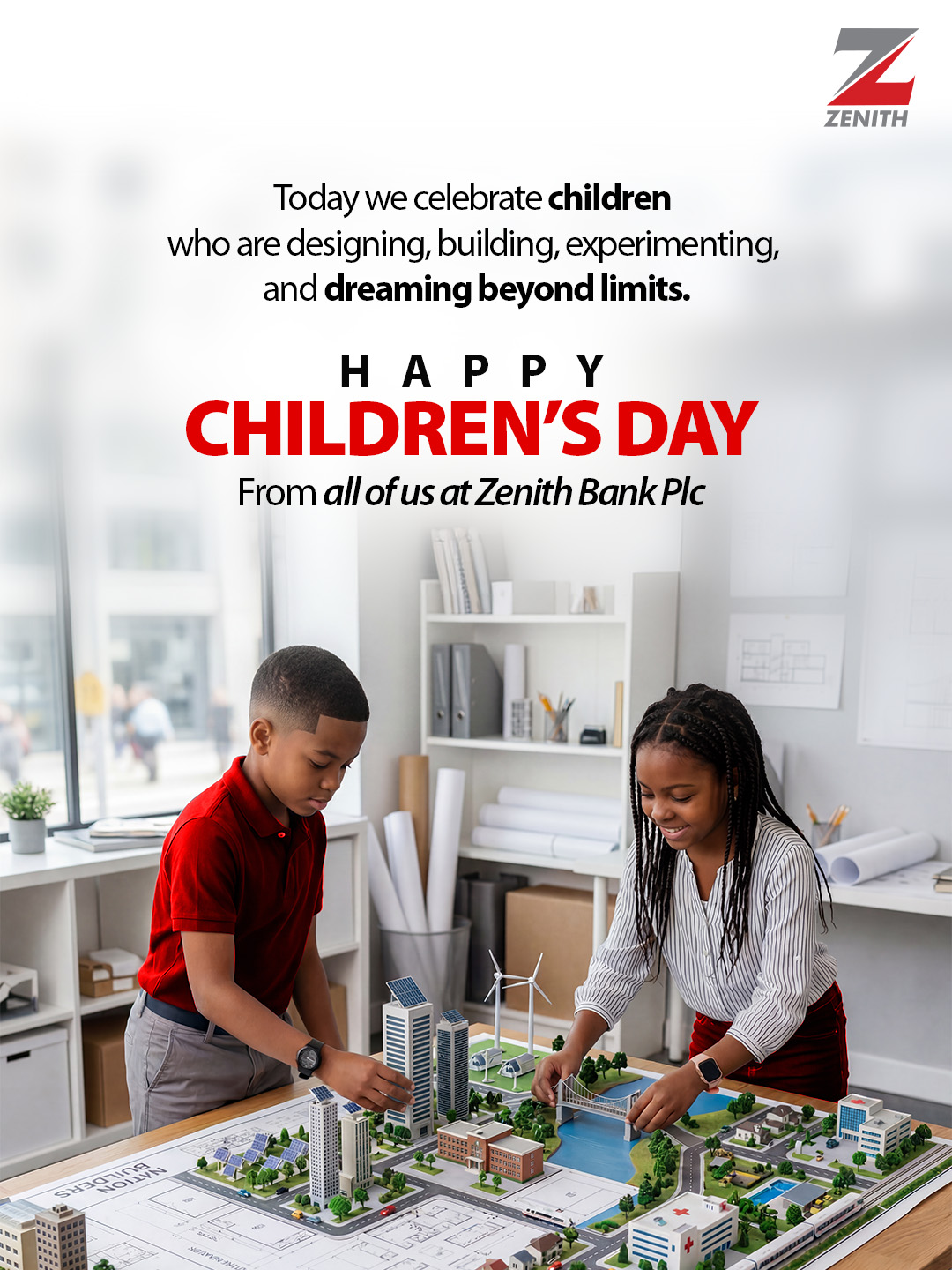
Children’s Day: Zenith Bank Renews Commitment to Raising Tomorrow’s Leaders

Published

on

Zenith Bank Children's Day

By Modupe Gbadeyanka

Zenith Bank is championing the narrative that children are the true leaders of tomorrow by deepening its investment in carefully curated initiatives that elevate kids across education, financial literacy, health, digital inclusion, and social protection, building a generation equipped to thrive and lead.

For Zenith Bank, much more than commemorating the annual Children’s Day marked every May 27, every child matters, and the bank’s footprint reflects a deliberate, pan-African strategy to nurture potential from the earliest age.

Zenith Bank has been the financial institution partner to Kiddies Corner on Inspiration 92.3FM Lagos for over three years, anchoring the Tuesday edition and the Zenith Financial Literacy Friday show. The programme blends spelling bee contests with financial literacy questions, creating awareness and onboarding children into the Zenith Children’s Account (ZECA). This partnership came alive at the Inspiration FM Children’s Day Carnival on Saturday, May 23, 2026, where Zenith Bank hosted over 1,000 children and their parents, celebrating ZECA winners with games, skits, and Zenith Bank-branded gifts.

The company’s Zenith Financial Literacy Week, held quarterly, takes this mission into select schools across all 36 states and the FCT. Students are trained on savings, budgeting, basic investments, and their retail products, with the top performer in each school awarded N50,000. Complementing this is the Bank’s nationwide Financial Literacy Program under the CBN-mandated Global Money Week, which in 2025 alone reached 3,622 students across 22 LGAs, deploying 137 bank employee volunteers as educators.

In alignment with the United Nations’ (UN) Sustainable Development Goal (SDG) 4 on Quality Education, Zenith Bank has donated state-of-the-art ICT centres and computer systems to schools and universities nationwide, including a Computer Centre to Bamaina Academy, Dutse, Jigawa State. Its transformative interventions include fully equipped libraries, vocational facilities, and large-scale school renovations, from Ojota Secondary School and Victoria Island Secondary School in Lagos to Hugallawa Primary School in Jigawa. Targeted financial support further breaks barriers with a N1 million cash donation to Louisville Girls High School, Ijebu-Itele, supporting girl-child education; infrastructure upgrades at Maryland Comprehensive Secondary School; a N1 million scholarship endowment for St. Francis Catholic Secondary School; and support for the North-East Children’s Fund to aid education in conflict-affected communities.

Through its Primary Healthcare Centre Initiative across all 774 LGAs, Zenith Bank educates parents on early childhood savings during routine visits, linking health and financial well-being. The “PAD-A-QUEEN” Initiative commemorates the International Day of the Girl Child, reaching 5,000 girls in 10 schools with sanitary pads, hygiene kits, and menstrual health education to keep girls in school and promote SDGs 3, 4, and 5.

The lender’s compassion extends to the most vulnerable. At Bethesda Home and School for the Blind, Idi Oro, Lagos, Zenith donated braille materials, food, and toiletries. For the 2026 International Day for Street Children, it partnered with Bosco Child Protection Centre on medical check-ups, food, clothing, and counselling. Annual Christmas Charity Visits to orphanages deliver cash, toys, and essential supplies, while support for the Smile and Shine Children Foundation’s Strive Conference empowers over 2,000 adolescents with life skills and leadership training.

“At Zenith Bank, we are deliberate about initiatives that elevate children because they are not just our future, they are our present responsibility. As Whitney Houston so poignantly sang, ‘I believe the children are the future, teach them well and let them lead the way.’ That is the philosophy driving our investments in education, financial literacy, health, and digital inclusion. From Kiddies Corner to ICT centres, from PHCs to orphanages, we are teaching them well, equipping them early, and giving them the tools to lead. Zenith Bank renews its commitment to every Nigerian child, to nurture their dreams, protect their dignity, and secure their tomorrow,” the chief executive of Zenith Bank, Ms Adaora Umeoji, commented.

Championing youth expression, the Zenith Annual Youth Parade, hosted by the Bank for 19 years, stands as a flagship Corporate Social Responsibility initiative.  Bringing together thousands of children and teenagers in a vibrant showcase of unity and discipline, the parade has remained dedicated since its inception to the vital mission of supporting, nurturing, and empowering the Nigerian child, reinforcing the Bank’s belief that leadership is learned early through teamwork, confidence, and celebration of young Nigerian identity.

For Zenith Bank, Children’s Day is more than a date on the calendar. It is a daily pledge to empower, protect, and prepare Nigeria’s children for leadership. From classrooms to communities, the Bank’s initiatives are teaching them well and letting them lead the way because the future belongs to children who are equipped today.


Modupe Gbadeyanka is a fast-rising journalist with Business Post Nigeria. Her passion for journalism is amazing. She is willing to learn more with a view to becoming one of the best pen-pushers in Nigeria. Her role models are the duo of CNN's Richard Quest and Christiane Amanpour.

Click to comment

Leave a Reply

Your email address will not be published. Required fields are marked *

Banking

How to Get a Quick Loan in Nigeria With No Collateral

Published

on

Smart loan Collateral

Needing money fast is a common problem in Nigeria. Rent is due, or a small business runs short on stock money before the next sale. In the past, getting a loan from a bank meant paperwork, a guarantor, and sometimes property as collateral. That process could take weeks. Today, things have changed. Several licensed digital lenders in Nigeria now offer personal loans without collateral, and the entire process can be completed from a phone in under an hour.

This article explains how no collateral loans work in Nigeria, what lenders actually check before approving you, and how to avoid the mistakes that get loan applications rejected or, worse, land borrowers with apps that are not properly registered.

What “No Collateral” Really Means

A collateral loan asks you to pledge something of value, like land, a car, or a fixed deposit, as security. If you fail to repay, the lender has a legal right to seize that asset. Most working Nigerians do not have assets like this sitting idle, which is exactly why no collateral loans exist.

Instead of asking for property, digital lenders look at other signals to judge whether you can repay:

  • Your Bank Verification Number (BVN) or National Identification Number (NIN), used to confirm your identity
  • Your bank account history, which shows whether money moves in and out regularly
  • Your mobile money or airtime usage in some cases, which hints at your financial activity
  • Your repayment history with other lenders, if you have borrowed digitally before

This is why an app like LendSafe can approve a loan in minutes. There is no waiting for a bank manager to review your file. The decision is based on data you provide once, during registration.

Steps to Get a Quick Loan Without Collateral

The process is fairly similar across most reputable Nigerian loan apps, though the details differ slightly.

  1. Download a licensed loan app: Always check that the app is registered with the Federal Competition and Consumer Protection Commission (FCCPC) before installing it. Unregistered apps are the ones most often linked to harassment and hidden charges.
  2. Register with your phone number and basic details: Most apps ask for your name, phone number, and BVN or NIN to verify who you are.
  3. Answer a few simple questions: This usually covers your employment status, income range, and sometimes your address.
  4. Wait for your credit limit: Based on the information provided, the app calculates how much you qualify to borrow. This step typically takes a few minutes.
  5. Choose your loan amount and repayment plan: Pick an amount you are confident you can repay on time, not the maximum offered.
  6. Receive the funds: Once approved, money is sent directly to your bank account, often within minutes.

What to Check Before You Borrow

Before accepting any loan offer, confirm the following:

  • The interest rate and total repayment amount: A lender should show you exactly how much you will repay, not just how much you will receive.
  • The repayment date and any penalty for late payment: Missing a date by accident should not lead to extreme charges.
  • The lender’s registration status: Reputable lenders, such as those operating under the FCCPC’s Digital, Electronic, Online and Non-Traditional Consumer Lending Regulations, are required to disclose their licensing details. If an app cannot show this, treat it as a warning sign.
  • What permissions the app is requesting: A lender does not need access to your entire photo gallery or contact list to process a personal loan. Be cautious of apps that ask for more access than necessary.

Why ‘No Collateral’ Does Not Mean No Responsibility

Some borrowers assume that because no asset is on the line, a missed payment carries no real consequence. This is not true. Digital lenders report repayment behaviour to credit bureaus in Nigeria, including CRC Credit Bureau and CreditRegistry. A pattern of late or missed payments can affect your ability to borrow in the future, even from a different lender entirely.

The safest approach is to borrow only what you need and only when you are sure of your repayment date. A loan app should support a short-term need, not become a constant source of stress.

Conclusion

No collateral loans have made it possible for ordinary Nigerians, salaried or self-employed, to access quick cash without the long process traditional banks require. The key is choosing a lender that is properly licensed, transparent about costs, and respectful of your data and privacy. Apps that are upfront about their fees and regulatory status, like LendSafe by SmartLoans, are generally a safer place to start than apps with no clear company information behind them.

Before your next financial emergency arrives, it is worth knowing which licensed apps you can trust and how the no-collateral process actually works. That knowledge alone can save you from a costly mistake.

Continue Reading

Banking

Paystack Rolls Out Small Business Programme with Funding, Growth Support

Published

on

Paystack

 By Adedapo Adesanya

African payments technology giant, Paystack, has launched the Paystack Small Business Programme to support Nigerian small businesses through a range of initiatives designed to help them grow, connect with relevant opportunities, and access funding for their next stage of growth.

The initiative will support businesses as they start, manage and grow their operations, starting with the Paystack Small Business Bundle.

The bundle gives eligible Nigerian merchants access to up to N4 million in discounts on tools and services from selected partners across key areas of business operations, including commerce, bookkeeping, logistics, design, workspace, customer communication, and digital tools.

In the pilot phase, Paystack is targeting 2,000 Nigerian SMBs for the Small Business Bundle, with additional partner offers expected over time.

According to the company, in a statement on Monday, small businesses play a significant role in Nigeria’s economy, but many still face everyday operational challenges, from managing sales and records, reaching customers, handling deliveries, and accessing affordable tools.

As a result, the programme has been developed to provide practical support for these businesses as they manage daily operations and plan for their next stage of growth. Through the Small Business bundle, eligible merchants can access offers from partners including Bumpa, Ijeworks, Wiicreate, Flowcart, Simplebks, Africaworks, Paystack, Kindlybook, FezDelivery, Gamp, Pressone, Mercurie, Shuttlers and Canva.

The Paystack Small Business Programme will commence with three key initiatives designed to support the growth and sustainability of small businesses. These include the Paystack Small Business Bundle, which offers a range of tools, services, resources, and partner benefits to help businesses operate more efficiently and scale sustainably; the Paystack Small Business Launchpad, which provides dedicated, hands-on support to high-potential businesses, enabling them to maximize the value of Paystack’s solutions and accelerate growth; and the Paystack Small Business Grant, which offers financial support to promising businesses to help fund their next phase of expansion and development.

The Bundle is available to eligible Nigerian merchants with a live Paystack account, at least 10 Paystack transactions in the last 30 days, and operations in Nigeria.

Eligible merchants can visit the Small Business Bundle Page to browse available partner offers, submit their business details and receive redemption instructions once their eligibility has been confirmed.

Continue Reading

Banking

Why Access to Structured Merchant Financing Matters for SME Growth

Published

on

Seun Oyediran

By Seun Oyediran

The Nigerian economic landscape is defined by the resilience of its micro, small, and medium-sized enterprises (SMEs). From the high-traffic supermarkets of Lagos to the critical distribution hubs supporting the hinterlands, millions of entrepreneurs drive our domestic commerce. Yet, a recurring theme persists in our boardroom discussions and macroeconomic reviews: the “missing middle.” While demand remains robust across various sectors, limited access to financing remains one of the several constraints affecting SME growth, effectively putting a limit on how much the country’s economy can grow.

The data provided by the Small and Medium Enterprises Development Agency of Nigeria (SMEDAN) is unequivocal. SMEs constitute approximately 96% of all domestic businesses, contributing nearly 50% of the national GDP and employing over 80% of the workforce. They are not merely a segment of the economy; they are the economy. However, the International Finance Corporation (IFC) continues to highlight a staggering credit gap. This structural bottleneck means that even businesses with proven product-market fit are often unable to fulfill orders, optimize inventory, or expand their footprint, simply because traditional capital remains inaccessible.

Merchant credit represents one financing option available to support working capital and inventory management needs. Unlike the rigid structures of traditional commercial lending, merchant credit is purpose-built for the velocity of trade. By injecting capital directly at the point of need, specifically for inventory replenishment, business expansion and equipment acquisition, it may help address short-term liquidity requirements for eligible businesses. For a merchant, the inability to stock goods is not just a missed sale; it is a loss of market share and a regression in cash flow momentum. Merchant credit may help eligible businesses address short-term liquidity constraints and support inventory management.

From a risk management and credit perspective, the evolution of digital financial services has revolutionised how we view SME creditworthiness. Historically, the absence of collateral or formal credit histories led to the systemic exclusion of many viable businesses. A data-driven approach shifts the focus from static assets to dynamic performance, enabling lenders to deploy capital into businesses demonstrating sustainable operational performance.

The macroeconomic implications of optimising merchant credit are profound. Access to appropriately structured financing may contribute to broader economic activity, employment, and business expansion. In the context of Nigeria’s urgent need to diversify away from hydrocarbon dependence, the private sector, and SMEs in particular, must remain an important contributor to economic development. To build globally competitive brands and export-led enterprises, we must move beyond the rhetoric of “supporting” small businesses and transition toward integrating them into modern credit value chains.

The strategic imperative is clear. The chasm between a local business and a regional champion is rarely a lack of ambition; it is access to capital that remains a significant constraint for many businesses. If we are to foster a new generation of African industry leaders, we must prioritise the deployment of flexible, data-driven financing solutions. When responsibly structured and appropriately deployed, merchant credit can support business growth, inventory management, and operational continuity for eligible enterprises.

Seun Oyediran, Director, Merchant Lending

Continue Reading

Trending