Banking
EcobankPay Zone Enters South East Market in Grand Style
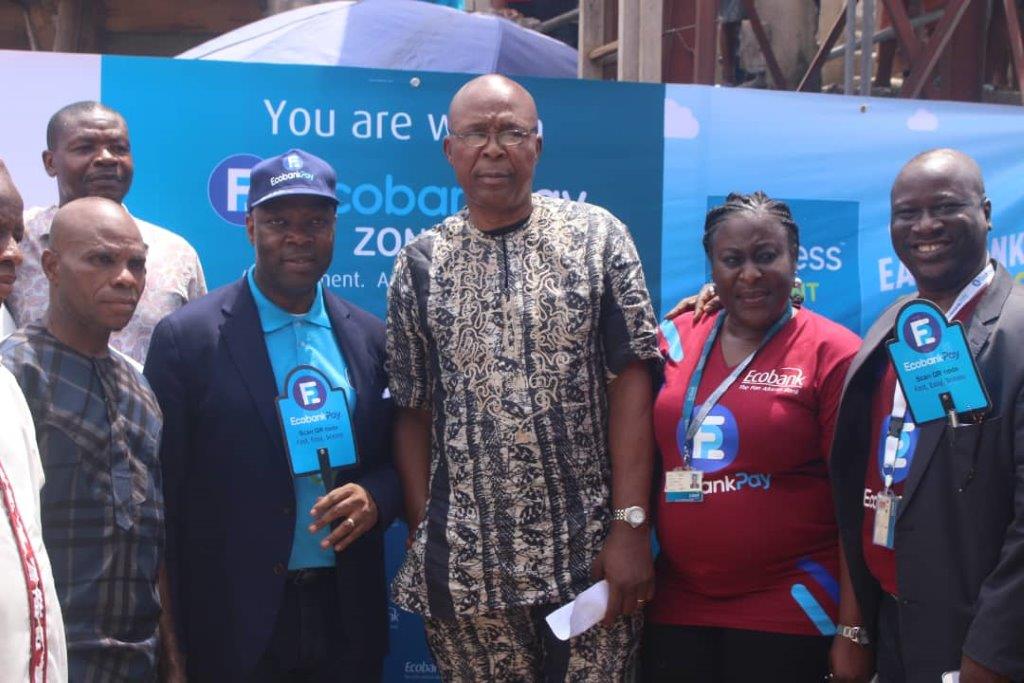
Ecobank Nigeria has taken its digital product, EcobankPay Zone to the South East market with a launch at the popular Ariaria Market, Aba.
Managing Director, Ecobank Nigeria, Patrick Akinwuntan while launching the product at the market said it will facilitate easy, secure and convenient transactions for merchants within Ariaria and other surrounding markets. The EcobankPay Zone is a digital payment hub enabling businesses within a location adopt Ecobank’s wide range of digital products for ease of payments for goods and services.
“It is our determination to create ease of payment and boost economic activities most especially in a town like Aba, renowned for indigenous production of shoes and textiles. Our digital offering will be an opportunity for both buyers and sellers to increase their sales in an enhanced and secured way and without fear.
“The EcobankPay digital hub makes it easy for the seller to be paid instantly and buyers pay with ease and also have rest of mind associated with doing business without carrying cash around. Our Xpress point is also around for you to transact with ease, in as much as you have your phone you can bank with Ecobank.
“The initiative of the Ecobankpay zone is to deepen financial inclusion in the communities and specifically aid business transactions between merchants and clients. EcobankPay’s unique offering is that anyone from any bank in Nigeria can pay with MasterPass, mVISA and mCASH with any phone by scanning QR code or using USSD”.
“If the person that wishes to buy goods from you is coming from a bank that has mVisa and wishes to pay, the same QRcode would accept an mVisa payment and vice versa. That creates synergy between us and the other banks and convenience for the merchants. And as you know, the QRcode is much cheaper than having a point of sale (PoS),” he said.
Mr Akinwuntan made an example of how the EcobankPay works by buying a pair of shoes from one of the Aba traders and make payment through QR scan and the seller received alert instantly.
EcobankPay is a fresh innovative payment solution that enhances transactions between merchants and their customers by eliminating risk of payment rejection and also delivers same day value and sales transparency for merchants. This is unlike the traditional ways that payments are made using cards on PoS where merchant, the small business person, the trader, the supermarket owner, the distributor that is holding a POS needs to wait for at least one day to get the value of the payment. EcobankPay enables the merchant receive credit instantly. This is very important for working capital particularly for small businesses.
Ecobankpay enables easy tracking of customers business profiling for quick access to credit, save faster, reduces the risk of security in terms of exposure to cash or exposure to pilfering of merchant’s credentials. The beauty of the Ecobankpay is in the cost of setting up as the shop owner simply print the QR code on a paper and can stick it anywhere and do not run any risks”.
Banking
Access Bank to Reduce Overseas Equity Exposure on CBN Directive Within 12 Months
By Adedapo Adesanya
Top Nigerian financial institution, Access Bank Plc, will reduce its equity stakes in some of its foreign subsidiaries to comply with new rules from the Central Bank of Nigeria (CBN) limiting external investments by local banks.
This was disclosed by Access Bank’s chief executive, Mr Roosevelt Ogbonna, on an investor call in Lagos on Tuesday.
The CBN has ordered banks to limit equity investments in foreign subsidiaries to no more than 10 per cent of total shareholders’ funds. This is to help contain risk and preserve capital, which are fundamental to long-term financial system stability.
Mr Ogbonna said Access Bank, which has operations in over 20 countries, has 12 months to comply.
“We are looking at divestments” to bring down our equity stake, from a current level of 19.4 per cent, the CEO said. “We will still be the controller of those banking entities, and the value creation will continue to be strong,” he said.
Nigerian banks began expanding aggressively across the continent after the country’s 2016 recession, seeking to mitigate risks from currency devaluation, rising non-performing loans, and to diversify income streams.
Access Bank has been at the forefront of that push, acquiring assets from financial groups including Standard Chartered Plc, Atlas Mara Ltd. and KCB Group Plc, helping it build a significant footprint across Africa’s banking industry.
In recent years, other Nigerian banks have boosted their external footprint, including Zenith Bank, UBA, and Guaranty Trust Holding Company (GTCO), among others.
Last year, Access Bank signalled a pause in acquisitions to focus on expanding its existing operations.
Mr Ogbonna also said the lender is considering refinancing a $500 million Eurobond due in September, not due to liquidity pressures, but to extend the maturity profile of its debt.
The executive said a final approval on that refinancing, as well as on a $500 million perpetual bond due in October, is expected this month.
Business Post reports that Access Holdings grew its 2025 financial year pre-tax profit by 16.2 per cent to N1.01 trillion while net interest income rose to N1.36 trillion, net fees and commission income recorded a particularly strong growth of 40.9 per cent to N585.1 billion, reflecting increasing diversification in revenue streams, and overall operating income after impairment grew by 23.9 per cent to N3.17 trillion.
At the same time, the firm improved its cost discipline, with its cost-to-income ratio declining to 51.7 per cent from 56.7 per cent in 2024. Returns also remained solid, with return on average equity at 18.4 per cent and return on average assets at 1.6 per cent, reinforcing the quality of earnings delivered during the year.
Banking
Zenith Bank Grows Q1 2026 Earnings by 6% as NPL Ratio Eases to 3.79%
By Aduragbemi Omiyale
Despite the challenging operating environment and tightening monetary policy stance, Zenith Bank Plc improved its gross earnings in the first quarter of 2026 by 6 per cent to N1.01 trillion from N950 billion in the corresponding period of 2025.
In the unaudited financial statements of the lender for the period ended March 31, it was revealed that the growth was driven by an increase in interest income and non-interest income.
In the results submitted to the Nigerian Exchange (NGX) Limited on Thursday, April 30, 2026, it was disclosed that the rise in interest income was primarily due to the expansion of the bank’s risk asset portfolio, supported by disciplined, risk-adjusted pricing.
It was observed that interest expense moderated by 5 per cent year-on-year in Q1 2026, underscored by a continued optimisation of the lender’s deposit mix and funding structure. This resulted in a 7 per cent growth in net interest income to N634 billion from N591 billion in Q1 2025.
Non-interest income also improved 19 per cent year on year to N106 billion from N89 billion, highlighting an improvement in fees and commissions and higher contributions from other operating income streams.
This performance reflects stronger customer activity and deeper transaction volumes across key business channels.
As a result, the profit before tax went up by 3 per cent year to N361 billion from N351 billion, and the profit after tax marginally increased by 1 per cent to N314 billion.
Profitability was further supported by a decline in cost of funds to 3.76 per cent in Q1 2026 from 3.90 per cent in Q1 2025; while cost of risk moderated to 2 per cent in Q1 2026, reflecting a prudent and proactive risk management stance in an elevated yield environment.
Gross loans increased by 9 per cent from N11.06 trillion as at full year 2025 to N12.04 trillion in Q1 2026, reflecting the continued commitment to carefully deploying credit into high-growth sectors of the economy that enhance portfolio returns.
Asset quality strengthened as the Non-Performing Loan (NPL) ratio eased to 3.79 per cent, from 3.82 per cent reported in December 2025, underpinned by disciplined credit risk management. Customer deposits rose to N24.47 trillion in Q1 2026, while total assets increased by 2 per cent to N32.01 trillion over the same period.
Return on Average Equity (ROAE) and Return on Average Assets (ROAA) stood at 24.9 per cent and 4 per cent, respectively, supported by strong top-line earnings and enhanced balance sheet efficiency.
Net interest margin (NIM) strengthened to 12.5 per cent, up from 10.3 per cent in Q1 2025, underscoring the Group’s ability to preserve its margins and deliver improved shareholder returns. Prudential ratios remained strong and comfortably above regulatory requirements.
The Group’s Capital Adequacy Ratio (CAR) and Liquidity Ratio stood at 23.5 per cent and 71 per cent, respectively, while the coverage ratio remained strong at 169 per cent, reinforcing the Bank’s resilient capital and liquidity position.
Its performance underscores its continued focus on sustaining high-quality earnings growth, further strengthening asset quality, and deepening customer engagement through continued digital innovation. The Bank remains firmly committed to delivering sustainable growth anchored on sound corporate governance, prudent risk oversight, and disciplined capital allocation.
Banking
Jim Ovia Retires as Zenith Bank Chairman, Mustafa Bello Takes Over
By Aduragbemi Omiyale
After 12 years on the board as a non-executive director, Mr Jim Ovia has retired as the chairman of Zenith Bank Plc, paving the way for Mr Mustafa Bello to take over.
Mr Ovia established Zenith Bank in 1990 and became its chief executive before retiring in 2010, and handing over to Mr Godwin Emefiele. He was appointed as the head of the board as a non-executive director in 2014 until his retirement.
At a board meeting held on April 27, 2026, the appointment of Mr Bello as the new chairman was approved to ensure continuity.
According to the statement, Bello, an engineer who joined the board on December 29, 2017, is currently the bank’s longest-serving director.
At the Annual General Meeting (AGM) of the lender in Lagos on Tuesday, Mr Ovia announced his retirement after completing the mandatory 12 years, and in compliance with the corporate governance guidelines of the Central Bank of Nigeria (CBN).
During his tenure as chairman, Mr Ovia gave direction to the financial institution and ensured strong leadership, strategic direction, and effective board oversight.
“The board expresses its deep appreciation to Mr Jim Ovia for his outstanding service and invaluable contributions.
“His visionary leadership, unwavering commitment to good governance, and dedication to stakeholder value creation significantly strengthened the group’s strategic positioning and reputation during his tenure.
“He has extensive leadership experience at board and executive levels, a strong understanding of corporate governance principles and regulatory expectations and a proven track record in strategic oversight and organisational growth. He has also demonstrated integrity, independence, and sound judgment,” the lender said.
-
Feature/OPED6 years agoDavos was Different this year
-
Travel/Tourism10 years ago
Lagos Seals Western Lodge Hotel In Ikorodu
-
Showbiz3 years agoEstranged Lover Releases Videos of Empress Njamah Bathing
-
Banking8 years agoSort Codes of GTBank Branches in Nigeria
-
Economy3 years agoSubsidy Removal: CNG at N130 Per Litre Cheaper Than Petrol—IPMAN
-
Banking3 years agoSort Codes of UBA Branches in Nigeria
-
Banking3 years agoFirst Bank Announces Planned Downtime
-
Sports3 years agoHighest Paid Nigerian Footballer – How Much Do Nigerian Footballers Earn