Connect with us

Banking

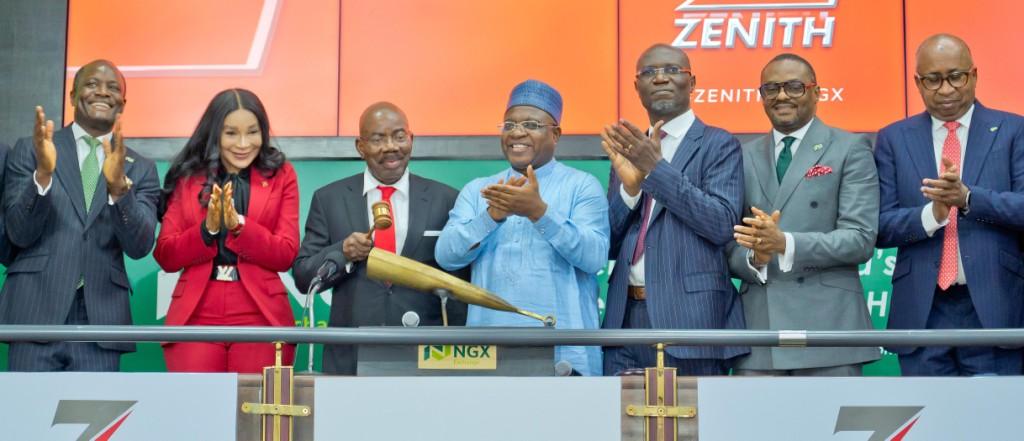
NGX Doyen Crowns Jim Ovia Doyen of Nigerian Banking Industry

Published

on

Zenith Bank NGX Closing GonG Ceremony

By Aduragbemi Omiyale

The doyen of the Nigerian Exchange (NGX) Limited, Mr Rasheed Yusuf, has described the chairman of Zenith Bank Plc, Mr Jim Ovia, as the “doyen of the commercial banking sector” in Nigeria because of his significant impact in the nation’s banking sector.

Speaking at the closing gong ceremony at the NGX in Lagos on Tuesday, Mr Yusuf commended Mr Ovia for his vision and leadership.

Also, speaking, the chief executive of Zenith Bank, Ms Adaora Umeoji, praised Mr Ovia for his leadership qualities, and expressed her delight in participating in the closing gong ceremony, acknowledging the visionary leadership and innovative initiatives of the bourse.

“We are delighted to be here today to perform the closing gong ceremony – a symbol of shared progress and enduring partnership,” Ms Umeoji said.

“The NGX’s leadership has been very creative and innovative, and their electronic trading platform – X-stream played a pivotal role in the success of our recapitalization exercise, which achieved a 160 per cent subscription.

“The bank’s stock price has doubled since the recapitalization exercise, from N36.50 per share to N68. Zenith Bank has also reported impressive financial results for the Half Year (H1) of 2025, becoming the most profitable bank in Nigeria and paying the highest dividend in the industry for the half year,” she added, noting, “We are committed to creating value for our stakeholders and will continue to partner with the NGX to boost the Nigerian economy.”

The foremost banker stated further that, “Our expansion strategy is focused on following our customers’ businesses and ensuring that we go to countries and economies where we can scale and provide more returns for our shareholders.”

She stressed that the bank plans to make good on its promise of being investors’ delight by paying quantum dividends to its shareholders by year end.

According to her “For us in Zenith, we are looking forward to paying more based on the confidence the market reposed on us. We are working assiduously to ensure that we do not disappoint the Market. We are going to continue to be the investors’ delight, and we assure the market that we would continue to pay enhanced dividends come end of the year.”

Also commenting, the Director General of the Securities and Exchange Commission (SEC), Mr Emomotimi Agama, emphasised the role of the NGX in creating value in the Nigerian economic space.

He said, “I want to thank you all for making the market what it is. Without you, the market wouldn’t have seen the leap that it has achieved in the last one-and-half year. I spoke earlier that at my assumption of office, market capitalization stood at N55 trillion, today it is hovering around 89 trillion and 93 trillion. That was not done by a spirit, it was done by you. Your ability, tenacity, courage, vision and transparency have moved the market where it is. Our vision is that by next year, we will have the market at 200 trillion.”


Banking

Why Fair Digital Access is the Foundation of Nigeria’s 2030 $1trn Roadmap Ambition

Published

on

Henry Obiekea, FairMoney Microfinance Bank

By Henry Obiekea

Nigeria’s pursuit of a $1 trillion Gross Domestic Product (GDP) by 2030 is perhaps the most significant economic objective in the nation’s history. This goal is audacious, yet wholly achievable, rooted in the nation’s greatest asset: its dynamic and youthful population. With a median age well below the global average, this demographic dividend is a reservoir of creativity, entrepreneurship, and innovation—the very fuel for an economic explosion.

However, harnessing this potential requires more than just ambition; it demands inclusive capital. Today, the brilliant ideas generated by young Nigerians—from tech startups to agri-business ventures—often stall due to a fundamental challenge: access to finance.

The Finance Minister, Mr. Wale Edun, recently amplified this imperative, urging financial institutions to actively finance the ideas of young Nigerians, warning that failure to do so risks pushing this talent into unregulated, unproductive ecosystems. This official focus underscores a critical truth: financial inclusion is the priority driver for meeting the $1 Trillion target.

Despite Nigeria’s status as a continental leader in technology adoption, a significant portion of its adult population remains financially underserved. Recent surveys show that the total gap—those entirely excluded or reliant only on informal systems—stands at 36%, representing approximately 40 million productive individuals.

This population includes 26% of adults who are fully cut off from the formal system, while another 10% rely solely on informal services. Persistent gaps are especially pronounced across regional and demographic lines, particularly in the North and among low-income groups.

Relegated largely to the informal economy, these millions of people are unable to save securely, build credit, or access the capital needed for scale. While mobile penetration, agent networks, and digital onboarding are actively narrowing the divide, sustained progress in inclusion-driven growth fundamentally demands access to credit.

Despite an observed increase in account ownership, Nigeria’s credit penetration remains notably shallow, registering between 13% and 19% of GDP, which is among the lowest globally and limits critical economic growth vectors, particularly for MSMEs and household consumption. This low credit-to-GDP ratio highlights a significant underdevelopment in the domestic credit market.

In contrast, regional African peers like Kenya and Egypt have credit ratios roughly twice as high, sitting between approximately 31% and 37%, supported by increasingly data-driven lending models that are more effective at reaching small businesses. Emerging global economies such as India and Brazil boast deep credit markets, where penetration reaches between 53% and 62%, providing the financial leverage necessary for robust private-sector expansion.

The extreme of the scale is occupied by nations with mature financial infrastructure, like South Africa, where the credit penetration rate is approximately 90% of GDP, underscoring the distance Nigeria must travel to unlock its full economic potential through a diversified and accessible lending base.

The opportunity lies in the digital revolution. With mobile phone usage soaring (over 93% of adults), the physical barrier of the bank branch has been rendered obsolete. Fintech companies in Nigeria have brilliantly seized this moment, leveraging mobile technology and data science to catalyze inclusion.

Digital access alone, however, is insufficient. The engine for sustained economic growth is authentic financial inclusion, characterised by fairness and transparency. Without these twin values, digital finance risks replacing physical exclusion with predatory models, characterised by hidden charges and opaque terms that ultimately erode trust, leading to financial distress and a retreat from the formal economy. To truly empower the populace and grow the GDP, every transaction must build, not break, the customer’s financial life. This is the principle that elevates financial services from a mere utility to a foundation of national economic strength.

This commitment to fairness is precisely where FairMoney acts as a crucial lever for the national ambition. Operating as a licensed microfinance bank providing financial services through our mobile app, FairMoney’s model directly tackles the barriers to entry by making every interaction transparent and efficient.

Our commitment to “no hidden charges” means customers understand the full cost of credit upfront, fostering a responsible borrowing culture. We leverage innovation to serve the excluded. We focus on accessibility and speed to enable instant account opening and rapid loan approvals by leveraging alternative data and advanced scoring algorithms, using technology for operational efficiency, such as Maps for remote operational address verification.

Beyond loans, we offer full-service banking with bank account numbers, competitive Fixed Deposits with good interest rates on savings, instant bill payments, and specialized services like POS services for small businesses. Our savings products, designed to track and build wealth, incentivize long-term financial health.

By providing these robust services with speed and transparency, FairMoney is not just offering a product; we are committed to digitally onboarding millions of Nigerians into a trusted, formal economic identity.

The impact of this fair digital model ripples across the economy, directly powering the $1 Trillion objective. A small business owner who secures a transparent, low-friction loan can instantly purchase inventory, hire staff, and expand operations. This immediate injection of capital and increased velocity of money—made possible by digital speed and trust—translates directly into higher output and taxable revenue, boosting GDP.

Also, by offering competitive savings and fixed deposit rates, we successfully mobilise capital that might otherwise sit dormant or be held in informal, non-productive assets. This pooled capital becomes the investment bedrock needed to fund the larger infrastructure and industrial projects essential for the 2030 target.

When entrepreneurs can access transparent loans or savings in a crisis, they prevent business collapse, maintaining employment and economic continuity. This resilience ensures that economic shocks do not derail the cumulative progress toward the national goal.

Authentic financial inclusion acts as a social safety net. Fairness in finance, therefore, is not a philanthropic ideal; it is a sound economic strategy. It ensures that the millions of productive economic units, especially the youth and the underbanked, are not just spectators but active, invested contributors to the nation’s growth story.

The path to a $1 Trillion economy is clear: it must be built on the principle of inclusion. This ambition will be realized by empowering the underbanked financially and leveraging digital solutions to dramatically improve access to finance across Nigeria. Financial institutions must champion Fair Digital Access—a commitment to innovation that FairMoney is already pioneering.

In the digital age, trust is the new currency. To fully unlock Nigeria’s trillion-dollar destiny, we must earn this trust through consistent value, transparency, and the fair and equitable deployment of financial capital.

Henry Obiekea is the Managing Director of FairMoney Microfinance Bank Nigeria

Continue Reading

Banking

NDIC Now With Stronger Legal Backing for Liquidation Mandate

Published

on

NDIC bank fraud

By Adedapo Adesanya

The Nigeria Deposit Insurance Corporation (NDIC), says its laws are now stronger and more effective to carry out its bank liquidation mandate.

The agency disclosed this in a statement issued on Sunday in Abuja by its Head of Communication and Public Affairs Department, Mrs Hawwau Gambo.

The statement quoted the NDIC chief executive, Mr Thompson Sunday, as saying the powers in liquidation of failed insured institutions had been enhanced with the enactment of the NDIC Act No. 30 of 2023.

Mr Sunday said that the Banks and Other Financial Institutions Act (BOFIA) 2020, also empowered the Corporation.

According to him, the NDIC is now better positioned to prosecute parties at fault in bank failures, unlike in the past when insufficient legal provisions allowed such individuals to evade accountability, commending the National Assembly for addressing the long-standing challenge of a weak legal framework which had constrained the corporation’s operations.

He also commended the judiciary for its growing expertise in deposit insurance law and practice, as demonstrated by the effective adjudication of failed bank cases through judgments that had brought relief to depositors.

“With stronger legal backing, individuals now approach the corporation to settle out of court, not necessarily because the law has caught up with them, but because they can see that the noose is tightening around those responsible for bank failures.

”The corporation’s ability to realise sufficient assets to declare a first round of liquidation dividends to the uninsured depositors of defunct Heritage bank Limited within one year of the revocation of its licence is due to the positive impact of the new legal framework,” Mr Sunday said.

He reiterated that the NDIC would continue to leverage the strengthened laws while collaborating with stakeholders to enhance the effective discharge of its mandate.

Continue Reading

Banking

Summit Bank Commences Non-Interest Banking Operations in Nigeria

Published

on

Summit Bank

By Faridat Yusuf

Nigeria’s new non-interest bank, Summit Bank Limited, has started full operations, promising to give Nigerians honest, clear, and fair banking services.

The Central Bank of Nigeria (CBN) listed Summit Bank as a regional non-interest bank with its head office in Abuja. It joins other non-interest banks in Nigeria like Jaiz Bank, Taj Bank, and Lotus Bank.

The Managing Director, Mr Sirajo Salisu, during a press briefing in Abuja, said that the bank was seeking to serve Nigerians very well.

“We are live, well-regulated, fully operational, and ready to serve Nigerians with clarity, integrity, and purpose.”

He also talked about people thinking the bank was linked to a big bank, saying, “We have followed the conversations with interest and gratitude, and the curiosity we have carefully observed tells us that people care about us and about ethical finance, now is the time for clarification, as Summit Bank’s establishment and operation have gone beyond speculation,” he stated.

On his part, the bank’s Executive Director, Mr Mukhtar Adam, said, “While some of our directors have built accomplished careers at frontline financial institutions such as Zenith Bank, Summit Bank is an independent financial entity governed by a professional board and fully compliant with Central Bank of Nigeria regulations.”

He added, “Our offerings promise no hidden costs or complicated banking for both banked and unbanked Nigerians, with clear, compliant banking services backed by robust technology, sophisticated banking infrastructure, and tested human resources.”

The bank was started in July 2024 and got its CBN licence in February 2025.

Continue Reading

Trending