
Banking
Who Owns Legacy Shares After $864m Write Off At Ecobank; Post Securities Fraud

By TheAnalyst/Proshare Research/News & Investigations
Following our May 10, 2015 publication on “How to buy a Nigerian bank with no money” and the series on why Skye Banks’s bid for Mainstreet Bank was a certain death knell for the bank; viz: “Reworking the Acquisition Maths of Mainstreet Bank by Skye Bank Plc” and “The Surprising New Math of Acquisition of Banks in Nigeria – The Skye Bank Case”; we have received a deluge of information and insights that has encouraged the belief that the operators in the Nigerian capital market are fundamentally hardworking men seeking the reversal of the normalization of absurdities that ensue.
Recent developments in the market, however, indicate that the non-resolution of key issues around regulatory oversight continues to harm the efforts of well-intentioned professionals to establish a culture of accountability, process, probity and best practice.
Most of these issues were easily predicted but more curious in the case of Ecobank was that they were audited and investigated by regulators and independent professional firms; yet no discernable actions were taken.
How a “Results Release” Empowered a Review
After the deluge of 2016 Annual financial accounts of key entities on the bourse and especially those in the financial services sector in Q1 2016; we have had cause to review the finer details of the returns given the key issues around quality of assets, legacy debts, difficulty in resolution of AMCON related loans and the general management of the banking entities during a very difficult time especially after the release of the financial stability report and ratings by credible rating agencies.
In the course of this review, interest was raised concerning a disclosure by Ecobank Transnational Incorporated (ETI) in its release to the bourse and market as captured here
ETI Declares N52.6bn Loss After Tax in 2016 Audited Results (SP:N8.20k), where it stated that, “Full impairment losses on financial assets of $864m absorbed, predominantly from specific client names related to a legacy portfolio experiencing deterioration in quality.”
This immediately raised our curiosity as we had covered developments around the challenges in the bank from 2013 up to and including 2016; especially during the public governance challenges raised then which have since been resolved.
A few enquiries soon revealed that of this $864m impairment, about $600m should relate to share purchase/margin loans portfolio issues arising from a public offer issued by ETI; and adjudged successful by management and SEC.
Who Owns the Shares After the Write-Offs?
The immediate questions arising centred around the following:
Who were the obligors?
What was written off and against whom and why?
What happened to the shares written off?
Who are the current owners (controlling and non-controlling) of the shares today?
Soon enough, these concerns grew into a much larger reality and remain pertinent given the unresolved issues and concerns raised and escalated to the Securities & Exchange Commission (SEC) in 2014; and became a public matter.
The Ernst & Young’s 2014 audit review, commissioned by the ETI board sub-committee to enable the group to respond to observations made in the regulators’ reports and to empower the management to respond to the concerns of the board on related matters; the scope of work covered:
- Examination of ERTI’s Share capital since incorporation;
- Review of consultants’ contracts issued by ETI between 2005 and 2013;
- Review of the specific questions raised by regulators, with specific reference to BEWCASTLE, WAVES BUILDING acquisition and oceanic bank transactions;
- Review of Ecobank’s 2008 public Offer; and
- Review of Ecobank Nigeria’s margin loan portfolio.
The Crucial Ernst & Young Report
The E&Y report made crucial and damning disclosures summited in its report for discussion to the board, viz:
“From the work we have done, it is clear that the Group’s governance framework and internal control procedures are not robust and have failed on a number of occasions. ….it is clear that senior executives, in their dealings with the Board, had been economical with the facts relating to matters presented to the Board and had not discharged the duties of their offices in a manner that would be generally accepted as acting in the best interests of the Bank and Group.
That was only going to be a teaser as they went on to make categorical executive summary statements/positions; highlighted below:
In particular, we would draw the attention of the Board to the following:
- No clear records have been maintained in the financial accounting department for key transactions. In particular, we are unable to locate documentation that clearly identifies and explains movements as they pertain to the share capital accounts.
- Payments have been made to contractors for large sums that have not been properly contracted or authorized.
- It is clear that the purchase of WAVES BUILDING and selected transactions were not properly brought to the Group Board for approval and validation. The way in which the former GCE (Arnold Ekpe) acted unilaterally without Board approval for a transaction that required significant borrowing to finance the purchase of the Waves building calls into question the probity of the transaction.
- The margin loans credit files do not fully explain or demonstrate any independent assessment of the quality of the credit prior to the granting of the loans.
- For a number of transactions during the period, relevant Board sub-committees have not been consulted. No proof has been provided for evidence of Board mandates/approvals that would be expected business practice when lending money to corporate PLCs – for example Ecobank Nigeria did not seek for ETI Board approval before lending money to finance Waves building. Indeed, corporate seals have been applied to documents in contradiction of the Articles of association.
- With regard to the guarantee given to Ecobank Nigeria by ETI for the loan made to Bewcastle, we can find no evidence of security taken or offered to ETI that would underwrite the guarantee. In effect, on paper, the group has guaranteed a loan made by its subsidiary to itself.
- A number of clients’ money through margin loans, used the proceeds to purchase ETI shares during the fundraising. These purchases, made up over 30% of the total offer and 57% of the shares sold in Nigeria. None of these activities were part of official underwriting activity.
- Furthermore, we found no evidence of shareholder approval for the board to purchase of facilitate the purchase of the company shares. Additionally, the bank’s own risk management system can demonstrate no evidence of action been taken to prevent this behavior.
- Given the volumes identified, it is difficult to conclude that this activity did not have a distorting effect on the content and success of the offer. The sanctioning of this activity was in violation of both the articles of association and generally accepted business rules/practice.
- In addition, this action could be considered to have contravened the CBN/SEC Guidelines and rule (6d) on Margin lending.
- The creation of TBPIC and related transaction removed non-performing margin loans from the balance sheet and converting them to an investment asset (held to maturity).
- We believe ETI carries the full burden of the potential liabilities that could arise from failure of TBPIC to service the interest on the Promissory Note and/or the eventual redemption of the Promissory Note. Management at both ETI and Ecobank Nigeria were unwilling to share information with EY on this transaction and therefore we are unable to comment on any potential impairment or the adequacy of the put-option agreed by ETI to hedge the transaction.
We can infer from above that the current management has had to contend with a lot of challenges which this forewarned eventuality led to the decisions taken in the 2016 accounts.
Not knowing the exact extent of the problem however does not inspire confidence that the full effect has been cleared and indeed, that the bank now owns the shares (funded from its own resources).
The Crucial Ex-Chairman Letter to SEC That Was Ignored
The larger concern, as alluded to earlier about how SEC/CBN dropped the ball on a report (originated by the CBN banking supervision which raised the concerns) is what will be examined in a subsequent write-up.
That became secondary when our file review came upon a 2nd October, 2014 suit filed at the Federal High Court of Nigeria in the Lagos Judicial Division by the erstwhile chairman of the bank against ETI, Ecobank Nigeria, SEC, Arnold Ekpe and five (5) others. It is instructive to note that these suits before Justice Abang have since been settled out of court.
Yet the public declaration therein appears pertinent and instructive. The August 18, 2014 acknowledged letter addressed to the Director-General of the Securities and Exchange Commission (SEC) was designated as being in the interest of justice, to protect the integrity of the market and sustain investors’ confidence in the capital market. We reproduce the same (as is) below:
SUSPECTED SECURITIES FRAUD, SHARE PRICE MANIPULATION, ILLEGAL TRADING IN RESPECT OF ECOBANK TRANSNATIONAL INCORPORATED (ETI) SHARES CONTRARY TO CENTRAL BANK OF NIGERIA REGULATIONS (CBN) AND SECURITIES AND EXCHANGE COMMISSION (SEC) RULES
- I was the Chairman of the Board of Ecobank Transnational Incorporated until the 29th October 2013. As you know, Ecobank Transnational Incorporated (“ETI”) is a transnational banking institution registered in Togo with headquarters in Lome, Togo, doing business and having offices in over 37 countries around the world including Nigeria. It is listed on the Nigeria Stock Exchange (“NSE”) and its shares are traded in Nigeria.
- In Nigeria, ETI operates banking business by license under the Banks & Other Financial Institutions Act, 1991, Cap B3, Laws of the Federation of Nigeria, 2004 by its subsidiary Ecobank Nigeria Ltd. (“Ecobank Nigeria”).
- The Board of ETI has, at the company’s AGM which took place on 30th June 2013, presented to the shareholders audited accounts for the year ended 31st December 2013 which contained heavy provisions described as being due to ‘certain legacy assets in Nigeria’. No further information or explanations were given to shareholders. The Board, having been alerted by an independent investigation that it commissioned Ernst and Young (EY) to carry out, to the fact that these losses derived from illegal and possibly fraudulent transactions, failed to fulfil its statutory duty of disclosure to shareholders.
- As the Chairman of the Board at the time of EY investigation was commissioned, I instructed my lawyers to write a letter to the Board expressly warning them of the illegality of presenting these accounts to the shareholders without making full disclosure of the facts. This letter was delivered to board members on the 26th June 2014 (See Appendix 1). Unfortunately, the letter was ignored by the Board of ETI and this obvious dereliction of duty continues to date.
- I am therefore legally and morally bound to bring these matters expressly to your esteemed attention as I outline as follows:
- Sometimes in 2012 the Central Bank of Nigeria (CBN) and Nigeria Deposit Insurance Corporation (NDIC) issued a Report of the affairs of Ecobank Nigeria. This report was brought to the attention of Mr Thierry Tanoh, the then Group Chief Executive of Ecobank Transnational Incorporated, the parent company of Ecobank Nigeria, by officials of the Central Bank of Nigeria who requested Mr Tanoh to investigate certain transactions which they had found suspicious. Over time, further enquiries conducted by me, including a briefing by the Chairman of Ecobank Nigeria and the Managing Director of Ecobank Nigeria at a meeting in Lagos on the 26th August 2013, led to my discovering of unauthorized and illegal transactions bordering on securities fraud, share price manipulation and illegal trading of ETI shares all orchestrated by the then management of Ecobank Nigeria, acting under instructions of the Executive Management of the parent company ETI. The Board of ETI was given false information in an effort to conceal these matters. These transactions have led to the drastic reduction and devaluation of ETI shares to the detriment of shareholders and investors.
- As the Chairman of the Board of ETI, it became my legal and moral duty to bring these facts to the attention of the Board of ETI, which I did in writing in a detailed letter to the Board dated September 17 2013. (Copy attached as Appendix 2). I presented and expanded on this letter to the Board at its meeting on September 20, 2013, and the deliberations were fully recorded in the minutes of this meeting. (Copy attached as Appendix 3). By the time your esteemed organization had commenced a corporate governance review of ETI and my expectations were that this review, which included a study of Board minutes, would have focused on the weighty issues raised in the minutes of the meeting of September 20, 2013. Unfortunately, this was not the case. In the end, the intervention by SEC and its consultants KPMG failed entirely to address these issues, which I would respectfully state were far more serious than the furore over so-called corporate governance lapses.
- The Board eventually agreed to commission the accounting firm. Ernst and Young (EY) to investigate these issues and I am aware that EY has now issued a report which corroborates the matters I presented to the Board at the aforementioned meeting. As a result of EY’s findings, the Board was compelled to make heavy provisions in the audited Group Accounts for the year ended 31st December 2013. These extraordinary provisions drastically reduced Group profits, resulted in a loss in AETI stand-alone accounts and made it impossible for dividends to be paid.
- The timeline of events can be summarized as follows:
- In 2007, the Board of ETI was informed that Renaissance Capital (a company which at the material time held 24.99% shareholding in ETI) was preparing to launch a hostile take-over of ETI. This take-over was intended to give Renaissance Capital a majority and controlling shareholding in ETI.
- In a bid to resist the take-over, the management of ETI began a defence of the institution by robustly engaging Renaissance Capital in meetings and discussions to ensure that the take-over did not succeed and also encouraged Renaissance Capital to sell down its holdings.
iii. During this attempted take-over by Renaissance Capital, Ecobank Nigeria was instructed by the Executive Management of ETI to unlawfully purchase and hold large volumes of ETI shares. This instruction was given surreptitiously and without the approval of the Board of ETI.
- This led to the reduction in ETI’s group capital because Ecobank Nigeria unlawfully gave substantial margin loans to stockbrokers to acquire and hold the shares.
- According to the findings of the EY investigation, the margin loans were issued without any independent assessment of the quality of credit prior to the granting of loans. As a result, ETI shares were bought with margin loans granted by Ecobank Nigeria to its customers, namely; (i) Mega Equities Limited; (ii) Falcon Securities Limited; (iii) ICMG Securities; and (iv) Springboard Investment Company. There appears to have been a tacit agreement with these customers that the bank would have no recourse to them as they were effectively holding the ETI shares on behalf of the bank. This of course provided an avenue for the manipulation of the share price of ETI.
- During this struggle with Renaissance Capital, Nigerian banks went to the market to raise capital but neither Ecobank Nigeria nor ETI could access the market at this point because the NSE refused to approve ETI’s plan to raise capital whilst the shareholder dispute with Renaissance Capital remained unresolved.
vii. This adversely affected Ecobank Nigeria because its capital had been eroded by the acquisition of ETI shares.
viii. Sometime in 2008, the Executive Management of ETI approached the Board to launch a Rights Issue to raise $2.5 billion from the capital market. This rights issue was launched in August 2008 and involved the bank in over one billion naira in expenses. Unfortunately, before the offer could close, the global financial crisis had set in and it became obvious that the projected $2.5 billion could not be raised.
- Upon closure of the public offer, the ETI Executive management reported to the Board that the subscription met the minimum percentage prescribed by the Commission. It has now been revealed that this was false and that the executive management of ETI deliberately misled the Board, the NSE and the Commission. Vital information regarding the true state of affairs was deliberately concealed from the Board.
- It has also since been discovered that through the non-recourse margin loans, depositors’ money were used unlawfully to purchase ETI shares which constituted over 30% of the total subscription.
- Another significant revelation is that the capital raised was substantially short of the 25% threshold (by about US$126 million) and that in reality all underwriting arrangements had failed.
xii. Instead of returning the monies to the investors as stipulated by the Commission’s Rule, Ecobank Nigeria, under the instruction of the Executive Management of ETI, unlawfully provide monies to stockbrokers to take up the shortfall. Again, for the second time, Ecobank Nigeria’s capital was used to buy and warehouse ETI shares. The public offer was priced at N38 per share. The fact that the subscription threshold was not met and that soon after the offer closed the share price fell to N8 proves that those people who had genuinely subscribed to the offer and whose money should have been returned, were made to incur heavy losses which have still not been recouped till today.
xiii. Since the bank had agreed with the stockbrokers that there would be no recourse to them for the loans granted, the bank has borne the full burden of the losses. The loans have been disguised as real estate loans or as fictitious margin loans. It is the totality of these fictitious loans that have been described in the 2013 accounts as ‘certain legacy assets in Nigeria’ and written off.
xiv. Management continued to conceal the afore-mentioned fraudulent transactions from the Board as well as the fact that the losses were the reason for the depletion of capital which the management presented to the Board as necessitating further proposed capital raising. With this excuse (now proven to be unjustified) the Executive Management of ETI convinced the Board to enter into a series of transactions, which involved the issue of large blocks of shares to certain institutions:.
These institutions include:
- The Public Investment Corporation of South Africa (Hereafter “PIC”) (now the largest shareholder in ETI);
- NEDBANK of South Africa (Hereafter “NEDBANK”), whose debt instrument, convertible at their potion, gives them the right to convert and top up to hold 20% of the ETI equity;
iii. AMCON: issued with 14% of the ETI equity at the depressed price as consideration for the purchase of Oceanic Bank. The procedures surrounding the purchase of Oceanic Bank by ETI have since been proved to be irregular by the independent audit report commissioned by the Board;
- The International Finance Corporation (IFC) has converted $175 million of debt into equity at the depressed price, giving hem close to a 16% interest in the ETI equity;
- These four entities now control or have the right to control 68% of the equity of ETI.
- In addition to these private placements, the then GCEO and other Executive Directors of ETI have exercised stock options at the depressed price and have since overseen the transfer of approximately 200 million dollars’ worth of ETI shares in an opaque manner to unknown persons through a special purpose vehicle called TBPIC. Again no Board approval was sought for this arrangement. In summary, large blocks of ETI’s equity have been given away at a massive discount meaning that a significant percentage of ETI had been sold for the equivalent of one year’s (that is 2012) profit before tax.
xvi. These transactions had serious implications for ETI shareholders, the stock market and investors and led to the devaluation of ETI share value.
xvii. All those who subscribed to the failed rights issue in 2008 and whose monies should have been returned were defrauded because they paid an artificial unsustainable price for their shares. The shares were offered at N38, the offer failed and the price very quickly fell to N8.
xviii. Ecobank Nigeria’s competitiveness was effectively destroyed through depletion of its capital by up to $400 million. The margin loans to stockbrokers could not be sold to Asset Management Corporation of Nigeria (Hereafter “AMCON”) neither could the bank have recourse to the Stockbrokers because of the tacit agreements the management of ETI and EBN has reached with them.
xix. Since then until January 2013, ETI shares had underperformed in the market and traded well below book value. Ecobank Nigeria is still undercapitalized compared to its peers and continues to struggle to compete.
- It has now been discovered that the board was misled through false information provided by the Executive Management to accept investment from NEDBANK and PIC in order to fraudulently increase the shareholding of the South African institutions and create a platform for the corporate takeover of ETI by these combined South African interests.
- Further discoveries have also shown that the then GCEO, Mr Arnold Ekpe has private business connections with the PIC and that he was involved in a plan for the PIC to gain control of NEDBANK thereby creating a situation where the PIC would control a combined 40% stake in ETI. These disclosures were made at a Board meeting held on 30th August 2013 by Mr Sipho Mseleku, a South African Director on the Board and Dr Daniel Majtila, the Director representing PIC on the Board and are recorded in the minutes of the meeting. (Attached as Appendix $: page 8 clause xxviii)
- An investment company called Atlas Mara has recently been formed and listed on the London Stock Exchange. This company raised substantial funds on listing. Papers filed by the company disclosed that the GCEO of ETI at the time these transactions were orchestrated, Mr Arnold Ekpe, is the Chairman of Atlas Mara. The papers file also discloses Atlas Mara’s intention to acquire an African Financial Institution. I also have information on good authority that Atlas Mara has made offers to buy the AMCON and IFC shares in ETI.
- Consequent to my letter of September 17 2013, the Board commissioned an independent audit and management firm, Ernst and Young (“EY”) to conduct an independent investigation into these suspect transactions and examine ETI’s share capital. EY, having concluded its audit, submitted a report dated 7th February 2014 to the Board and this report confirms that securities fraud in fact occurred and that ETI share were bought with margin loans granted by Ecobank Nigeria to its own customers.
- I believe that an investigation by the Commission into these allegations will protect the integrity of the market and sustain investors’ confidence in the capital market and a failure to investigate will give room for the continued perpetuation of fraud aimed at transferring control of ETI at a price well below the enterprise value of the institution.
- Furthermore, the validity of all private placements and special allotments of shares in ETI since 2008 has to be legally questioned because they all take their root from the fraudulent actions outlined above. These actions have compromised the integrity of the capital market and put investors’ monies to risk.
Accordingly, I now humbly request the Commission in its statutory capacity as the apex regulatory body of capital market activities, to carry out an investigation into these fraudulent activities with a view to redressing the fraud against the owners of the bank and bringing those who were complicit in this large-scale securities fraud to justice in line with its powers and duties under the Investments and Securities Act, 2007.
I believe that it will also be in the interest of justice that, pending the determination of the investigation, the Commission should;
- Demand a copy of the EY Report from the Board of ETI;
- Suspend all trading(s) in respect of ETI shares and ;
- Place a restriction on the rights of Mr. Arnold Ekpe, the Public Investment Corporation of South Africa, AMCON, International Finance Corporation and NEDBANK to vote, transfer, sell or otherwise deal in ETI shares either in their own name or in the names of any proxies.
I wish to assure you of my full co-operation in this investigation and I will attend any hearing or meeting, which the Commission may hold in respect thereto. If however the Commission neglects to commence it statutory duties (within fourteen days from the receipt of this letter), I and other affected shareholders will be constrained to approach the appropriate judicial authority for relief.
I would request that you kindly treat this letter as the statutory pre-action notice to the Commission prescribed by Section 289 of the Investments and Securities Act, 2007.
Holding Conclusions
While we continue to seek answers from the esteemed institution, who by all accounts, have since acted responsibly and perhaps without option in writing of some or majority or all of these margin loans and share purchase transactions; shareholders cannot conveniently say they are better off from where they were in 2014.
Recall that Ecobank Transnational Incorporated (ETI) and Ecobank Nigeria have absolved the former ETI Chairman of all allegations made against his person and his chairmanship of the board as presented during the 2013 Ecobank Board “Governance Crisis”, in which the Securities & Exchange Commission (SEC) of Nigeria played a central role and issued several public releases. This significant move must have been encouraged by the current leadership’s commitment to accountability and due process.
We acknowledge the prudence and professionalism shown so far but believe that this would be properly concluded if clarity is provided as to the current ownership of the shares under reference; and how it was retrieved/treated in the books.
Publicly, there is no clarity on this and other related misappropriations running into billions of naira; nor do shareholders (of which we are one) know of the revised register of members of ETI subsequent to the resolution of this fraud (now written off).
The role of the Securities and Exchange Commission (SEC) is naturally brought to the fore.
It is our hope that as we conclude our review of this episode, institutional memory can give way to a deployment of organizational imagination by all parties involved; especially from the Securities & Exchange Commission, Central Bank of Nigeria and ETI.
Source: Proshare Research






By Adedapo Adesanya
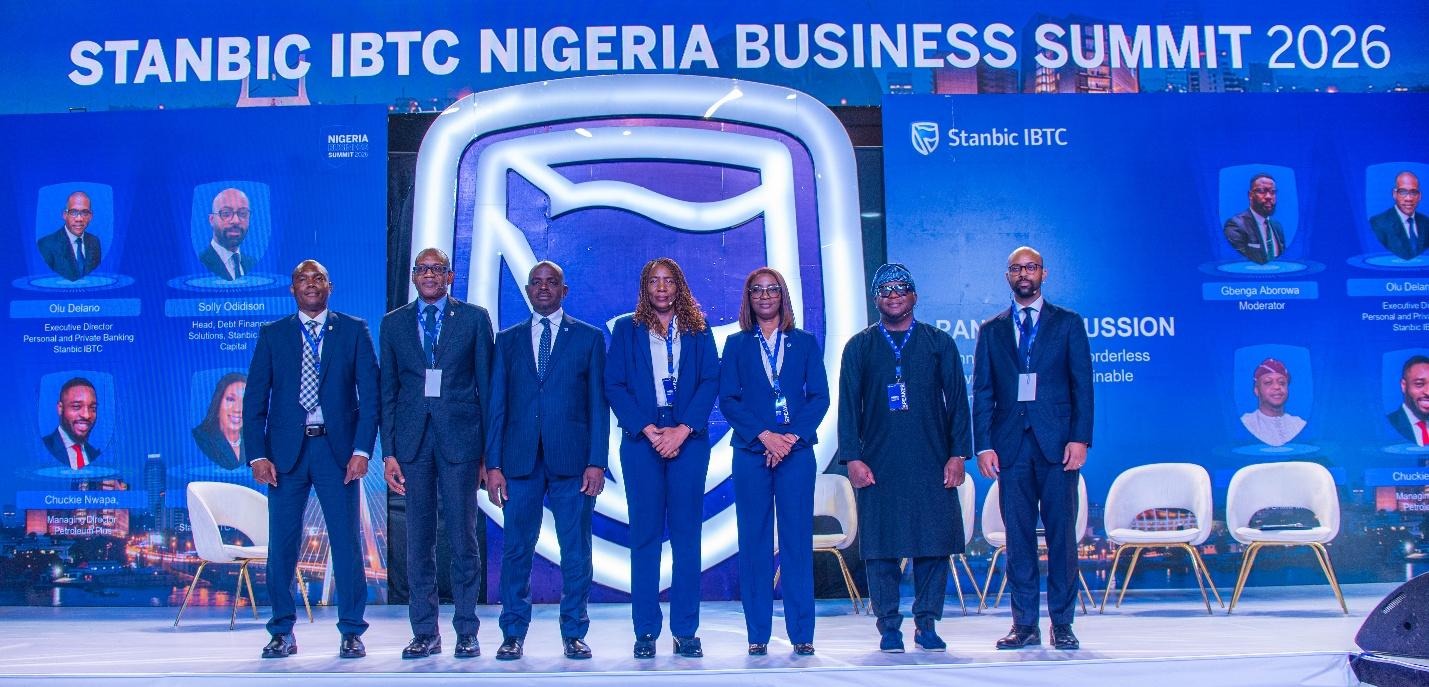
Top financial services provider in Nigeria, Stanbic IBTC, has reiterated its commitment to empowering businesses, strengthening key sectors and positioning Nigeria as a competitive player in the global economy.
This came on the back of the 2026 edition of the Nigeria Business Summit from Wednesday, April 1 to Thursday, April 2, 2026, at the Landmark Event Centre, Victoria Island, Lagos. The two-day summit brought together industry leaders, policymakers, entrepreneurs and stakeholders across multiple sectors to explore sustainable business practices, foster economic growth and unlock global trade opportunities.
With the theme, Nigeria Means Business: Powering Sectors, Growing Sustainable SMEs & Unlocking Global Trade, the summit addressed critical issues across key sectors, including agribusiness, renewable energy, trade and Africa–China banking, as well as ICT and telecommunications. Additional sessions covered areas such as family business sustainability, artificial intelligence, employee value banking, insurance, pension and wealth management.
The event featured a keynote address by the Minister of Finance and Coordinating Minister of the Economy, Mr Wale Edun, who emphasised the urgent need for Nigeria to reposition itself as a leading export-driven economy to achieve sustained growth.
“Our true potential lies in becoming a leading export economy,” Edun stated. “Increased participation in regional and global trade will be critical to diversifying foreign exchange earnings and driving inclusive growth.”
He noted that while Nigeria’s GDP growth has improved to approximately 4 per cent, it remains below the level required to significantly reduce poverty. According to him, the country’s economic strategy is now shifting from stabilisation to growth acceleration, with trade expansion playing a central role.
Mr Edun highlighted ongoing reforms, including improved foreign reserves, rising non-oil revenues and renewed investor confidence, as indicators of a more resilient economy. However, he stressed that enhancing trade competitiveness would require continued investment in infrastructure, logistics and policy coordination.
He also highlighted the importance of small and medium-sized enterprises (SMEs), which account for over 90 per cent of businesses, noting that inclusive growth will depend on stronger collaboration between the public and private sectors.
Participants engaged in a rich line-up of activities, including expert presentations, panel discussions and high-level networking opportunities. Highlights of the summit included the Africa Trade Barometer presentation, client testimonial showcases and insightful discussions on the state of the African economy and intra-African trade opportunities.
Breakout sessions on agribusiness, ICT and healthcare, Africa-China banking and trade, as well as renewable energy, provided attendees with deeper, practical insights into some of the most critical sectors driving Nigeria’s economic future.
Speaking at the event, Mr Chuma Nwokocha, chief executive of Stanbic IBTC Holdings, represented by the organisation’s Chief Finance and Value Management Officer, Mr Kunle Adedeji, emphasised the importance of collaboration and innovation in driving sustainable growth.
“This summit has reinforced the importance of creating platforms where ideas can flourish, and businesses can grow sustainably. By working together, we can unlock new opportunities and drive economic advancement across Nigeria and the African continent,” he said.
The summit also spotlighted practical strategies for integrating sustainability into business operations, encouraging organisations to adopt environmentally conscious practices while maintaining profitability and competitiveness.
Mr Remy Osuagwu, Executive Director, Business & Commercial Banking, expressed satisfaction at the level of interest from participants, a critical element for a successful summit.
“From our conversations on energy and healthcare to the deep dives into trade, Africa-China relations, and agribusiness, Day 1 has offered perspectives that were both insightful and practical. I believe we’re all leaving with a stronger understanding of the opportunities emerging across our industries,” he said.
He acknowledged the level of engagement, questions, contributions and willingness of participants to share experiences, describing this as the real power of the Nigeria Business Summit, and a solid foundation for tomorrow.
The Chief Executive of Stanbic IBTC Bank, Mr Wole Adeniyi, who was represented by Mrs Bunmi Dayo-Olagunju, Deputy Chief Executive of Stanbic IBTC Bank, opened Day Two of the Nigeria Business Summit by highlighting the focus of the summit’s SME Day.
“Today, we build on Day One’s momentum with conversations that are equally critical for the future – from the dynamics of family businesses to the growing influence of artificial intelligence; the evolution of insurance, and the emerging space of electric vehicle banking.”
She further added, “Our goal on Day Two is simple: to explore what’s next. To understand how these developments will shape our businesses and how we can position ourselves ahead of the curve.”

By Dipo Olowookere
Tech enthusiasts interested in participating in the Take on Squad Hackathon, organised by Guaranty Trust Holding Company (GTCO) Plc, can now enter the contest via the official portal at https://squadco.com/hackathon.
The programme enters its third edition in 2026, and the theme for this year is Smart Systems: The Intelligent Economy, according to a statement issued by the organisers.
The hackathon brings together developers, designers and entrepreneurs across Nigeria in a collaborative environment to build practical solutions across key sectors, including financial services, healthcare, commerce and digital inclusion.
Participants are challenged to design and build intelligent, data-driven solutions that transform how communities engage with money.
It is part of the organisation’s commitment to fostering innovation, empowering talent, and supporting the development of technology-driven solutions that address real-world challenges across Africa.
“Today’s dynamic, digitally driven world demands continuous innovation, which is shaping how economies grow, how businesses scale, and how societies evolve.
“Through Take on Squad Hackathon, we are deliberately investing in the ideas and talent that will define the future.
“Our objective is not simply to encourage innovation, but to enable its translation into scalable solutions that deliver real and measurable impact.
“This reflects GTCO’s role as a financial services platform that connects capital, capability, and creativity to drive sustainable progress,” the Managing Director of HabariPay, Ms Eduofon Japhet, stated.
The social coding event remains a cornerstone of HabariPay’s mission to foster creativity and problem-solving among emerging tech talents. Competing teams will leverage Squad’s advanced APIs to create scalable digital tools that address everyday challenges faced by businesses and individuals.
Through initiatives such as this, GTCO continues to position itself at the intersection of finance, technology and enterprise, actively shaping the future of digital transformation in Africa.
By Dipo Olowookere
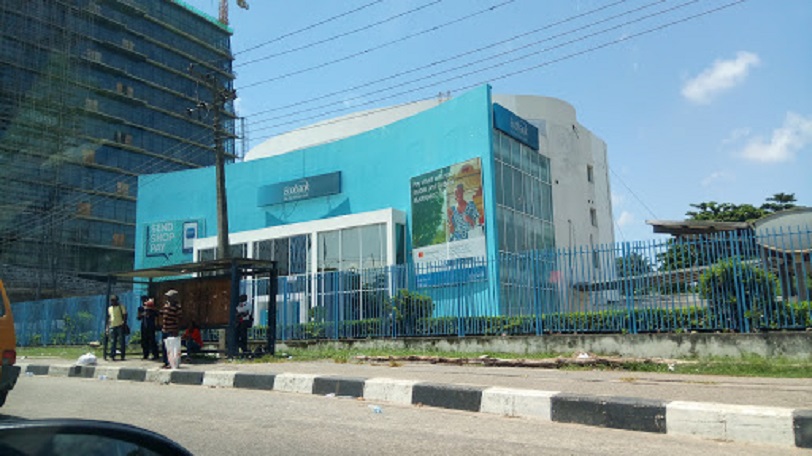
Banking services will not be interrupted throughout the Easter public holidays, from Friday, April 3, to Monday, April 6, 2026, for any reason, Ecobank Nigeria has assured its customers.
In a message over the weekend, the member of Africa’s leading pan-African banking group, Ecobank Transnational Incorporated, said customers would continue to enjoy quality service delivery during the period.
It noted that its secure and robust digital platforms would remain fully operational to support financial activities during the festive period.
All digital channels, including the Ecobank Mobile App, Ecobank Business App, USSD *326#, Ecobank Online, OmniPlus, Omnilite, EcobankPay, Ecobank Cards, ATMs, PoS terminals, and over 35,000 Ecobank Xpress Point agent locations nationwide, will remain accessible throughout the holiday, the financial institution further said, urging customers to conveniently conduct transactions at any time using this wide range of digital solutions.
Ecobank customers were encouraged to maximise the bank’s alternative channels for transfers, bill payments, airtime purchases, card services, and account management.
They were also advised to stay vigilant by shopping only on trusted websites; avoiding the sharing of PINs, passwords, and one-time passwords (OTPs); refraining from banking on public Wi-Fi networks; being cautious of urgent or emotionally charged messages; and regularly monitoring their account activity.
“Customers will continue to enjoy a full bouquet of services during the holiday, including local and international funds transfers, bill payments, airtime top-ups, merchant payments, balance enquiries, account statements, and cardless cash withdrawals via ATMs,” the Head of Products & Analytics, Consumer & Commercial Banking at Ecobank Nigeria, Mr Victor Yalokwu, stated.
“We understand that festive seasons come with increased financial activity, and our priority is to ensure our customers enjoy fast, reliable, and secure banking wherever they are.
“Our digital channels are designed to support uninterrupted transactions, and we have strengthened our systems to guarantee optimal performance throughout the Easter break,” he added.
Mr Yalokwu noted that, “Ecobank remains committed to providing innovative financial solutions and exceptional customer service. We wish all our customers and partners a peaceful and joyful Easter celebration.”
-
 Feature/OPED6 years ago
Davos was Different this year
-
Travel/Tourism10 years ago
Lagos Seals Western Lodge Hotel In Ikorodu
-

 Showbiz3 years ago
Estranged Lover Releases Videos of Empress Njamah Bathing
-
 Banking8 years ago
Sort Codes of GTBank Branches in Nigeria
-

 Economy3 years ago
Subsidy Removal: CNG at N130 Per Litre Cheaper Than Petrol—IPMAN
-

 Banking3 years ago
Sort Codes of UBA Branches in Nigeria
-

 Banking3 years ago
First Bank Announces Planned Downtime
-

 Sports3 years ago
Highest Paid Nigerian Footballer – How Much Do Nigerian Footballers Earn