
Banking
Wema Bank’s ALAT Gives Quick Loans, Virtual Dollar Card to Customers

By Dipo Olowookere
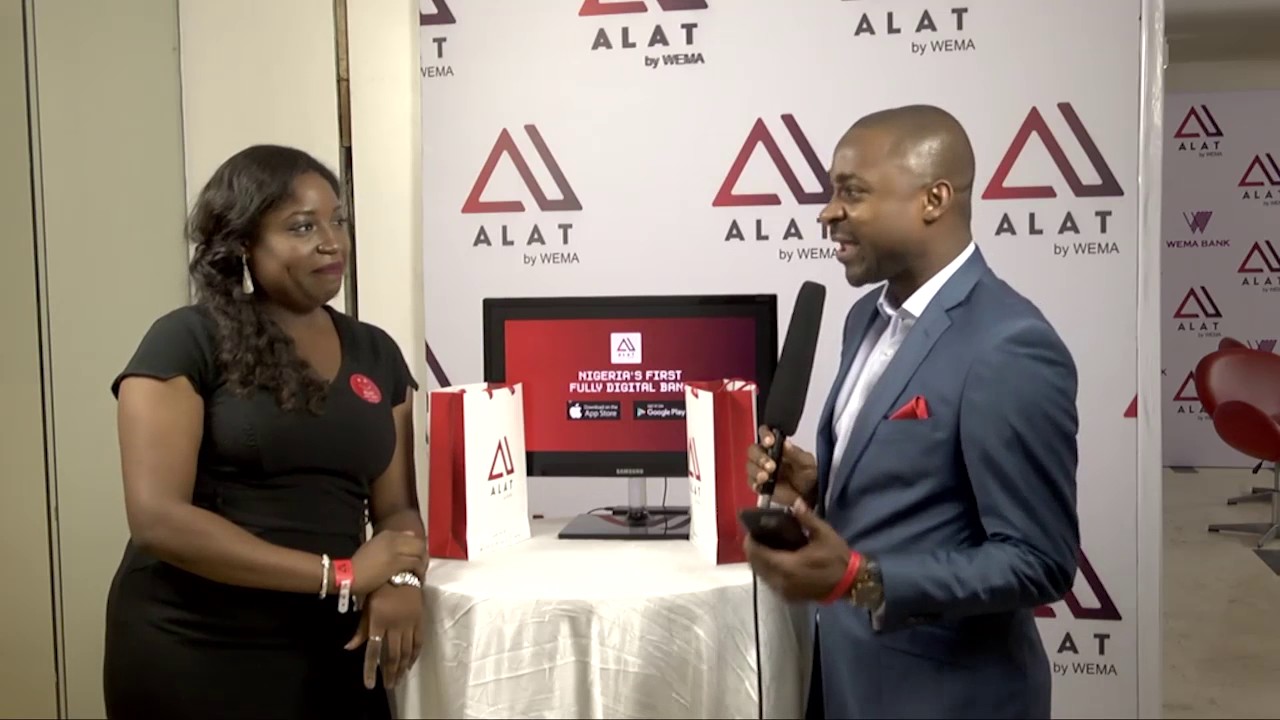
Nigeria’s only fully digital bank created by Wema Bank Plc, ALAT, has released two exciting new features; quick short-term loans and a virtual dollar card for paying online internationally.
A statement issued in Lagos by the lender explained that ALAT Loans are accessible to all ALAT customers through the bank’s Android and iOS apps.
The ALAT Virtual Dollar Card is a non-physical, dollar-denominated debit card designed for online payments. Like ALAT Loans, the card is available to all the bank’s customers through its apps.
In addition, customers of the bank can now connect other Nigerian bank accounts to their ALAT profile on the app. This makes moving money around a lot easier for people who use multiple bank accounts.
The feature is one of several ways ALAT users can fund their account. Other ways are through local and international bank cards, and by transfer.
Speaking on the launch of the new features, the bank’s Chief Digital Officer, Mr Dele Adeyinka, expressed his team’s passion to make banking even easier for everyday people.
“A bank should do more than just keep money safe. That’s the bare minimum. The way we see things at ALAT, that bare minimum is no longer acceptable.
“We believe that these new features will further show the world that banking can and should be relevant to people’s lifestyles,” he said.
ALAT has been well-received since its launch in May 2017, with over 200,000 accounts opened and over 1.1 billion naira in deposits as at February 2018.
ALAT is a branchless, paperless bank which provides financial services through its Android, iOS and web applications. It was designed in response to the growing needs of Nigerians for a financial institution that understands their needs, responds quickly to them and helps them save money.









By Modupe Gbadeyanka
A leading provider of consumer and business financing solutions in Nigeria, Zedvance Finance Limited, intends to increase its lending to commercial entities in the country by 160 per cent in 2026.
Last year, it provided N96 billion loans to support enterprises across key sectors of the economy, including oil and gas, automotive, logistics, renewable energy, fintech, e-commerce, trade distribution value chains, agri-businesses and others.
This year, Zedvance, a subsidiary of Zedcrest Group, plans to push this amount higher to N250 billion across key economic sectors, including off-grid power, smart devices and home equipment, vehicle dealerships and mobility platforms, agribusiness and manufacturing, consumer and industrial goods distribution and hospitality.
This expansion reinforces its mission to accelerate enterprise growth by providing faster and broader access to credit across Africa.
“We are proud of our accomplishments so far, especially the impact we’ve made in sectors that are critical to economic development,” said the Managing Director of Zedcrest Group, Mr Adedayo Amzat.
“Through solar and asset on-lending, we have helped to expand energy access and improve income opportunities for gig workers by financing mobility asset platforms across Nigeria.
“Because our customers are at the heart of our business, we were intentional about designing our flagship product, Liquidity Solutions, to allow businesses to unlock faster credit delivery across all high-growth sectors. This has proven impactful as we continue to witness our clients record great successes,” Mr Amzat further said.
Leveraging its 11-year legacy, Zedvance’s Commercial Solutions business, launched in 2025, has in just one year become a major driver of credit expansion, achieving one of the highest loan disbursement rates among financial institutions, empowering thousands of local enterprises and boosting economic growth.
Through offerings such as working capital, invoice/PO financing, equipment and trade finance, and ecosystem-based solutions, Zedvance enables access to liquidity for buy-now-pay-later providers, asset acquisition, and cross-border credit lines for imports & exports, aiding business expansion and strengthening operational resilience in a dynamic economic environment.
On his part, the acting executive director for Commercial Solutions, Mr Ayooluwa Oladimeji, said Zedvance leverages technology, product innovation, deep sector expertise and risk-moderated structures to deploy diverse funding solutions, including multi-currency credit lines, BNPL facilities, and equipment financing across automotive, renewable energy, manufacturing, fintech, and trade distribution sectors.
“In 2025 alone, Zedvance Commercial Solutions business recorded tremendous growth, driven by strong partnerships and a rapidly expanding portfolio. We are proud to have supported a range of businesses, including Shekel Mobility, Tradegrid, Sapphire, CredPal and other ecosystem partners.
“Beyond these successes, our focus remains on strengthening credit access across Africa’s commercial ecosystems to enable businesses to scale with confidence and resilience,” he said.

By Aduragbemi Omiyale
The capital raise programme of FCMB Group Plc for the recapitalisation of its banking subsidiary, First City Monument Bank Limited, and its pension business, FCMB Pensions Limited, has been concluded.
The financial services group confirmed this development in a statement filed with the Nigerian Exchange (NGX) Limited on Monday.
In the notice signed by the chief executive of the organisation, Mr Ladi Balogun, it was disclosed that the requisite approvals have been received from the relevant regulatory authorities.
These regulators include the Central Bank of Nigeria (CBN), the National Pension Commission (PenCom), and the Securities and Exchange Commission (SEC).
The banking segment of FCMB Group operates with an international licence and is required to have a capital base of N500 billion.
In the disclosure today, FCMB said it has met this minimum capital requirement of the central bank after getting N231.8 billion through a public offer in 2025.
It stressed that as of December 31, 2025, the lender, based on verified eligible capital (paid-up share capital and share premium), had N266.5 billion.
The company further disclosed that it raised an additional N11.0 billion from the minority divestment of approximately 10 per cent of the issued share capital of FCMB Pensions Limited.
“Together, the public offer and minority divestment provide sufficient capital for the bank to meet the revised N500 billion minimum capital requirements for an international banking licence. This is based on verified eligible capital (paid-up share capital and share premium) of N266.5 billion as at December 31, 2025.
“FCMB Group expresses its sincere appreciation to the regulatory authorities, investors, and other stakeholders for their continued support in achieving this important milestone,” parts of the statement read.

By Adedapo Adesanya
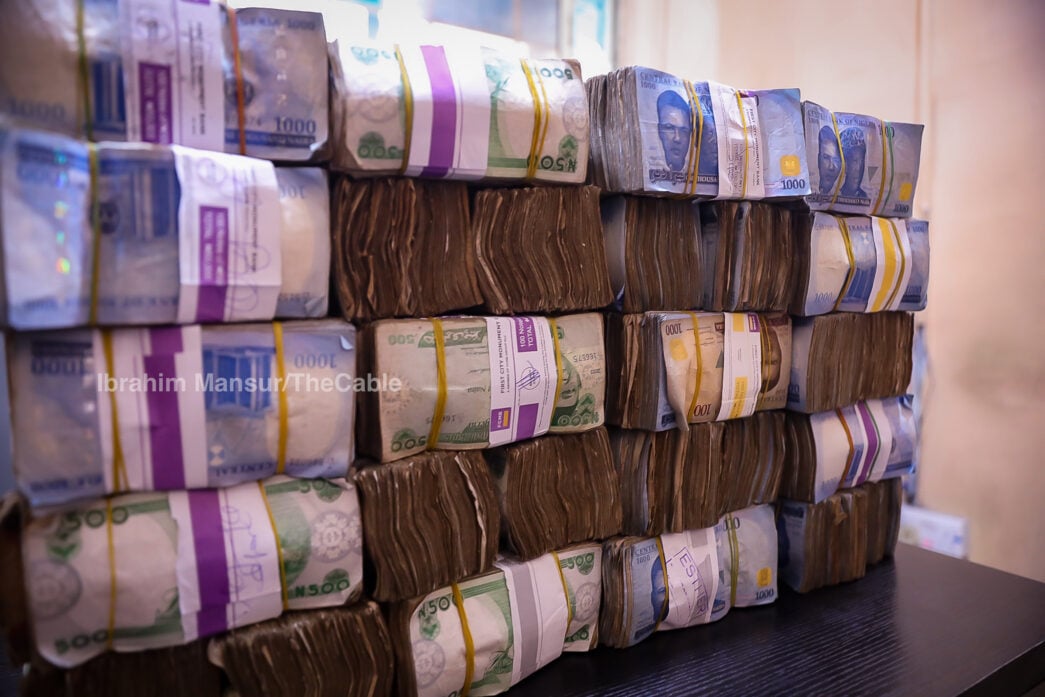
Nigeria’s broad money supply (M3) dropped to N123.36 trillion in January 2026, from N124.4 trillion in December 2025, signalling a modest contraction in system liquidity amid intensified tightening measures by the Central Bank of Nigeria (CBN).
According to the latest money and credit statistics from the CBN, marginal declines were recorded in currency outside the banking system and total currency in circulation, reflecting easing cash demand after the year-end festive surge.
Currency held outside banks dropped 3.66 per cent to N5.21 trillion in January from N5.41 trillion the previous month. Total currency in circulation similarly moderated to N5.73 trillion from N5.732 trillion, underscoring stable but adjusting liquidity conditions at the year’s start.
These shifts highlight Nigeria’s persistent reliance on physical cash, especially in the informal sector, even as the CBN ramps up efforts to sterilise excess liquidity through Open Market Operations (OMO) and Treasury bill issuances. Broad money supply (M3)—encompassing currency in circulation, demand deposits, savings, time deposits, and foreign currency deposits—reflects these policy actions aimed at curbing inflation and stabilising the foreign exchange market.
A deeper look at components shows different outcomes. For instance, net foreign assets plunged to N29.6 trillion, driven by reduced foreign currency holdings, while net domestic assets rose to N93.76 trillion, buoyed by domestic credit growth.
The January dip follows a familiar seasonal trend. Cash outside banks spiked to N5.41 trillion in December 2025 from N4.91 trillion in November, mirroring the N5.13 trillion surge from November 2024’s N4.65 trillion amid festive spending and informal sector activity.
Earlier in 2025, the trend fluctuated but stayed elevated: N4.65 trillion in October, N4.46 trillion in August (after July’s N4.42 trillion), N4.49 trillion in June, N4.63 trillion in May, N4.57 trillion in April, N4.60 trillion in March, N4.51 trillion in February, and N4.74 trillion in January.
Total currency in circulation echoed this, climbing to N5.26 trillion in November 2025 from October’s N5.06 trillion, with relative stability in the third quarter (N4.95 trillion in September, N4.92 trillion in August and July) and second quarter (N4.92 trillion in June, N5.01 trillion in May).
First-quarter figures hovered around N5 trillion: N5.01 trillion in April, N5 trillion in March, N5.03 trillion in February, and N5.04 trillion in January.











-
 Feature/OPED6 years ago
Davos was Different this year
-
Travel/Tourism10 years ago
Lagos Seals Western Lodge Hotel In Ikorodu
-

 Showbiz3 years ago
Estranged Lover Releases Videos of Empress Njamah Bathing
-
 Banking8 years ago
Sort Codes of GTBank Branches in Nigeria
-

 Economy3 years ago
Subsidy Removal: CNG at N130 Per Litre Cheaper Than Petrol—IPMAN
-

 Banking3 years ago
Sort Codes of UBA Branches in Nigeria
-

 Banking3 years ago
First Bank Announces Planned Downtime
-

 Sports3 years ago
Highest Paid Nigerian Footballer – How Much Do Nigerian Footballers Earn
1 Comment