
Brands/Products
Why SMEs Must Develop Risk Strategies for Payment Security—Kemi Okusanya


By Modupe Gbadeyanka
The need for businesses to develop risk strategies that promote payment security has been emphasised by the Vice President, Cluster Country Head of Visa, Ms Kemi Okusanya.
In this interview, she explained businesses, especially those in the small and medium-scale enterprises (SMEs) sector, are very critical of the economy and must make efforts to remain alive at a time the global health crisis is posing a serious threat to them.
Why have you focused on SMEs?
According to a study commissioned and published by PWC, SMEs contribute 48 per cent of national GDP, account for 96 per cent of businesses and 84 per cent of employment in Nigeria.
This means that SMEs are the backbone of our communities. Their significant value in the community positions them as an essential factor, contributing to the growth of the Nigerian economy.
Unfortunately, SMEs were most affected by the COVID-19 pandemic, as the change in consumer behaviour took a toll on their revenue.
As a result, providing extraordinary support to help small businesses navigate this extraordinary time became expedient for us at Visa. This is why we decided to support SMEs through our Where You Shop Matters initiative
Tell us more about the Where You Shop Matters Initiative?
The Where You Shop Matters initiative enables entrepreneurs by providing them with the tools and information required to start, run, and grow small businesses online while encouraging consumers to support small businesses.
At its core, the initiative is a movement. A call for merchants to tap into the expertise of thought-leaders to shape their future. A call to the consumer to understand the power of spending and the importance of supporting the local economies. It is also a call to the industry and the ecosystem to do what we can to support these businesses. This is about everyone coming together to support small business owners around the country.
What are the key focus areas for Visa to drive SME growth in Nigeria?
We are focusing on promoting digital commerce and economic growth, with plans to continue to create products and services as the needs of entrepreneurs change over time. We are committed to empowering digital-first businesses.
To see to the realization of this, we have built localized online resource centres, providing tools, partnership offers, and information on how to start, run and grow small digital-first businesses.
Also, we are encouraging digital payments as well as advocating neighbourhood support for local businesses. We want customers to be conscious of the importance of shopping locally.
More online transactions mean more fraud cases. How is Visa ensuring consumers’ security?
We take security very seriously and we continue to provide and improve on solutions necessary to protect both our merchants and consumers. For nearly 20 years, we have been helping online merchants and issuers identify potentially fraudulent transactions.
As e-commerce in Nigeria is growing rapidly, consumers expect always-on connectivity with mobile devices and rely on retailers to provide payment experience, both secure and frictionless.
As a result, we recently introduced Visa Secure (previously known as Verified by Visa), an updated program to help make online payments more secure.
This solution provides rules and policies that merchants and issuing banks have to follow to authenticate e-commerce transactions and verify cardholders’ identity before a transaction can be authorized.
Consumers can benefit from a smoother and consistent user experience across multiple payment channels, including mobile web, in-app and digital wallet payments, without any compromise in security.
What are your key learnings from the impacts of the pandemic and how would you advise SMEs to position for economic recovery?
As a result of the COVID-19 pandemic, we have witnessed an unprecedented acceleration of digital adoption throughout our industry and the broader society at large.
While the near-term response has focused on maintaining business continuity, we think businesses should develop risk strategies that promote payment security and strengthen the trust foundation necessary for long-term recovery and growth.
As more consumers have tilted towards the online method of shopping, we believe that there’s a need for SMEs to embrace digital commerce. We have quality resources available for free on our website – visa.com.ng.


The way people consume television content has changed dramatically over the past decade. Traditional cable and satellite TV are steadily being replaced by more flexible and internet-based solutions. One of the most popular innovations in this space is IPTV, or Internet Protocol Television. This technology allows users to stream their favorite shows, movies, and live channels directly over the internet, offering greater convenience and a wider range of content.
IPTV is gaining traction globally because of its adaptability and user-friendly features. Unlike conventional broadcasting methods, IPTV does not rely on fixed schedules. Instead, viewers can choose what they want to watch and when they want to watch it. This on-demand flexibility has made IPTV a preferred choice for modern audiences who value control over their entertainment experience.
Another major advantage of IPTV is its cost-effectiveness. Many users find that switching to IPTV significantly reduces their monthly entertainment expenses while providing access to a broader selection of channels. From sports and news to international programming and premium movies, IPTV platforms cater to diverse interests without the need for multiple subscriptions.
For those interested in exploring reliable IPTV services, platforms like iptv provide a comprehensive solution. They offer a variety of channel packages, high-quality streaming, and consistent service performance. With stable internet connectivity, users can enjoy seamless viewing without the interruptions often associated with traditional broadcasting systems.
In addition to affordability and variety, IPTV also supports multiple devices. Whether you prefer watching content on your smart TV, smartphone, tablet, or computer, IPTV services are designed to be compatible across different platforms. This level of accessibility ensures that users can stay connected to their favorite content anytime and anywhere.
Another key feature that sets IPTV apart is its advanced functionality. Many IPTV services include features such as pause, rewind, and recording options. This allows viewers to customize their viewing experience further, ensuring they never miss important moments. Moreover, interactive features and personalized recommendations enhance user engagement, making IPTV more than just a passive viewing experience.
Security and reliability are also important considerations when choosing an IPTV provider. Reputable services prioritize user data protection and offer stable servers to ensure uninterrupted streaming. Choosing a trusted provider like iptv can make a significant difference in overall user satisfaction, as it ensures both quality content and dependable service.
As internet infrastructure continues to improve worldwide, the future of IPTV looks promising. Faster speeds and better connectivity will only enhance the streaming experience, making IPTV even more appealing to a broader audience. It is clear that IPTV is not just a trend but a long-term evolution in how people consume media.
In conclusion, IPTV represents a modern, flexible, and cost-effective alternative to traditional television services. With its wide range of content, multi-device support, and advanced features, it has become a leading choice for entertainment in the digital age.

By Modupe Gbadeyanka
At least two residents of the Iraboko area of Lagos State were recently given a N100,000 grant each by the mobile money arm of MTN Nigeria, MoMo Payment Service Bank (PSB).
The beneficiaries, Mr Ibrahim Abdulrazaq and Ms Sobanke Rasheedat, were also each given a POS device to launch their own businesses at the commissioning of a new Y’ello Box digital centre in Awoyaya.
“I’m so happy that I’m among the people they picked. I really appreciate it. This MoMo account means a lot to me,” Ms Sobanke enthused.
“I would like to use the money to upgrade my business because I’m a business owner. I sell bags. And my mom sells flowers,” she added.
The digital centre cited in the community is to equip the local population, particularly women, with the necessary digital financial skills to navigate the modern economy and secure their families’ futures.
The Central Bank of Nigeria recently stated that there is still an over 20 per cent gap left to meet its National Financial Inclusion Strategy (NFIS) target of 95 per cent overall financial inclusion (this was originally set for the end of 2024).
Currently, 74 per cent of Nigerians are financially included, as of the first half of 2025. This presents an opportunity that MoMo PSB intends to step in to fill.
“Our initiative is centred on financial inclusion – ensuring that the economic value generated within this ecosystem remains in the community to fuel sustainable local growth,” the acting Chief Commercial Officer of MoMo PSB, Mr Victor Onyebuchi, stated.
The activation was an immersive experience led by the MoMo team, under the guidance of the company’s Chief Compliance Officer, Ms Deborah Odo-Effimi. Residents were taught how to use MoMo for secure transactions, SIM registrations, and business management.
To encourage the adoption of digital banking, MoMo rewarded active participants with prizes. Residents walked away with solar-powered fans to combat the heat, umbrellas for the rainy season, and branded caps and wristbands.
Brands/Products
Migo Emerges as West Africa’s Most Trusted Gift Card Trading Platform, Offering Instant Cash for Apple, Steam,Razer Gold, and 50+ Gift Card Brands

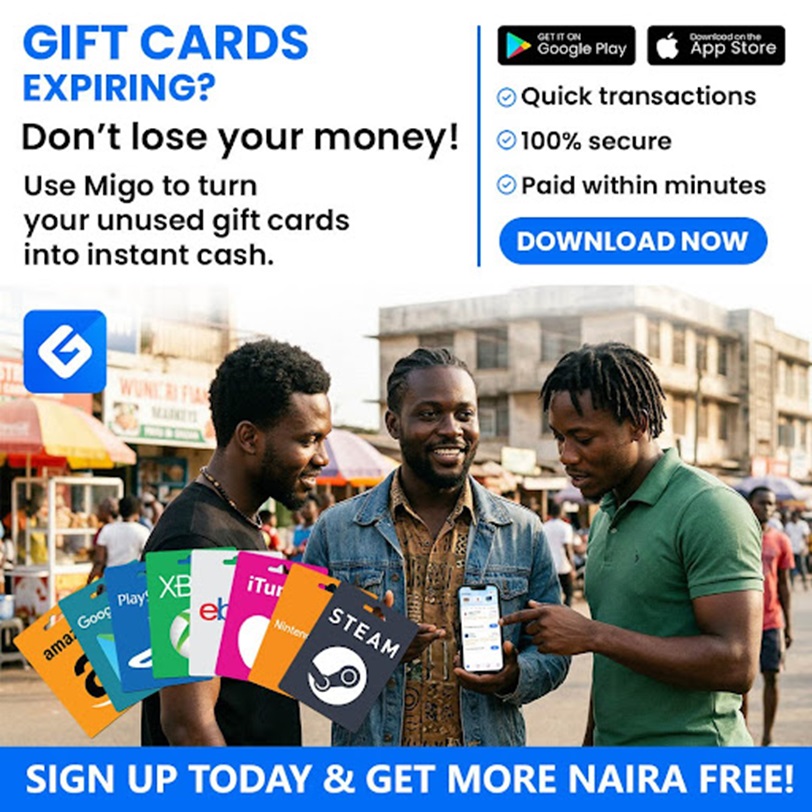
The Migo – Sell Gift Cards app is redefining how Nigerians and Ghanaians convert unused gift cards into instant cash — with the best exchange rates, bank-level security, and payments delivered in minutes.
Migo, a leading fintech platform in West Africa, today announced a major expansion of its gift card trading services, positioning itself as the definitive solution for Nigerians and Ghanaians seeking to sell gift cards for cash at the best available market rates. The platform now supports over 50 gift card brands — including Apple Gift Card, Amazon Gift Card, Go2Bank Gift Card, Google Play Gift Card, Visa Gift Card, Steam Wallet, and many more — with instant payment directly to Nigerian bank accounts and Ghanaian mobile money wallets.
West Africa’s Gift Card Market Is Booming — and Underserved
Gift cards have become one of the most widely circulated financial instruments in Nigeria and Ghana. Driven by growing diaspora remittances, the rise of remote work, international e-commerce, and corporate reward programmes, millions of dollars worth of gift cards flow into West Africa every year.
Apple Gift Cards, Amazon Gift Cards, Google Play Gift Cards, iTunes Gift Cards, Steam Wallet Gift Cards, eBay Gift Cards, Vanilla Visa Gift Cards, American Express Gift Cards, Sephora Gift Cards, Go2Bank Gift Cards, and Razer Gold Gift Cards are among the most commonly received cards in the region. Yet the vast majority of these cards cannot be used for everyday purchases in Nigeria or Ghana — they are locked to US or UK retail ecosystems.
Millions of naira in gift card value go unused every month across Nigeria and Ghana because recipients do not know where to sell safely.
Until recently, those looking to convert gift cards to cash had few good options. Social media groups on WhatsApp, Telegram, and Facebook Marketplace were riddled with fraudsters. Unregulated local dealers offered unpredictable rates and slow payment. The market urgently needed a trustworthy, technology-driven platform.
Migo was built to fill exactly that gap.
Migo – Sell Gift Cards: Built for Nigeria. Built for Ghana. Built for Speed.
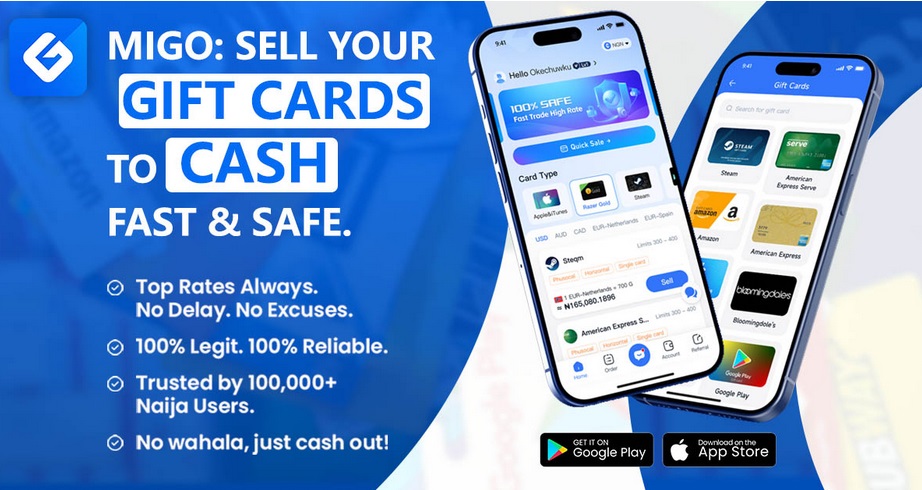
Migo – Sell Gift Cards is a mobile-first fintech application that enables users across Nigeria and Ghana to sell gift cards instantly, securely, and at the best exchange rates. Available on Android and iOS — and free to download — Migo has rapidly grown into one of the most trusted gift card exchange platforms in West Africa.
The platform was designed with a single mission: to eliminate the friction, fear, and financial loss that has historically defined gift card trading in West Africa. With Migo, the process of converting an Apple Gift Card to Naira, exchanging a Visa Gift Card for Cedis, or cashing out a Steam Wallet Gift Card takes minutes, not days.
Platform: Migo – Sell Gift Cards
Available in: Nigeria and Ghana
Supported cards: 50+ brands including Apple, Amazon, Google Play, Visa, Go2Bank, Steam, eBay, Sephora, iTunes, Razer Gold, and more
Payment methods: Nigerian bank transfer (all major banks) | MTN MoMo | Vodafone Cash | AirtelTigo Money
Official Website: www.migogiftcard.com
Download — Android: Google Play Store
Download — iOS: Apple App Store
Online trading — WEB: Trade Now
A Platform That Accepts Every Major Gift Card Brand
One of Migo’s most significant competitive advantages is the breadth of its gift card catalogue. Users can sell virtually any major gift card brand on the platform, including:
Technology & Entertainment Gift Cards
- Apple Gift Card / iTunes Gift Card / App Store Gift Card — sell for Naira or Cedis
- Google Play Gift Card — convert to instant bank transfer
- Steam Gift Card — sell at competitive exchange rates
- Razer Gold Gift Card — trade for cash in Nigeria and Ghana
- Xbox Gift Card / PlayStation Gift Card — sell gaming gift cards for cash
Retail & Shopping Gift Cards
- Amazon Gift Card — one of the highest-demand gift cards in Nigeria
- eBay Gift Card — sell at live market rates
- Walmart Gift Card — convert to Naira or Cedis instantly
- Target Gift Card — sell securely via the Migo app
- Sephora Gift Card — beauty gift cards accepted at great rates
- Nike Gift Card — sports and lifestyle gift card exchange
Financial & Prepaid Visa/Mastercard Gift Cards
- Vanilla Gift Card (all types) — including Vanilla Visa, OneVanilla, MyVanilla Gift Card
- Go2Bank Gift Card (Visa-backed) — sell for instant cash in Nigeria and Ghana
- American Express Gift Card — Amex gift card exchange at live rates
- Paysafe Card — sell paysafe card for cash
Fashion, Lifestyle & Other Gift Cards
- Nordstrom Gift Card — fashion and lifestyle gift card exchange
- Macy’s Gift Card — sell department store gift cards
- Foot Locker Gift Card — sneaker gift cards converted to cash
- And 20+ more brands — check the Migo app for the full updated list
No matter which gift card brand you hold, Migo’s platform is designed to give you the fastest, safest, and most financially rewarding exit.
https://youtu.be/tE4_Kb6-zmU?si=dLUdP0uuGtxOqTkw
Why Thousands of Nigerians and Ghanaians Trust Migo for Gift Card Trading
1. Real-Time Gift Card Exchange Rates — Always Transparent
Migo’s live rate engine continuously monitors the global gift card market and forex conditions to offer users the most competitive rates available. Whether you are checking the Apple Gift Card rate today, Amazon Gift Card rate in Nigeria, Visa Gift Card exchange rate, or Go2Bank Gift Card rate in Ghana — Migo shows you exactly what you will receive before you commit. No hidden fees, no bait-and-switch pricing.
2. Fastest Gift Card Payment in Nigeria and Ghana
Once your gift card is verified, payment is processed and delivered — directly to your Nigerian bank account or Ghanaian mobile money wallet — typically within minutes. Supported Nigerian banks include GTBank, Access Bank, Zenith Bank, First Bank, UBA, Fidelity Bank, Stanbic IBTC, and all other commercial banks. Supported Ghanaian wallets include MTN MoMo, Vodafone Cash, and AirtelTigo Money.
3. Bank-Level Security for Every Transaction
Migo uses end-to-end encryption and a multi-layered fraud detection system to protect all card details and personal data. Unlike anonymous social media sellers, Migo operates as a verified, regulated fintech business with full accountability.
4. Simple Onboarding — Start Trading in Under 5 Minutes
Download the app for free, register with your phone number or email, complete a quick identity verification, and you are ready to sell any supported gift card brand. The onboarding process takes under five minutes.
5. All-in-One Gift Card Trading Dashboard
Check live rates for multiple gift card brands simultaneously, track transaction history, manage payment methods, and contact support — all within the Migo app.
6. Dedicated Customer Support — 24 Hours a Day, 7 Days a Week
Migo’s support team is available around the clock through in-app live chat, email, and social media. For more information, visit www.migogiftcard.com.
How to Sell Gift Cards on Migo: A Simple 4-Step Process
Migo has streamlined the gift card selling experience into four simple steps:
Step 1 Download the Migo app for free from Google Play or the App Store.
Step 2 Register and verify your account in under 2 minutes.
Step 3 Select your gift card brand, enter card details, and review your live payout amount.
Step 4 Confirm your preferred payment method and receive cash — directly to your bank or mobile wallet.
Most Migo users go from opening the app to receiving payment in under 20 minutes.
The Gift Card Trading Landscape in Nigeria and Ghana: Key Facts
To understand why Migo’s services are in such high demand, it helps to understand the scale of the gift card market in West Africa:
- Nigeria is one of the largest gift card trading markets in Africa, with millions of dollars in Apple Gift Cards, Amazon Gift Cards, and Visa Gift Cards received annually from the diaspora.
- Ghana’s mobile money infrastructure makes it one of the fastest-growing gift card exchange markets on the continent.
- Gift card scams cost Nigerian and Ghanaian users hundreds of millions of naira each year — making secure platforms like Migo essential.
- The most traded gift card brands in Nigeria include Apple Gift Card, Amazon Gift Card, iTunes Gift Card, Google Play Gift Card, Visa Gift Card, Steam Gift Card, and eBay Gift Card.
- The most traded gift card brands in Ghana include Apple Gift Card, Amazon Gift Card, Vanilla Visa Gift Card, Go2Bank Gift Card, and Google Play Gift Card.
- Remote workers and freelancers in Nigeria and Ghana frequently receive payment in gift cards from US and UK employers, driving sustained demand for reliable gift card exchange platforms.
- The Apple Gift Card rate in Nigeria and Amazon Gift Card rate in Nigeria are among the most searched financial queries in the country.
What Migo Users Are Saying
Across Nigeria and Ghana, Migo users consistently highlight three things: speed, security, and the best gift card rates. Here is what real users are saying:
Chukwuemeka, Lagos — Sold Apple Gift Card $100
NGN 162,000 received in 18 minutes
“I had been scammed twice on WhatsApp trying to sell my Apple Gift Card. Migo paid exactly what they showed me, with zero drama. Best gift card trading app in Nigeria, full stop.”
Abena, Kumasi, Ghana — Sold Amazon Gift Card $50
GHS 780 received via MTN MoMo in 23 minutes
“I use Migo for every gift card I receive now — Amazon, Google Play, Vanilla Visa. The rates are always the best I find anywhere, and the money comes fast.”
Biodun, Ibadan, Nigeria — Sold Go2Bank Visa Gift Card $500
NGN 814,000 received in 28 minutes
“For large amounts I need to trust the platform completely. I compared five platforms before choosing Migo. Best Go2Bank Gift Card rate, fastest payment, and zero hidden charges.”
Tunde, Abuja, Nigeria — Sold Steam Gift Card $200
NGN 326,000 received in 20 minutes
“I had a Steam Gift Card from a gaming client. Migo was the only platform that gave me a fair Steam Gift Card rate in Nigeria and actually paid on time. Highly recommended.”
Frequently Asked Questions (FAQ)
Q1: What is Migo – Sell Gift Cards?
A: Migo – Sell Gift Cards is a mobile application that allows users in Nigeria and Ghana to sell gift cards for instant cash. The platform supports over 50 gift card brands and delivers payment directly to local bank accounts and mobile money wallets at the best available exchange rates.
Q2: Which gift cards can I sell on Migo?
A: Migo accepts a wide range of gift cards including Apple Gift Card, Amazon Gift Card, Google Play Gift Card, iTunes Gift Card, Visa Gift Card, Go2Bank Gift Card, Vanilla Visa Gift Card, Steam Wallet Gift Card, eBay Gift Card, Sephora Gift Card, Razer Gold Gift Card, American Express Gift Card, Mastercard Gift Card, Xbox Gift Card, Walmart Gift Card, Target Gift Card, Nike Gift Card, Nordstrom Gift Card, and many more. Check the full list in the Migo app.
Q3: How do I download the Migo app?
A: The Migo – Sell Gift Cards app is free to download. Android users can get it on Google Play. iOS users can download it from the Apple App Store. You can also visit the official website at www.migogiftcard.com for more information.
Q4: How long does it take to receive payment after selling a gift card on Migo?
A: Most transactions are completed within minutes. In some cases, depending on card verification, it may take up to 30 minutes. Migo consistently delivers faster payments than other gift card trading platforms in Nigeria and Ghana.
Q5: What is the current gift card exchange rate on Migo?
A: Gift card exchange rates on Migo are updated in real time and vary by brand, denomination, and current forex market conditions. To check the latest Apple Gift Card rate, Amazon Gift Card rate, Visa Gift Card rate, or any other brand, open the Migo app or visit www.migogiftcard.com.
Q6: Is it safe to sell gift cards on Migo?
A: Yes. Migo uses end-to-end encryption, multi-layer fraud detection, and strict identity verification to protect all users and transactions. Migo is a registered and regulated fintech business — not an anonymous social media trader. Thousands of users across Nigeria and Ghana have safely traded gift cards on the platform.
Q7: How do I receive my payment after selling?
A: You can choose to receive payment via Nigerian bank transfer (GTBank, Access Bank, Zenith Bank, First Bank, UBA, and all major banks) or Ghanaian mobile money (MTN MoMo, Vodafone Cash, AirtelTigo Money). Simply enter your account details in the app before confirming your trade.
Q8: Does Migo charge any fees or hidden charges?
A: No. Migo does not charge hidden fees. The exchange rate displayed in the app is the final payout rate — what you see is exactly what you receive. There are no surprise deductions after submission.
Q9: Can I sell gift cards in Ghana using Migo?
A: Yes. Migo is fully available in Ghana. Ghanaian users can sell all supported gift card brands and receive payment in Cedis directly to their MTN MoMo, Vodafone Cash, or AirtelTigo Money wallet, or via bank transfer.
Q10: Where can I learn more about Migo?
A: Visit the official Migo website at www.migogiftcard.com for the latest rates, supported gift card brands, platform updates, and support resources.
About Migo – Sell Gift Cards
Migo – Sell Gift Cards is a West African fintech platform dedicated to providing safe, fast, and transparent gift card trading services for users in Nigeria and Ghana. The platform supports over 50 major gift card brands, offers real-time exchange rates, and delivers instant payment to all major Nigerian banks and Ghanaian mobile money providers. Visit www.migogiftcard.com or download the app on Google Play or App Store to get started.
-
 Feature/OPED6 years ago
Davos was Different this year
-
Travel/Tourism10 years ago
Lagos Seals Western Lodge Hotel In Ikorodu
-

 Showbiz3 years ago
Estranged Lover Releases Videos of Empress Njamah Bathing
-
 Banking8 years ago
Sort Codes of GTBank Branches in Nigeria
-

 Economy3 years ago
Subsidy Removal: CNG at N130 Per Litre Cheaper Than Petrol—IPMAN
-

 Banking3 years ago
Sort Codes of UBA Branches in Nigeria
-

 Banking3 years ago
First Bank Announces Planned Downtime
-

 Sports3 years ago
Highest Paid Nigerian Footballer – How Much Do Nigerian Footballers Earn