Connect with us

Economy

$400m Loan to Nigeria not Cancelled—AfDB

Published

on

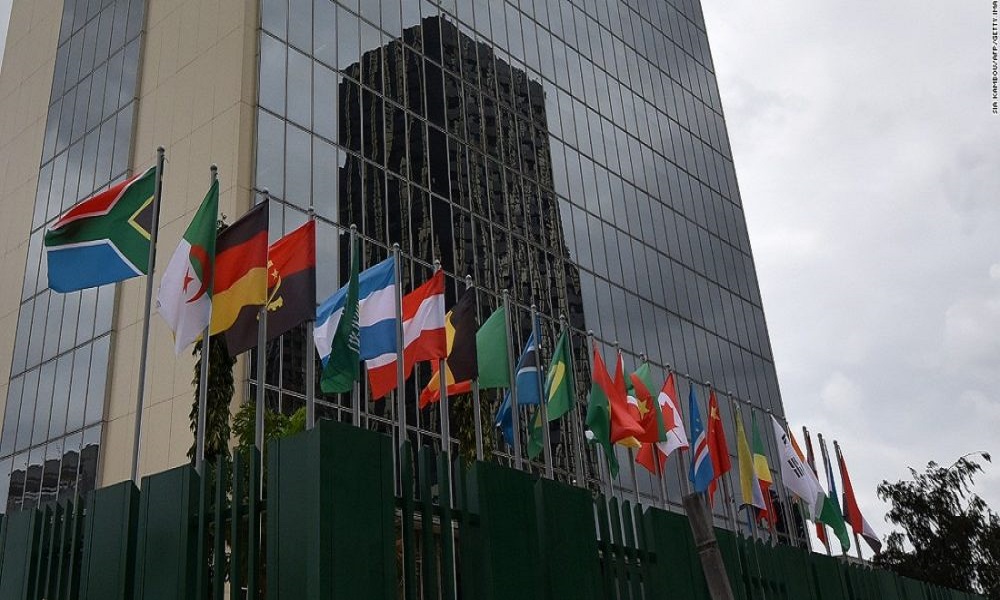
afdb complex

By Dipo Olowookere

The management of African Development Bank (AfDB) has refuted a report by Reuters that it (AfDB) has called off its $400 million loan to the Nigerian government aimed to support the country’s economic recovery process.

Last year, Nigeria officially went into recession due to decline in the prices of crude oil, the country’s major source of foreign exchange (forex) as well as drop in the volume of oil produced as a result of attacks by militants on oil facilities in the oil-rich Niger Delta region of the nation.

In order to revive the economy, the Nigerian government sought help outside and in November 2016, the board of AfDB approved a $600-million loan to support Nigeria’s efforts to cope with macroeconomic and fiscal shocks that arose from the massive decline in price of crude oil.

An additional $400 million in support could be considered, if requested and approved by the board, as part of a larger coordinated effort with other development partners, including the World Bank and the International Monetary Fund (IMF).

But yesterday, Reuters quoted AfDB Vice-President for Power, Energy, Climate and Green Growth, Amadou Hott, as saying that the bank had “called off loans to Nigeria.”

Reacting to this in a statement issued on Tuesday, the continental lender said it “strongly supports Nigerian government’s economic recovery efforts” and that the loan was still intact contrary to the report, which emanated on Monday.

According to the statement issued by AfDB, it emphasised that consultations were ongoing with the Nigerian government on how best to continue its support for its laudable Economic and Growth Recovery Plan (EGRP) through investment projects that will help address existing structural challenges, including infrastructure, power, agriculture and support to boost private sector and job creation.

“The African Development Bank is highly encouraged by the economic recovery of Nigeria from recession and salutes the government’s efforts towards diversification of the economy.

“The bank also strongly supports the Economic and Growth Recovery Plan of the Government and efforts to stem corruption and strengthen fiscal consolidation and efficiency,” the statement obtained by Business Post stated.


Dipo Olowookere is a journalist based in Nigeria that has passion for reporting business news stories. At his leisure time, he watches football and supports 3SC of Ibadan. Mr Olowookere can be reached via [email protected]

Click to comment

Leave a Reply

Your email address will not be published. Required fields are marked *

Economy

Seplat to Sell 10% Stake in NNPC JV for $281.6m, Plans Special Dividend, Debt Reduction

Published

on

Seplat Energy

By Adedapo Adesanya

Seplat Energy Plc has signed an agreement with the Nigerian National Petroleum Company (NNPC) Limited to sell a 10 per cent working interest in its joint venture assets for approximately $281.6 million, a move aimed at strengthening its balance sheet while boosting shareholder returns.

The Nigerian energy company, which is listed on both the Nigerian Exchange (NGX) Limited and the London Stock Exchange (LSE), announced on Thursday that its subsidiaries, Seplat Energy Offshore Limited (SEOL) and Seplat Energy Producing Nigeria Unlimited (SEPNU), reached the agreement with the Nigerian oil company following earlier discussions.

The transaction represents about 25 per cent of the gross consideration paid by Seplat for its acquisition of SEPNU, including any contingent payments.

Upon completion of the deal, SEPNU will retain a 30 per cent working interest in the joint venture and continue as operator, while NNPC Limited’s stake will increase from 60 per cent to 70 per cent. Seplat Energy will continue to own 100 per cent of SEPNU’s share capital.

The transaction remains subject to regulatory approvals and other customary closing conditions, with completion expected in the second half of 2026. The effective date has been backdated to April 1, 2026.

Seplat said it intends to deploy the proceeds in line with its capital allocation framework, splitting the funds equally between reducing debt and enhancing shareholder returns.

Subject to the completion of the transaction, the company plans to pay a special cash dividend of about $140 million, equivalent to 23.3 US Cents per share, in addition to its regular performance-based dividend.

The company also disclosed plans to reduce its gross debt by up to $300 million. It noted that $200 million of its Advanced Payment Facility (APF) had already been repaid during the second quarter of 2026, while the remaining $100 million will be settled after the transaction closes.

Seplat said the divestment would not affect production targets for the NNPCL/SEPNU joint venture in 2026, as operational performance has remained strong.

SEPNU currently contributes around 80,000 barrels of oil equivalent per day (kboepd) at the midpoint of Seplat’s 2026 production guidance of 135,000 to 155,000 kboepd. Based on the transaction’s effective date of April 1, 2026, that contribution would reduce to about 65,000 kboepd, with production guidance to be updated after completion.

Looking further ahead, Seplat said the proceeds from the sale and the lower capital expenditure associated with the reduced working interest are expected to largely offset the impact of lower cash flows from the joint venture through 2030.

Consequently, its long-term production target will be revised from 200,000 kboepd to 170,000 kboepd on a net working interest basis.

Despite the adjustment, the company reaffirmed its commitment to distribute between 40 and 50 per cent of free cash flow over the 2026–2030 period and said it remains on track to deliver at least $1 billion in cumulative shareholder distributions.

The transaction will also affect Seplat’s reserves. Based on its latest reserves assessment, the company’s 2P reserves are expected to decline by approximately 13 per cent to 872.9 million barrels of oil equivalent following completion.

Commenting on the agreement, Seplat Energy’s outgoing chief executive, Mr Roger Brown, described the NNPCL/SEPNU joint venture as one of Nigeria’s most strategically important energy assets.

“The NNPCL/SEPNU JV is one of the pre-eminent licence areas in Nigeria and of strategic importance to the country. Our relations with our partner NNPCL are strong, and we are fully aligned on the agreed work programmes.

“Together, we are focused on delivering significant value from the JV, which has responded very well to increased development activity since we became operator and has clear potential to deliver strong production growth well into the next decade,” he said.

Mr Brown added that Seplat’s strong financial position allows it to use the proceeds from the disposal to increase shareholder distributions while further reducing financial leverage, thereby creating greater cash flow flexibility for future returns.

Continue Reading

Economy

NASD Unveils Digital Securities Platform for Issuance, Trading, Others

Published

on

NASD securities exchange

By Aduragbemi Omiyale

A regulated infrastructure designed for the issuance, trading, clearing and settlement of tokenised securities in Nigeria has been launched by NASD OTC Securities Exchange.

This initiative is known as the NASD Digital Securities Platform and was developed with blockchain technology supplied by Blockstation Incorporated.

The platform is anticipated to kick off public market activity with its first digital securities offering in September 2026.

It was learned that the NASD Digital Securities Platform should deepen access to capital and modernise the nation’s capital markets.

This is because it supports fractional investment and improves the efficiency and transparency of securities transactions.

Its market impact will, however, depend on the quality of initial issuances, regulatory clarity, investor protection, custody arrangements, settlement reliability, secondary-market liquidity and the participation of licensed intermediaries.

The platform will enable companies to issue tokenised securities through NASD’s regulated market infrastructure while giving investors access to a new class of regulated digital investment products.

Investors will also require clear disclosure of the rights attached to each digital security, the underlying assets, valuation methodology, technology and cybersecurity risks, transfer restrictions and procedures for enforcing claims.

The initiative is the product of collaboration among NASD, technology providers, regulators and other market participants to establish what the exchange describes as a secure and trusted marketplace for digital securities.

“The NDSP introduces greater transparency, more efficient issuance and trading processes, and modern market infrastructure designed to support the next generation of regulated capital markets.

“We look forward to welcoming issuers, brokers and investors as this market continues to grow,” the acting chief executive of NASD OTC Securities Exchange, Ms Chinwendu Ekeh, commented.

Also, the chief executive of Blockstation Incorporated, Mr Jai Waterman, said, “With one of the youngest and most entrepreneurial populations in the world, Nigeria has an extraordinary opportunity to expand access to regulated capital markets.

“Enabling greater participation in capital formation is an important step toward long-term wealth creation and economic growth.

“We are proud to support NASD in introducing the NDSP and look forward to seeing the market empower the next generation of Nigerian issuers and investors.”

Also commenting, a representative of TK Tech Africa, Mr Damola Akindolire, said, “Opening a new regulated market requires close collaboration between technology providers, market operators, regulators and industry participants. Today’s announcement establishes a strong foundation for future digital securities issuances in Nigeria.”

Continue Reading

Economy

Oyedele Says Nigeria’s Subsidy Savings Absorbed by Debt, Higher Spending

Published

on

Taiwo Oyedele Taiwo Oyedele vehicle ownership verification tax

By Adedapo Adesanya

The Minister of Finance, Mr Taiwo Oyedele, has disclosed that Nigeria’s savings from the removal of fuel subsidies and foreign exchange market reforms have largely been absorbed by higher debt-servicing costs and increased government spending.

Speaking at the Seventh Africa Emerging Markets Forum in Abuja, Mr Oyedele said the reforms introduced by President Bola Tinubu’s administration in 2023 were painful but necessary to restore macroeconomic stability after years of fiscal distortions.

President Tinubu’s subsidy removal and exchange rate liberalisation have won the backing of investors and international lenders but triggered a sharp rise in living costs, prompting questions over how the resulting savings have been utilised.

Mr Oyedele said fuel subsidies and what he described as an implicit subsidy on foreign exchange had previously cost Nigeria about five per cent of its Gross Domestic Product (GDP).

Responding to concerns over the fate of the savings, he acknowledged the public’s demand for accountability.

“I’ve heard this question so many times, and guess what? It’s a valid question,” he said, announcing that the government will soon publish a comprehensive account of how the savings had been spent.

In the meantime, he said, a significant portion had gone into servicing public debt, implementing the new national minimum wage and expanding social intervention programmes.

According to the minister, debt-servicing costs have risen sharply following the reforms, with borrowing rates increasing to as much as 24 per cent from around eight per cent previously.

“Instead of paying about eight per cent on our debts, we’re paying as high as 24 per cent. When you need to service debt, you don’t debate it. You pay, and you pay on time,” he said.

Mr Oyedele also said the government’s wage bill almost doubled after the national minimum wage was raised from N30,000 to N70,000 monthly.

He added that substantial funding had been committed to the Nigerian Education Loan Fund (NELFUND), which now provides tuition support and monthly stipends to more than 1.5 million students.

The minister rejected criticism that the reforms had failed because poverty initially worsened, arguing that temporary hardship was unavoidable after years of economic distortions.

“Before the reforms, we were printing money to spend. If you stop printing, the spending doesn’t disappear. You need to finance the money you were printing before,” he said.

He also dismissed suggestions that continued government borrowing contradicted improved revenue performance, explaining that borrowing remained necessary where approved expenditure exceeded revenue.

“If your budget is 10, your revenue target is six, and you eventually collect seven, you have exceeded your revenue target, but you still need to borrow three,” he said.

Responding to the International Monetary Fund’s 2026 Article IV assessment, Mr Oyedele maintained that the removal of fuel subsidies and adoption of a market-determined exchange rate were necessary reforms to reduce economic risks.

He said the government would measure progress through reductions in multidimensional poverty, improvements in real per capita income and declining income inequality rather than headline GDP growth alone, while insisting the reforms would ultimately translate into better living standards for Nigerians.

Continue Reading