Connect with us

Economy

500 million Litres of Petrol Lying Fallow in Our Tanks—Dangote Laments

Published

on

Dangote refinery petrol

By Dipo Olowookere

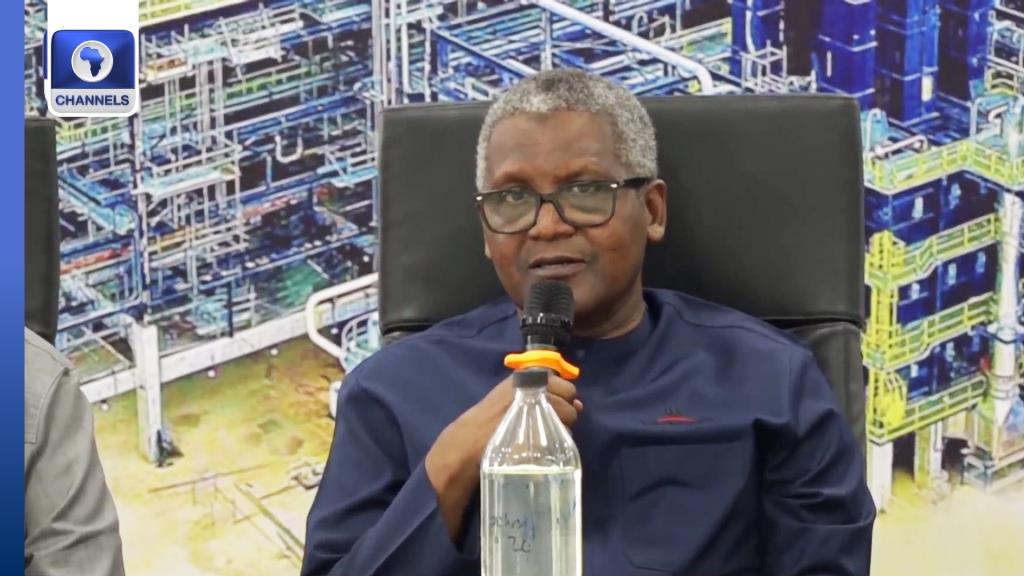
Africa’s richest man, Mr Aliko Dangote, has expressed frustration at the refusal of petroleum marketers to lift premium motor spirit (PMS), commonly known as petrol, from his $20 million refinery in Lagos.

In September 2024, the Dangote Refinery, which has the capacity to refine 650,000 million barrels of crude oil per day, commenced the production of petrol.

Initially, the product was exclusively sold to the Nigerian National Petroleum Company (NNPC) Limited, but this month, the federal government allowed independent marketers to buy directly from the company.

Speaking in Abuja on Tuesday after a meeting with President Bola Tinubu, the business mogul said his refinery has about 500 million litres of petrol lying fallow, noting that he can produce about 30 million litres per day.

“We have enough supply of crude; we can produce much more than 30 million litres every day. At full capacity, we can even supply whatever is being consumed.

“But what I estimated as consumption, which I believe may be about 30, 32 million that one we can even start producing by next week.

“It is not an issue because, as we speak today, we have 500 million litres in our tanks.

“So, 500 million litres in our tanks even if there’s no production from anybody or no imports.

“This will take the country more than 12 days, you know, with no imports, with no production, nothing.

“So, we are very ready. We are more than ready. And you know, I’m also putting my name on the line by giving Mr President my word that, yes, we will be able to supply the market a minimum of 30 million litres per day, and we’ll be ramping up. We are ready. We’re more than ready,” he told newsmen after the meeting to deliberate on the pricing of the product in the country.

Mr Dangote lamented that the action of the fuel marketers was making him lose money since “I am not in the business of retail. If I’m in the business of retail then you hold me responsible.”

“I don’t know whether you understand what it takes to keep half a billion litres inside our tank. It’s costing me money every day. If I can collect the naira, I can charge somebody 32 per cent in interest.

“So right now, that’s what I’m losing. And you are talking about 500 million, you know, I mean, we don’t print money. But the issue is that if they come and collect then you will not see any queues in the filling stations,” he stated.


Dipo Olowookere is a journalist based in Nigeria that has passion for reporting business news stories. At his leisure time, he watches football and supports 3SC of Ibadan. Mr Olowookere can be reached via [email protected]

Economy

FrieslandCampina, Food Concepts Weaken NASD OTC Exchange by 0.57%

Published

on

FrieslandCampina

By Adedapo Adesanya

The duo of FrieslandCampina Wamco Nigeria Plc and Food Concepts Plc weakened the NASD Over-the-Counter (OTC) Securities Exchange by 0.57 per cent on Thursday, November 13.

FrieslandCampina Wamco Plc dropped N5.95 to N54.00 per share from N59.95 per share and Food Concepts lost 3 Kobo to end at N3.50 per unit compared with the previous day’s N3.53 per unit.

In the ensuing melee, the market capitalisation lost N12.42 billion in value to close at N2.180 trillion compared with the N2.193 trillion it finished a day earlier, and the NASD Unlisted Security Index (NSI) went down by 20.75 points to 3,644.61 points from 3,665.36 points.

Yesterday, the volume of securities traded by investors plunged by 99.5 per cent to 119,329 units from the previous day’s 22.1 million units, the value of securities slumped by 99.9 per cent to N1.9 million from N1.3 billion, and the number of deals depreciated by 26.3 per cent to 14 deals from 19 deals.

At the close of transactions, Infrastructure Credit Guarantee Company (InfraCredit) Plc remained the most traded stock by value with a year-to-date sale of 5.8 billion units valued at N16.4 billion, followed by Okitipupa Plc with 170.3 million units transacted for N8.0 billion, and Air Liquide Plc with 507.4 million units worth N4.2 billion.

InfraCredit Plc was also the most traded stock by volume on a year-to-date basis with 5.8 billion units traded for N16.4 billion, trailed by Industrial and General Insurance (IGI) Plc with 1.2 billion units sold for N419.7 million, and Impresit Bakolori Plc with the sale of 536.9 million units for N524.9 million.

Continue Reading

Economy

Naira Appreciates to N1,441/$1 as FX Pressure Eases

Published

on

Naira-Denominated Assets

By Adedapo Adesanya

Recent foreign exchange (FX) pressure on the Naira eased on Thursday as its against the US Dollar closed stronger in the Nigerian Autonomous Foreign Exchange Market (NAFEM) by N1.64 or 0.11 per cent to N1,441.44/$1 from the N1,443.08/$1 it was exchanged a day earlier.

Equally, the Nigerian Naira improved its value against the Pound Sterling in the official market by N2.44 to sell for N1,898.96/£1 versus the previous day’s N1,901.40/£1. However, it depreciated against the Euro by 99 Kobo to close at N1,674.96/€1, in contrast to Wednesday’s closing price of N1,673.97/€1.

At the GTBank forex counter, the domestic depreciated against the Dollar yesterday by N3 to settle at N1,450/$1 versus the preceding session’s rate of N1,447/$1, and in the black market, the exchange rate of the Naira to the Dollar remained unchanged at N1,455/$1.

The local currency is trying to claw back some losses recorded this week as unmet demand from thin US dollar supply has invited pressure across key segments.

However, positive signals like Nigeria’s gross external reserves rising by more than $30 million day on day to close at $43.427 billion as of November 11, 2025, gives the Central Bank of Nigeria (CBN) enough power to make significant intervention.

In recent weeks, the apex bank FX injection has been minimal and erratic due to increasing FX inflows from foreign portfolio investors and exporters. FX inflow into currency market has fallen from peaked of $1.37 billion to $899 million.

In the cryptocurrency market, there were significant declines on Thursday as short and long-term investors liquidated their positions. More than $1 billion in leveraged crypto positions were wiped out over 24 hours, with roughly $887 million coming from longs.

Ethereum (ETH) slumped by 10.9 per cent to $3,160.25, Solana (SOL) went south by 10.3 per cent to $140.65, Cardano (ADA) depreciated by 9.6 per cent to $0.5146, Ripple (XRP) fell by 9.2 per cent to $2.27, Dogecoin (DOGE) slipped by 8.2 per cent to $0.1620, Bitcoin (BTC) dropped 6.9 per cent to $96,351.91, Binance Coin (BNB) shrank by 6.1 per cent to $909.83, and Litecoin (LTC) went down by 5.4 per cent to $95.57, while the US Dollar Tether (USDT) and the US Dollar Coin (USDC) remained unchanged at $1.00 apiece.

Continue Reading

Economy

Oil Rises Amid Global Oversupply Concerns, Lukoil Sanctions

Published

on

OPEC Global Oil Demand

By Adedapo Adesanya

Oil gained on Thursday as investors weighed concerns about global oversupply with looming sanctions against Russia’s Lukoil.

The price of the Brent crude grade chalked up 30 cents or 0.5 per cent to $63.01 a barrel, and the US West Texas Intermediate (WTI) crude increased by 20 cents or 0.3 per cent to $58.69 a barrel.

The US has imposed sanctions on Lukoil as part of its efforts to bring the Russian government to peace talks with Ukraine. The sanctions prohibit transactions with the Russian company after November 21.

According to JPMorgan, nearly a third of Russia’s current seaborne oil export potential is now stuck in tankers as the US sanctions upend crude flows and Russia’s top buyers, China and India, are still struggling to assess the implications of the sanctions.

“Russia’s oil exports are entering a new phase of disruption as sanctions targeting Rosneft and Lukoil are set to take effect, prompting its two largest customers — India and China — to sharply reduce their December purchases,” the Wall Street bank said in a note.

JPMorgan estimates that as many as 1.4 million barrels per day of Russian crude oil or nearly a third of its exporting potential are on tankers at present, amid re-routing and slowed unloading as buyers are hesitant following the US sanctions on Russia’s top oil producers and exporters, Rosneft and Lukoil.

Also, the US Energy Information Administration (EIA) showed a larger-than-expected rise in US crude stocks, while gasoline and distillate inventories fell less than expected last week. Crude inventories rose by 6.4 million barrels to 427.6 million barrels in the week ended November 7, the EIA said.

The Organisation of the Petroleum Exporting Countries (OPEC) said global oil supplies would slightly exceed demand in 2026, a further shift from the group’s earlier projections of a deficit.

It also said it expected the supply surplus next year because of wider production increases by OPEC+, a group of producers that includes OPEC members and allies like Russia.

The International Energy Agency (EIA) raised its global oil supply growth forecasts for this year and next in its monthly oil market report on Thursday, signaling a bigger surplus in 2026.

The US EIA also said in its Short-Term Energy Outlook on Wednesday that U.S. oil production is expected to set a larger record this year than previously forecast.

Global oil inventories will grow through 2026 as production increases faster than demand for petroleum fuels, adding to pressure on oil prices, the EIA added.

Continue Reading

Trending