Economy
Airtel Africa, 17 Others Lift Stock Exchange by 0.46%
By Dipo Olowookere
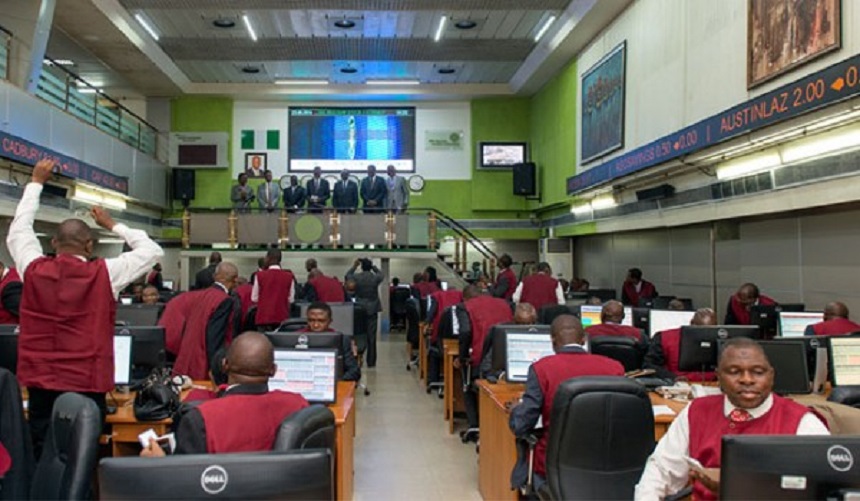
Nigeria’s stock exchange closed positive on Friday by 0.46 per cent following a renewed bargain hunting in Airtel Africa, Guinness Nigeria, Sterling Bank, Ardova and 14 others.
This pushed the All-Share Index (ASI) of the Nigerian Exchange (NGX) Limited by 199.52 points to 43,308.29 points from the previous day’s 43,108.77 points and jerked the market capitalisation higher by N104billion to N22.598 trillion from N22.494 trillion.
Royal Exchange and ABC Transport grew by 10.00 per cent each at the trading session to finish at 55 kobo and 33 kobo respectively.
AIICO Insurance gained 9.38 per cent to close at 70 kobo, University Press appreciated by 8.89 per cent to N2.94, while Regency Assurance jumped 7.69 per cent to 42 kobo.
On the other hand, UPDC REIT topped the losers’ table of 24 members with a price depreciation of 9.82 per cent to settle for the day at N5.05.
Champion Breweries retreated by 5.90 per cent to N2.55, UPDC moderated by 5.07 per cent to N1.31, FTN Cocoa eased by 4.76 per cent to 40 kobo, while Veritas Kapital contracted by 4.55 per cent to 21 kobo.
Unlike the preceding day, the level of activity was mixed yesterday with the trading value declining by 15.15 per cent to N3.6 billion from N4.2 billion, while the trading volume rose by 14.73 per cent to 305.3 million units from 266.1 million, with the number of deals rising by 13.96 per cent 4,450 deals from 3,905 deals.
FCMB finished the day as the most active stock with 81.1 million units worth N247.9 million, trailed by GTCO with 29.5 million units valued at N738.3 million.
Further, Access Bank transacted 28.1 million units valued at N253.9 million, Honeywell Flour sold 16.8 million units worth N70.2 million, while Zenith Bank exchanged 13.2 million units for N320.2 million.
At the market on Friday, the insurance sector gained 1.98 per cent, while the quartet of the consumer goods, banking, energy and industrial goods counter lost 0.89 per cent, 0.33 per cent, 0.03 per cent and 0.01 per cent respectively.
Economy
FAAC Distributes N2.55trn June Revenue to Federal, State, Local Governments
By Adedapo Adesanya
The Federation Account Allocation Committee (FAAC) distributed about N2.550 trillion from the revenue generated by the nation in June 2026 to the three tiers of government after its July meeting in Abuja.
A statement signed by the Director of Press in the Office of the Accountant General of the Federation, Mr Bawa Mokwa, “The N2.550 trillion total distributable revenue comprised N1.809 trillion in distributable statutory revenue and N740.724 billion in distributable Value Added Tax (VAT) revenue.”
It was gathered that a total gross revenue of N4.500 trillion was available in June 2026, with deductions for the cost of collection amounting to N160.744 billion, and transfers and refunds at N1.789 trillion.
According to a communiqué after the gathering, gross statutory revenue of N3.700 trillion was received in June 2026, N1.049 trillion higher than the N2.651 trillion received in the preceding month, while gross revenue of N799.746 billion was generated from VAT, N56.058 billion higher than the N743.688 billion recorded in May 2026.
It was stated that from the N2.550 trillion total distributable revenue, the federal government received N923.438 billion, the state governments got N838.208 billion, while the local government councils were given N591.390 billion, with N197.610 billion allocated to the benefiting states as 13 per cent of mineral derivation revenue.
From the N1.809 trillion distributable statutory revenue, the federal government went away with N849.366 billion, states shared N430.810 billion, local councils took N332.136 billion, while the benefiting states got N197.610 billion as derivation revenue.
From the N740.724 billion distributable VAT earnings, the central government got N74.072 billion, the states received N407.398 billion, and the local government councils were allocated N259.253 billion.
The communiqué further stated that in June 2026, collections from Companies Income Tax (CIT), Capital Gains Tax (CGT), Stamp Duties (SDT), Petroleum Royalties, Gas Flare Penalties, Rent, Mineral Oil Royalties (MOR), Value Added Tax (VAT), Import Duty, and Common External Tariff (CET) Levies increased significantly, while Petroleum Profit Tax (PPT), Hydrocarbon Tax (HT), Mineral Royalties, and Fees declined considerably. Excise Duty recorded only a marginal increase.
Economy
NRS Bets on e-Invoicing to Boost Tax Compliance, Transparency
By Adedapo Adesanya
The Nigeria Revenue Service (NRS) says the rollout of electronic invoicing (e-invoicing) will strengthen tax compliance, curb revenue leakages and improve transparency in tax administration as it moves to fully digitise the country’s tax system.
The Project Lead for the NRS e-Invoicing Project, Mr Mohammed Bawa, stated this at the DigiTax E-Invoicing Compliance Breakfast Session held in Lagos on Wednesday.
The event, organised by DigiTax, an NRS-accredited e-invoicing platform, formed part of efforts to support the agency’s ongoing education and sensitisation campaign on the e-invoicing mandate.
Mr Bawa said the initiative aligns with global trends in tax digitisation and is expected to help improve Nigeria’s tax-to-GDP ratio, which remains one of the lowest in Africa.
According to him, the system will provide the NRS with greater visibility into transactions across sectors, formalise activities within the informal economy and standardise invoice formats nationwide using globally recognised invoice schemas.
He added that e-invoicing would improve operational efficiency for both businesses and tax authorities while supporting the NRS’ transition from manual and electronic tax administration processes to a fully automated system-to-system interaction model.
Mr Bawa noted that the legal framework for implementation is backed by the Nigeria Tax Administration Act, which prescribes penalties for non-compliance.
He disclosed that the NRS has completed onboarding large taxpayers and is preparing to enforce compliance with defaulting entities.
According to him, medium taxpayers are expected to begin compliance in the third quarter of 2026, while onboarding of emerging taxpayers will commence in 2027, with full adoption targeted for all taxpayers by the end of 2028.
Mr Bawa urged taxpayers yet to be onboarded onto the platform to begin the process and work with accredited service providers to ensure compliance.
On his part, Country Director of DigiTax Nigeria, Mr Olumide Akinsola, urged businesses to look beyond their internal systems and assess the compliance status of suppliers and counterparties.
He warned that businesses whose suppliers fail to transmit invoices through the MBS platform risk losing eligibility to claim Value Added Tax (VAT) input credits on such transactions, describing the resulting supply chain exposure as a significant commercial risk that many organisations have yet to quantify.
Mr Akinsola also announced the launch of DigiTax’s white paper, The State of E-Invoicing Readiness in Nigeria, which examines compliance adoption trends and the readiness gap across different taxpayer segments.
He added that DigiTax operates in Nigeria, Kenya, Zambia and the United Arab Emirates (UAE), noting that experience from those markets shows businesses that integrate early are better positioned to avoid disruptions when enforcement begins.
Economy
CAC to Delete Alariwo of Afrika, First Union PFA, Investopedia, Other Firms from Register
By Aduragbemi Omiyale
The names of about 100,000 companies registered by the Corporate Affairs Commission (CAC) are about to be deleted for inactivity, especially for failing to file their annual tax returns, Business Post reports.
This information was disclosed by the CAC via a notice signed by its management on Wednesday, July 15, 2026.
The list contains organisations like the Nigeria-Poland Chamber of Trade Invest Ltd, Alariwo of Afrika Ltd, Ovation Sports International, First Union Pension Fund Administrators, Investopedia Limited, Baptist High School Abuja Ltd, and Yobe Aluminium Manufacturing Industries Ltd, amongst others.
In the statement, the commission said its decision to strike off the names of the affected firms from the register aligns with the provisions of Section 692(3) (3) and (4) of the Companies and Allied Matters Act (CAMA), 2020.
However, the affected companies can still salvage the situation by filing all outstanding annual returns and regularising their records within 90 days.
“Please note that companies that fail to comply within the stipulated timeline shall be struck off the register without further notice,” it declared, expressing its continued commitment to providing prompt and efficient registration and regulatory services to the satisfaction of its valued customers.
See the full list below: