Connect with us

Economy

Asian Equities Close Mixed on Thursday

Published

on

By Investors Hub

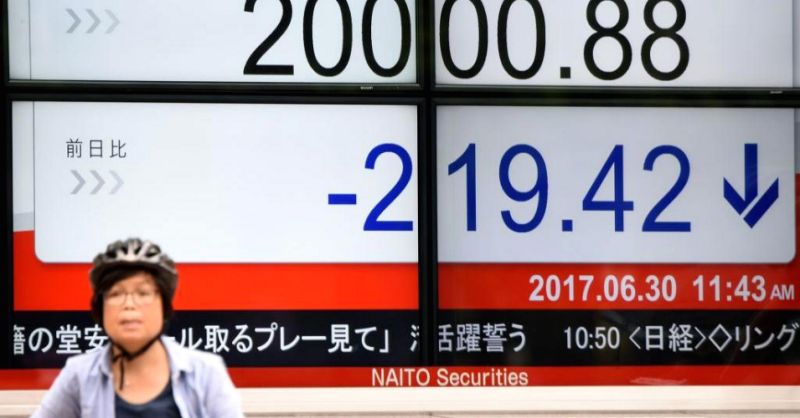
Asian stocks ended mixed on Thursday as a strong start to the U.S. earnings season and hopes for progress on the Brexit front were partly offset by worries about U.S.-China trade relations.

The pound held steady after British Prime Minister Theresa May’s government survived a vote of no confidence in parliament.

Safe-haven assets such as gold and the yen rose after the Wall Street Journal reported that U.S. federal prosecutors are investigating Chinese tech giant Huawei Technologies for allegedly stealing trade secrets from U.S. companies.

Chinese stocks ended lower as investors braced for GDP data due to be released next Monday. Growth worries resurfaced after Chinese Premier Li Keqiang said the country is facing a challenging environment.

The benchmark Shanghai Composite Index fell 10.79 points or 0.4 percent to 2,559.64, while Hong Kong’s Hang Seng Index ended down 146.47 points or 0.5 percent at 26,755.63.

Japanese shares reversed earlier gains to finish lower as automakers sagged on worries about increased U.S. tariffs.

The benchmark Nikkei 225 Index dipped 40.48 points or 0.20 percent to 20,402.27, while the broader Topix closed 0.4 percent higher at 1,543.20 on speculation the Bank of Japan may ramp up bond buying at next week’s policy meeting.

Automakers fell after a Republican senator told reporters U.S. President Donald Trump is “inclined” to move ahead with tariffs on imported vehicles. Toyota Motor shed 0.8 percent and Honda Motor edged down slightly.

Banks and other financial firms closed higher, tracking overnight gains among their U.S. counterparts. Daiwa Securities gained 1.3 percent and Nomura Holdings jumped 4.1 percent.

Australian stocks hit over two-month highs after Wall Street’s major indexes hit one-month highs overnight.

The S&P/ASX 200 Index rose 14.90 points or 0.3 percent to 5,850.10, extending gains for the third straight session. The broader All Ordinaries Index ended up 16.10 points or 0.3 percent at 5,909.80.

Banks ANZ, Commonwealth and Westpac rose between 0.3 percent and 0.7 percent, tracking overnight gains among their U.S. peers.

Diversified miner South32 rallied 3.6 percent after its second quarter coking coal output nearly doubled. BHP edged down 0.2 percent ahead of its second quarter production report due next week, while rival Rio Tinto, which will unveil its quarterly production figures on Friday, added 1 percent.

Whitehaven Coal climbed 3.7 percent after it achieved record quarterly output. Woodside Petroleum gained 0.7 percent as it reported a 43 percent jump in fourth quarter revenue.

AGL Energy dropped 2 percent after it revealed a problem with heavy-metal levels detected in coal ash from its Hunter Valley power stations.

On the economic front, official data showed that the number of home loan approvals fell by 0.9 percent in November. Economist expected a decline of 1.5 percent following the 2.2 percent jump in October.

Seoul stocks finished marginally higher as investors cheered strong earnings from Bank of America and Goldman Sachs.


Dipo Olowookere is a journalist based in Nigeria that has passion for reporting business news stories. At his leisure time, he watches football and supports 3SC of Ibadan. Mr Olowookere can be reached via [email protected]

Click to comment

Leave a Reply

Your email address will not be published. Required fields are marked *

Economy

Capital Inflows to Nigeria Rise 83.8% to $10.37bn in Q1 2026

Published

on

Nigeria's capital inflows

By Adedapo Adesanya

Nigeria attracted $10.37 billion in capital importation in the first quarter of 2026, representing an 83.8 per cent increase from the $5.64 billion recorded in the corresponding period of 2025, according to the National Bureau of Statistics (NBS).

The latest Capital Importation Report released by the stats bureau also showed that capital inflows rose by 60.97 per cent from $6.44 billion recorded in the fourth quarter of 2025.

The report stated, “In Q1 2026, total capital importation into Nigeria stood at $10.37bn, higher than $5.64bn recorded in Q1 2025, indicating an increase of 83.83 per cent. In comparison to the preceding quarter, capital importation increased by 60.97 per cent from $6.44bn in Q4 2025.”

Analysis of the inflows showed that portfolio investment remained the dominant source of foreign capital, accounting for $9.86 billion or 95.09 per cent of the total amount imported into the economy.

The stats office disclosed that foreign direct investment stood at $135.08 million, representing only 1.30 per cent of total capital inflows, while other investments accounted for $374.48 million or 3.61 per cent.

“Portfolio Investment ranked top with $9.86bn, accounting for 95.09 per cent, followed by Other Investment with $374.48m, accounting for 3.61 per cent. Foreign Direct Investment recorded the least with $135.08m, representing 1.30 per cent of total capital importation in Q1 2026,” the report added.

A further breakdown showed that money market instruments attracted the largest share of portfolio investments at $6.50 billion, while investments in bonds amounted to $3.23 billion.

Equity investments under the portfolio category stood at $131.81 million.

The banking sector emerged as the biggest destination for foreign capital during the quarter, attracting $7.55 billion, representing 72.79 per cent of total inflows.

The financing sector followed with $2.43 billion or 23.42 per cent, while the production and manufacturing sector attracted $152.27 million, accounting for 1.47 per cent of total capital imported.

Other sectors that received foreign investments included shares, trading, agriculture, information technology services, telecommunications, oil and gas, transport, construction, healthcare, education, and consultancy services.

The United Kingdom remained Nigeria’s largest source of foreign capital, accounting for $5.08 billion or 49.01 per cent of total inflows. The United States followed with $3.18 billion, representing 30.69 per cent, while South Africa accounted for $983.83 million or 9.49 per cent.

Among financial institutions, Standard Chartered Bank Nigeria Limited received the highest capital inflow during the quarter at $4.41 billion, representing 42.56 per cent of the total.

Stanbic IBTC Bank Plc followed with $2.78 billion or 26.79 per cent, while Rand Merchant Bank handled $930.82 million, accounting for 8.97 per cent.

Other banks that facilitated capital inflows into the country during the period included Citibank Nigeria, Access Bank, First Bank of Nigeria, Guaranty Trust Bank, Zenith Bank, FCMB, Ecobank, Fidelity Bank, and United Bank for Africa.

Continue Reading

Economy

NUPRC Plans Another Licensing Round in Q3 2026

Published

on

Oil Licensing Round

By Aduragbemi Omiyale

The 2026 licensing round for oil fields is expected to commence in the third quarter of 2026, the Nigerian Upstream Petroleum Regulatory Commission (NUPRC) has disclosed.

This followed the approval of President Bola Tinubu, who doubles as the Minister of Petroleum Resources.

A statement issued by the spokesperson of NUPRC, Mr Eniola Akinkuotu, on Wednesday said the authorisation is in compliance with the Petroleum Industry Act (PIA).

“We are also fortunate that the President and Minister of Petroleum Resources has approved the 2026 Licensing Round,” the chief executive of the agency, Mrs Oritsemeyiwa Eyesa, was quoted as saying in the statement when she received representatives of Meren Energy (formerly Africa Oil) in Abuja yesterday.

Mrs Eyesan, who expressed satisfaction with the conduct of the 2025 Licensing Round so far, stated that the commercial bid would take place in July, after which the next licensing round would commence.

The NUPRC boss said the heightened participation in the 2025 Licensing Round was a testament to the fact that Nigeria was headed in the right direction.

She said the rise in investments, coupled with the upswing in production, was evidence that Nigeria’s oil and gas sector, under the leadership of President Bola Tinubu, had become attractive.

“We are in the process of finalising the 2026 launch, which will happen by the third quarter at the latest. So, this is the make-or-break point, and we want to make sure we make it,” she stated.

In his remarks, the chief executive of Meren Energy, Mr Oliver Quinn, said the current reforms had inspired the company to increase its investments in Nigeria, hence its interest in asset divestments and licensing rounds, revealing that his company’s investment priority is Africa, of which Nigeria ranks as number one.

“We have operated in Agbami, Akpo and Egina world-class fields. I think till date, in 20 years, about $11bn in capital from our side has gone into these assets, and about $4bn has gone to tax and royalties,” he said, adding, “Nigeria remains the core of our business today because of the quality of these assets.”

According to Mr Quinn, Meren Energy is pressuring its partners on these assets to deepen their investments and then increase overall production, noting that the energy firm was the first in Nigeria to sell crude oil to the Dangote refinery and will continue to fulfil its Domestic Crude Supply Obligation so long as the price remains right.

Continue Reading

Economy

FrieslandCampina Wamco, MRS Oil Buoy NASD Exchange by 0.91%

Published

on

NASD securities exchange

By Adedapo Adesanya

The NASD Over-the-Counter (OTC) Securities Exchange extended its gains by 0.91 per cent on Wednesday, June 3, spurred by three price gainers led by FrieslandCampina Wamco Nigeria Plc, which rose by N13.90 to sell N210.41 per share versus the previous day’s N196.51 per share. MRS Oil appreciated by N10 to N190.00 per unit from N180.00 per unit, and Food Concepts Plc added 5 Kobo to sell at N3.00 per share versus N2.95 per share.

As a result, the market capitalisation increased by N23.91 billion to N2.660 trillion from N2.636 trillion, and the NASD Unlisted Security Index (NSI) gained 39.97 points to finish at 4,446.27 points, in contrast to Tuesday’s 4,406.30 points.

The NASD exchange witnessed three price losers at midweek, led by Nipco Plc, which shrank by N21.30 to close at N325.97 per unit compared with the previous session’s N347.27 per unit, Nitrox Industrial Gases Plc went down by N1.20 to quote at N24.30 per share versus the preceding session’s N25.50 per share, and Central Securities Clearing System (CSCS) Plc weakened to by 69 Kobo to N75.41 per unit from N76.10 per unit.

The volume of trades yesterday significantly improved by 71.5 per cent to 527,221 units from Tuesday’s 307,363 units, as the value of transactions soared by 49.9 per cent to N64.2 million from the preceding session’s N49.9 million, and the number of deals surged by 9.5 per cent to 46 deals from 42 deals.

When trading activities ended for the day, Great Nigeria Insurance (GNI) Plc remained the most active stock by value on a year-to-date basis with 3.4 billion units valued at N8.4 billion, followed by Infrastructure Credit Guarantee (Infracredit) Plc with 2.3 billion units worth N6.5 billion, and CSCS Plc with 64.6 million units exchanged for N4.4 billion.

GNI Plc also ended the session as the most traded stock by volume on a year-to-date basis with 3.4 billion units sold for N8.4 billion, followed by Infracredit Plc with 2.3 billion units traded for N6.5 billion, and Resourcery Plc with 1.1 billion units transacted for N415.7 million.

Continue Reading

Trending