Connect with us

Economy

Asian Stocks Close Mixed After Cautious Trading

Published

on

By Investors Hub

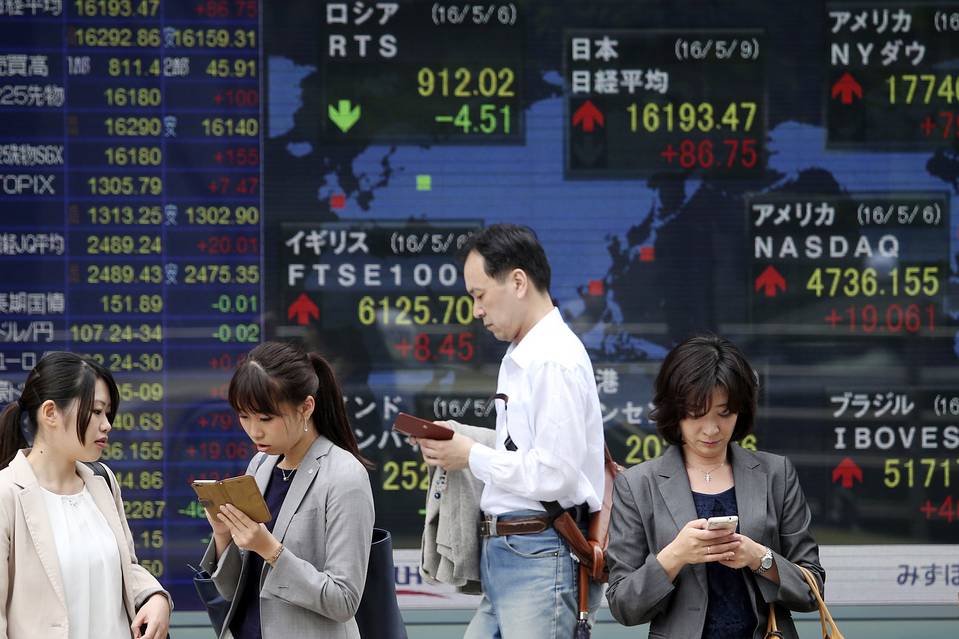
Asian markets ended on a mixed note on Tuesday after a cautious session ahead of the U.S. midterm elections and the Federal Reserve’s monetary policy announcement.

Stocks in mainland China edged lower, with software and telecom sections seeing notable declines. The Shanghai Composite Index edged down 6.07 points or 0.2 percent to 2,659.36. Meanwhile, Hong Kong?s Hang Seng Index climbed 186.57 points or 0.7 percent to 26,120.96.

The Japanese markets showed a strong move to the upside, with the benchmark Nikkei 225 Index jumping 248.76 points or 1.1 percent to 22,147.75.

Chiyoda Corp. and Sumitomo Dainippon Pharma both surged up by over 7 percent. Daiichi Sankyo, Toyota Tsusho Corp., Marubeni Corp. and Sojitz Corp. also advanced by 4 to 5 percent.

Meanwhile, Pioneer Corp., Dainippon Screen Manufacturing and Shimizhu Corp. lost 4 to 5 percent. Softbank Corp., TDK, Tokyo Electron and Olympus Corp. were also among the prominent losers.

Australian stocks also ended notably higher. The benchmark S&P/ASX 200 Index climbed up 57.10 points or 1 percent to 5,875.20 while the broader All Ordinaries Index ended up 53.90 points or 0.9 percent at 5,958.70.

The Reserve Bank of Australia left its benchmark interest rate on hold at a record low for the 26th consecutive meeting. The board of the Reserve Bank of Australia voted to maintain the cash rate at 1.5 percent. The interest rate has been at the current level since August of 2016.

?Taking account of the available information, the Board judged that holding the stance of monetary policy unchanged at this meeting would be consistent with sustainable growth in the economy and achieving the inflation target over time,? the bank said in a statement.

Policymakers observed that the low level of interest rates is continuing to support the Australian economy. Although they expect further progress in the reduction of unemployment and inflation returning to target, the bank noted progress is likely to be gradual.

Incitec Pivot, Bellamys Australia, Syrah Resources and Western Areas turned in some of the market?s best performances on the day.

Shares of Appen Limited, Skycity Entertainment Group and CYBG lost more than 2 percent, while Infigen Energy shed about 1.9%.

Meanwhile, stocks in Singapore declined sharply, with the benchmark Straits Times Index plunging 1.8 percent. Markets in Indonesia, Malaysia and Taiwan also declined, albeit with less pronounced losses.

In economic news, average household spending in Japan was down 1.6 percent year-over-year in September at 271,273 yen, the Ministry of Internal Affairs and Communications said. That was well shy of expectations for an increase of 1.5 percent and down sharply from the 2.8 percent gain in August.

South Korea had a current account surplus of $10.83 billion in September, up from $8.44 billion in August, data from the Bank of Korea showed.


Modupe Gbadeyanka is a fast-rising journalist with Business Post Nigeria. Her passion for journalism is amazing. She is willing to learn more with a view to becoming one of the best pen-pushers in Nigeria. Her role models are the duo of CNN's Richard Quest and Christiane Amanpour.

Click to comment

Leave a Reply

Your email address will not be published. Required fields are marked *

Economy

NGX All-Share Index Rises 1.12% on Sustained Bargain-Hunting

Published

on

NGX All-Share Index

By Dipo Olowookere

Sustained bargain-hunting in local stocks further lifted the Nigerian Exchange (NGX) Limited by 1.12 per cent on Monday.

The buying pressure was across the major sectors of Customs Street, though the consumer goods space came under profit-taking, closing flat.

But the banking counter expanded by 3.14 per cent, the industrial goods index gained 2.82 per cent, the insurance sector increased by 0.25 per cent, and the energy segment soared by 0.08 per cent.

Consequently, the All-Share Index (ASI) surged by 2,721.83 points to 246,183.96 points from 243,462.13 points, and the market capitalisation went up by N1.755 trillion to N158.812 trillion from N157.057 trillion.

Custodian Investment and NEM Insurance chalked up 10.00 per cent each to sell for N75.90 and N30.80, respectively, BUA Cement rose by 9.98 per cent to N303.10, First Holdco improved by 9.95 per cent to N105.50, and FTN Cocoa advanced by 9.94 per cent to N9.29.

On the flip side, SUNU Assurances shrank by 10.00 per cent to N3.60, Tripple Gee slipped by 9.77 per cent to N3.51, ABC Transport tumbled by 9.62 per cent to N7.05 per cent, Abbey Bank crashed by 9.00 per cent to N9.10, and Coronation Insurance dipped by 7.69 per cent to N2.40.

The market breadth index was flat yesterday, as there were 31 price gainers and 31 price losers.

First Holdco led the activity chart during the session, with a turnover of 203.9 million shares valued at N21.5 billion. Access Holdings sold 190.7 million equities worth N4.8 billion, UBA traded 29.2 million stocks for N1.4 billion, Zenith Bank transacted 24.7 million shares valued at N2.9 billion, and Sterling Holdings exchanged 23.6 million equities worth N187.4 million.

When trading activities ended at 4 pm, investors traded 851.6 million stocks for N49.6 billion in 56,873 deals compared with the 685.9 million stocks valued at N42.7 billion transacted in 44,134 deals last Friday, representing a rise in the trading volume, value, and number of deals by 24.16 per cent, 16.16 per cent, and 28.86 per cent, respectively.

Continue Reading

Economy

Oil Prices Gain Over 1% on Supply Concerns, Middle East Escalation

Published

on

Oil Prices fall

By Adedapo Adesanya

Oil prices settled over 1 per cent ​higher on Monday as the market weighed the prospect of renewed US-Iran negotiations against escalating supply risks following escalations in the Middle East.

Brent crude futures gained $1.12 or 1.3 per cent to trade at $89.22 per barrel, while the US West Texas Intermediate (WTI) crude soared by 74 cents or 0.9 per cent to $83.23 a barrel.

The Middle East conflict escalated over the weekend, with the US conducting a ninth straight night of attacks against Iran, while American allies Kuwait and Bahrain reported more Iranian strikes.

Traders weighed hopes of renewed US-Iran negotiations against Yemen’s Houthis’ imposition of a ‌naval blockade against Saudi Arabia. The group said the “maritime embargo” was retaliation for what it described as a Saudi siege of Yemen.

This development brings the US-Iran war officially to the southern entrance of the Red Sea and threatens an export route used by Saudi Arabia to bypass disruptions in the Strait of Hormuz. About 20 per cent of global oil supplies flowed through the waterway.

Iran had previously instructed the Houthis to prepare to close the Bab el-Mandeb Strait if the US continued attacking Iranian power infrastructure. A full closure could disrupt oil shipments equivalent to about 7 per cent of global supply.

Meanwhile, Iran has received a proposal for a 10-day ceasefire, and both Iran and the US have left open the possibility of renewed negotiations.

Market analysts noted that if a ceasefire does not materialise and the Strait of Hormuz remains largely closed while the Houthi threat to Red Sea shipping intensifies, the risk of a significant rebound in oil prices would be substantial.

Kpler analysts said in a note that there is also the possibility that a record amount of crude oil on water, ​estimated at around 1.35 billion barrels, could limit the next leg of oil price increases.

A drone struck a tanker loading crude oil at the Caspian Pipeline Consortium’s (CPC) Black Sea export terminal on Monday, forcing the suspension of exports for the second time in less than 24 hours.

The CPC system accounts for roughly 1 per cent of global oil supply, carrying crude primarily from Kazakhstan’s giant Tengiz, Kashagan and Karachaganak fields, with additional volumes from Russian producers in the Caspian region.

Continue Reading

Economy

CSCS Declares N1 Interim Dividend as H1 2026 Pre-Tax Profit Jumps 115%

Published

on

CSCS Stocks

By Adedapo Adesanya

The Central Securities Clearing System (CSCS) Plc has declared the first interim dividend in its history after posting its financial results for the first half of 2026, reflecting robust earnings growth, improved operating efficiency and stronger capital market activity.

The board approved an interim dividend of N1.00 per ordinary share for the six months ended June 30, 2026, citing the company’s strong cash generation, resilient balance sheet and confidence in the sustainability of its earnings.

The interim payout represents about 56 per cent of the total dividend of N1.78 per share paid for the 2025 financial year, underscoring its strong earnings momentum while preserving financial flexibility to invest in technology, innovation and future growth.

CSCS recorded one of the strongest financial performances in its history during the review period, with total operating income rising by 92 per cent to N18.51 billion from the corresponding period of 2025.

The growth was driven by higher transaction fee income as capital market activity strengthened, continued expansion in depository services, increased collateral management revenues and stronger contributions from data and technology-enabled services. Investment income also improved as the company optimised its investment portfolio.

Despite the sharp rise in revenue, operating expenses increased by only 38 per cent, reflecting disciplined cost management and the scalability of the company’s business model.

As a result, operating profit surged by 186 per cent to N10.11 billion, while profit before tax climbed by 115 per cent to N13.21 billion. Earnings per share also rose significantly to 190.1 kobo from 109.1 kobo in the corresponding period of 2025.

The organisation also recorded improvements in operating efficiency. Its cost-to-income ratio declined to 45.4 per cent from 63.2 per cent a year earlier, while operating profit margin improved to 54.6 per cent from 36.8 per cent.

According to the company, the results demonstrate not only the benefits of stronger market activity but also the resilience of its operating model and its ability to convert revenue growth into higher profitability, improved shareholder returns and sustainable long-term value creation.

Commenting on the interim dividend, the Chairman of CSCS Plc, Mr Temi Popoola, said the board’s decision reflected confidence in the firm’s financial strength, earnings quality and long-term strategic direction.

He said the strong performance was driven not only by increased market activity but also by sustained improvements in operational efficiency, disciplined cost management and the continued diversification of revenue streams.

Mr Popoola noted that the Board remained committed to balancing shareholder returns with investments in technology, innovation, resilience and new growth opportunities that would strengthen CSCS’ position as Nigeria’s leading financial market infrastructure and one of Africa’s foremost post-trade institutions.

The chief executive of CSCS Plc, Mr Shehu Yahaya Shantali, attributed the strong performance to the resilience of the entity’s business model, the dedication of its workforce and the confidence of market participants.

He said the first-ever interim dividend demonstrated the company’s ability to translate strong earnings growth and improved operating efficiency into enhanced shareholder value.

Mr Shantali added that CSCS would continue to strengthen its core market infrastructure, invest in technology and innovation, diversify its revenue base and enhance value creation for stakeholders while supporting the development of Nigeria’s capital market.

Continue Reading