
Economy
AXA Mansard Offers MSME Customers Free Exhibition Stands at Fair

By Modupe Gbadeyanka
Customers of AXA Mansard in the Micro Small and Medium Scale Enterprise (MSME) sector of the economy will enjoy free exhibition stands at the Made by Nigerians Fair.
The fair is scheduled to take place on Saturday, December 7 and Sunday, December 8, 2024, at the Landmark Event Centre, Lagos.
To support small business owners, AXA Mansard is paying for stands for selected entrepreneurs to showcase their products at the fair, which attracts thousands of people.
According to the Head of Marketing at AXA Mansard Insurance Plc, Mr Olusesan Ogunyooye, this is another gesture by the company to show that MSMEs can benefit from having insurance.
He described MSMEs as the backbone of any economy, noting that they drive innovation, create jobs, and contribute significantly to national development.
“Our support for these businesses at the MBN Fair reflects the commitment to their growth and sustainability. We are passionate about helping them reach their full potential by connecting them with resources and opportunities that foster success.
“By the very nature of insurance, its benefits are in the future and they are uncertain. That has been a main source of discouragement, particularly to MSMEs. Businesses are geared to making money.
“So, when thinking about insurance, an average MSME would rather invest the money in the growth of his business first.
“The risks that businesses face are also real. There are various types of risks businesses have to contend with today; from burglary to fire, the health of employees, and so on.
“When these risks manifest, they can significantly impact a business negatively. We understand that to get MSMEs to protect themselves and the millions of jobs they create, we must help them strike a balance between growing their businesses and protecting them.
“So, we have come up with different Initiatives to help them grow their businesses. The opportunity to exhibit their products and services to thousands of visitors to the MBN Fair is another in the series of our initiatives.
“We are convinced that for insurance to grow, we need to help people and businesses see it as a strategic lever to grow their businesses, not a cost that takes away from them. If we get this right, it can’t have a massive impact on our economy because, when MSMEs thrive, the economy will prosper.
“We have experimented with this model, and we are particularly excited about the responses from our customers. It is a call for us to do more, and we are committed to Nigerian MSMEs,” Mr Ogunyooye stated.







By Aduragbemi Omiyale
Five stockbroking firms operating in the Nigerian capital market have been sanctioned for engaging in market infractions.
The affected companies, Meristem Stockbrokers Limited, CSL Stockbrokers Limited, Cowry Securities Limited, Associated Asset Managers Limited, and SMADAC Securities Limited, were fined a total of N291 million.
The Nigerian Exchange Regulation (NGX RegCo) Limited, which imposed the penalties on the stockbrokers, accused them of being involved in wash trades and self-matching transactions.
It was gathered that the culprits were investigated by the exchange’s panel, which uncovered repeated instances of improper trading practices such as artificial price formation and misleading market activity.
They have all been directed to undergo mandatory compliance and market conduct training.
Business Post learned from a notice to the Securities and Exchange Commission (SEC) that CSL Stockbrokers Limited was fined over N91 million, while the other four firms were each fined N50 million in line with provisions of the Investment and Securities Act 2025.
NGX RegCo noted that the penalties reflect the gravity of the breaches and were aimed at strengthening market discipline, deterring misconduct and preserving the integrity of the Nigerian capital market.
It further stated that the action reinforces its drive to ensure a fair, orderly and transparent trading environment, while bolstering investor confidence through stricter enforcement of market rules.
In accordance with the Memorandum and Articles of Association (MemArt) of the Exchange, the board of NGX Regco held a meeting on March 27, 2026, wherein it confirmed the decision of the RNBC to sanction the five trading license holder firms. These sanctions are commensurate to infractions and to serve as a deterrence to these violations,” a part of the notice read.
The action of RegCo came a few weeks after the price movement of a company on the NGX platform, Zichis Agro-Allied Industries Plc, was probed after gaining almost 900 per cent in one month.
Trading in the shares of the company was suspended for about a month and was only lifted on March 23, 2026, with its share price adjusted downward to N8.58 from N17.36.
By Aduragbemi Omiyale
Over 200 secondary school students from Covenant Child Academy, Testimony College, and Green Pastures High School were recently introduced to the fundamentals of financial literacy, capital markets, and responsible investing, offering early exposure to wealth-building principles by the Nigerian Exchange (NGX) Limited.
It was part of Customs Street’s week-long programme to commemorate Global Money Week 2026, themed Smart Money Talks.
The bourse joined the global community to celebrate the week as part of its commitment to advancing financial literacy and equipping the next generation of investors.
The students, who underwent the seminar under the NGX’s flagship X-Tour initiative, were guided by representatives from NGX and NGX Regulation on key considerations before investing, as well as common warning signs to watch for when evaluating investment opportunities.
The session reinforced the importance of cultivating positive money habits to support sound financial decisions in the future.
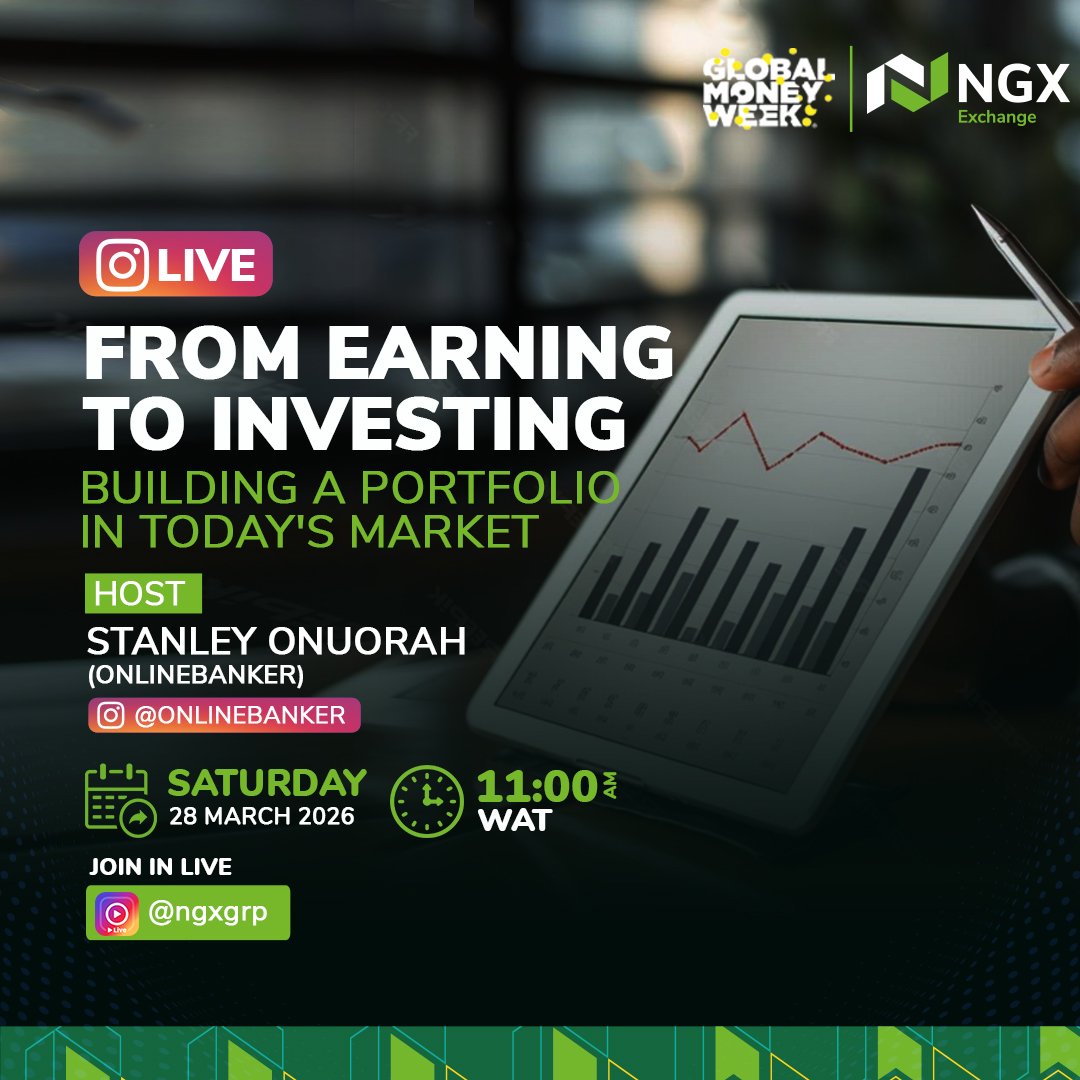
Extending its impact beyond in-person engagement, the exchange also convened an interactive Instagram Live session in collaboration with United Capital Plc.
Featuring Stanley Onuorah, widely known as Online Banker, the session focused on Building a Portfolio in Today’s Markets. It addressed pressing questions from young Nigerians on navigating the capital market, understanding available investment products, and making informed financial choices.
During the session, a representative from NGX’s Trading and Products division shared practical insights into the range of instruments available in the market, including equities, fixed income securities, and exchange-traded funds, while outlining clear pathways for getting started and building resilient portfolios across varying market conditions.
In parallel, a representative from Market Regulation emphasised the importance of investor protection frameworks, educating participants on their rights, the safeguards that ensure fair market practices, and the necessity of due diligence in sustaining trust and integrity within the market.
The session has since attracted thousands of views, significantly amplifying awareness around financial literacy and encouraging greater youth participation in the capital market.
Through these initiatives, NGX continues to play a pivotal role in shaping financially responsible citizens, in line with its broader mandate to drive inclusive growth and strengthen investor confidence within Nigeria’s financial ecosystem.


By Adedapo Adesanya
The NASD Over-the-Counter (OTC) Securities Exchange declined by 2.14 per cent on Monday, March 30, weakening the Unlisted Security Index (NSI) by 89.95 points to 4,109.74 points from 4,199.69 points.
During the session, investors lost N53.82 billion, leaving the market capitalisation of the trading platform at N2.458 trillion versus the previous session’s N2.512 trillion.
The bourse recorded four price gainers and four price losers led by 11 Plc, which shed N35.12 to close at N316.50 per share compared with last Friday’s value of N351.17 per share. MRS Oil Plc declined by N20.00 to quote at N190.00 per unit versus the previous price of N21o.00 per unit, FrieslandCampina Wamco Nigeria Plc dropped N11.00 to trade at N99.00 per share versus N110.00 per share, and Central Securities Clearing System (CSCS) Plc dipped N2.93 to N77.17 per unit from N80.10 per unit.
Conversely, IPWA Plc appreciated by 55 Kobo to N6.06 per share from N5.51 per share, Industrial and General Insurance (IGI) Plc expanded by 5 Kobo to 57 Kobo per unit from 52 Kobo per unit, Geo-Fluids Plc gained 4 Kobo to close at N3.22 per share versus N3.18 per share, and Acorn Petroleum Plc improved by 1 Kobo to N1.34 per unit from N1.33 per unit.
Trading data revealed a decline of 63.7 per cent in the volume of securities to 21.3 million units from 58.6 million units, a 59.6 per cent drop in the value of securities to N651.1 million from N1.6 billion, and a 24 per cent contraction in the number of deals to 38 deals from 50 deals.
The most active stock by value on a year-to-date basis was CSCS Plc with 56.3 million units exchanged for N3.8 billion, trailed by Okitipupa Plc with 27.5 million units traded for N1.8 billion, and Infrastructure Guarantee Credit Plc with 400 million units valued at N1.2 billion.
Resourcery Plc was the most traded stock by volume on a year-to-date basis with 1.1 billion units worth N415.7 million, followed by Infrastructure Guarantee Credit Plc with 400 million units sold for N1.2 billion, and Geo-Fluids Plc with 133.1 million units transacted for N511.2 million.










-
 Feature/OPED6 years ago
Davos was Different this year
-
Travel/Tourism10 years ago
Lagos Seals Western Lodge Hotel In Ikorodu
-

 Showbiz3 years ago
Estranged Lover Releases Videos of Empress Njamah Bathing
-
 Banking8 years ago
Sort Codes of GTBank Branches in Nigeria
-

 Economy3 years ago
Subsidy Removal: CNG at N130 Per Litre Cheaper Than Petrol—IPMAN
-

 Banking3 years ago
Sort Codes of UBA Branches in Nigeria
-

 Banking3 years ago
First Bank Announces Planned Downtime
-

 Sports3 years ago
Highest Paid Nigerian Footballer – How Much Do Nigerian Footballers Earn