
Economy
Best Prop Trading Firms in Nigeria 2026

A typical trader’s risk appetite often increases once they’ve scored a few wins. The reasoning is that, if I take bigger risks, I may go home with a bigger paycheck. But risk appetite alone doesn’t increase the chances of higher earnings; you also must invest a lot more money.
This need for higher trading capital is a gap that prop trading firms seek to plug. They give skilled traders capital and then agree on how to split the gains. The tradeoff for you as a trader is that you often pay upfront fees for evaluation or instant funding, operate under strict guidelines, and may lose access if you violate risk limits. And this is why you must choose a firm with which you can have a healthy relationship. This article presents the top options in Nigeria.
List of best prop trading firms in Nigeria 2026
- OneFunded – the fastest growing prop firm in 2026, with easy and transparent trading rules.
- FundedNext – prop firm offering trader-friendly challenge models
- FTMO – prop firm known for strict rules and structured evaluations
- Topstep – a futures prop firm focused on discipline and risk control
- Take Profit Trader – a prop firm with simple evaluations and clear rules
1. OneFunded
| Year founded | 2024 |
| Headquarters | London, England, UK |
| Funding model | Evaluation/challenge |
| Max capital | $200,000 |
| Profit split range | 80% default, 90% after purchasing add-on |
| Primary markets | Forex, crypto, indices, and metals |
| Trading platforms | cTrader, TradeLocker, MT5 |
Challenge Structure
OneFunded’s funding model is exclusively challenge-based. That is, traders access a funded account with a simulated trading environment after passing the evaluation. You can choose between a 1-step and 2-step challenge and pay a one-time fee, which is also refundable. The table below shows a detailed summary of the firm’s challenge structure.
| 1-Step Challenge | 2-Step Challenge | 1F Limited Challenge | |
| Phases | 1 | 2 | 2 |
| Account sizes available | $2,000, $5,000, $10,000, $25,000, $50,000, $100,000, $200,000 | $2,000, $5,000, $10,000, $25,000, $50,000, $100,000, $200,000 | $2,000, $5,000, $10,000, $25,000 |
| Profit targets | 10% | 8% (Phase 1) 5% (Phase 2) | 7% (Phase 1) 4% (Phase 2) |
| Drawdown limits | Daily: 4% Maximum: 6% | Daily: 5% Maximum: 10% | Daily: 5% Maximum: 11% |
| Minimum trading days | 5 days | 3 days (per phase) | 2 days (per phase) |
| Trading period | Unlimited | Unlimited | Unlimited |
| Entry fees (per account size) | $2K: $29; $5K: $56; $10K: $107; $25K: $143; $50K: $215; $100K: $395; $200K: $699 | $2K: $23; $5K: $45; $10K: $89; $25K: $125; $50K: $195; $100K: $361; $200K: $650 | $2K: $25; $5K: $49; $10K: $92; $25K: $135 |
Payouts and Trader Support
This prop trading firm processes payouts on a 14-day cycle after requests, but you can shorten this period with a seven day add-on. And the available methods are cryptocurrency (USDT) for payouts below $1,000 and bank transfer for higher amounts.
According to our research, users find OneFunded as quite reliable. For example, the firm has a 4.4-star rating from 141 Trustpilot reviews. Most reviewers praise the firm for transparent payouts and fair trading conditions. Support is also quite responsive. We established that your queries will be addressed within 24 hours.
Strengths and Ideal Users
Our research established that OneFunded has a high pass rate, which could be due to its no-pressure environment. The unlimited challenge durations allow traders to strategize without time constraints. Also, the firm provides all the details on its website regarding trading rules, fees, and payout processes. OneFunded is best for Nigerian traders seeking accessible and supportive platforms with flexible conditions.
2. FundedNext
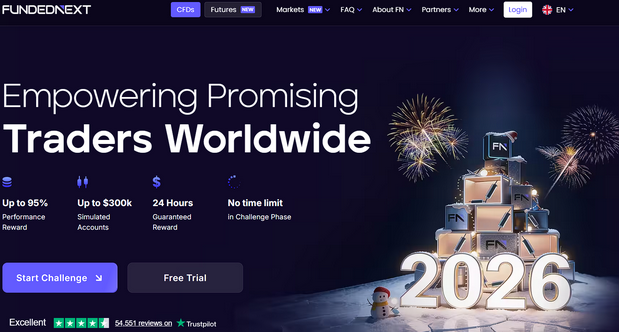
| Year founded | 2022 |
| Headquarters | Ajman, United Arab Emirates |
| Funding model | Evaluation with progression to a funded account; Instant funding |
| Max capital | $200,000 |
| Profit split range | Starts at 15% in challenge accounts, progresses to 90% in FundedNext accounts |
| Primary markets | Forex, indices, and commodities |
| Trading platforms | MetaTrader 4 and 5, cTrader, and Match-Trader. TradingView for analysis |
Challenge Structure
FundedNext offers two categories of funded trading programs, one for CFDs and the other for futures. The CFDs one is the broadest in terms of paths to funded status; there is Evaluation (2-step), Express (1-step with high target), Stellar 1-Step, Stellar 2-Step, and Stellar Lite (2-step). The table below summarizes the key features of these programs:
| Stellar 1-Step | Stellar 2-Step | Stellar Lite (2-Step) | Stellar Instant | |
| Account sizes available | $6k, $15k, $25k, $50k, $100k, $200k | $6k, $15k, $25k, $50k, $100k, $200k | $5k, $10k, $25k, $50k, $100k, $200k | $2k, $5k, $10k, $20k |
| Profit targets | 10% | 8%(Phase 1) 5%(Phase 2) | 8%(Phase 1)
4%(Phase 2) |
N/A |
| Drawdown limits | Daily: 3% Maximum: 6% | Daily: 5% Maximum: 10% | Daily: 4% Maximum: 8% | Daily: N/A
Maximum: 6% |
| Minimum trading days | 2 days | 5 days (per phase) | 5 days (per phase) | N/A |
| First withdrawal | 5 days | 21 days | 21 days | On demand |
| Performance reward | 15% | 15% | 15% | Up to 80% |
| Entry fees | $6k: $66; $15k: $130;
$25k: $220; $50k: $330; $100k: $570; $200k: $1,100 |
$6k: $60; $15k: $120; $25k: $200; $50k: $300; $100k: $550; $200k: $1,100 | $5k: $33; $10k: $60; $25k: $140; $50k: $230; $100k: $400;
$200k: $799 |
$2k: $60; $5k: $150, $10k: $300; $20k: $600 |
| Refundable fee | Full price for all account sizes | Full price for all account sizes | Full price for all account sizes | N/A |
For the FundedNext Futures product, the firm offers two regular challenge models (Rapid and Legacy), and one limited-time exclusive challenge called Bolt. Below are the key features:
| Rapid (1-Step) | Legacy (1-Step) | Bolt (1-Step) | |
| Account sizes available | $25k, $50k, $100k | $25k, $50k, $100k | $50k |
| Profit target(s) | $25K: $1,500; $50K: $3,000; $100K: $5,000 | $25K: $1,250; $50K: $2,500; $100K: $6,000 | $3,000 |
| Drawdown limits | Maximum (Trailing): $25K: $1,000; $50K: $2,000; $100K: $2,500;
Daily: N/A |
Maximum (Trailing): $25K: $1,000; $50K: $2,000; $100K: $3,000;
Daily: N/A |
Maximum: $2,000
Daily: $1,000 |
| Entry fee | $25k: $110; $50k: $200; $100k: $280 | $25k: $80; $50k: $150; $100k: $250 | $100 |
| Reset fee | $25k: $97; $50k: $176; $100k: $247 | $25k: $70; $50k: $132; $100k: $220 | $88 |
Payouts and Trader Support
Our investigation found that FundedNext processes payouts within five to 24 hours. In fact, the firm offers an extra $1,000 compensation for each delayed payout. First payouts vary depending on the challenge and market. For CFDs models like Stellar 2-Step and Stellar Lite, the initial withdrawal is available 21 days after funding; it comes down to five days for Stellar 1-Step, and on-demand for Stellar Instant. And when the process is successful, you can receive funds via RiseWorks, Confirmo, and crypto (USDT).
Trustpilot reviews, 54,551 at writing, give the firm a strong 4.5/5 rating. Most users commend FundedNext for fast and reliable payouts. And regarding customer support, most users state that it is professional and responsive. Our research can confirm this, and add that the chat function on the website worked better.
Strengths and Ideal Users
FundedNext offers the most comprehensive funded trader programs in Nigeria. Add to that performance rewards during challenges, unlimited time for evaluations, and news trading allowance. The firm also has flexible trading guidelines and the support is professional. The firm is best for forex and futures traders seeking high profit shares, news/event strategies, and rapid scaling without time pressure.
3. FTMO
| Year founded | 2014 |
| Headquarters | Prague, Czech Republic |
| Funding model | Two-step evaluation process |
| Max capital | $200,000 |
| Profit split range | Up to 90% |
| Primary markets | Forex, crypto, indices, and commodities |
| Trading platforms | MetaTrader 4 and 5, cTrader, and DXtrade |
Challenge Structure
Unlike OneFunded, FTMO has only one challenge, the FTMO Challenge. This is a two-phase evaluation process that leads to a funded FTMO Account. You must know that the funded account operates in a simulated environment, which means that the funds are fictitious but the profit splits are real money. The table below presents the key features:
| FTMO challenge account size | $200,000 | $100,000 | $50,000 | $25,000 | $10,000 |
| Profit target | STEP 1: 10% STEP 2: 5% | STEP 1: 10%
STEP 2: 5% |
STEP 1: 10%
STEP 2: 5% |
STEP 1: 10% STEP 2: 5% | STEP 1: 10% STEP 2: 5% |
| Max. daily loss | 5% | 5% | 5% | 5% | 5% |
| Max. loss | 10% | 10% | 10% | 10% | 10% |
| Min. trading days | 4 days | 4 days | 4 days | 4 days | 4 days |
| Trading period | Unlimited | Unlimited | Unlimited | Unlimited | Unlimited |
| Refund | Yes 100% | Yes 100% | Yes 100% | Yes 100% | Yes 100% |
| Entry fee | €1,080 | €439 (offer) | €345 | €250 | €89 |
Payouts and Trader Support
FTMO allows on-demand payouts after a minimum of 14 days from the first trade on funded accounts. It processes the payouts within 1-2 business days via bank wire, Skrill, cryptocurrencies, or instant card transfers like Visa Direct (up to $20,000). The firm doesn’t charge a cent on its platform during this process.
We established that FTMO’s customer support channels operate 24/7 in 20 languages. There is also plenty of community features, including a 100k+ member Discord, and a 400k-subscriber YouTube channel. The firm also offers plenty of educational material via FTMO Academy.
Strengths and Ideal Users
FTMO has one of the longest running trader funding programs in the sector. This speaks to its tenacity and relevance. Other strengths include robust educational resources and advanced analytics tools (e.g., Account MetriX, Trading Journal, etc.). We also learned through Reddit that the firm is reliable, operates transparently, and traders experience minimal slippage issues despite strict rules.
FTMO is best for experienced traders seeking a reputable, resource-rich platform with high capital access and scaling opportunities in Nigeria.
4. TopStep
| Year founded | 2012, rebranded from TopStepTrader to TopStep in 2020 |
| Headquarters | Chicago, Illinois, USA |
| Funding model | Evaluation with progression to a live funded account |
| Max capital | $150k in challenges; $750k across five Express Funded Accounts |
| Profit split range | 50% to 100% |
| Primary markets | CME Foreign Exchange Futures, CME Equity Futures, CME Agricultural Futures, CME NYMEX Futures, CME CBOT Agricultural Futures, CME CBOT Financial/Interest Rate Futures, and CME COMEX Futures |
| Trading platforms | TopStepX, NinjaTrader, Quantower, Tradovate, TradingView |
Challenge Structure
TopStep takes prospective traders through a primary challenge phase; the evaluation is called Trading Combine. Those who pass this stage proceed to the Express Funded Account. This is funded account that uses fictitious funds to hone traders’ skills. And the upside that you receive rewards for every successful trade. If the team and TopStep are satisfied with your skills, you may be called upon to operate a Live Funded Account.
The table below summarizes the account sizes you can choose at the Trading Combine stage; the structure is the same up to the Live Funded Account. Note that you can choose the “No activation fee” path or the “Standard” path.
| Path | Account Size (Buying Power) | Profit Target | Monthly Price | Max Loss Limit | Max Position Size | Activation Fee |
| No Activation Fee | $50k | $3,000 | $89 | $2,000 | 5 contracts | Free |
| No Activation Fee | $100k | $6,000 | $139 | $3,000 | 10 contracts | Free |
| No Activation Fee | $150k | $9,000 | $189 | $4,500 | 15 contracts | Free |
| Standard | $50k | $3,000 | $49 | $2,000 | 5 contracts | $129 (one-time, after passing) |
| Standard | $100k | $6,000 | $99 | $3,000 | 10 contracts | $129 (one-time, after passing) |
| Standard | $150k | $9,000 | $149 | $4,500 | 15 contracts | $129 (one-time, after passing) |
Payouts and Trader Support
TopStep starts rewarding traders at the Express Funded Account (XFA) stage. The first payout requires at least five winning days of $150 or more in profits, and you can request up to four withdrawals in a month. The firm processes payouts daily with instant deductions for quick access, though specific channels like bank transfers or other methods are handled via the platform with dedicated support.
Also, the firm offers robust educational resources such as in-depth strategy courses, daily TopStepTV broadcasts featuring expert insights, and personalized Coach T analytics. There is also a vibrant community through a large Discord chatroom with over 150,000 members and coaches, plus a Facebook group for networking and accountability. Customer support is accessible via 24/7 chat, weekday phone assistance, SMS, WhatsApp, and email options for prompt help.
Strengths and Ideal Users
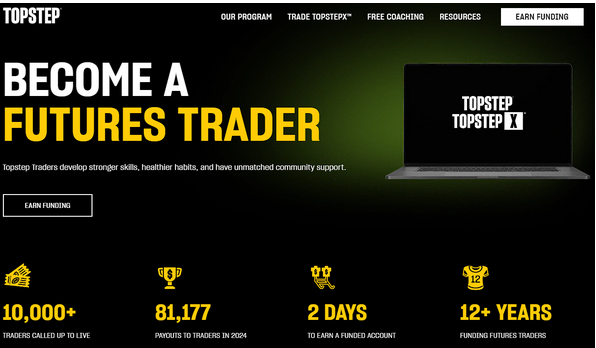
TopStep specializes in the futures market, and, according to information on its website, it has funded more than 10,000 traders into live accounts for over 12 years. The Trading Combine feature is also a standout program that offers a streamlined single-rule path to a live funded account. Traders also enjoy features like TopStepX, a proprietary trading platform tailored for futures traders. As such, the firm is best for futures traders needing structure and coaching.
5. Take Profit Trader
| Year founded | 2021 |
| Headquarters | Windermere, Florida, USA |
| Funding model | Subscription-based evaluation with progression to a live account |
| Max capital | $150,000 |
| Profit split range | 80% for PRO Accounts; 90% for PRO+ Accounts |
| Primary markets | Futures and options contracts across Equity Indices, Energy, Metals, Currencies, Agriculture, Crypto, and Treasuries |
| Trading platforms | NinjaTrader, TradingView, Tradovate, Quantower, R Trader, MetaTrader 4, MetaTrader 5 |
Challenge Structure
Take Profit Trader uses a single-step evaluation process and upon passing, traders move to a funded PRO account. Traders get a test account at the evaluation phase, where they trade in a simulated environment. They don’t get a live environment until they graduate to the PRO+ account. The table below summarizes some of the key features of the different account types:
| Feature | TEST | PRO | PRO+ |
| Trading environment | Simulated | Simulated | Live |
| Withdrawals | None | Day one | Day one |
| Profit split | None | 80/20 | 90/10 |
| Maximum withdrawal amount | None | No max | No max |
| Buffer rules | None | Yes | None |
| Drawdown | End of Day | Intra day | End of Day |
| Consistency rule | Yes | None | None |
| Scaling rule | None | None | None |
| Broker rates | $5/$0.50 RT | $5/$0.50 RT | Broker rates |
And, you can choose a trading account from $25,000 to $150,000, the maximum allocation. The table below details the parameters of each account size:
| Account Size | Monthly Subscription | Profit Target | Max Position Size | Daily Loss Limit | EOD Trailing Drawdown |
| $25,000 | $150 | $1,500 | 3 contracts/
30 micros |
Removed | $1,500 |
| $50,000 | $170 | $3,000 | 6 contracts/
60 micros |
Removed | $2,000 |
| $75,000 | $245 | $4,500 | 9 contracts/
90 micros |
Removed | $2,500 |
| $100,000 | $330 | $6,000 | 12 contracts/
120 micros |
Removed | $3,000 |
| $150,000 | $360 | $9,000 | 15 contracts/ 150 micros | Removed | $4,500 |
Payouts and Trader Support
Once you graduate to the PRO account, Take Profit Trader offers payouts starting from day one. But your account balance must exceed the buffer zone (equal to max drawdown). You will get an 80% share of profits with a PRO account and 90% on PRO+ after 60 trading days. Our investigation showed that the firm processes payouts in 24-36 hours via Plaid (US banks), PayPal, or Wise. You can request withdrawals as many times as possible, and payouts are free over $250, and a $50 fee under that. And, KYC verification is required before first withdrawal using standard ID documents.
However, Tak Profit Trader does not offer educational resources such as those available at competitors. Instead, you’ll have to rely on help articles for rules and a Discord community for peer discussion. Customer support operates via live chat, email, and Discord.
Strengths and Ideal Users
Take Profit Trader’s single-step evaluation makes it stand out, especially for traders looking for an expedited path to funded accounts. It’s pricing is also competitive, and even the broker fees are affordable. However, a lack of educational resources makes the firm best for risk-tolerant and experienced futures traders only.
Comparative Analysis of the Best Prop Firms
| Firm | Max Allocation | Profit Split | Evaluation Steps | Best Feature | Trustpilot Rating |
| OneFunded | $200,000 | Up to 90% | Multiple paths (1-Step & 2-Step) | Unlimited challenge duration with a high pass rate | 4.4/5 |
| FTMO | $200,000 | Up to 90% | Two-Step Challenge | Robust educational resources and advanced analytics tools | 4.8/5 |
| FundedNext | $200,000 (CFDs); $100,000 (Futures) | Up to 90% | Multiple paths (1-Step & 2-Step; Instant) | Most comprehensive funded trader programs with news trading allowance. | 4.5/5 |
| TopStep | $150,000 | 50%–100% | Single-step Trading Combine | Futures specialization with coaching, community, and proprietary trading platform. | 3.6/5 |
| Take Profit Trader | $150,000 | 80% (PRO); 90% (PRO+) | Single-Step Evaluation | Day-one withdrawals on funded accounts | 4.4/5 |
Strategies for Selecting a Prop Firm in Nigeria
1. Align Challenge Rules with Your Trading Timeframe
Choose a firm whose evaluation period structure matches your typical position-holding duration. If you trade slowly or prefer no time pressure, opt for firms offering unlimited challenge durations. Ensure the minimum trading day requirement fits your natural trading frequency to avoid forced, suboptimal trades.
2. Calculate Your True Cost to Profitability
Look beyond the initial evaluation fee. Factor in the potential costs of multiple attempts, since most traders do not pass on the first try. Include all associated expenses such as platform fees, data costs, and reset charges to accurately compare the total investment required across different firms.
3. Verify Withdrawal Track Record
Conduct independent research on payout reliability. Check reviews on platforms like Trustpilot, Reddit, and trading forums for consistent patterns of praise or complaints regarding withdrawals. Pay attention to how firms respond to and resolve payment issues.
4. Test Rules Against Your Actual Trade History
Audit your past trading performance against a firm’s specific rules. Review your last 50-100 trades to see if your largest losses would violate daily or maximum drawdown limits. Confirm that your typical position sizes comply with the firm’s lot or contract limits.
5. Prioritize Rule Clarity Over Generous Splits
Select firms with explicitly documented and transparent trading guidelines. Avoid any with vague terminology like “reasonable trading” or rules subject to discretionary interpretation, as these can be used to disqualify you regardless of a high profit share percentage.
6. Evaluate Support Before You Pay
Proactively test the firm’s customer service before purchasing a challenge. Send pre-sales questions to gauge response time and quality. Explore available support channels like live chat, email, and community forums to assess their usefulness and the general sentiment among funded traders.
FAQs
- How difficult is it to pass a prop firm’s evaluation challenge?
Passing rates vary, but most traders do not succeed on their first attempt due to psychological pressure and strict risk limits. Firms like OneFunded report higher pass rates, often attributed to their no-pressure, unlimited-time evaluation structure.
- What are the most common reasons traders fail prop firm challenges?
The primary reasons are violating daily or maximum drawdown limits and failing to meet profit targets within the required minimum trading days. Emotional trading under time pressure and over-leveraging are also frequent causes of failure.
- Can I trade with multiple prop firms simultaneously?
Yes, most firms allow it, but you must manage separate accounts and adhere to each firm’s specific rules. However, ensure you can handle the psychological and operational complexity of juggling multiple evaluation criteria and risk limits.
- How quickly can I scale my account after getting funded?
Scaling policies vary. Some firms offer scaling plans based on consistent profitability, often increasing your capital by 25% to 50% after meeting specific profit milestones over a set period.
- Are profits from prop trading taxable?
Yes, payout profits are generally considered taxable income. However, tax treatment depends on your country of residence and the firm’s structure. It is advisable to consult with a local tax professional to understand your specific reporting obligations.





By Adedapo Adesanya
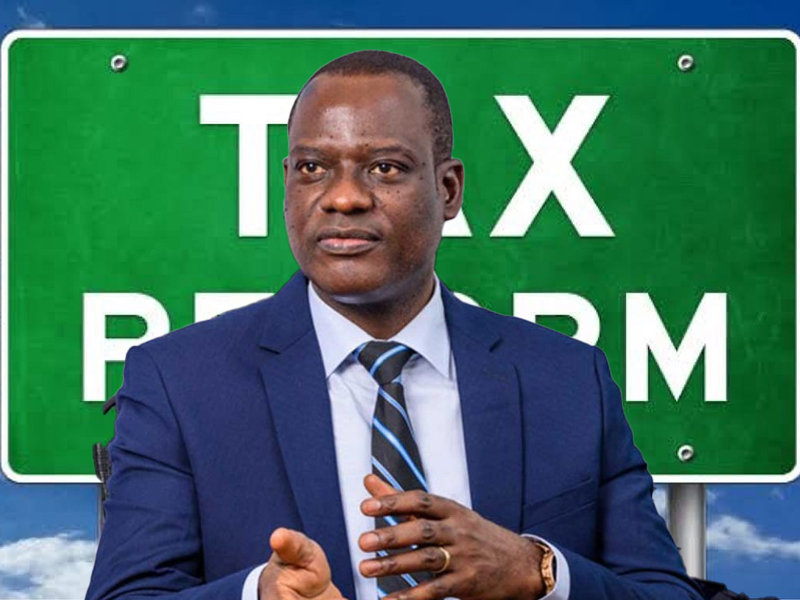
The Minister of State for Finance, Mr Taiwo Oyedele, has denied admitting errors in Nigeria’s new tax laws, describing the reports as “misleading” and a false misrepresentation.
In a Sunday statement, attributed to the Presidential Fiscal Policy and Tax Reforms Committee and posted on Mr Oyedele’s official X handle, the reports were described as an unhelpful twisted narrative that risks distorting public understanding and misleading the very people the reforms were designed to benefit.
“Our attention has been drawn to misleading media reports claiming that the Minister of State for Finance, Mr Taiwo Oyedele, has ‘finally admitted errors in the new tax laws.’
“These publications misrepresent the Minister’s statements, falsely alleging that he urged Nigerians to await the outcome of a legislative probe, a process that has long been concluded and the gazetted copies certified by the National Assembly [have been] published since early January 2026.
“This twisted narrative is unhelpful as it risks distorting public understanding and misleading the very people the reforms were designed to benefit,” the statement read.
The committee explained that the minister, while speaking at a fireside chat during the Nigerian Bar Association Section on Legal Practice conference in Lagos, highlighted early gains from the tax reforms.
According to the statement, the gains highlighted by the Minister included a significant increase in the number of informal businesses seeking registration with the Corporate Affairs Commission, as well as a rise in the number of registered taxpayers from about 10 million to over 100 million nationwide.
These impressive results stem from the robust design and progressive nature of the new laws, including an exemption of small companies from tax, increased exemption thresholds for low-income earners, tax exemptions on basic consumption items like food, education, healthcare, transportation, and rent, and the introduction of the Tax Ombud to protect taxpayer rights, it stated.
The statement added, “The Minister contrasted the transformative changes in the new laws with the regressive provisions in the old laws. He, however, emphasised that no law is perfect.
“Therefore, ongoing stakeholder engagement is essential to identify and address any errors or gaps for appropriate legislative updates through Finance Bills as part of a continuous improvement process.”
By Adedapo Adesanya
Lafarge Africa Plc will change its corporate name to HBM Nigeria Plc, reflecting new majority ownership by China’s Huaxin Cement Co., subject to approval by shareholders of the 67-year old cement maker.
The company will ask shareholders to approve the change of its corporate identity to HBM Nigeria Plc at its 67th Annual General Meeting scheduled for April 30, 2026, in Lagos.
The proposed name change is part of a broader AGM agenda that also includes financial reporting, dividend approval, and board restructuring.
The rebrand marks a new chapter following Holcim’s exit and signals Huaxin’s intent to deepen its footprint in Nigeria’s construction materials sector.
The company highlighted the proposed name change as a key special resolution requiring shareholder approval at the meeting. Management noted that the amendment will formally alter Clause 1 of its Memorandum of Association, redefining its legal identity.
Lafarge Africa Plc reported strong financial performance for the 2025 financial year, underscoring the backdrop to its proposed strategic shift. The company recorded significant growth across key financial metrics.
Revenue rose to N1.1 trillion in 2025, up 53 per cent from N696.8 billion in 2024. Profit after tax increased from N100.1 billion to N273 billion, representing a 173 per cent growth. Operating profit climbed from N193 billion to N392 billion, driven by cost optimisation and operational efficiency.
Earnings per share surged from N6.22 to N17, reflecting improved profitability. The company has proposed a final dividend of N6.00 per share, subject to shareholder approval and applicable withholding tax.
Huaxin Cement acquired a controlling 83.81 per cent stake in Lafarge Africa Plc from the Holcim Group for roughly $1 billion. The deal, finalised in late 2025, marks Holcim’s complete exit from Nigeria to focus on other markets, with Huaxin aimed at expanding its footprint in Africa.
The chairman of Lafarge Africa, Mr Gbenga Oyebode, said Nigeria’s market holds vast potential with its positive growth indices, increasing urbanisation, and infrastructure demand.
“This development will further solidify Lafarge Africa’s position as a leading contributor to Nigeria’s infrastructure and economic growth. Nigeria’s market holds vast potential with its positive growth indices, increasing urbanisation, and infrastructure demand. We remain committed to leveraging these opportunities while maintaining our focus on sustainability and innovation.”
Lafarge expanded into Nigeria in 2001 through the acquisition of Blue Circle, thereby taking over its stake in West African Portland Cement Company (WAPCO), later rebranding it as Lafarge Cement WAPCO Plc and significantly increasing production capacity with new plants and infrastructure in Ogun State.
By Adedapo Adesanya
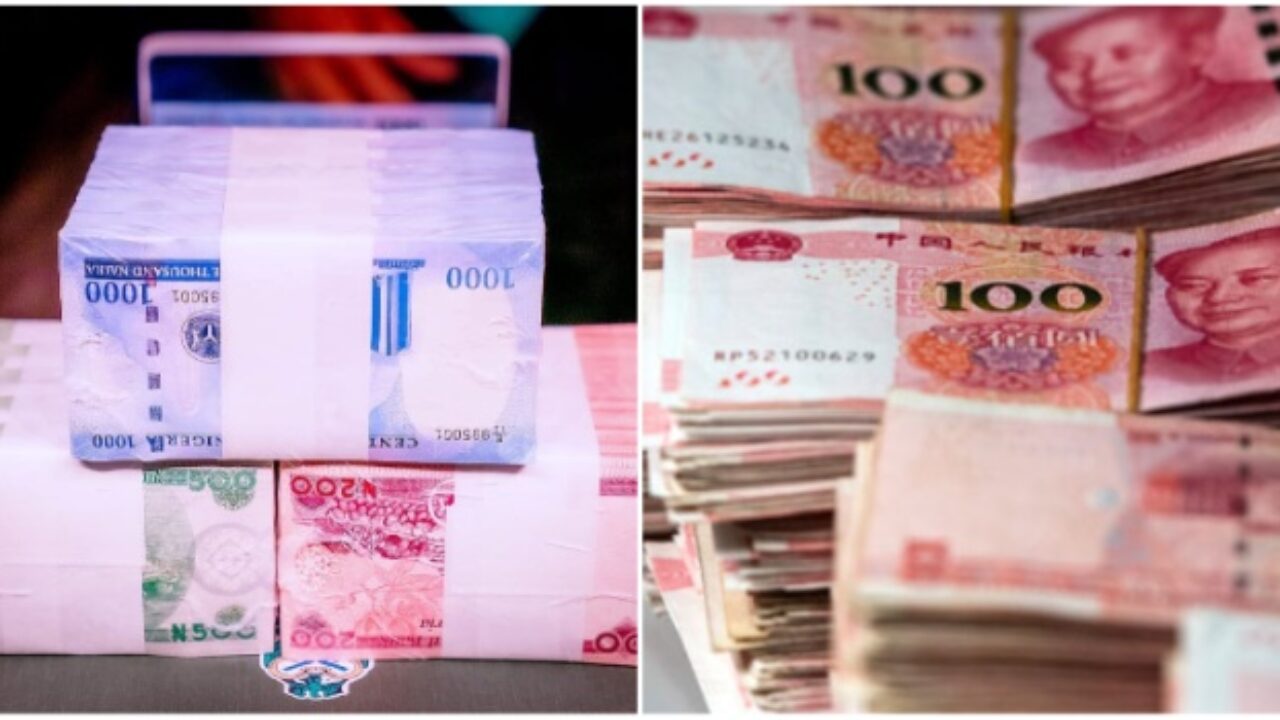
The Naira extended its gain on the Dollar in the Nigerian Autonomous Foreign Exchange Market (NAFEX) on Friday, April 10, by 0.18 per cent or N2.43 to trade at N1,356.89/$1 compared with the previous day’s N1,359.32/$1.
It also improved its value against the Pound Sterling in the same market window by N16.01 to close at N1,828.82/£1 versus N1,844.83/£1, but lost N3.40 against the Euro to sell at N1,592.58/€1 versus N1,589.18/€1.
In the parallel market, the Nigerian Naira further appreciated against the Dollar during the session by N5 to settle at N1,385/$1 compared with the previous day’s rate of N1,390/$1.
With the FX market operating with greater liquidity and efficiency, market participants now transact without extraordinary interventions from the Central Bank of Nigeria (CBN).
However, external reserves fell for 16 straight days through April 8, the longest declining run since July 2025. The central bank’s foreign exchange holdings declined by $1.1 billion in the period to $48.94 billion, the lowest level since February 19, the lender’s data show.
After initially weakening, as the Iran war broke out, the Nigerian currency has recovered losses and is one of only four of 23 African currencies still standing in the period.
The CBN had pledged to stabilise the Naira and has boosted sales of high-yield short-term debt to attract inflows of Dollars.
As for the cryptocurrency market, Bitcoin (BTC) and other major cryptocurrencies fell after US Vice President J.D. Vance announced that the country and Iranian negotiators had failed to agree to an extended ceasefire. BTC lost 1.9 per cent to sell at $71,549.08.
The parties met in Pakistan on Saturday to negotiate an agreement after the US’s nearly six-week-long campaign against Iran. VP Vance said at a press conference afterwards that the US had “not reached an agreement.”
Cardano (ADA) fell 4.3 per cent to $0.2398, Solana (SOL) depreciated by 2.7 per cent to $82.22, Binance Coin (BNB) slumped 2.2 per cent to $593.61, Dogecoin (DOGE) went down by 1.9 per cent to $0.0912, Ethereum (ETH) weakened by 1.4 per cent to $2,214.56, and Ripple (XRP) crashed by 1.3 per cent to $1.33.
However, TRON (TRX) appreciated by 0.9 per cent to $0.3217, while the US Dollar Tether (USDT) and the US Dollar Coin (USDC) closed flat at $1.00 each.
-
 Feature/OPED6 years ago
Davos was Different this year
-
Travel/Tourism10 years ago
Lagos Seals Western Lodge Hotel In Ikorodu
-

 Showbiz3 years ago
Estranged Lover Releases Videos of Empress Njamah Bathing
-
 Banking8 years ago
Sort Codes of GTBank Branches in Nigeria
-

 Economy3 years ago
Subsidy Removal: CNG at N130 Per Litre Cheaper Than Petrol—IPMAN
-

 Banking3 years ago
Sort Codes of UBA Branches in Nigeria
-

 Banking3 years ago
First Bank Announces Planned Downtime
-

 Sports3 years ago
Highest Paid Nigerian Footballer – How Much Do Nigerian Footballers Earn