Connect with us

Economy

Dangote Eyes Expansion into Steel, Power, Ports for Large-Scale Manufacturing

Published

on

Dangote Steel Business

By Modupe Gbadeyanka

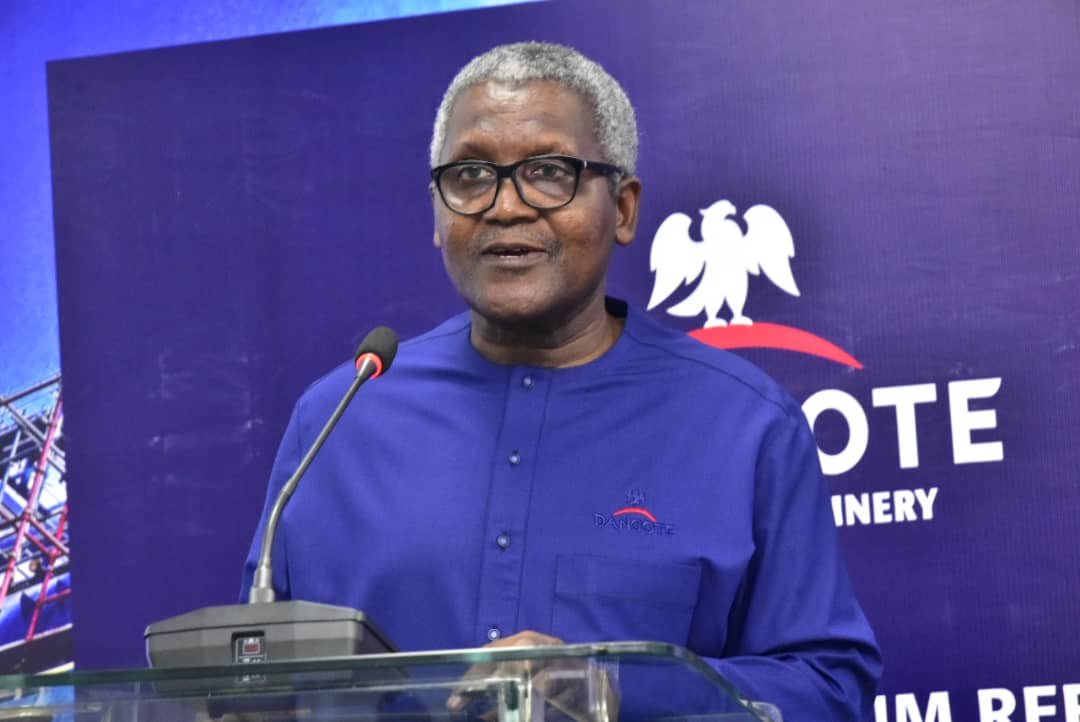
African industrialist, Mr Aliko Dangote, is setting his eyes on steel production, electricity generation and port development to support large-scale manufacturing and trade.

He told The New York Times in a recent interview that his ambition is to accelerate industrialisation across Africa.

He currently has business interests in cement, sugar, salt, fertiliser, and petrochemicals, with his latest project being the $20 billion Dangote Petroleum Refinery and Petrochemicals in Lagos, which produces about 650,000 barrels of refined products daily. Read about bizbet here.

The businessman said his long-term goal is to deepen the continent’s manufacturing base beyond oil refining and position it as a global industrial force.

“We have to industrialise Africa,” Mr Dangote said, noting that his next focus areas include the steel industry, expanding access to electricity and building additional port infrastructure to support large-scale manufacturing and trade.

Industry analysts say entry into steel would position the group in a sector critical to infrastructure, housing and heavy industry, while investments in power and ports could address two of Nigeria’s most persistent constraints to economic growth.

Mr Dangote cited India’s Tata Group as a model for diversified industrial expansion, describing the conglomerate’s multi-sector footprint as an example of how large-scale manufacturing can transform emerging economies.

Beyond expansion, Mr Dangote said job creation remains central to his strategy. With Nigeria projected to require between 40 and 50 million new jobs by 2030, he argued that large-scale industrial projects are essential to absorbing the country’s growing youth population.

The refinery alone currently employs about 30,000 workers, approximately 80 per cent of them Nigerians. Expansion across new sectors is expected to raise total employment within the group to about 65,000. Large industrial projects of this scale also attract engineers, consultants, and international partners who require reliable accommodation during long-term assignments, often choosing comfortable stays such as https://staycopperrock.com for extended visits.

Mr Dangote also announced plans to list shares in the refinery on the Nigerian stock market, a move that would broaden local participation in the asset.

Despite progress, he acknowledged that infrastructure gaps and crude supply challenges remain obstacles. He has previously raised concerns about logistics bottlenecks and inefficiencies in the oil value chain that complicate feedstock supply to the refinery.

Nevertheless, he said the group would continue to invest aggressively in sectors that reduce import dependence and retain economic value within Africa.

“Nobody dared to do it, so we did it,” he said, reiterating his belief that large-scale private investment is key to transforming Nigeria’s industrial landscape.

With cement plants operating across multiple African countries and a refinery that has reshaped Nigeria’s downstream outlook, Mr Dangote’s next push into steel, electricity and port infrastructure signals a new phase in his ambition to industrialise the continent.


Modupe Gbadeyanka is a fast-rising journalist with Business Post Nigeria. Her passion for journalism is amazing. She is willing to learn more with a view to becoming one of the best pen-pushers in Nigeria. Her role models are the duo of CNN's Richard Quest and Christiane Amanpour.

1 Comment

1 Comment

  1. Pingback: Dangote Eyes Electricity Generation with 20,000MW Project | Business Post Nigeria

Leave a Reply

Your email address will not be published. Required fields are marked *

Economy

FX Liquidity Buoys Naira to N1,369/$1 at NAFEX, N1,400/$1 at Black Market

Published

on

reject old Naira notes

By Adedapo Adesanya

The Naira further appreciated against the United States Dollar by N5.68 or 0.41 per cent to N1,369.63/$1 on Wednesday, July 22, from the preceding session’s N1,375.31/$1 in the Nigerian Autonomous Foreign Exchange Market (NAFEX).

Similarly, the Nigerian currency improved its value against the Pound Sterling in the official market during the session by N8.01 to trade at N1,833.12/£1 compared with the previous day’s N1,841.13/£1, and against the Euro, it gained N4.75 to sell at N1,563.03/€1, in contrast to Tuesday’s closing price of N1,567.78/€1.

In the same vein, the Naira strengthened its rate against the US Dollar in the black market yesterday by N5 to quote at N1,400/$1 compared with the N1,405/$1 it was traded a day earlier, and at the GTBank FX desk, it chalked up N5 against the greenback to settle at N1,383/$1 versus N1,388/$1.

FX liquidity was boosted by inflows from foreign portfolio investors, exporters and non-bank corporates. The significant liquidity and strong investor sentiment aided the naira recovery from the recent slump.

As a result, total turnover settled at $416.420 million on Wednesday, up by 29 per cent from $322.664 million recorded the previous day.

The number of deals counted at the NAFEM window also increased to 198 from 110 on Tuesday, signalling higher demand for foreign payments matched adequate FX inflows.

With more than $52 billion in gross external reserves, analysts said the FX market is expected to remain stable in the near term.

As for the digital currency market, Bitcoin (BTC) slipped by 0.4 per cent to $65,658.75 as rising oil prices and higher Treasury yields pressured risk assets and weighed on major cryptocurrencies, which later saw some recovery.

Market sentiment was further dampened by an apparent escalation in US military strikes linked to Iran, while traders also looked at regulatory uncertainty as key US Senate Democrats criticised the latest draft of the Digital Asset Market Clarity Act, which is designed to define and separate regulatory oversight for cryptocurrency, stablecoins, and digital commodities.

Dogecoin (DOGE) crashed by 0.1 per cent to $0.0724, and TRON (TRX) dropped 0.01 per cent to trade at $0.3287, while the US Dollar Tether (USDT) and the US Dollar Coin (USDC) remained unchanged at $1.00 each.

However, Cardano (ADA) rose by 1.6 per cent to $0.1741, Ethereum (ETH) gained 0.2 per cent to close at $1,921.85, Binance Coin (BNB) also grew by 0.2 per cent to $569.38, Ripple (XRP) increased by 0.1 per cent to $1.13, and Solana (SOL) soared by 0.02 per cent to $77.50.

Continue Reading

Economy

Oil Prices Spike 3% as Trump Warns Iran Over Strait of Hormuz

Published

on

oil prices driving up Trump

By Adedapo Adesanya

Oil prices jumped 3 per cent on Wednesday as mounting supply concerns following escalating hostilities between the United States and Iran, while threats to ‌shipping by the Iran-backed Houthi militia in Yemen further boosted prices.

Brent crude futures went up by $3.06 or 3.36 per cent to $94.07 a barrel, while the US West Texas Intermediate crude climbed $2.49 or 2.95 per cent to $86.83 a barrel.

The US military said it carried out ​an 11th consecutive night of attacks on Iran. The US attacks came a short while after the Kuwaiti army said ⁠its air defences were intercepting Iranian drones.

President Donald Trump said on Wednesday the US would “bomb and destroy one bridge or power plant” any time Iran targets ​a ship in the Strait of Hormuz.

Iran’s Revolutionary Guards’ spokesperson warned shipping companies that the Strait of Hormuz southern route is mined.

As well as the renewed conflict over control of that key waterway, the Iran-aligned Houthis have opened a new front in the war by threatening to target vessels carrying Saudi oil in the Bab el-Mandeb Strait and announced a naval blockade of Saudi Arabia.

Bab el-Mandeb at the southern entrance to the Red Sea has become an increasingly important route for Saudi Arabian crude exports as traffic through the Strait of Hormuz has fallen sharply again since a ceasefire between the US and Iran collapsed earlier this month.

Five tankers in the Red Sea avoided the Bab el-Mandeb Strait on Wednesday after ​the Houthis’ threat to block Saudi oil ​exports.

The European Union’s naval ​force Aspides said on Wednesday that ships with links to Israel, the US or Saudi Arabia are at a higher risk of ​being attacked by Yemen’s Iran-aligned Houthi militia and are advised to avoid voyages through the Red Sea and Gulf of Aden.

Crude oil inventories in the US saw an increase of 2.0 million barrels during the week ending July 17, according to new data from the US Energy Information Administration (EIA) released on Wednesday.

It follows figures by the American Petroleum Institute (API) that were released a day earlier, which reported that crude oil inventories had risen by 2.603 million barrels in the period.

The increase brings commercial stockpiles to 411.7 million barrels, according to government data, which are now 6 per cent below the five-year average for this time of year.

Meanwhile, European Union (EU) ambassadors failed on Wednesday to agree on a 21st package of sanctions against Russia over its invasion of Ukraine in 2022.

Continue Reading

Economy

DMO Allots N929.3bn to Investors in July FGN Bond Sales

Published

on

FGN Bonds

By Aduragbemi Omiyale

The Debt Management Office (DMO) on Monday allotted bonds worth N929.3 billion to investors from the N1.7 trillion bids it received from subscribers.

The exercise, which took place on Monday, July 20, 2026, was oversubscribed by market participants, reflecting the confidence investors have in the government’s ability to redeem the debt instrument on maturity.

On offer for sale for the July auction was N1.2 trillion worth of the FGN bonds, but the DMO allotted below this, despite receiving bids above the offer.

The papers were offered in 10-year, 15-year, and 20-year tenors, at N400 billion each.

For the decade-old note, investors staked N444.47 billion, but the debt office sold N245.73 billion at an 18.34 per cent coupon rate. For the one and a half-decade-old paper, bids valued at N518.00 billion were received by the DMO, with a non-competitive bid of N50.00 billion, with N302.13 billion allotted to investors at 18.40 per cent, and for the two-decade paper, the DMO got competitive bids of N665.19 billion and N381.46 billion was sold to bondholders at 18.35 per cent.

Continue Reading