Economy
Beta Glass Rebuilds DF1 Furnace at Ughelli Plant in 48 Days
By Dipo Olowookere
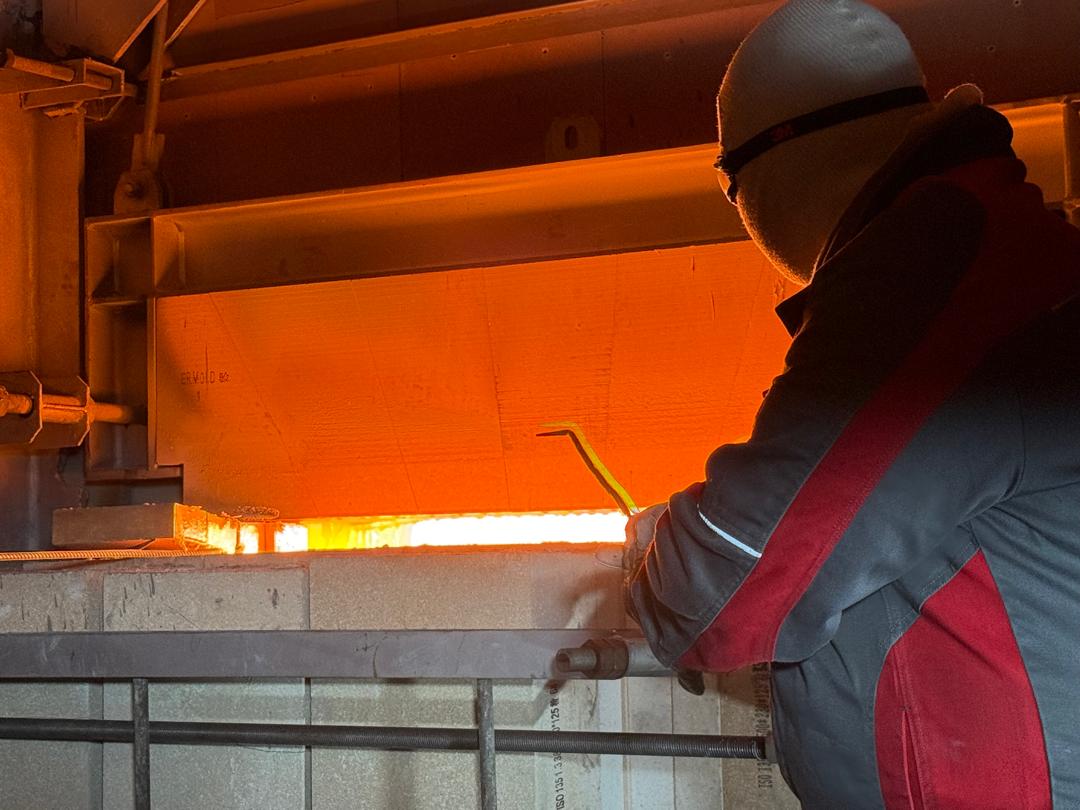
The leading manufacturer of glass packaging solutions in West and Central Africa, Beta Glass Plc, has completed rebuilding its DF1 container glass furnace in Ughelli, Delta State.
The company carried out the exercise in a record 48 days, setting a new global benchmark in the glass container industry.
The DF1 furnace rebuild at its state-of-the-art manufacturing facility in Ughelli is expected to increase production capacity as it was embedded with a smart SCADA technology for remote monitoring and advanced process control.
It was gathered that the new 250 tonnes and 70-square meter container glass furnace has gas reduction units, blowers, burners, and state-of-the-art combustion and cooling skids installed in it.
Also installed were advanced exhaust draught systems, dampers, batch chargers, boosters, probes, cameras, and cooling tower relocation.
The furnace has energy savings of 7 per cent and a furnace lifespan extension of over 17 years and achieved with zero accident through precise planning and 24-hour task force coordination involving 130 expert contractors and global partners like BDF, Furnotherm, All Glass, Bottero, and MSK Tiama.
The team overhauled three IS forming machines, and put two new forming machines, and installed an advanced cold end inspection system featuring AI and smart technology.
According to a statement from the organisation, the exercise was led by the Chief Operating Officer, Jagdish Agarwal, whose leadership ensured flawless execution and robust risk management protocols.
“This world-record DF1 furnace rebuild underscores Beta Glass’ commitment to operational excellence, innovation, and sustainability.
“The DF1 rebuild not only strengthens our production capabilities but also reinforces our position as a leader in glass manufacturing across Africa.
“Our ability to deliver such a complex project safely, on time, and to the highest standards is a testament to the expertise and dedication of our team, partners, and suppliers,” the chief executive of Beta Glass, Mr Alexander Gendis, said.
Economy
Dangote Refinery Target $50bn Valuation for Nigeria IPO
By Adedapo Adesanya
Dangote Refinery is targeting a $50 billion valuation ahead of the planned Initial Public Offering (IPO) in Nigeria later this year.
A report by Bloomberg, quoting sources, noted that the company wants to sell up to a 10 per cent stake, potentially raising around $5 billion in one of Nigeria’s biggest capital market deals.
The 650,000-barrels-per-day refinery has transformed Nigeria’s fuel supply chain by reducing dependence on imported petroleum products.
A senior executive at the Dangote Group confirmed to Bloomberg that the projected valuation reflects the company’s internal expectations but declined to comment further on the timing or structure of the transaction.
The planned listing comes as rising global crude oil prices and stronger domestic fuel consumption improve the refinery’s commercial outlook.
The Dangote Group has also appointed a consortium of three financial advisers to manage the offering. Stanbic IBTC Capital, operating under the Standard Bank umbrella, will handle the international book-building process and lead engagement with foreign portfolio investors.
Vetiva Capital Management, which has advised on previous Dangote listings, will manage retail investor distribution within Nigeria, while FirstCap will focus on placements with Nigerian institutional investors, particularly pension funds, according to the report
Located in the Lekki Free Zone in Lagos, the facility has a refining capacity of 650,000 barrels per day, making it Africa’s largest single-train refinery.
Since beginning large-scale production of petrol, diesel, and aviation fuel, the refinery has reshaped Nigeria’s fuel supply chain, reducing reliance on imported petroleum products and increasing local refining capacity in Africa’s biggest oil producer.
Last year, Mr Aliko Dangote, the majority stakeholder at the refinery, indicated that Nigerian investors would soon have an opportunity to buy shares directly in the refinery business, signalling a broader push to attract domestic participation in the energy sector.
The IPO is anchored by an unprecedented dividend structure that allows investors to purchase shares in Nigerian naira but receive returns in US Dollars, backed by an estimated $6.4 billion in annual petrochemical export revenues.
The prospectus has already been submitted for regulatory review, and a subscription window is expected to open by August 2026.
It will also be the first time that the Refinery will become available for public ownership. The refinery, located in the Lekki Free Trade Zone near Lagos, was commissioned in May 2023 after nearly a decade of construction and an investment of approximately $20 billion.
By February 2026, the facility had reached its full processing capacity of 650,000 barrels of crude oil per day, making it the world’s largest single-train refinery and Africa’s biggest refining complex.
Economy
Nigeria Runs to World Bank for Fresh $1.25bn Loan
By Adedapo Adesanya
Nigeria is currently in talks with the World Bank for a fresh $1.25 billion loan in June 2026.
According to a document titled Nigeria Actions for Investment and Jobs Acceleration, the proposed loan will finance ongoing economic reforms, job creation, and competitiveness.
Already, talks are at the critical stage for the loan facility expected to be presented for approval on June 26, 2026. The loan has progressed beyond the initial concept and appraisal phases.
If approved, it will come off as the second-largest loan facility after the approval of the ‘$1.5bn Reforms for Economic Stabilisation to Enable Transformation Development Policy Financing’ approved by the Bank in June 2024.
The borrower is listed as the Federal Republic of Nigeria, while the Federal Ministry of Finance will serve as the implementing agency.
This comes as the country’s debt profile remains high. As of December 31, 2025, external debt stood at $51.86 billion, while Nigeria’s total public debt in dollars is currently at $110.97 billion
The loan is now at the decision-meeting stage of the World Bank’s project cycle, a point at which the lender’s management reviews the final appraisal package and determines whether the project should proceed to the Board of Executive Directors for approval.
This stage comes after appraisal and negotiations have been concluded, with key policy actions, financing terms, and reform commitments already agreed in principle between the borrower and the World Bank team.
In the World Bank process, the decision meeting represents a near-final internal clearance, after which the project is prepared for formal Board consideration, where final approval is granted.
The World Bank document stated, “The review did authorise the team to appraise and negotiate,” meaning the project has successfully passed earlier internal checks and is advancing toward final approval.
According to the global lender, the loan is designed “to support the government’s efforts to expand access to finance, digital, and electricity services, and strengthen competitiveness through tax, trade, and agriculture reforms.”
Under President Bola Tinubu, the World Bank has approved about $9.35 billion in loans and credits for Nigeria between June 2023 and May 2026.
These approvals span multiple sectors, including power, education, healthcare, agriculture, social protection, renewable energy, MSME financing, and economic reform support.
Key packages include the $2.25 billion RESET and ARMOR reform financing in June 2024, $1.57 billion for HOPE and SPIN programmes in September 2024, and $1.08 billion for education and resilience programmes in March 2025.
Economy
FrieslandCampina Wamco, CSCS Lift NASD OTC Market by 1.05%
By Adedapo Adesanya
The duo of FrieslandCampina Wamco Nigeria Plc and the Central Securities Clearing System (CSCS) Plc boosted the NASD Over-the-Counter (OTC) Securities Exchange by 1.05 per cent on Monday, May 11.
FrieslandCampina Wamco added N13.07 to sell N146.00 per share versus the previous price of N132.98 per share, and CSCS Plc rose by 10 Kobo to close at N76.00 per unit compared with last Friday’s N75.90 per unit.
As a result, the market capitalisation increased by N26.20 billion to N2.514 trillion from N2.488 trillion, and the NASD Unlisted Security Index (NSI) went up by 48.80 points to 4,202.57 points from 4,158.77 points.
The volume of securities bought and sold by market participants decreased by 55.2 per cent yesterday to 236,921 units from 528,891 units, the value of securities slid by 51.5 per cent to N16.5 million from N34.0 million, and the number of deals contracted by 20 per cent to 20 deals from 25 deals.
Great Nigeria Insurance (GNI) Plc ended the day as the most traded stock by value on a year-to-date basis, with 3.4 billion units traded for N8.4 billion, followed by CSCS Plc with 60.5 million units exchanged for N4.1 billion, and Okitipupa Plc with 27.8 million units transacted for N1.9 billion.
GNI Plc also closed the session as the most traded stock by volume on a year-to-date basis with 3.4 billion units worth N8.4 billion, followed by Resourcery Plc with 1.1 billion units valued at N415.7 million, and Infrastructure Guarantee Credit Plc with 400 million units sold for N1.2 billion.
-
Feature/OPED6 years agoDavos was Different this year
-
Travel/Tourism10 years ago
Lagos Seals Western Lodge Hotel In Ikorodu
-
Showbiz3 years agoEstranged Lover Releases Videos of Empress Njamah Bathing
-
Banking8 years agoSort Codes of GTBank Branches in Nigeria
-
Economy3 years agoSubsidy Removal: CNG at N130 Per Litre Cheaper Than Petrol—IPMAN
-
Banking3 years agoSort Codes of UBA Branches in Nigeria
-
Banking3 years agoFirst Bank Announces Planned Downtime
-
Sports3 years agoHighest Paid Nigerian Footballer – How Much Do Nigerian Footballers Earn

Pingback: Helios to Acquire Frigoglass’ Stake in Beta Glass for Up to €100m | Business Post Nigeria
Pingback: Investors Lose N693Nbn as Stock Market Bleeds | Business Post Nigeria