

Economy
Buhari Directs EFCC to Investigate SEC Boss

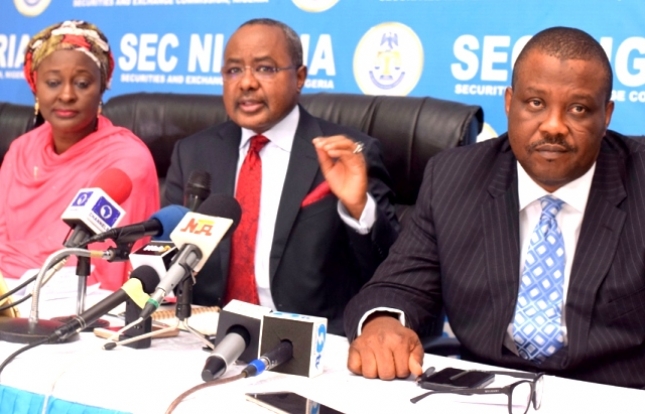
By Modupe Gbadeyanka
Chairman of the Economic and Financial Crimes Commission (EFCC) has been directed to launch an investigation into allegations of gross misconduct against the Director-General of the Securities and Exchange Commission (SEC), Mr Mournir Gwarzo.
This directive, given by President Muhammadu Buhari, followed a petition filed against the embattled SEC boss by the Centre for Anti-Corruption and Open Leadership (CACOL).
In the petition signed by CACOL Executive Chairman, Mr Debo Adeniran, it was alleged that Mr Gwarzo paid himself a severance package of N104 million in “total disregard to the standing rule in the civil service.”
As a result, CACOL urged the President to “order a thorough audit of the finances of the Commission.”
The petition, received at the Presidential Villa last Saturday, copied the President, the Senate President, Speaker of the House of Representatives, Chairmen of Senate and House of Representatives Committees on Capital Market; Acting EFCC Chairman, Chairman of the Independent Corrupt Practices and other related offences Commission, Chairman of the Presidential Advisory Committee on Anti-Corruption, Commissioner of Police at the Special Fraud Unit and others.
It was gathered that the President, after viewing the petition, directed the EFCC to thoroughly look into the matter.
The Acting Chairman of the EFCC was ordered to work with CACOL to determine if the SEC DG paid himself the N104 million as alleged.
Mr Magu is also to find out if Mr Gwarzo is running the capital market regulatory agency like his personal estate.
The anti-graft agency was further mandated to determine if the SEC boss awarded contracts to firms belonging to his allies or relatives.
These companies include Outlook Communications, Tida International Limited, Outbound Investment Limited, Acromac Nigeria Limited, Balfort International Investment Limited, Medusa Investments Limited, Interactiven Worldwide Nigeria Limited, Northwind Environmental Services, and Micro-Technologies Limited.
Below is the petition filed by CACOL against Mr Gwarzo:
ALLEGATION OF CORRUPTION AND ABUSE OF OFFICE AGAINST THE DIRECTOR-GENERAL, SECURITIES AND EXCHANGE COMMISSION, SEC, MR MOURNIR HALIRU GWARZO
The attention of the Centre for Anti-Corruption and Open Leadership (CACOL) has been drawn to a large-scale abuse of office and gross official recklessness on the part of the Director-General of the Securities and Exchange Commission (SEC), Mr Mournir Haliru Gwarzo, who by our findings, has engaged in series of anti-establishment manipulations to enrich himself through acts that are at variance with civil service rules and regulations.
As Your Excellency is perhaps aware, our organisation, the Centre for Anti-Corruption and Open Leadership, CACOL, is an aggregate of human rights, community based and civil society organisations and individuals with anti-corruption and openness in governance agenda across Nigeria.
It is a non-political, non-religious, non-sectional and non-profit making organisation. We set for ourselves the tasks of promoting accountability, openness in governance and using any available means to cause relevant authorities to probe and bring to book, corrupt leaders both in public and private institutions.
We also strive to protect interest of persons or groups found to be victims or potential victims of corrupt practices or processes of manipulation and violation of human rights.
The decision to embark on the journey was taken in 2007 in view of the need to confront, once and for all, the monster that is ravaging all facets of our national life in Nigeria – CORRUPTION.
It is in view of our avowed commitment to the fight against corruption that we have presented the perceived official excesses and acts of corruption perpetrated by Mr Mournir Haliru Gwarzo before Your Excellency, having petitioned the President of the Senate, Speaker of the House of Representatives, the Economic and Financial Crimes Commission (EFCC) and other anti-corruption and law enforcement agencies.
The Issues:
On January 2, 2013, Mr Mournir Haliru Gwarzo was appointed an Executive Commissioner in the Securities and Exchange Commission for a four-year tenure by the then administration of President Goodluck Jonathan.
Before the expiration of the four-year deal, Gwarzo was elevated by same government as the Director General of the Commission on May 22, 2015. But consequent upon resumption of office as the Director General of SEC, Mr Gwarzo, ordered the payment of a severance benefit to himself to the tune of N104,851,154.94 (One hundred and four million, eight hundred and fifty one thousand, one hundred and fifty four naira and ninety-four kobo. We view this development as total disregard to the standing rule in the civil service that states that severance benefit can only be paid to an employee who has concluded his or her service and has completely disengaged from service and not to an employee who has been promoted within the Commission as is in the case of Mr Gwarzo.
- It is alleged that Mr Haliru Gwarzo runs SEC as his personal estate and appointed companies with links to him and some of his cronies in office to carry out transactions and provide services to the Commission. Some of the Companies listed to have links with Mr Gwarzo, his wife and other cronies are:
- Outbound Investment Ltd, RC NO. O. 807317
- Medusa Investments Limited, RC NO. 326829
- Northwind Environmental Services. REG NO BN2389176
- Micro-Technologies LTD RC NO. 173805
- Tida International Ltd RC NO. 26414
- Outlook Communications
- Acromac Nig Ltd RC NO. 10687864
- Balfort International Investment Ltd RC NO. 109153
- Interactiven Worldwide Nig Ltd RC NO. 779442
CACOL will want Your Excellency to direct the Economic and Financial Crimes Commission to look into the allegations of illegal creation of wealth from SEC by Mr Mournir Gwarzo.
We make bold to say that the personal interest of Mr Gwarzo in the above listed companies clearly contravenes the provisions of Nigerian law which distinctively prohibits public officers from putting themselves in situations where their personal interest conflicts with their public duties.
Our prayers
It is in view of these noted discrepancies that we urge Your Excellency to direct the Economic and Financial Crimes Commission to beam searchlights on the activities of Mr Mournir Haliru Gwarzo as the Director General of the Securities and Exchange Commission. The EFCC is in possession of all supporting documents on the above stated allegations which are at our disposal where from the above-enumerated issues were teased out. We are, however, at Your Excellency’s service or that of any of the anti-corruption agencies to provide more documents that may be necessary to facilitate a prompt delivery on the investigation at any point we are called upon for such assistance.
- That Your Excellency should take immediate steps to constitute a Board for the Securities and Exchange Commission as provided for in the extant laws establishing the Commission. The Investment and Securities Act (ISA) 2007 which gives the Commission its current powers also made a provision for the appointment of a nine (9) member Board to be headed by a Chairman. The idea of the Board is to, amongst other things, ensure that no Director-General of the Commission can become a law onto himself or herself and act without appropriate checks by the Board.
- Considering the high probability that a lot more atrocities may have been committed unchecked under the present circumstance in which the Securities and Exchange Commission has functioned without a Board, CACOL considers it incumbent to call on President Muhammadu Buhari to order a thorough audit of the finances of the Commission.
Please accept our esteemed regards as we look forward to Your Excellency’s decisive intervention in unearthing the issues raised here with strict compliance with the rule of law.


