Connect with us

Economy

Bulls, Bears Share Spoils on Nigerian Exchange

Published

on

Equities Market bearish bullish

By Dipo Olowookere

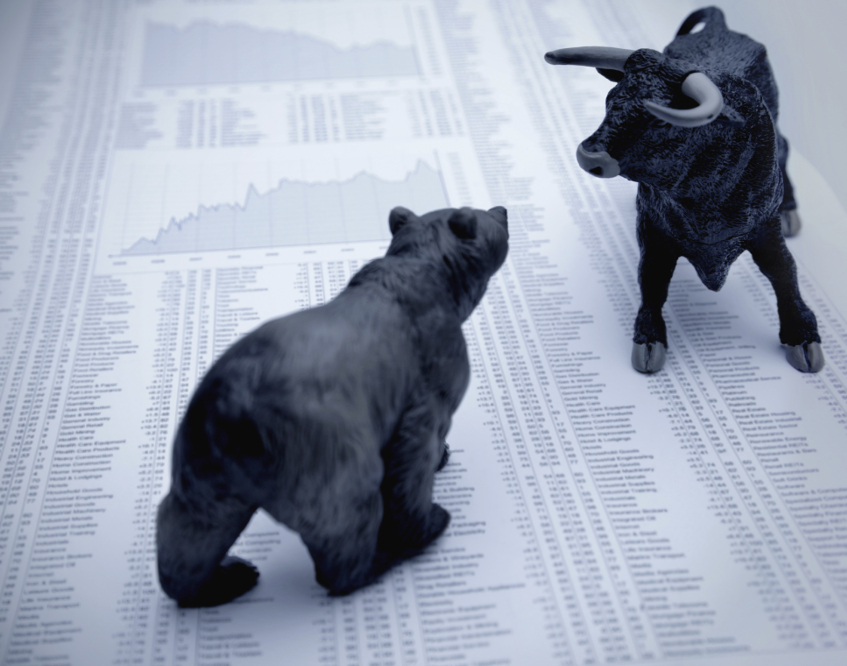
The first trading day of the week at the Nigerian Exchange (NGX) Limited ended in stalemate on Monday, though the key performance indicators were slightly up.

The All-Share Index (ASI) inched higher by 1.39 points to 149,437.88 points from last Friday’s 149,436.48 points and the market capitalisation was up by N3 billion to finish at N95.267 trillion compared with the previous trading session’s N95.264 trillion.

The financial services space was upbeat yesterday, with the banking index gaining 0.89 per cent and the insurance counter rising by 0.87 per cent.

However, the consumer goods segment performance badly, losing 0.79 per cent as the energy sector declined by 0.05 per cent, while the commodity and the industrial goods indices closed flat.

Business Post reports that investor sentiment was bullish during the session as there were 28 appreciating stocks and 23 depreciating stocks, representing a positive market breadth index.

Sovereign Trust Insurance led the gainers’ gang after it chalked up 10.00 per cent to sell for N3.74, Guinness Nigeria appreciated by 9.96 per cent to N239.50, Mecure Industries rose by 9.88 per cent to N41.70, First Holdco improved by 9.86 per cent to N34.55, and AIICO Insurance also expanded by 9.86 per cent to N3.79.

The losers’ group was led by Prestige Assurance after it gave up 10.00 per cent to finish at N1.53, FTN Cocoa lost 8.16 per cent to trade at N4.50, Guinea Insurance depreciated by 7.69 per cent to N1.08, Royal Exchange crashed by 7.25 per cent to N1.79, and Nigerian Breweries slipped by 6.86 per cent to N76.75.

A total of 553.2 million shares valued at N13.3 billion were transacted in 28,907 deals on Monday versus the 602.8 million shares worth N30.7 billion traded in 20,550 deals last Friday, indicating a shortfall in the trading volume and value by 8.23 per cent and 56.68 per cent apiece, and an improvement in the number of deals by 40.67 per cent.

FCMB was the most active stock with a turnover of 92.0 million equities valued at N964.0 million, Access Holdings sold 67.9 million shares for N1.4 billion, Consolidated Hallmark transacted 50.8 million equities worth N208.8 million, Fidelity Bank exchanged 35.8 million shares valued at N672.4 million, and Jaiz Bank traded 29.7 million stocks worth N134.1 million.


Dipo Olowookere is a journalist based in Nigeria that has passion for reporting business news stories. At his leisure time, he watches football and supports 3SC of Ibadan. Mr Olowookere can be reached via [email protected]

Economy

Naira Appreciates 0.06% to N1,419/$1 at Official Market

Published

on

Fake Naira notes banknotes

By Adedapo Adesanya

The Naira rebounded on Tuesday, January 20 in the Nigerian Autonomous Foreign Exchange Market (NAFEM) as it appreciated against the US Dollar by 93 Kobo or 0.06 per cent to N1,419.35/$1 from Monday’s N1,420.28/$1.

However, it depreciated against the Pound Sterling in the official market by N2.43 to trade at N1,908.31/£1 versus the previous day’s N1,905.88/£1 and lost N13.53 against the Euro to finish at N1,666.31/€1 compared with the preceding session’s closing price of N1,652.78/€1.

The Nigerian currency also weakened against the Dollar at the GTBank forex counter yesterday by N5 to sell at N1,429/$1, in contrast to Monday’s exchange rate of N1,424/$1 and maintained stability at the parallel market at N1,485/$1.

Market analysts said they expect the current trading range of the Naira to remain firm in the near term supported by stronger foreign inflows driven by higher oil receipts, improved FPI participation, and consistent FX management by the Central Bank of Nigeria (CBN).

Boost from exporters’ and importers’ inflows in addition to non-bank corporate supply will also help enhance liquidity.

The Dollar also faced pressure in the international market in the midst of a dispute between the US and its European allies over Greenland, which President Donald Trump said “no going back” on his campaign thereby triggering selloffs to other safe haven assets.

As for the cryptocurrency market, Bitcoin (BTC) dropped below $90,000 on Tuesday amid a sharp shift in global risk sentiment, triggering more than $1 billion in forced liquidations of leveraged crypto positions.

The crypto sell-off coincided with broader market jitters tied to renewed tariff threats from President Donald Trump and a sell-off in Japanese government bonds that pushed global yields higher and pressured risk assets, with the BTC down by 1.6 per cent to $89,456.08.

Ethereum (ETH) lost 4.7 per cent to trade at $2,974.67, Binance Coin (BNB) slumped by 4.1 per cent to $878.27, Solana (SOL) depreciated by 2.8 per cent to $128.14, Cardano (ADA) crashed by 1.9 per cent to $0.3595, Ripple (XRP) slipped by 1.8 per cent to $1.91, Litecoin (LTC) declined by 1.7 per cent to $68.92, and Dogecoin (DOGE) shrank by 1.5 per cent to $0.1251.

On the flip side, the US Dollar Tether (USDT) appreciated by 0.01 per cent to trade at $1.00, and the US Dollar Coin (USDC) gained 0.03 per cent to settle at $1.00.

Continue Reading

Economy

Stock Investors Recover N93bn after Previous Day’s Loss

Published

on

Attract Stock Investors

By Dipo Olowookere

The Nigerian Exchange (NGX) Limited returned to green territory on Tuesday after it chalked up 0.09 per cent on the back of renewed buying pressure.

The market regained strength yesterday despite profit-taking in the banking space, which caused its index to close lower by 0.69 per cent.

Business Post reports that insurance counter was up by 2.80 per cent, the energy sector appreciated by 2.40 per cent, the commodity segment grew by 1.22 per cent, and the consumer goods industry improved by 0.03 per cent, while the industrial goods counter closed flat.

At the close of transactions, the All-Share Index (ASI) went up by 144.32 points to 166,256.82 points from 166,112.50 points and the market capitalisation gained N93 billion to finish at N106.436 trillion compared with the N106.343 trillion it settled on Monday.

During the session, investors transacted 795.5 million equities valued at N20.0 billion in 45,410 deals versus the 629.6 million equities worth N14.8 billion executed in 57,858 deals a day earlier, indicating a rise in the trading volume and value by 26.35 per cent and 35.14 per cent apiece and a decline in the number of deals by 21.52 per cent.

Tantalizers was the busiest stock yesterday with a turnover of 87.0 million units valued at N300.9 million, Secure Electronic Technology traded 74.2 million units worth N87.6 million, a new member of the NGX, Zichis Agro Allied Industries, transacted 69.6 million units for N138.5 million, Zenith Bank sold 49.1 million units valued at N3.5 billion, and GTCO exchanged 39.1 million units worth N3.8 billion.

On Tuesday, the market breadth index was positive after Customs Street ended with 39 appreciating shares and 25 depreciating shares, representing a bullish investor sentiment.

Deap Capital, NPF Microfinance Bank, and Red Star Express gained 10.00 per cent each to sell for N5.39, N4.73, and N15.95 apiece, as NCR Nigeria soared by 9.97 per cent to N155.50, and Morison Industries also increased by 9.97 per cent to N6.84.

Conversely, Aluminium Extrusion lost 9.95 per cent to settle at N17.20, Jaiz Bank declined by 9.88 per cent to N7.21, FTN Cocoa shrank by 8.44 per cent to N7.05, UPDC decreased by 8.06 per cent to N5.70, and Caverton slumped by 5.59 per cent to N7.60.

Continue Reading

Economy

Kazakh Supply Disruptions, Positive Economic Data Buoy Oil Prices

Published

on

Kazakh Supply

By Adedapo Adesanya

Oil prices rose on Tuesday on the temporary suspension of output at Kazakhstan’s oil fields and expectations of firmer global economic growth that could drive fuel demand.

Brent futures chalked up 98 cents or 1.53 per cent to trade at $64.92 a barrel and the US West Texas Intermediate (WTI) crude contract for February, which expired on Tuesday, gained 90 cents or 1.51 per cent to close at $60.34 per barrel.

Kazakh oil producer Tengizchevroil said on Monday it had temporarily halted production at the Tengiz and Korolev oilfields after an issue affected power distribution systems.

The Chevron-operated joint venture operating the supergiant 700,000 barrels per day Tengiz field onshore Kazakhstan stated that it had suspended production as a “precautionary measure” after a fire broke out at the field’s power distribution systems.

Tengiz could be halted for another seven to 10 days, cutting crude exports via the Caspian Pipeline Consortium (CPC).

Market analysts noted that Tengiz is amongst the largest fields in the world and so the outage is certainly disruptive for crude flows.

The oil market also drew support from better-than-expected fourth-quarter Chinese gross domestic product data released on Monday as data showed that the economy of the world’s largest oil producer grew by 5 per cent last year and the country’s refinery throughput in 2025 climbed 4.1 per cent on a year-over-year basis, data showed on Monday. China’s crude oil output also grew 1.5 per cent.

Prices also gained on an upward revision of this year’s global economic growth estimate by the International Monetary Fund (IMF).

The IMF in its World Economic Outlook update forecast global GDP growth at 3.3 per cent in 2026, up ‌0.2 percentage point from its last estimate in October. That’s even with 3.3 per cent growth in 2025, which will also beat the October estimate by 0.1 percentage point.

The lender said that globally, inflation was forecast to continue to decline, ​from 4.1 per cent in 2025 to 3.8 per cent in 2026 and 3.4 per cent in 2027.

Investors continued to monitor US President Donald Trump’s tariff threats against European states that oppose his push to acquire Greenland.

The American president said he would impose additional 10 per cent levies from February 1 on goods imported from EU members Denmark, Finland, France, Germany, Sweden and the Netherlands, as well as Britain and Norway, rising to 25 per cent on June 1 if no deal on Greenland was reached.

President Trump’s tariff threats have a negative bearing on crude prices as the levies could lead to lower global economic growth and therefore reduce oil demand growth.

Continue Reading

Trending