Connect with us

Economy

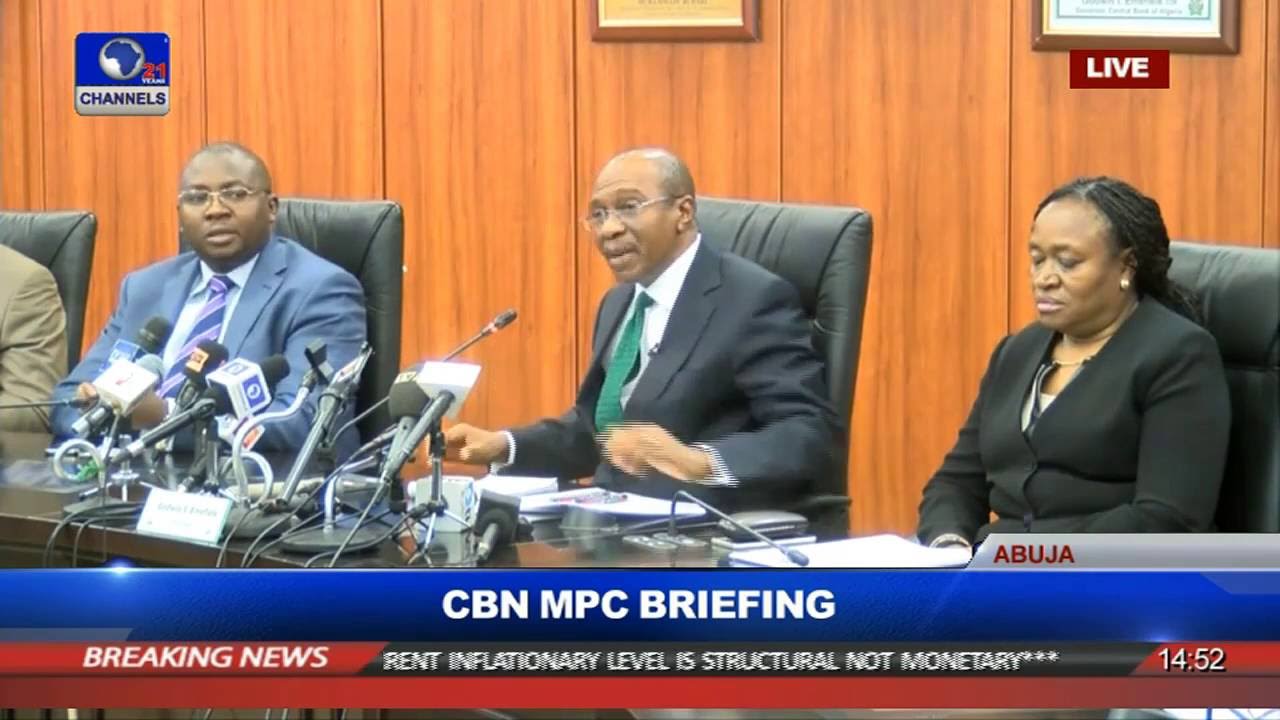
CBN Begins Last MPC Meeting for 2019 Today

Published

on

MPC Meeting CBN

By Modupe Gbadeyanka

The last Monetary Policy Committee (MPC) meeting of the Central Bank of Nigeria (CBN) for 2019 has kicked off today in Abuja.

The two-day gathering, according to a statement from the apex bank, is taking place at the MPC Meeting Room, 11th Floor, Wing C, of the CBN Corporate Headquarters, Abuja.

On Tuesday, Governor of the central bank, Mr Godwin Emefiele, will have an interaction with members of the media to update them on outcome of the crucial meeting held every quarter.

Going into the MPC meeting today, members of the council will look into two economic data released recently by the National Bureau of Statistics (NBS); the inflation figures for October and Gross Domestic Product (GDP) for the third quarter.

Last Monday, the stats office said the inflation rate for last month significantly increased to 11.61 percent from 11.24 percent recorded in September, while the GDP grew by 2.28 percent in the third quarter of this year.

With the figures of last week, analysts strongly believe the benchmark interest rates, which currently stand at 13.50 percent, would be retained at their present levels.

In a recent chat with Bloomberg, Mr Emefiele had hinted that rates won’t be tampered with until next year because some parameters would be monitored and studied before any action can be taken.


Modupe Gbadeyanka is a fast-rising journalist with Business Post Nigeria. Her passion for journalism is amazing. She is willing to learn more with a view to becoming one of the best pen-pushers in Nigeria. Her role models are the duo of CNN's Richard Quest and Christiane Amanpour.

Click to comment

Leave a Reply

Your email address will not be published. Required fields are marked *

Economy

Aradel, Dangote Cement, Others Pull Back Stock Exchange by 1.65%

Published

on

Aradel Holdings

By Dipo Olowookere

The gains recorded by the Nigerian Exchange (NGX) Limited on Tuesday were quickly erased on Wednesday after stocks like Dangote Cement, Aradel Holdings, International Breweries and others recorded losses.

Apart from the insurance index, which closed higher by 0.42 per cent, every other sector ended in the red, with the energy space down by 4.41 per cent. The industrial goods segment lost 3.63 per cent, the banking sector depreciated by 1.49 per cent, and the consumer goods counter fell by 0.93 per cent.

Consequently, the All-Share Index (ASI) contracted by 3,729.11 points to 225,690.07 points from 229,419.18 points, and the market capitalisation retreated by N2.393 trillion to N144.825 trillion from N147.218 trillion.

Investor sentiment was bearish after the stock exchange closed the day with 22 appreciating equities and 32 depreciating equities, indicating a negative market breadth index.

Neimeth shed 10.00 per cent to settle at N8.10, Aradel bled by 10.00 per cent to quote at N1,275.80, NASCON crashed by 9.98 per cent to N197.60, International Breweries lost 9.52 per cent to trade at N9.50, and Livestock Feeds slipped by 9.43 per cent to N28.12.

On the flip side, Austin Laz gained 10.00 per cent to sell for N3.30, Guinea Insurance appreciated by 9.89 per cent to N1.00, DAAR Communications rose by 9.60 per cent to N1.37, Regency Alliance expanded by 9.52 per cent to 92 Kobo, and Sovereign Trust Insurance grew by 7.85 per cent to N2.06.

Business Post reports that the level of activity dropped yesterday, and Sterling Holdings led the activity log, with a turnover of 124.6 million units worth N980.6 million. UPDC traded 40.1 million units for N130.4 million, Access Holdings exchanged 36.8 million units valued at N811.6 million, Honeywell Flour transacted 33.8 million units worth N490.1 million, and United Capital sold 28.4 million units for N469.1 million.

At the close of transactions, market participants traded 488.1 million units valued at N14.0 billion in 46,929 deals versus the 966.7 million units worth N40.0 billion executed in 49,579 deals in the previous session, implying a drop in the trading volume, value, and number of deals by 49.51 per cent, 65.00 per cent, and 5.35 per cent, respectively.

Continue Reading

Economy

Crude Oil Drops Nearly 2% as Trump Hails Iran Talks

Published

on

Crude Oil Theft special court

By Adedapo Adesanya

Crude oil was down by nearly 2 per cent ​on Wednesday as optimism over US-Iran talks eased supply concerns after US President Donald ‌Trump said discussions in Qatar had gone well.

Brent futures gave up $1.38 or 1.89 per cent to sell for $71.57 a barrel, and the US West Texas Intermediate (WTI) crude lost 92 cents or 1.32 per cent to trade at $68.58 a barrel.

President Trump said on Wednesday that the US was getting along ⁠very well with Iran and that recent meetings in Qatar went well.

“The denuclearisation of ​Iran is moving along well,” the American President ​told reporters. “They’ve had very good meetings, and ⁠we’ll see.”

The US and Iran held technical talks in Doha as they seek ​to agree on the flow of shipping through the Strait of Hormuz and secure a lasting ceasefire, a source with direct knowledge ​of the talks and an Iranian official said.

The US and Iran have sparred publicly over the meaning of the interim pact, exchanging military strikes over the past week.

Meanwhile, US Vice President JD Vance again signalled that the White House is prepared to use force against Iran if diplomacy fails, raising the stakes around a 60-day memorandum of understanding (MOU) that has halted open hostilities but left the core disputes unresolved.

Crude oil inventories in the United States decreased by 3.8 million barrels during the week ending June 26, according to new data from the U.S. Energy Information Administration (EIA) released on Wednesday. The EIA’s data release follows figures by the American Petroleum Institute (API) that were released a day earlier, which reported that crude oil inventories saw a draw of 6.072 million barrels in the period.

Analysts have cut their 2026 oil price forecasts for the first time since the Iran war began, as the reopening of the Strait of Hormuz eased concerns over prolonged supply disruptions.

Meanwhile, a sub-group of oil-producing countries in the Organisation of the Petroleum Exporting Countries and its allies (OPEC+) will likely agree on a further hike ​in their output targets from August when they meet on Sunday. The target will increase by about 188,000 barrels per day for August, the same as for June and July.

The seven core OPEC+ members have increased their output quotas from April to July by almost 800,000 barrels ​per day even as the Iran war led to a sharp drop in production among key members.

Continue Reading

Economy

Underrated National Currencies in Crypto Exchange: Why NGN and VND Are Emerging as Promising Markets

Published

on

Crypto Market

Crypto exchange is no longer limited to familiar pairs involving the US dollar or the euro. When the goal is specific, e.g., buying USDT with a local currency, receiving an international transfer, or cashing out Bitcoin to a bank account, local fiat currencies take centre stage. The Nigerian naira, or NGN, and the Vietnamese dong, or VND, are excellent examples of this trend. Demand for these currencies is driven not by speculation, but by people solving everyday financial needs.

Why Local Currencies Are Becoming More Important in Crypto Exchange

Across developing markets, cryptocurrency adoption is accelerating where traditional financial infrastructure is slow, expensive, or limited. High international transfer fees, volatile exchange rates, and lack of access to foreign currencies have made digital assets an efficient bridge between local and global financial systems.

Between July 2024 and June 2025, the volume of on-chain cryptocurrency transactions in Sub-Saharan Africa exceeded $205 billion, representing approximately 52% year-over-year growth. Transactions below $10,000 accounted for 8% of total volume, compared with roughly 6% globally, indicating that demand extends well beyond stablecoins such as USDT and USDC. In Southeast Asia, meanwhile, crypto adoption is fueled primarily by the digital economy, cross-border commerce, e-commerce, and high retail participation.

NGN: Why Nigeria Has Become One of the World’s Leading Crypto Markets

Following Nigeria’s currency reforms in 2023–2024, the naira depreciated significantly. Access to U.S. dollars remained limited, while the gap between official and market exchange rates widened. As a result, Bitcoin and stablecoins evolved from investment assets into practical tools for payments and savings and drove a demand for USDT to naira exchanges, as well as Bitcoin to naira conversions.

The numbers illustrate the dynamic. In 2023, Nigeria ranked first globally in the peer-to-peer (P2P) cryptocurrency trading sub-index. In 2024, it climbed to second place in the Global Crypto Adoption Index. During the twelve months ending June 2025, Nigeria’s cryptocurrency transaction volume exceeded $92.1 billion—nearly three times that of South Africa.

Demand patterns are equally impressive. Approximately 89% of cryptocurrency transactions in Nigeria involve naira-to-BTC conversions, for which excellent rates can be found on BestChange’s dedicated page with NGN-to-BTC exchange offers. Around 80% of surveyed Nigerians already own stablecoins, while 95% said they would prefer receiving payments in stablecoins rather than in naira. Since 2019, Nigeria has accounted for roughly 60% of all stablecoin inflows into Sub-Saharan Africa. On BestChange, users can also compare offers for exchanging NGN to USDT TRC20, including, as well as the reverse direction, i.e., purchasing naira with crypto, such as BTC to naira or, for example, offers with rates for converting TRX to naira.

International remittances add another major source of demand. In 2024, remittance inflows reached $20.93 billion. While bank transfers cost an average of 15% of the transferred amount, comparable transfers using stablecoins were approximately 60% cheaper.

The legal landscape is also evolving. In 2025, virtual assets were formally brought under Nigeria’s regulatory supervision, while pressure on unregulated platforms increased. As a result, trusted exchange routes and reputable providers are becoming increasingly important in the crypto exchange market.

VND: Why Vietnam Remains Among the Global Leaders in Crypto Adoption

Vietnam paints a different picture. Unlike Nigeria, it faces no major currency instability, yet it has one of the world’s most active retail cryptocurrency markets. In 2025, the country ranked fourth in the Global Crypto Adoption Index, maintaining a top-five position for several consecutive years. Crypto transactions exceeded $200 billion in total during the twelve months ending June 2025.

Two factors consistently drive demand for crypto exchanges with dong: international remittances and Vietnam’s rapidly expanding digital economy. During 2024–2025, annual remittance inflows exceeded $16 billion, creating steady demand for converting foreign assets into Vietnamese dong.

Users looking to cash out can exchange USDT to VND (TRC20 network) or convert crypto from another network, e.g., USDT (ERC20) to Vietnamese dong. The flagship cryptocurrency exchanges are also available in the list of offers for Bitcoin-to-VND conversions. Those moving in the opposite direction can compare offers to convert VND to USDT (TRC20) or dong to USDT (ERC20) on BestChange.

Vietnam’s e-commerce market has also grown to approximately $32 billion, driving additional demand for fast, efficient payment solutions.

Additionally, crypto regulation is gradually becoming more structured. Beginning in January 2026, Vietnamese authorities started accepting license applications from cryptocurrency platform operators, followed by the launch of an accelerated regulatory pilot program later that spring.

How BestChange Helps Find NGN and VND Exchange Offers

In emerging markets, evaluating an exchange route means looking beyond the exchange rate alone. The cryptocurrency, blockchain network, payout method, available reserves, transaction limits, and service reputation all matter.

BestChange allows users to compare these factors before sending funds. For each exchange direction, you can instantly view offers from verified exchange services, including exchange rates, reserves, limits, payout methods, and—perhaps most importantly—reviews from other users.

Before sending cryptocurrency, it is also recommended to check the wallet addresses involved using an AML analyser to reduce compliance risks.

NGN and VND are no longer niche markets. They support real-world financial needs, including international transfers, everyday payments, and holding part of one’s savings in stablecoins.

Continue Reading

Trending