Connect with us

Economy

CFAN to Collect Bio-data of Cocoa Farmers

Published

on

cocoa-farmers

By Adedapo Adesanya

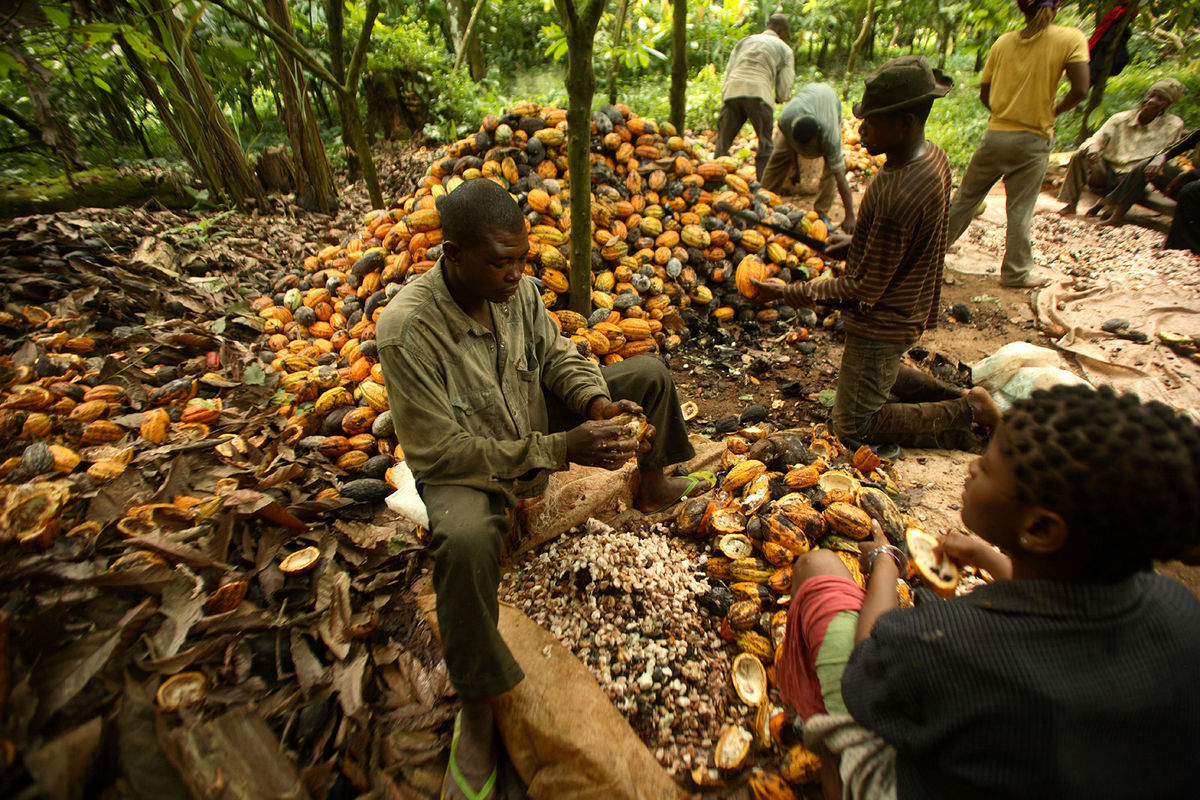
President of the Cocoa Farmers Association of Nigeria (CFAN), Mr Adeola Adegoke, has said the group would soon start collecting bio-data from all cocoa farmers in the country.

Mr Adegoke said this task would be done in collaboration with the cocoa value-chain stakeholders across the cocoa-producing states and cocoa communities’ traditional leaders.

According to him, this would enable the investors, policymakers, and other relevant stakeholders to know all the information they need about their cocoa beans, cocoa plantation environment, inputs/GAP, and activities in cocoa plantations.

Speaking on Thursday at the first National Cocoa Festival tagged Stakeholders’ Collaboration To Make Nigeria Cocoa Industry Sustainable in Ondo State, the CFAN leader urged members of the association who have received bank loans to repay fully without any further delay to sustain the Central Bank of Nigeria (CBN) and other financial partners’ support for the cocoa production sub-sector.

Mr Adegoke said this was the only way to guarantee the continuity of such programmes and to sustain support for the cocoa industry.

At the event, the Minister of Agriculture and Rural Development, Mr Muhammed Abubakar, said the country was positioning itself to regain a top-tier spot in cocoa production.

He informed the gathering that in the first quarter of this year, Nigeria earned N122.89 billion from the export of raw cocoa beans and cocoa products.

“It is now obvious that Nigeria cannot continue to rely on crude oil to develop economically, going by the instability of crude oil prices due to the Russian-Ukraine war,” he said.

He reiterated the need for the federal government’s commitment to supporting the agricultural sector to diversify the economy, especially in the area of an increase in cocoa production.

According to him, the changing economic landscape has made diversification a top priority, ensuring that Nigeria regains its position as one of the highest cocoa-producing countries in the world.

Mr Abubakar, represented by the ministry’s South-West Zonal Director, Mrs Omolara Abimbola-Oguntuyi, maintained that agriculture holds the key to the collective survival as a people, both in terms of job creation, income generation, food, and nutritional security, as well as foreign exchange earnings.

On his part, the Ondo State Governor, Mr Rotimi Akeredolu, said the state government would continue to provide an enabling environment for businesses to strive in the state.

Mr Akeredolu, represented by his Senior Special Assistant on Agric and Agribusiness, Akin Olotu, urged the stakeholders across the states to support cocoa production in the country.

The Ooni of Ife, Mr Enitan Adeyeye Ogunwusi, was decorated as the Grand Patron of CFAN. He said that to make Nigeria’s cocoa industry sustainable, all cocoa-producing states must contribute to the country’s cocoa production development.


Adedapo Adesanya is a journalist, polymath, and connoisseur of everything art. When he is not writing, he has his nose buried in one of the many books or articles he has bookmarked or simply listening to good music with a bottle of beer or wine. He supports the greatest club in the world, Manchester United F.C.

Economy

Dangote Refinery Takes 1.1 billion Litres of Aviation Fuel to Europe

Published

on

Modular Refinery for Aviation Fuel

By Modupe Gbadeyanka

About 1.1 billion litres of aviation fuel have been exported to Europe by the Dangote Petroleum Refinery and Petrochemicals after supplying over 95 per cent of the volume needed by airlines operating in Nigeria.

This development was confirmed by the spokesperson of the Airlines Operators of Nigeria (AON), Mr Obiora Okonkwo, during a television interview.

It was gathered that the volume of the petroleum product taken out of the country by the Lagos-based private refinery was between March and April 20.

“It is a matter of fact that over 95 per cent of aviation fuel supplied across the country comes from the Dangote refinery. To airline operators in Nigeria, Dangote is not just a refinery; it is a game changer and, indeed, a lifesaver,” Mr Okonkwo said.

He noted that despite the refinery’s consistent supply, airlines continue to face severe operational strain due to escalating Jet A1 prices, which he attributed to sharp practices within the downstream distribution chain.

According to him, some fuel marketers are allegedly creating artificial scarcity in spite of available supply from the refinery, leading to disproportionate price increases. He disclosed that airline operators have recorded Jet A1 price hikes of up to 300 per cent since the onset of the Middle East crisis.

“We consider this exploitation. The refinery has not indicated any shortage, yet we are witnessing artificial scarcity and unjustifiable price increases. What airlines pay does not reflect depot prices,” he said, suggesting the presence of racketeering within the market.

Echoing these concerns after a closed‑door meeting between AON and the federal government, the chief executive of Air Peace, Mr Allen Onyema, described the situation as deeply troubling, particularly given that the Dangote refinery sells its products at comparatively lower rates.

“The truth is that marketers must be called to account. How do prices rise by as much as 300 per cent when Dangote’s supply remains the cheapest and some marketers source directly from the refinery?” Mr Onyema asked. “So, why the astronomical increase?”

Meanwhile, the Dangote Refinery continues to expand its footprint in the international aviation fuel market. Industry data indicate that the facility exported approximately 876,000 metric tonnes of jet fuel to Europe within the period under review—about 456,000 tonnes in March and an additional 420,000 tonnes by April 20.

These export volumes underscore the refinery’s growing capacity and improved logistics, further reinforcing Nigeria’s emerging role in the global downstream oil and gas market, even as it strengthens domestic energy security.

Continue Reading

Economy

Oyedele Rules Out Policy Reversals Amid Reform Push

Published

on

Taiwo Oyedele

By Adedapo Adesanya

The new Minister of Finance, Mr Taiwo Oyedele, has said the federal government will stay the course on economic reforms, declaring that policy reversals will not define the current phase of the country’s economic management.

The Minister stated this while speaking at the launch of the Nigerian Economic Summit Group Private Sector Outlook 2026 in Lagos on Thursday, according to a statement issued by the Director of Information in the Ministry of Finance, Mr Efe Ovuakporie.

Mr Oyedele, who gave the assurance to investors at the event, said the administration was shifting from stabilisation to measurable growth, where reforms will be judged by outcomes rather than intent.

His comments came barely 48 hours after he assumed office, following the exit of Mr Wale Edun from the Federal Executive Council (FEC) over health reasons.

“We are not looking back,” Mr Oyedele said, stressing that consistency in policy direction remains critical to investor confidence.

He warned that mixed signals or abrupt reversals could stall progress, noting that “businesses need to know that today’s decisions will still hold tomorrow.”

While pointing to early signs of macroeconomic stabilisation, including a more aligned exchange rate and improved revenue performance, the minister said these gains must translate into tangible outcomes such as job creation, productivity growth and better living standards.

He identified four priorities for driving investment in the next phase: policy consistency, predictability across fiscal and regulatory frameworks, reduction in the cost of doing business, and improved access to capital.

On financing, Mr Oyedele said the government is working to expand credit across the economy, from consumer lending to industrial financing, with support from institutions such as the Bank of Industry, to stimulate growth and unlock private sector participation.

He added that Nigeria must target stronger real GDP per capita growth to make a meaningful impact on poverty, noting that modest growth figures would not be sufficient given the country’s population dynamics.

The minister further described the current stage of reforms as decisive, where success will depend on execution. “Reforms on their own do not create growth. We need investment at scale,” he said, adding that investors respond to stable and predictable environments, not policy announcements.

In the area of productivity, Mr Oyedele said Nigeria must move beyond consumption-driven expansion and focus on improving output and competitiveness in key sectors, including agriculture, manufacturing, energy and the digital economy.

He also called for deeper collaboration between the government and the private sector, maintaining that economic growth cannot be delivered by public policy alone.

As the country enters what he termed a consolidation phase, Mr Oyedele said the government would continue to deepen reforms, strengthen public financial management and improve coordination across all tiers of government.

He, however, acknowledged risks, including reform fatigue, inflationary pressures from global uncertainties, and political tensions ahead of the election cycle, but maintained that these challenges are surmountable with discipline and cooperation.

“Our task now is execution,” Mr Oyedele said, adding that “This phase demands focus, consistency and accountability. That is the direction we are pursuing.”

Continue Reading

Economy

Dangote Plans New Refinery in Tanzania for East African Region

Published

on

Dangote monopoly Political Economy of Failure

By Adedapo Adesanya

African businessman, Mr Aliko Dangote, has announced plans to build a new oil refinery in Tanzania, as the war in Iran exposes the continent’s over-reliance on fuel imports from the Middle East.

The project will include a pipeline that links the Kenyan port city of Mombasa to the northeastern Tanzanian harbour of Tanga, where the facility will be situated, Kenyan President William Ruto said at an Africa Finance Corp summit in Nairobi on Thursday.

The refinery will process crude from countries, including the Democratic Republic of Congo and South Sudan, he said at the forum.

“We are discussing that we are going to have a joint refinery in Tanga to benefit all of us,” Mr Dangote said at the forum on Thursday. “My commitment today here is that we will lead the refinery. We’ll make sure that that refinery is built within the next four to five years.”

The plans to build the facility in Tanzania coincide with Mr Dangote’s $40-billion expansion of his industrial empire, aimed at more than doubling capacity at his 650,000 barrel-a-day plant in Lagos.

“I can give commitment to the two presidents that were here, if they will support the refinery, we’ll build the identical one that we have in Nigeria,” Mr Dangote said on a panel discussion that included President Ruto and Ugandan President Yoweri Museveni.

Kenyan President confirmed the ongoing discussions with the Nigerian billionaire, saying the proposed project.

“Aliko is telling us that the private sector and the government can discuss a refinery in Tanzania, a joint refinery to benefit all of us. The oil will take on board the oil from Kenya, DRC, and even Uganda. We just need to construct a pipeline from Tanga to Mombasa, and the finished product will come by the already built pipeline we have in Uganda,” he said.

He said countries should avoid pursuing individual gains and instead collaborate in shaping policies that benefit the East African market.

The announcement on the oil refinery in Tanzania comes after the Nairobi Securities Exchange (NSE) Chief Executive Officer, Mr Frank Mwiti, said on April 12 that discussions had been held on how the NSE and other African exchanges could support what may become Africa’s largest initial public offering (IPO).

Dangote’s IPO is aimed at expanding Mr Dangote’s refinery business and is estimated at about $22 billion.

The planned offering is expected to float between 5 per cent and 10 per cent of the refinery’s equity. Analysts estimate the refinery’s valuation at between $40 billion and $50 billion.

The share sale targets up to $5 billion, which will make it the largest IPO ever conducted on an African stock exchange.

Continue Reading

Trending