Economy
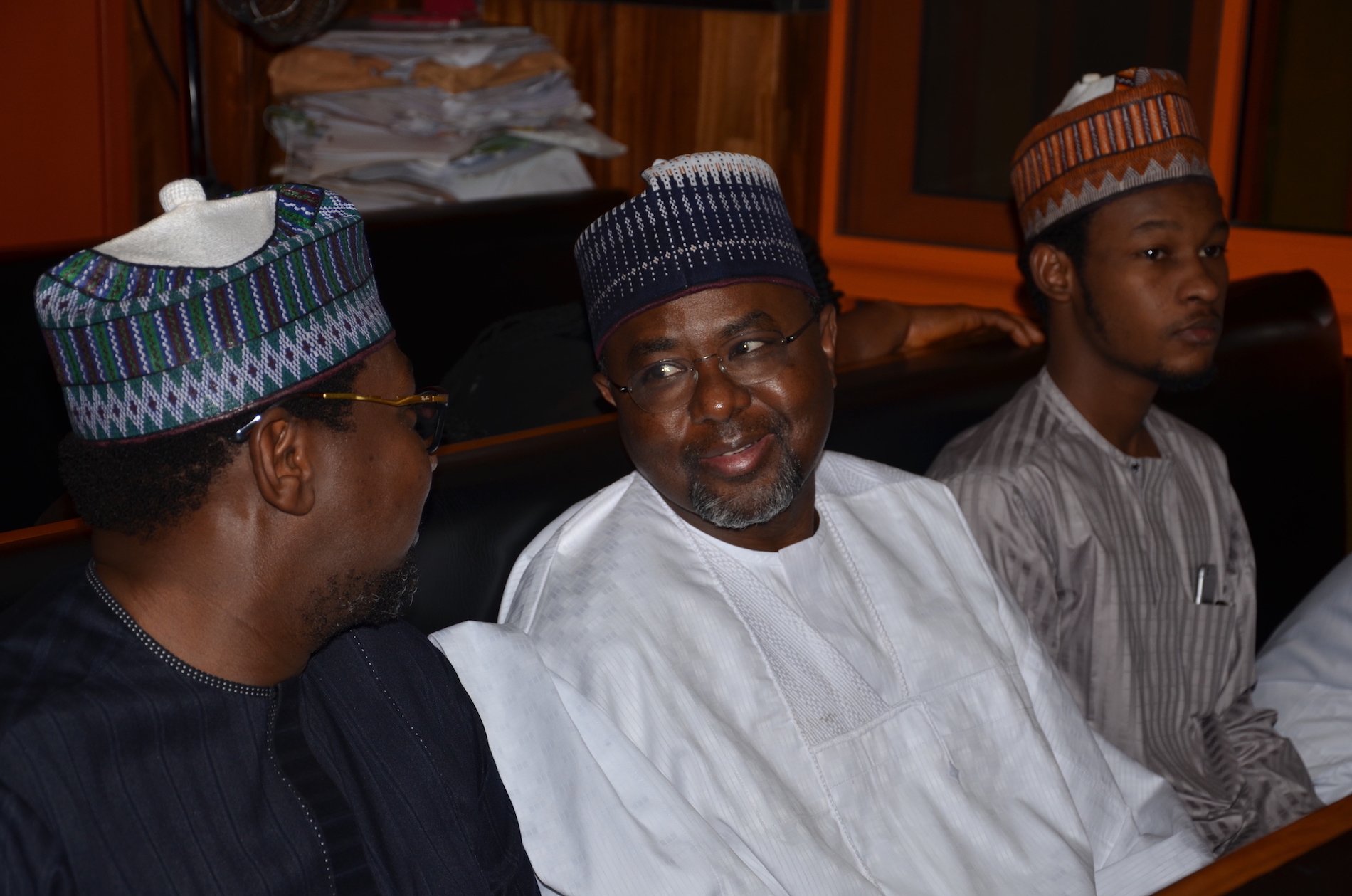
Court Grants Suspended SEC DG Gwarzo N25m Bail
By Dipo Olowookere
An Abuja High Court on Tuesday granted the suspended Director-General of the Securities and Exchange Commission (SEC), Mr Mounir Gwarzo, a bail of N25 million with a surety. Also granted bail was a SEC commissioner, Zakwanu Garuba.
Justice Husseini Baba-Yusuf directed that the sureties to be produced by the defendants must not be less than a Deputy Director in any Federal Government establishment and they must be resident and own landed properties in Abuja and must also submit the title documents of the properties to the court’s registry.
Mr Gwarzo and Mr Garuba were arraigned in court yesterday by the Independent Corrupt Practices and other related offences Commission (ICPC) for allegedly mismanaging over N115 million.
Mr Gwarzo was suspended from office in November last year by the Minister of Finance, Mrs Kemi Adeosun, over alleged financial misconduct.
He was accused of paying himself N104.9 million as severance benefit in 2015 when he had yet to retire, resign or disengage from service. He was also alleged to have received the sum of N10.98 million in excess of car grant three years ago.
On his part, Mr Garuba, an Executive Commissioner, Corporate Services of SEC, was accused of conferring a corrupt advantage on another public officer in the person of Mr Gwarzo by approving the payments to the suspended SEC boss.
After the charges were read to them, they both pleaded not guilty to the five counts, three of which related to Mr Gwarzo and the two others to Mr Garuba.
Part of the charge read, “That you Dr Mounir Haliru Gwarzo (m) sometime in June, 2015 or thereabout at Abuja Federal Capital Territory, while being a Public officer used your position as Director-General of the Security and Exchange Commission (SEC) to confer corrupt advantage upon yourself when you received the sum of N104,851,154.94 (One Hundred and Four Million, Eight Hundred and Fifty One Thousand, One Hundred and Fifty Four Naira, Ninety Four Kobo) as severance benefit whereas yow were yet to retire, resign or disengage from the service of SEC and you thereby committed an offence contrary to and punishable under section 19 of the Corrupt Practices and Other Related Offences Act,2000.”
Shortly after the defendants pleaded not guilty to the charges, their lawyers moved their separate bail applications anchored on the provisions of the Nigerian Constitution and the Administration of Criminal Justice Act, 2015 and filed on May 30.
Meanwhile, the judge has adjourned the case until June 28 and 29 for trial.
Economy
Nigerian Stock Market Rebounds 2.30% Amid Cautious Trading
By Dipo Olowookere
The Nigerian Exchange (NGX) Limited returned to winning ways on Tuesday after it closed higher by 2.30 per cent amid cautious trading.
Yesterday, investor sentiment at the Nigerian stock market was weak after finishing with 37 price gainers and 40 price losers, indicating a negative market breadth index.
It was observed that the industrial goods sector rose by 4.86 per cent, the energy index appreciated by 4.66 per cent, and the consumer goods segment soared by 2.74 per cent. They offset the 1.38 per cent loss recorded by the banking counter and the 0.20 per cent decline printed by the insurance sector.
At the close of business, the All-Share Index (ASI) was up by 5,137.90 points to 228,740.19 points from 223,602.29 points, and the market capitalisation went up by N3.308 trillion to N147.278 trillion from N143.970 trillion.
The trio of FTN Cocoa, Industrial and Medical Gases, and Lafarge Africa gained 10.00 per cent each to sell for N5.50, N39.60, and N324.50, respectively, while Austin Laz grew by 9.71 per cent to N3.73, and Aradel Holdings jumped 9.52 per cent to N1,840.00.
On the flip side, UBA lost 10.00 per cent trade at N44.55, Trans-Nationwide Express slipped by 9.99 per cent to N6.40, NASCON crashed by 9.18 per cent to N187.90, Jaiz Bank depreciated by 8.93 per cent to N8.01, and Berger Paints crumbled by 8.66 per cent to N68.00.
Yesterday, market participants traded 908.0 million equities valued at N68.2 billion in 72,886 deals compared with the 678.2 million equities worth N44.1 billion transacted in 82,838 deals on Monday, showing a drop in the number of deals by 12.01 per cent, and a spike in the trading volume and value by 33.88 per cent and 54.65 per cent, respectively.
Economy
Nigeria Records Five-Year Peak in Oil Output at 1.71mbpd
By Adedapo Adesanya
Nigeria’s oil production recorded a five-year high of 1.71 million barrels per day, marking a significant rebound for the country’s upstream sector amid renewed efforts to restore output and improve operational stability.
The latest figure, released by Nigerian National Petroleum Company (NNPC) Limited, covers the period from April 2025 to April 2026 and underscores a steady recovery in crude production after years of disruptions caused by theft, pipeline vandalism and underinvestment.
According to the chief executive of the national oil company, Mr Bayo Ojulari, the performance reflects measurable progress across the company’s upstream, gas and downstream operations, with production gains supported by improved asset management and stronger field performance.
Within its exploration and production business, NNPC recorded a peak daily output of 365,000 barrels in December 2025, the highest level ever achieved by its upstream subsidiary. The company also advanced key contractual reforms, including revised production-sharing terms for deepwater assets aimed at unlocking additional gas reserves.
Nigeria’s gas ambitions are also gaining traction. Gas supply rose to 7.5 billion standard cubic feet per day in 2025, driven by major infrastructure milestones such as the River Niger crossing on the Ajaokuta-Kaduna-Kano pipeline and the commissioning of the Assa North-Ohaji South gas processing plant.
These investments are beginning to strengthen domestic gas utilisation. New supply agreements with major industrial consumers, including Dangote Refinery, Dangote Fertiliser and Dangote Cement, are expected to deepen gas penetration across manufacturing and power generation.
On the downstream front, NNPC has continued crude supply to Dangote Refinery under the crude-for-naira arrangement, a policy designed to reduce foreign exchange demand, support local refining and improve fuel market stability. The company also reaffirmed its 7.25 per cent equity stake in the refinery as part of its long-term energy security strategy.
Financially, the national oil company said it has resumed full monthly remittances to the Federation Account since July 2025. It has also reinstated regular performance reporting and held its first earnings call, moves widely seen as part of a broader push towards greater transparency and corporate accountability.
Despite the progress, challenges remain. Crude theft, pipeline outages and infrastructure bottlenecks continue to threaten production stability. Sustaining this recovery will depend on stronger security, reliable infrastructure and policy consistency as Nigeria seeks to maximise the benefits of rising domestic refining capacity.
Economy
UAE to Leave OPEC May 1
By Adedapo Adesanya
The United Arab Emirates has announced its decision to quit the Organisation of the Petroleum Exporting Countries (OPEC) to focus on national interests.
This dealt a heavy blow to the oil-exporting group at a time when the US-Israel war on Iran had caused a historic energy shock and rattled the global economy.
The move, which will take effect on May 1, 2026, reflects “the UAE’s long-term strategic and economic vision and evolving energy profile”, a statement carried by state media said on Tuesday.
“During our time in the organisation, we made significant contributions and even greater sacrifices for the benefit of all,” it added. “However, the time has come to focus our efforts on what our national interest dictates.”
The loss of the UAE, a longstanding OPEC member, could create disarray and weaken the oil cartel, which has usually sought to show a united front despite internal disagreements over a range of issues from geopolitics to production quotas.
UAE Energy Minister Suhail Mohamed al-Mazrouei said the decision was taken after a careful look at the regional power’s energy strategies.
“This is a policy decision. It has been done after a careful look at current and future policies related to the level of production,” the minister said.
OPEC’s Gulf producers have already been struggling to ship exports through the Strait of Hormuz, a narrow chokepoint between Iran and Oman through which a fifth of the world’s crude oil and liquefied natural gas supplies normally pass, because of threats and attacks against vessels during the war.
The UAE had been a member of OPEC first through its emirate of Abu Dhabi in 1967 and later when it became its own country in 1971.
The oil cartel, based in Vienna, has seen some of its market power wane as the US has increased its production of crude oil in recent years.
Additionally, the UAE and Saudi Arabia have increasingly competed over economic issues and regional politics, particularly in the Red Sea area.
The two countries had joined a coalition to fight against Yemen’s Iran-backed Houthis in 2015. However, that coalition broke down into recriminations in late December when Saudi Arabia bombed what it described as a weapons shipment bound for Yemeni separatists backed by the UAE.
-
Feature/OPED6 years agoDavos was Different this year
-
Travel/Tourism10 years ago
Lagos Seals Western Lodge Hotel In Ikorodu
-
Showbiz3 years agoEstranged Lover Releases Videos of Empress Njamah Bathing
-
Banking8 years agoSort Codes of GTBank Branches in Nigeria
-
Economy3 years agoSubsidy Removal: CNG at N130 Per Litre Cheaper Than Petrol—IPMAN
-
Banking3 years agoSort Codes of UBA Branches in Nigeria
-
Banking3 years agoFirst Bank Announces Planned Downtime
-
Sports3 years agoHighest Paid Nigerian Footballer – How Much Do Nigerian Footballers Earn