
Economy
Crypto Exchanges – How to Choose the Right One


With the prevalence of cryptocurrencies in the digital age, many businesses and investors regularly use the crypto market to build their portfolios and gradually amass a passive income. However, due to the volatility of the market and fluctuations in prices, trading can be risky, as prospectors may lose all their deposited funds with no reward. Crypto exchanges operate as platforms to help you navigate the cryptocurrency market.
Qualities of a Digital Currency Exchange
These facilities make accessing the crypto market more convenient for you. Before exchanges existed, you had to use a command line and type in a command to send crypto coins to your peers. Over time, developers designed user interfaces to make the process easier as cryptocurrency acquired a mass audience of people interested in the cryptoverse and performing related transactions.
Financial Security
Whether you want to buy Bitcoin in Nigeria or another digital coin, you must be cautious of scams and frauds that could mislead you into giving away your personal information. Secure exchanges will offer transparent services and be open about what they contribute and how they use your sensitive information. They will provide a privacy policy describing what details they employ and for what purpose. Secondly, legit services typically have a physical address for their headquarters. You will know the legal ramifications of your expenditures and how to confront issues if you have the address. Otherwise, you will lose money and need to understand where it went.
Reputable Services
The best cryptocurrency exchanges will have positive reviews with testimonies about the offered services. Remember, you need to be able to trust this financial institution before you confide your private data, including identifiable and monetary information, in it. What have other users said about the platform’s security? How is the exchange’s customer service? Reviews should be able to answer your questions about the facility and whether you should invest in it.
Pairs and Transaction Fees
Some platforms offer access to hundreds of pairs, while others provide trading options for only a few. The platform you choose depends on your needs and how diverse you want your portfolio to be.
Remember that most exchanges may incur transaction fees depending on the transaction size, network-related costs, and your account activity. Because crypto transactions occur on the blockchain, blockchain participants require a processing fee for their work on the chain. Some exchanges may charge fees for the transaction, so if you plan to trade daily, consider one with a fair payment.
ChangeNOW As an Effective Service
Founded in 2017, ChangeNOW is a quick and efficient exchange facility. Its headquarters are in Seychelles, and it is operated by proficient blockchain developers. It has over 70,000 trading pairs and 700 coins available with no trading limits. You may perform a high-value transaction at will, and ChangeNOW will process it as swiftly as possible. Typically, its processing speed is between 5 and 20 minutes, but larger blocks take longer to convert.
As a non-custodial exchange service, ChangeNOW has your personal safety and financial protection in mind because it does not require registering to use its services. Instead, you only need a crypto wallet and its payout address to hold your assets. In this way, you do not need to worry about financial theft while using the platform. Its servers do not store identifiable information; you remain anonymous with ChangeNOW.
When you are ready to make a crypto trade, ChangeNOW finds and offers the best exchange rate, ensuring you get the best price. Multiple trading platforms like Binance and Kucoin have integrated ChangeNOW to provide these rates. With any swap, the platform only charges network or mining fees; it does not impose service fees.
In addition to swapping cryptocurrency pairs, you can buy crypto through ChangeNOW using fiat currency. The platform uses Simplex, a third party, to handle these transactions so you can utilize Visa, Mastercard, and other card providers to purchase crypto. Keep in mind network fees apply to these transactions depending on the currency.
The Bottom Line
Do your research before officially choosing a platform, and be aware of the associated risks with crypto trading. If hackers compromise a service, your funds may disappear. However, knowing an exchange’s trustworthiness and authenticity can help you decide how secure your digital assets will be.











By Adedapo Adesanya
The NASD Over-the-Counter (OTC) Securities Exchange declined by 2.14 per cent on Monday, March 30, weakening the Unlisted Security Index (NSI) by 89.95 points to 4,109.74 points from 4,199.69 points.
During the session, investors lost N53.82 billion, leaving the market capitalisation of the trading platform at N2.458 trillion versus the previous session’s N2.512 trillion.
The bourse recorded four price gainers and four price losers led by 11 Plc, which shed N35.12 to close at N316.50 per share compared with last Friday’s value of N351.17 per share. MRS Oil Plc declined by N20.00 to quote at N190.00 per unit versus the previous price of N21o.00 per unit, FrieslandCampina Wamco Nigeria Plc dropped N11.00 to trade at N99.00 per share versus N110.00 per share, and Central Securities Clearing System (CSCS) Plc dipped N2.93 to N77.17 per unit from N80.10 per unit.
Conversely, IPWA Plc appreciated by 55 Kobo to N6.06 per share from N5.51 per share, Industrial and General Insurance (IGI) Plc expanded by 5 Kobo to 57 Kobo per unit from 52 Kobo per unit, Geo-Fluids Plc gained 4 Kobo to close at N3.22 per share versus N3.18 per share, and Acorn Petroleum Plc improved by 1 Kobo to N1.34 per unit from N1.33 per unit.
Trading data revealed a decline of 63.7 per cent in the volume of securities to 21.3 million units from 58.6 million units, a 59.6 per cent drop in the value of securities to N651.1 million from N1.6 billion, and a 24 per cent contraction in the number of deals to 38 deals from 50 deals.
The most active stock by value on a year-to-date basis was CSCS Plc with 56.3 million units exchanged for N3.8 billion, trailed by Okitipupa Plc with 27.5 million units traded for N1.8 billion, and Infrastructure Guarantee Credit Plc with 400 million units valued at N1.2 billion.
Resourcery Plc was the most traded stock by volume on a year-to-date basis with 1.1 billion units worth N415.7 million, followed by Infrastructure Guarantee Credit Plc with 400 million units sold for N1.2 billion, and Geo-Fluids Plc with 133.1 million units transacted for N511.2 million.
By Dipo Olowookere
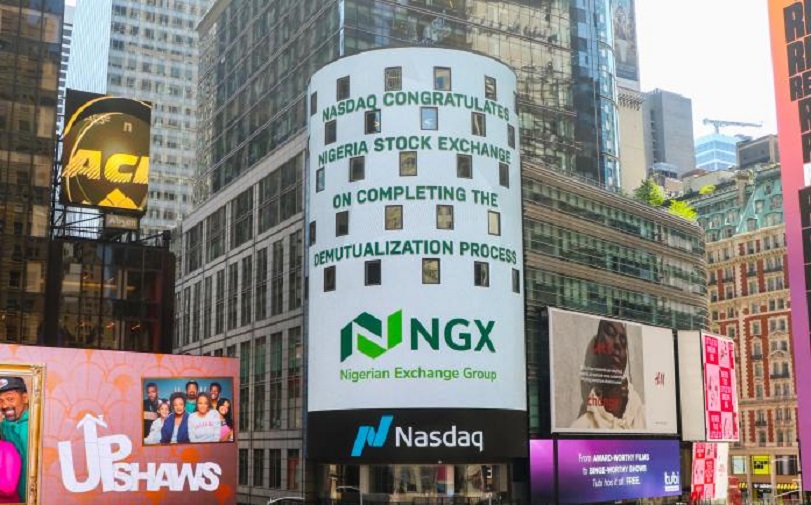
The Nigerian Exchange (NGX) Limited began the new week bearish after it shed 0.21 per cent on Monday due to profit-taking.
Business Post reports that four of the five key sectors of Customs Street tracked pointed southwards yesterday, as only the energy index gained 0.10 per cent.
The insurance counter lost 1.38 per cent, the banking space depreciated by 0.81 per cent, the industrial goods sector weakened by 0.45 per cent, and the consumer goods segment declined by 0.02 per cent.
As a result, the All-Share Index (ASI) retreated by 428.63 points to 200,484.43 points from 200,913.06 points, and the market capitalisation moderated by N275 billion to N128.694 trillion from N128.969 trillion.
The market breadth index was negative during the session, as there were 27 price gainers and 34 price losers, representing weak investor sentiment.
Secure Electronic Technology depreciated by 10.00 per cent to N1.17, May and Baker slumped by 9.42 per cent to N38.00, Legend Internet tumbled by 8.67 per cent to N6.85, Cutix shrank by 8.29 per cent to N3.21, and Fortis Global Insurance lost 7.97 per cent to trade at N1.27.
On the flip side, Austin Laz appreciated by 9.98 per cent to N4.41, Zichis gained 9.93 per cent to quote at N15.16, Trans Nationwide Express soared by 9.65 per cent to N2.84, The Initiates advanced by 9.60 per cent to N21.70, and Learn Africa improved by 9.41 per cent to N9.30.
The bourse closed with a turnover of 593.3 million shares valued at N25.7 billion executed in 60,311 deals compared with the 595.2 million shares worth N24.5 billion traded in 43,440 deals in the previous trading day.
This showed that the value of transactions went up by 4.90 per cent, the number of deals increased by 38.84 per cent, and the volume of trades decreased by 0.32 per cent.
Access Holdings finished the session as the most active with 86.6 million units sold for N2.3 billion, First Holdco exchanged 84.6 million units worth N4.3 billion, Secure Electronic Technology traded 31.1 million units valued at N37.4 million, Fidelity Bank transacted 26.7 million units worth N512.4 million, and Zenith Bank traded 26.1 million units valued at N2.6 billion.
By Adedapo Adesanya
The first trading session for the Naira in the Nigerian Autonomous Foreign Exchange Market (NAFEX) ended on a negative note, as it lost N3.00 or 0.22 per cent against the Dollar on Monday, March 30, to trade at N1,383.58/$1 compared with last Friday’s closing price of N1,380.58/$1.
The local currency remains under pressure as increased demand for forex for international settlements and import-related obligations continue t0 strain available FX supply.
Last week, the Central Bank of Nigeria (CBN) shed the policy requiring International Oil Companies (IOCs) to keep half of their export proceeds in Nigeria and allowed them to fully access their funds. Market analysts noted that this could reduce the dollar supply, putting pressure on the nation’s legal tender whenever outflows exceed inflows.
The country’s external reserves recorded a marginal decline, falling by 0.7 per cent to $49.48 billion, reflecting a depletion of about $350 million and signalling continued pressure on Nigeria’s FX buffer.
However, the Nigerian currency further appreciated against the Pound Sterling in the official market during the session by N12.05 to N1,824.94/£1 from N1,836.99/£1, and gained N5.80 against the Euro to sell at N1,586.28/€1 versus N1,592.08/€1.
Equally, at the GTBank forex desk, the Naira improved its value against the greenback yesterday by N7 to N1,394/$1 from N1,401/$1, and remained unchanged at the parallel market at N1,410/$1.
As for the cryptocurrency market, it was mixed even as Federal Reserve Chairman Jerome Powell eased any concerns about imminent rate hikes.
The central banker said the lender is inclined to look past the Iran-related energy shock for now and hold rates steady, adding that the US central bank — for the moment — is looking past short-term oil price shocks and focusing on inflation expectations that remain “well anchored.” As a result, bond yields fell, but oil continued its rise, ultimately pressuring the stock market and crypto.
Solana (SOL) gained 1.1 per cent to sell at $82.68, Ethereum (ETH) appreciated by 1.0 per cent to $2,021.66, Cardano (ADA) grew by 1.0 per cent to $0.2431, Ripple (XRP) jumped 0.2 per cent to $1.32, and Bitcoin (BTC) added 0.1 per cent to settle at $66,568.25.
However, TRON (TRX) dipped 1.0 per cent to $0.3199, Dogecoin (DOGE) went down by 0.2 per cent to $0.0909, and Binance Coin (BNB) dropped 0.1 per cent to $609.25, while the US Dollar Tether (USDT) and the US Dollar Coin (USDC) closed flat at $1.00 each.









-
 Feature/OPED6 years ago
Davos was Different this year
-
Travel/Tourism10 years ago
Lagos Seals Western Lodge Hotel In Ikorodu
-

 Showbiz3 years ago
Estranged Lover Releases Videos of Empress Njamah Bathing
-
 Banking8 years ago
Sort Codes of GTBank Branches in Nigeria
-

 Economy3 years ago
Subsidy Removal: CNG at N130 Per Litre Cheaper Than Petrol—IPMAN
-

 Banking3 years ago
Sort Codes of UBA Branches in Nigeria
-

 Banking3 years ago
First Bank Announces Planned Downtime
-

 Sports3 years ago
Highest Paid Nigerian Footballer – How Much Do Nigerian Footballers Earn