Economy
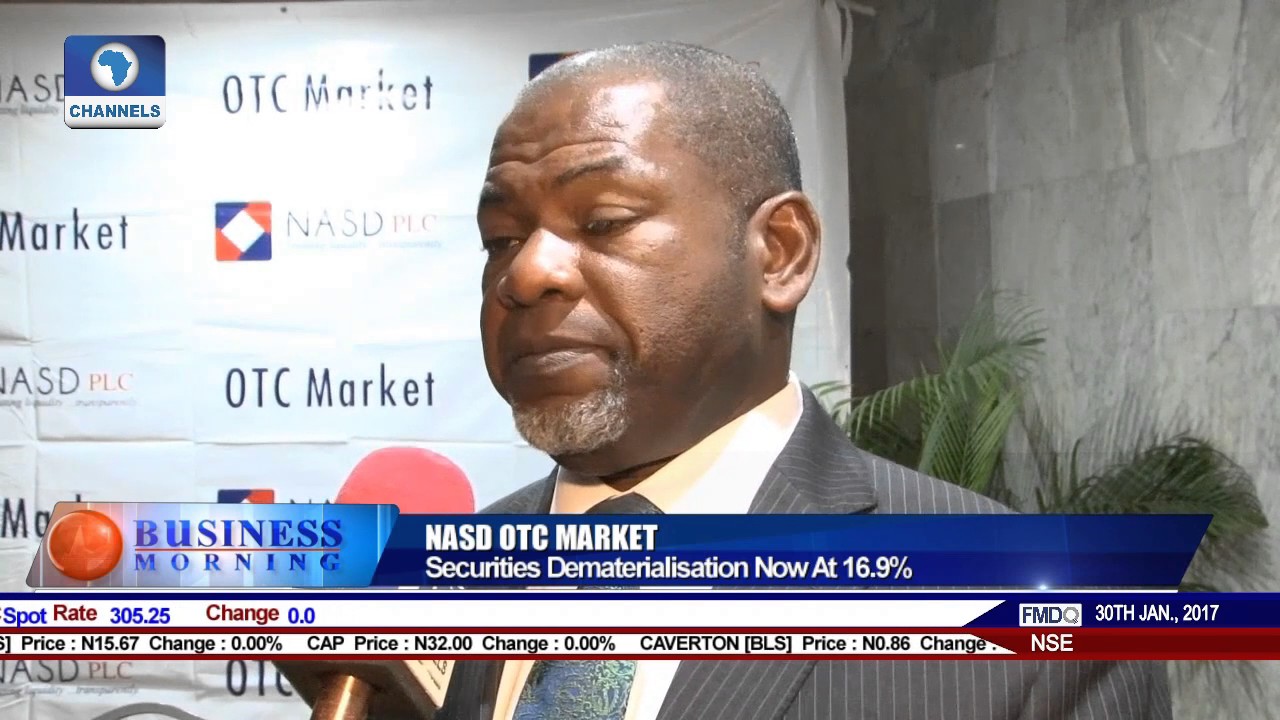
CSCS, UBN Property Depress NASD Market Cap by 0.68%
By Adedapo Adesanya
The NASD Over-the-Counter (OTC) Securities Exchange extended its stay in the negative zone on Friday as it went down by 0.68 per cent at the close of business.
The NASD market closed bearish as a result of the decline in the share prices of Central Securities Clearing Systems (CSCS) Plc and UBN Property Plc.
During the trading session, CSCS Plc depreciated by N1.03 or 6.4 per cent to trade at N16.17 per unit compared with the previous close of N17.20 per unit, while UBN Property Plc fell by one kobo or one per cent to trade at 99 kobo per share in contrast to N1 per share of the preceding session.
The duo weakened the gains printed by Nigerian Exchange (NGX) Group Plc as the stock could not determine the outcome of the unlisted securities market. NGX Group Plc appreciated by 44 kobo or 2.7 per cent to close at N16.45 per unit as against N16.01 per unit it traded a day earlier.
At the close of transactions, the total value of stocks on the exchange decreased by N4.35 billion to N638.75 billion from N643.10 billion, while the NASD Unlisted Security Index (NSI) decreased by 4.99 points to wrap the session at 734.90 points compared with 734.90 points recorded at the previous session.
Business Post reports that there was an increase of 125.7 per cent in the volume of securities traded at the bourse at the final session for the week as investors exchanged 2.9 million units compared to 1.3 million units of securities traded at the preceding session.
There was also a rise in the value of shares traded yesterday by 56.5 per cent to N32.6 million from N20.8 million made on Thursday. These trades were carried out in 27 deals, 22.7 per cent higher than the 22 deals executed at the preceding session.
Geo Fluids Plc finished the trading day as the most active stock by volume (year-to-date) as it has traded 1.0 billion units of its shares for N700.1 million. NGX Group Plc remained on the second spot as it has traded 417.9 million units valued at N8.7 billion, while Food Concepts Plc occupied third place with 295.0 million units worth N386 million.
However, the most active stock by value (year-to-date) was NGX Group Plc for transacting 417.9 million units of its securities for N8.7 billion. VFD Group Plc remained in the second spot with 6.6 million units of its securities valued at N2.2 billion, followed by FrieslandCampina WAMCO Plc with 8.2 million units worth N1.0 billion.
Economy
Oil Prices Jump 5% as Hormuz Attacks Intensify Supply Fears
By Adedapo Adesanya
Oil prices appreciated by nearly 5 per cent on Wednesday as fresh attacks on ships in the Strait of Hormuz worsened supply disruption fears.
Brent futures gained $4.18 or 4.8 per cent to settle at $91.98 a barrel, while the US West Texas Intermediate (WTI) futures increased by $3.80 or 4.6 per cent to $87.25 a barrel.
Three more vessels have been hit by projectiles in the Strait of Hormuz, maritime security and risk firms said on Wednesday. That brought the number of ships struck in the region to at least 14 since the Iran war began.
Iran warned that no oil shipments will be allowed to pass through the Strait of Hormuz until the attacks stop, placing the world’s most critical oil trade point at the centre of the escalating conflict. The narrow waterway between Iran and Oman normally handles roughly 20 per cent of global oil supply and a large share of liquified natural gas (LNG) trade, making any sustained disruption a major threat to global energy markets.
Tanker movements through the region have already begun slowing as insurers and ship operators reassess the risks of transiting the corridor.
The country, which is one of the largest producers in the Organisation of the Petroleum Exporting Countries, on Wednesday said that crude could surge to $200 per barrel if the war involving the US and Israel continues to destabilise the Middle East’s energy corridors.
Crude briefly surged to around three digits earlier this week before retreating toward the $90 range after US President Donald Trump suggested the conflict might end soon. However, renewed attacks on shipping and infrastructure have quickly revived fears of supply disruptions.
Meanwhile, the International Energy Agency (IEA) recommended the release of 400 million barrels of oil, the largest such move in its history, to try to rein in energy prices, which are now up more than 25 per cent since the war began. The energy watchdog said the time frame for the release will be decided in due course.
The proposed volume is more than double the 182 million barrels released in 2022 following Russia’s invasion of Ukraine. Analysts, however, said it was ultimately insufficient to resolve supply losses from a prolonged war in the Middle East.
Member countries collectively hold roughly 1.2 billion barrels of strategic reserves, which can be tapped during supply emergencies.
Crude oil inventories in the US increased by 3.8 million barrels during the week ending March 6, according to data from the US Energy Information Administration (EIA). The EIA’s data release follows figures from the American Petroleum Institute (API) that were released a day earlier, which reported that crude oil inventories fell by 1.7 million barrels in the period.
Economy
Weak Sentiment Further Crashes Nigeria’s Stock Market by 0.09%
By Dipo Olowookere
The bears consolidated their grip on Nigeria’s stock market by 0.09 per cent on Wednesday due to sustained selling pressure amid global instability.
Yesterday, only two of the five sectors tracked by Business Post ended in green, with the industrial goods up by 1.42 per cent, and the banking sector gained 0.04 per cent.
However, the insurance counter depleted by 0.44 per cent, the consumer goods index lost 0.43 per cent, and the energy industry shed 0.06 per cent.
As a result, the All-Share Index (ASI) deflated by 167.58 points to 195,898.53 points from 196,066.11 points, and the market capitalisation shrank by N108 billion to N125.750 trillion from N125.858 trillion.
The laggards’ group was led by Presco, which decreased by 10.00 per cent to N2,083.90. UAC Nigeria lost 9.97 per cent to trade at N104.25, Morison Industries crashed by 9.94 per cent to N10.87, SCOA Nigeria gave up 9.86 per cent to quote at N25.15, and Linkage Assurance slipped by 9.83 per cent to N1.56.
On the flip side, NGX Group gained 10.00 per cent to settle at N186.45, Premier Paints expanded by 9.92 per cent to N19.40, Omatek surged by 8.95 per cent to N2.80, Prestige Assurance advanced by 8.39 per cent to N1.68, and Haldane McCall chalked up 6.67 per cent to close at N4.00.
The market breadth index remained negative after the bourse finished with 30 appreciating equities and 42 depreciating equities, indicating weak investor sentiment.
Wema Bank was the busiest stock at midweek, with a turnover of 106.4 million units for N2.8 billion. Access Holdings traded 59.0 million units worth N1.5 billion, Mutual Benefits sold 38.5 million units valued at N183.2 million, Fortis Global Insurance transacted 32.7 million units worth N40.3 million, and Sterling Holdco exchanged 30.2 million units valued at N219.1 million.
At the close of transactions, 671.3 million shares worth N26.1 billion exchanged hands in 58,792 deals during the session, in contrast to the 746.9 million shares valued at N27.9 billion transacted in 65,275 deals a day earlier, representing a drop in the trading volume, value, and number of deals by 10.12 per cent, 6.45 per cent, and 9.93 per cent apiece.
Economy
IEA Releases 400 million Barrels from Crude Stockpiles to Calm Oil Crisis
By Adedapo Adesanya
The International Energy Agency (IEA) has ordered the largest release of government oil reserves in its history to help calm the oil price crisis triggered by the US-Israel attacks on Iran.
The world’s energy watchdog said its 32 members had agreed unanimously to release about 400 million barrels of emergency crude, which is over 30 per cent of the group’s total government stockpiles.
Members of the IEA, which was set up after the Middle East oil crisis in the 1970s, are required to hold at least 90 days’ worth of crude supplies in reserve, which can be released to the market in the event of a supply shock.
In total, its members hold more than 1.2 billion barrels of public emergency oil stocks and a further 600 million barrels of stocks held by industry under government obligation.
The latest emergency intervention is bigger than the release of 182 million barrels of oil by IEA countries after Russia’s full-scale invasion of Ukraine in February 2022.
The IEA said the emergency stocks would be made available to the global market, which has lost about 15 million barrels of crude a day because of a block on trade via the Strait of Hormuz, over a timeframe appropriate to the national circumstances of each member, bolstered by supplementary emergency measures from some countries.
The IEA executive director, Mr Fatih Birol, said: “Oil markets are global, so the response to major disruptions needs to be global, too. Energy security is the founding mandate of the IEA, and I am pleased that IEA members are showing strong solidarity in taking decisive action together.”
Although no G7 countries have faced physical shortages of oil since the war began last month, the price of Brent crude has fluctuated wildly, briefly jumping as high as $119.50 a barrel on Monday. As of press time, it is up 4 per cent at $92 per barrel.
The historic market intervention will deliver the equivalent of about 26 days of crude typically delivered via the strait, where deliveries have ground to a halt because of the threat of attack from Iran.
On Wednesday, three commercial vessels were attacked as Iran’s military said the world should be prepared for oil to hit $200 a barrel.
-
Feature/OPED6 years agoDavos was Different this year
-
Travel/Tourism10 years ago
Lagos Seals Western Lodge Hotel In Ikorodu
-
Showbiz3 years agoEstranged Lover Releases Videos of Empress Njamah Bathing
-
Banking8 years agoSort Codes of GTBank Branches in Nigeria
-
Economy3 years agoSubsidy Removal: CNG at N130 Per Litre Cheaper Than Petrol—IPMAN
-
Banking3 years agoSort Codes of UBA Branches in Nigeria
-
Banking3 years agoFirst Bank Announces Planned Downtime
-
Sports3 years agoHighest Paid Nigerian Footballer – How Much Do Nigerian Footballers Earn