Connect with us

Economy

Customs Street Loses 0.32% on Weak Investor Sentiment

Published

on

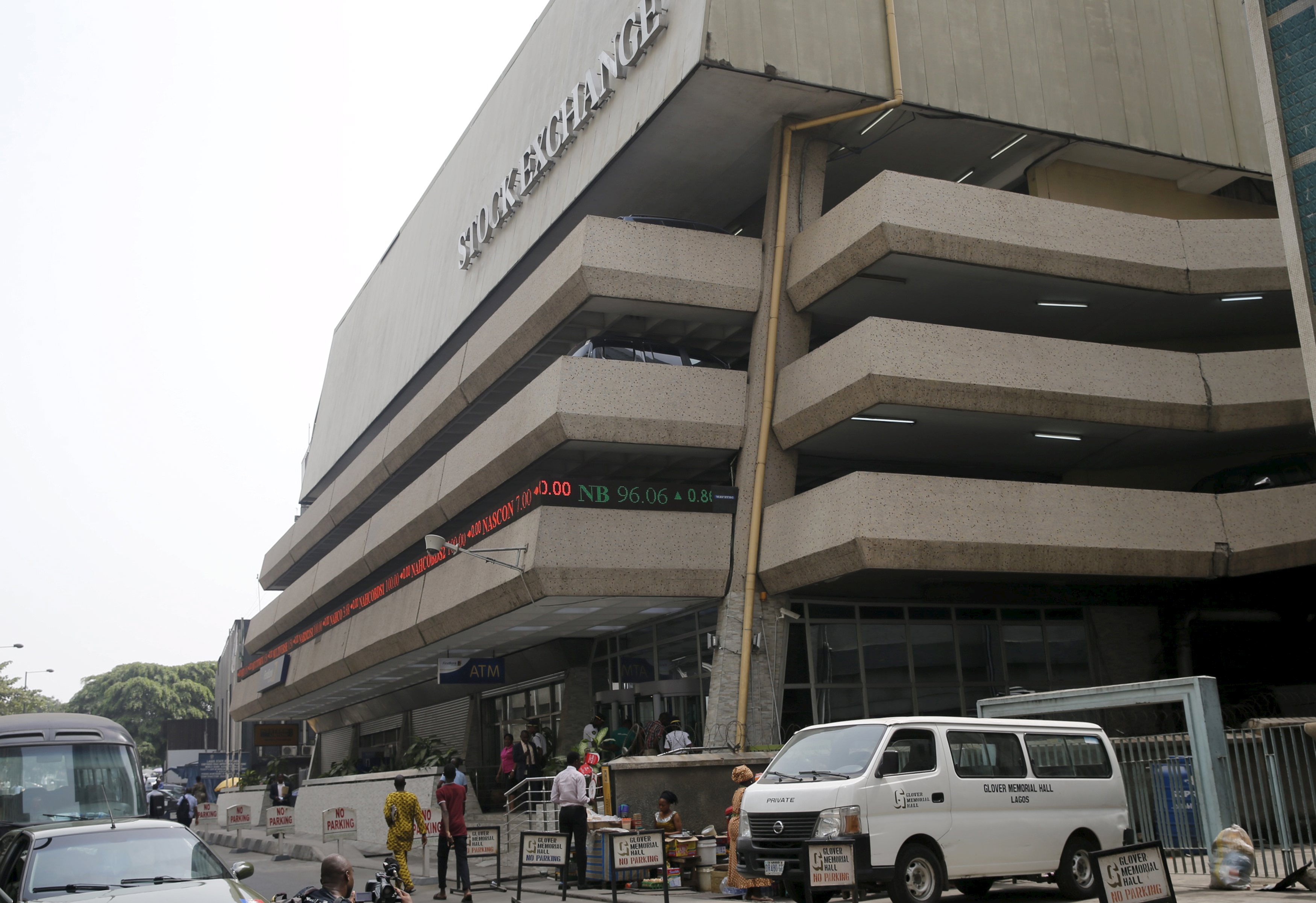
Customs Street Nigerian Stock Exchange

By Dipo Olowookere

The Nigerian Exchange (NGX) Limited on Customs Street, Lagos maintained its downward trajectory on Thursday with a decline of 0.32 per cent triggered by sustained profit-taking and weak investor sentiment.

A total of 24 equities depreciated in value during the trading session while only 14 stocks closed on the gainers’ chart at the close of transactions.

All the major sectors of the exchange but one closed in red yesterday, reflecting the true mood of the market.

The energy space lost 1.64 per cent, the banking counter went down by 1.16 per cent, the consumer goods sector fell by 1.06 per cent, the industrial goods index declined by 0.01 per cent, while the insurance sector grew by 0.64 per cent.

When the market finished for the trading day, the All-Share Index (ASI) was down by 136.25 points to 43,108.77 points from 43,245.02 points, while the market capitalisation depreciated by N71 billion to close at N22.494 trillion compared with the preceding day’s N22.565 trillion.

MRS Oil was the biggest price loser yesterday, losing 9.87 per cent to close at N13.70, trailed by Chams, which lost 8.70 per cent to end at 21 kobo.

Ecobank depreciated by 8.57 per cent to N8.00, Consolidated Hallmark Insurance fell by 8.06 per cent to 57 kobo, while Unity Bank dropped 7.27 per cent to trade at 51 kobo.

On the flip side, Honeywell Flour topped the gainers’ table with a price appreciated of 9.76 per cent to close at N4.05, followed by AIICO Insurance, which grew by 8.47 per cent to sell for 64 kobo.

Regency Assurance appreciated by 8.33 per cent to 39 kobo, University Press improved by 8.00 per cent to N2.70, while Ikeja Hotel also rose by 8.00 per cent to N1.35.

Business Post reports that Honeywell was investors’ bride on Thursday, closing as the most transacted stocks with the sale of 52.5 million units valued at N209.6 million.

GTCO sold 23.0 million stocks worth N578.6 million, Zenith Bank traded 22.9 million equities for N559.0 million, Transcorp exchanged 18.5 million shares for N17.7 million, while Access Bank transacted 13.9 million equities valued at N127.4 million.

At the close of business for the day, investors traded 266.1 million shares worth N4.2 billion in 3,905 deals in contrast to the 243.2 million shares worth N3.8 billion in 3,777 deals traded on Wednesday, indicating that the trading volume rose by 9.43 per cent, the trading value grew by 12.54 per cent, while the number of deals increased by 3.39 per cent.


Dipo Olowookere is a journalist based in Nigeria that has passion for reporting business news stories. At his leisure time, he watches football and supports 3SC of Ibadan. Mr Olowookere can be reached via [email protected]

Economy

Naira Opens Week Stronger at N1,374/1$ in Official Market

Published

on

Naira-Dollar exchange rate gap

By Adedapo Adesanya

The Naira appreciated against the US Dollar in the Nigerian Autonomous Foreign Exchange Market (NAFEX) by 54 Kobo or 0.04 per cent on Monday, May 25, to trade at N1,374.92/$1 compared to last Friday’s value of N1,375.46/$1.

However, it further depreciated against the Pound Sterling in the official market during the session by N6.01 to sell for N1,855.73/£1 versus the preceding session’s N1,849.72/£1 and lost N158.02 against the Euro to close at N1,755.06/€1, in contrast to the N1,590.04/€1 it was traded last Friday.

In the same vein, the Nigerian Naira weakened against the United States Dollar at the GTBank FX counter yesterday by N2 to quote at N1,383/$1 versus N1,381/$1, and gained N5 in the parallel market to settle at N1,385/$1 compared with the previous rate of N1,390/$1.

The performance of the domestic currency comes as the external reserves inched higher to $48.72 billion, indicating a complex mix of sustained FX demand pressures and modest reserve accretion.

The movement in the FX market underscores the continued tension between demand-side pressure and policy-driven attempts to stabilise the naira.

While recent monetary tightening measures by the Central Bank of Nigeria (CBN) have helped to moderate extreme volatility, market participants are struggling to navigate a landscape shaped by intermittent dollar inflows, import-related demand and shifting investor sentiment.

As for the cryptocurrency market, most tokens were up amid optimism of a near-term US-Iran peace deal, as Iranian negotiators arrived in Doha, Qatar, for talks.

The Strait of Hormuz has been largely blockaded since the US and Israel struck Iran on February 28, though traffic has partially resumed in recent days. The agenda would include the reopening as well as uranium control.

TRON (TRX) rose by 1.8 per cent to $0.3714, Cardano (ADA) added 1.2 per cent to trade at $0.2444, Bitcoin (BTC) improved by 0.9 per cent to $77,283.62, Binance Coin (BNB) jumped 0.8 per cent to $661.30, and Ripple (XRP) increased by 0.8 per cent to $1.35.

Further, Ethereum (ETH) grew by 0.7 per cent to $2,018.82, Solana (SOL) expanded by 0.6 per cent to $85.37, and Dogecoin (DOGE) appreciated by 0.6 per cent to $0.1001, while the US Dollar Tether (USDT) and the US Dollar Coin (USDC) remained unchanged at $1.00 apiece.

Continue Reading

Economy

Oil Prices Crash 7% on Hopes of US-Iran Peace Deal

Published

on

Oil Prices fall

By Adedapo Adesanya

Oil prices fell nearly 7 per cent on Monday as optimism grew that the United States and ‌Iran were moving closer to a peace deal that would reopen the Strait of Hormuz.

Brent crude futures were down by $7.24 or almost 7 per cent to $96.30 a barrel, and the US West Texas Intermediate (WTI) crude futures decreased by $6.30 or 6.5 per cent to trade ​at $90.88 per barrel.

Comments by President Donald Trump that diplomatic negotiations with Iran are advancing eased market fears of severe energy supply disruptions due to the Middle East conflict.

This is as a top negotiator of Iran, and its foreign minister was in Doha ​for talks with Qatar’s prime minister on a potential deal with the US to end the three-month-old ⁠war

Recently, both countries have downplayed expectations for an immediate peace agreement to end their three-month-old war, backing away from claims of an imminent breakthrough.

President Trump later revealed that he has instructed negotiators not to rush the process, asserting that the US naval blockade on Iranian ports will remain in full effect until a finalised accord is certified and signed.

Also, the US Secretary of State Marco Rubio has affirmed that the US government will exhaust diplomatic channels, also warning that it will handle Iran in “another way” if a good agreement cannot be secured, hinting at a potential return to active war.

The deal outlines a process to fully reopen the vital global shipping lane without tolls, resolving the global energy crunch. Iran would receive targeted sanctions relief and the gradual unfreezing of up to $20 billion to $25 billion in assets currently held in foreign banks.

Even if ⁠a peace deal is reached, analysts expect a return to normal oil flows through the strait will take months, while damaged oil and gas facilities are repaired. There is currently a supply shortfall of up to 11 million ​barrels per day of crude oil that does not go away immediately, even if a deal is reached soon.

Ship-tracking data showed three Liquefied Natural Gas (LNG) tankers passed through the ​strait in recent days, heading to Pakistan, China and India, as well as a supertanker with Iraqi crude for China after being stranded for nearly three months.

Continue Reading

Economy

Nigeria Records 3.89% GDP Growth in Q1 2026

Published

on

4.03% GDP Growth

By Adedapo Adesanya

Nigeria’s economic growth rate eased in the first quarter of 2026 to 3.89 per cent year-on-year, as a slowdown in the oil sector offset gains recorded in the non-oil sector.

The economy, measured by Gross Domestic Product (GDP), slowed in the first three months of this year from the 4.07 per cent recorded in the previous quarter (Q4 2025), according to data released by the National Bureau of Statistics (NBS) on Monday. However, it was higher than the 3.13 per cent recorded in the first quarter of 2025.

In the first quarter of 2026, Nigeria recorded an average daily oil production of 1.55 million barrels per day, lower than 1.62 million barrels per day in the same quarter of 2025 and lower than the 1.58 million barrels per day in the fourth quarter of 2025.

The real growth of the oil sector was 2.57 (year-on-year) in Q1 2026, indicating an increase of 0.70 per cent compared with the 1.87 per cent in the corresponding quarter of 2025.

However, growth decreased by 4.22 per cent compared to 6.79 per cent in Q4 2025, and on a quarter-on-quarter basis, the oil sector recorded a growth rate of 9.31 per cent.

For the non-oil sector, it contributed 96.08 per cent to the nation’s GDP between January and March 2026, versus 96.03 per cent in the same period of last year and lower than 97.13 per cent in the fourth quarter of last year.

During the quarter under review, agriculture grew by 3.15 per cent. The growth of the industry sector stood at 3.50 per cent versus 3.42 per cent in the first quarter of last year, while the services sector recorded a growth of 4.31 per cent, in contrast to 4.33 per cent in the same quarter of 2025.

In terms of share of the GDP, the services sector contributed 57.73 per cent compared to 57.50 per cent in the first quarter of 2025.

In the quarter under review, aggregate GDP at basic price stood at N110.79 trillion in nominal terms, higher than N94.1 trillion in the first quarter of 2025 by 17.79 per cent.

Continue Reading

Trending