Economy
Customs Street Sinks Deeper by 0.66% as Sell-offs Persist
By Dipo Olowookere
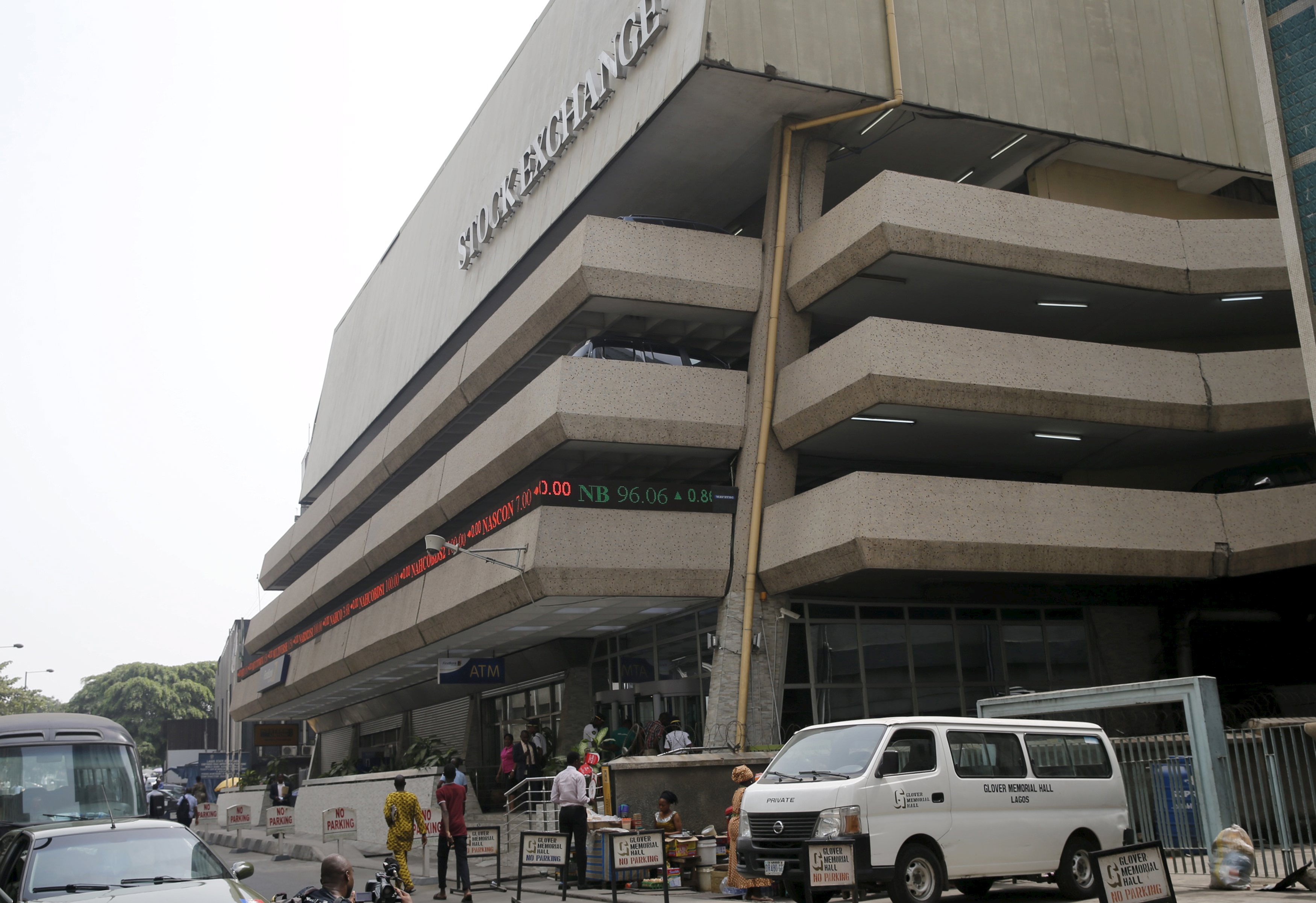
For another trading session, the Nigerian Exchange (NGX) Limited ended on a negative note with a 0.66 per cent loss on Tuesday.
This decline was influenced by persistent selling pressure in large and mid-cap equities listed on Customs Street.
Data from the bourse showed that Cadbury Nigeria finished as the worst-performing stock with a 9.89 per cent fall to close at N16.40.
Academy Press depreciated by 9.87 per cent to N2.83, Royal Exchange shed 9.72 per cent to trade at 65 Kobo, Aradel Holdings shrank by 8.33 per cent to N550.10, and Sovereign Trust Insurance went down by 8.06 per cent to 57 Kobo.
On the flip side, Northern Nigerian Flour Mills ended the session as the best-performing stock after it appreciated by 10.00 per cent to settle at N37.40, Eunisell grew by 9.87 per cent to N4.23, The Initiates expanded by 9.81 per cent to N2.35, Livestock Feeds rose by 7.73 per cent to N4.04, and CWG increased by 4.96 per cent to N6.35.
Business Post reports that the insurance sector gained 0.18 per cent yesterday and the energy counter improved by 0.03 per cent.
However, the banking index depreciated by 1.46 per cent, the industrial goods space declined by 0.33 per cent, and the consumer goods marginally crumbled by 0.01 per cent.
As a result, the All-Share Index (ASI) retreated by 650.83 points to settle at 98,058.07 points compared with Monday’s 98,708.90 points, and the market capitalisation decreased by N394 billion to quote at N59.418 trillion, in contrast to the preceding day’s N59.812 trillion.
It was observed that the market was busy on Tuesday as the trading volume, value and number of deals increased by 13.05 per cent, 93.48 per cent, and 1.38 per cent, respectively.
The market participants bought and sold 399.3 million equities valued at N8.9 billion in 9,547 deals during the trading day versus the 353.2 million equities worth N4.6 billion transacted in 9,417 deals a day earlier.
At the close of business, UBA traded 90.4 million shares worth N2.6 billion, Chams exchanged 80.6 million stocks valued at N162.0 million, Transcorp transacted 31.7 million equities for N1.6 billion, Zenith Bank sold 22.9 million shares valued at N892.2 million, and Access Holdings traded 15.7 million equities worth N346.3 million.
Economy
31 Stocks Lift Nigerian Exchange by 0.74% as Bulls Take Charge
By Dipo Olowookere
The Nigerian Exchange (NGX) Limited bounced back into the green zone on Thursday after it closed higher by 0.74 per cent.
This growth was triggered by the gains recorded in three of the six key sectors of the local stock market, after the banking and the energy indices shed 0.35 per cent and 0.03 per cent apiece, with the commodity space closing flat.
Business Post reports that the insurance counter expanded by 2.99 per cent, the consumer goods index appreciated by 1.15 per cent, and the industrial goods counter marginal grew by 0.01 per cent.
At the close of business, the All-Share Index (ASI) was up by 1,088.58 points to 147,950.59 points from 146,862.01 points and the market capitalisation jumped by N694 billion to N94.319 trillion from N93.625 trillion.
During the trading day, 31 stocks ended on the advancers’ chart and 24 stocks finished on the laggards’ log, showing a positive market breadth index and bullish investor sentiment.
Japaul gained 9.88 per cent to sell for N2.78, Berger Paints also appreciated by 9.88 per cent to N40.05, Morison improved by 9.77 per cent to N4.27, PZ Cussons advanced by 9.36 per cent to N45.00, and Legend Internet soared by 8.91 per cent to N5.50.
Conversely, John Holt lost 9.26 per cent to trade at N4.90, Champion Breweries depreciated by 7.86 per cent to N12.90, Eterna dipped by 5.48 per cent to N30.20, VFD Group shed 5.07 per cent to N10.30, and The Initiates contracted by 4.80 per cent to N11.90.
Yesterday, the trading volume, value, and number of deals went down by 29.10 per cent, 0.81 per cent, and 5.23 per cent, respectively.
This was because traders traded 529.7 million equities for N12.3 billion in 18,159 deals compared with the 747.1 million equities worth N12.4 billion transacted in 19,161 deals on Wednesday.
On top of the activity chart was Access Holdings with a turnover of 156.3 million units worth N3.2 billion, FCMB exchanged 74.5 million units valued at N819.5 million, Fidelity Bank sold 42.9 million units for N812.7 million, Japaul transacted 41.2 million units worth N106.0 million, and Zenith Bank traded 20.3 million units valued at N1.3 billion.
Economy
Russia-Ukraine Peace Talks, Trim in Expected Surplus Weaken Oil Prices
By Adedapo Adesanya
Oil prices fell on Thursday as investors focused on Russia-Ukraine peace talks and trimming in the projected 2026 oil surplus, with Brent crude trading at $61.28 a barrel after losing 93 cents or 1.49 per cent and the US West Texas Intermediate (WTI) crude at $57.60 a barrel, down by 86 cents or 1.47 per cent.
The prospect of a possible peace agreement between Russia and Ukraine also appeared to be driving the market lower. Such a deal would likely increase the supply of Russian oil that is currently off the market for most of the world.
Despite attacks, market analysts noted that there seems to be some movement on a possible path to peace between Russia and Ukraine.
The leaders of Britain, France and Germany held a call on Wednesday with US President Donald Trump to discuss the US’ latest peace efforts to end the war in Ukraine, in what they said was a “critical moment” in the process.
Russian Foreign Minister Sergei Lavrov said on Thursday that a recent visit to Moscow by US envoy Steve Witkoff had resolved misunderstandings between the two countries.
Ukraine’s security services (SBU) executed a long-range drone strike on the Vladimir Filanovsky offshore oil field in the Caspian Sea, a key Lukoil facility, forcing a suspension of oil and gas production.
The attack is significant as it marks the first time Kyiv has targeted hydrocarbon extraction assets in the distant Caspian region, demonstrating a growing capability to hit critical upstream assets far from the frontline.
On Wednesday, the US said it seized an oil tanker off the coast of Venezuela, as escalating tensions between the two countries raised concerns about supply disruptions.
The Organisation of the Petroleum Exporting Countries (OPEC) in its latest monthly report maintained a firm demand outlook for 2025-2026, pointing to resilient consumption in China, India, and the Middle East while reiterating that non-OPEC supply growth is set to moderate after 2025.
The group also noted that OPEC+ supply management continues to anchor market stability, a markedly more optimistic stance than the International Energy Agency (IEA’s) earlier glut-heavy narrative.
In its latest update, the agency trimmed the projected 2026 surplus for the first time since May, cutting its glut forecast from 4.09 million barrels per day to 3.84 million barrels per day as sanctions on Russia and Venezuela curb supply and as global demand proves stronger than previously assumed. Improved macro conditions and easing tariff concerns also prompted the IEA to revise 2026 demand growth upward by 90,000 barrels per day.
Economy
Lagos Ranks Best State for Business Operations in Nigeria
By Adedapo Adesanya
Lagos remains Nigeria’s top-performing state for ease of doing business, according to a new report by the Presidential Enabling Business Environment Council (PEBEC).
PEBEC in its Subnational Ease Of Doing Business Report 2025, which analyses the business environment across Nigeria’s 36 states and the Federal Capital Territory (FCT), noted that five states stood out as the strongest performers: Lagos, Kaduna, Oyo, the FCT and Ogun.
Lagos with 85.6 per cent stood out particularly for infrastructure such as roads and logistics, land administration, regulatory digital transformation, and digital literacy. It also continues to serve as the country’s tech hub and logistics gateway. Others include Kaduna (65.1 per cent), Oyo (62.7 per cent), the FCT (61.0 per cent) and Ogun (59.9 per cent).
Meanwhile, states such as Benue, Borno, and Zamfara remain at the bottom of the ranking as years of prolonged conflict and terrorism continue to make business operations challenging.
“Lagos state demonstrates strong market access, supported by efficient one-stop shops and clearly published incentives. Streamlined regulatory procedures and coordinated institutional support enable businesses to enter and expand operations with minimal delays, fostering investor confidence and enhancing the state’s attractiveness for new investment,” it said.
While Lagos ranks ahead of its peers, critical gaps include touting and loitering, investor aftercare, and digital connectivity.
PEBEC warned that “the presence of unauthorized individuals loitering around key business and logistics touchpoints creates an environmental nuisance and introduces significant security and safety concerns for commercial operators and the public.”
On digital connectivity, PEBEC said with network coverage concentrated in urban centres, limiting businesses to city clusters and restricting e-commerce adoption in inner towns and communities, and curtailing digital economic gains, adding that poor performance in investor aftercare signals gaps in post-entry support.
“The absence of a dedicated desk or poorly functioning departments results in delayed responses, inconsistent engagement, and limited guidance for investors, reducing Lagos state’s ability to retain existing investments and attract new capital.”
PEBEC noted that the Lagos State government must launch a high-capacity, dedicated Investor Aftercare Service to provide white-glove support for existing investors.
In the medium term, it advised that the state to prioritize enhanced security measures and regulatory enforcement by integrating real-time surveillance at key street corners and business corridors, coupled with deploying dedicated special task forces to physically remove loitering individuals.
“Crucially, the state should also pass an anti-loitering law to provide the legal framework necessary for sustained enforcement.”
On tackling its long term challenges, Lagos needs to upgrade digital infrastructure by extending fiber optic networks and incentivising last-mile connectivity.
“This will make high-speed internet more reliable, cut operational friction, and help businesses access markets easier,” PEBEC said.
-
Feature/OPED6 years agoDavos was Different this year
-
Travel/Tourism9 years ago
Lagos Seals Western Lodge Hotel In Ikorodu
-
Showbiz3 years agoEstranged Lover Releases Videos of Empress Njamah Bathing
-
Banking7 years agoSort Codes of GTBank Branches in Nigeria
-
Economy3 years agoSubsidy Removal: CNG at N130 Per Litre Cheaper Than Petrol—IPMAN
-
Banking3 years agoFirst Bank Announces Planned Downtime
-
Banking3 years agoSort Codes of UBA Branches in Nigeria
-
Sports3 years agoHighest Paid Nigerian Footballer – How Much Do Nigerian Footballers Earn