Connect with us

Economy

Dangote Buys One Million Barrels of Crude from Algeria in Ramp Up Capacity

Published

on

Fifth Crude Cargo Dangote Refinery

By Adedapo Adesanya

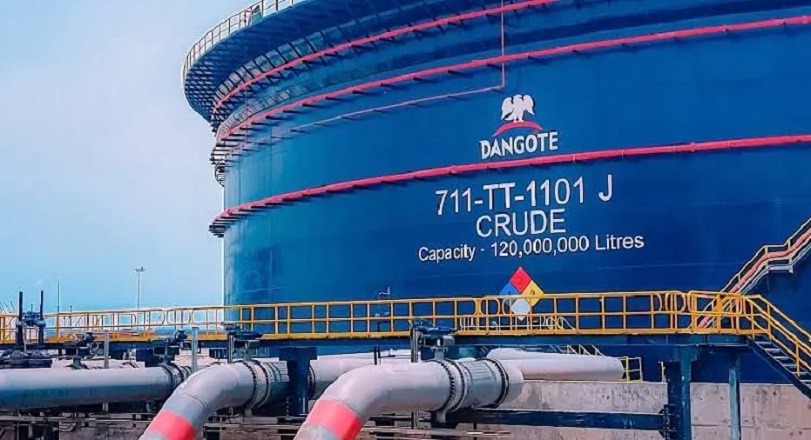
The Dangote Petroleum Refinery has bought one million barrels of crude oil from Algeria, a member of the Organisation of the Petroleum Exporting Countries (OPEC).

According to a new report from Augus Media, the refinery bought the crude cargo from Glencore trading firm in February, and is due at the 650,000 barrels capacity refinery between March 15 and March 20.

The move comes as the refinery, valued at $20 billion, is chasing 100 per cent refining capacity, with drawbacks from crude loadings affecting its ability to produce fuels at optimal capacity.

The Lagos-based oil facility received about 24 million barrels of Nigerian supply in October and November last year.

Last month, Mr Edwin Devakumar, vice-president of Dangote Industries Limited (DIL), said the refinery could begin operating at full capacity in 30 days.

The major shareholder in the structure and chairman, Mr Aliko Dangote assured Nigerians that his refinery has over N600 billion worth of premium motor spirit (PMS) in storage that can sufficiently meet Nigeria’s needs.

Augus Media also said none of the tankers which have loaded in Algeria in February have flagged Africa as their destination, suggesting the cargo will load in March.

According to the report, a trader noted that the Saharan blend’s quality is suitable for the Dangote refinery and that it is competitively priced compared to Nigerian grades.

“Nearly 420,000 b/d of crude was delivered to Lekki for Dangote so far this year, with about 82pc of that made up of light sweet grades, Vortexa data show. Nigerian crude accounted for 87pc of all arrivals,” the Augus Media report said.

“The March-loading trade cycle for Saharan Blend was slow to kick off due to sluggish demand in Europe because of seasonal refinery maintenance and ample light crude supply.

“This may have encouraged buyers in Europe to hold off on purchases of Saharan Blend in anticipation of weaker price differentials, prompting sellers to look to alternative outlets.”

The report added that Saharan blend prices have dropped by $1 per barrel in February when March-loading cargoes were trading, and now stand at a 20 cents per barrel discount to the north.


Adedapo Adesanya is a journalist, polymath, and connoisseur of everything art. When he is not writing, he has his nose buried in one of the many books or articles he has bookmarked or simply listening to good music with a bottle of beer or wine. He supports the greatest club in the world, Manchester United F.C.

Economy

Renewed Buying Interest Lifts Local Stock Exchange by 0.57%

Published

on

Local Stock Exchange

By Dipo Olowookere

The Nigerian Exchange (NGX) Limited ended in the green territory on Monday after it chalked up 0.57 per cent on the back of renewed buying interest in financial equities.

The local stock exchange witnessed the insurance and the banking counters closing higher by 0.54 per cent and 0.08 per cent, respectively, amid profit-taking in the others. The energy index shed 1.77 per cent and the consumer goods sector depreciated by 0.26 per cent, while the industrial goods industry was flat.

At the close of business, the All-Share Index (ASI) went up by 1,412.65 points to 251,125.02 points from 249,712.37 points, and the market capitalisation soared by N906 billion to N160.983 trillion from N160.077 trillion.

Investor sentiment was bullish yesterday after Customs Street ended with 35 price gainers and 30 price losers, indicating a positive market breadth index.

Airtel Africa surged 10.00 per cent to N3,655.70, International Energy Insurance advanced by 9.68 per cent to N3.74, Sovereign Trust Insurance went up by 9.65 per cent to N2.50, Caverton rose by 9.63 per cent to N7.40, and VFD Group gained 9.55 per cent to close at N10.90.

Conversely, McNichols lost 10.00 per cent to finish at N7.20, The Initiates dropped 9.91 per cent to trade at N30.45, Learn Africa slipped by 9.69 per cent to N11.65, Zichis crashed by 7.93 per cent to N30.98, and May and Baker declined by 6.60 per cent to N46.70.

During the trading day, market participants transacted 629.4 million shares worth N40.9 billion in 82,434 deals compared with the 711.9 million shares valued at 29.1 billion traded in 62,386 deals last Friday, implying a decline in the trading volume by 11.59 per cent, and a rise in the trading value and number of deals by 40.55 per cent and 32.14 per cent, respectively.

Access Holdings was the busiest equity for the session with a turnover of 61.3 million units valued at N1.5 billion. Zenith Bank traded 37.9 million units worth N5.0 billion, Fidelity Bank sold 35.8 million units for N851.2 million, Japaul exchanged 24.7 million units valued at N90.9 million, and Tantalizers transacted 22.8 million units worth N103.2 million.

Continue Reading

Economy

Naira Opens Week Stronger at N1,374/1$ in Official Market

Published

on

Naira-Dollar exchange rate gap

By Adedapo Adesanya

The Naira appreciated against the US Dollar in the Nigerian Autonomous Foreign Exchange Market (NAFEX) by 54 Kobo or 0.04 per cent on Monday, May 25, to trade at N1,374.92/$1 compared to last Friday’s value of N1,375.46/$1.

However, it further depreciated against the Pound Sterling in the official market during the session by N6.01 to sell for N1,855.73/£1 versus the preceding session’s N1,849.72/£1 and lost N158.02 against the Euro to close at N1,755.06/€1, in contrast to the N1,590.04/€1 it was traded last Friday.

In the same vein, the Nigerian Naira weakened against the United States Dollar at the GTBank FX counter yesterday by N2 to quote at N1,383/$1 versus N1,381/$1, and gained N5 in the parallel market to settle at N1,385/$1 compared with the previous rate of N1,390/$1.

The performance of the domestic currency comes as the external reserves inched higher to $48.72 billion, indicating a complex mix of sustained FX demand pressures and modest reserve accretion.

The movement in the FX market underscores the continued tension between demand-side pressure and policy-driven attempts to stabilise the naira.

While recent monetary tightening measures by the Central Bank of Nigeria (CBN) have helped to moderate extreme volatility, market participants are struggling to navigate a landscape shaped by intermittent dollar inflows, import-related demand and shifting investor sentiment.

As for the cryptocurrency market, most tokens were up amid optimism of a near-term US-Iran peace deal, as Iranian negotiators arrived in Doha, Qatar, for talks.

The Strait of Hormuz has been largely blockaded since the US and Israel struck Iran on February 28, though traffic has partially resumed in recent days. The agenda would include the reopening as well as uranium control.

TRON (TRX) rose by 1.8 per cent to $0.3714, Cardano (ADA) added 1.2 per cent to trade at $0.2444, Bitcoin (BTC) improved by 0.9 per cent to $77,283.62, Binance Coin (BNB) jumped 0.8 per cent to $661.30, and Ripple (XRP) increased by 0.8 per cent to $1.35.

Further, Ethereum (ETH) grew by 0.7 per cent to $2,018.82, Solana (SOL) expanded by 0.6 per cent to $85.37, and Dogecoin (DOGE) appreciated by 0.6 per cent to $0.1001, while the US Dollar Tether (USDT) and the US Dollar Coin (USDC) remained unchanged at $1.00 apiece.

Continue Reading

Economy

Oil Prices Crash 7% on Hopes of US-Iran Peace Deal

Published

on

Oil Prices fall

By Adedapo Adesanya

Oil prices fell nearly 7 per cent on Monday as optimism grew that the United States and ‌Iran were moving closer to a peace deal that would reopen the Strait of Hormuz.

Brent crude futures were down by $7.24 or almost 7 per cent to $96.30 a barrel, and the US West Texas Intermediate (WTI) crude futures decreased by $6.30 or 6.5 per cent to trade ​at $90.88 per barrel.

Comments by President Donald Trump that diplomatic negotiations with Iran are advancing eased market fears of severe energy supply disruptions due to the Middle East conflict.

This is as a top negotiator of Iran, and its foreign minister was in Doha ​for talks with Qatar’s prime minister on a potential deal with the US to end the three-month-old ⁠war

Recently, both countries have downplayed expectations for an immediate peace agreement to end their three-month-old war, backing away from claims of an imminent breakthrough.

President Trump later revealed that he has instructed negotiators not to rush the process, asserting that the US naval blockade on Iranian ports will remain in full effect until a finalised accord is certified and signed.

Also, the US Secretary of State Marco Rubio has affirmed that the US government will exhaust diplomatic channels, also warning that it will handle Iran in “another way” if a good agreement cannot be secured, hinting at a potential return to active war.

The deal outlines a process to fully reopen the vital global shipping lane without tolls, resolving the global energy crunch. Iran would receive targeted sanctions relief and the gradual unfreezing of up to $20 billion to $25 billion in assets currently held in foreign banks.

Even if ⁠a peace deal is reached, analysts expect a return to normal oil flows through the strait will take months, while damaged oil and gas facilities are repaired. There is currently a supply shortfall of up to 11 million ​barrels per day of crude oil that does not go away immediately, even if a deal is reached soon.

Ship-tracking data showed three Liquefied Natural Gas (LNG) tankers passed through the ​strait in recent days, heading to Pakistan, China and India, as well as a supertanker with Iraqi crude for China after being stranded for nearly three months.

Continue Reading

Trending