

Economy
Dangote Launches $2.5bn Fuel Storage, Pipeline Project in Namibia

By Adedapo Adesanya
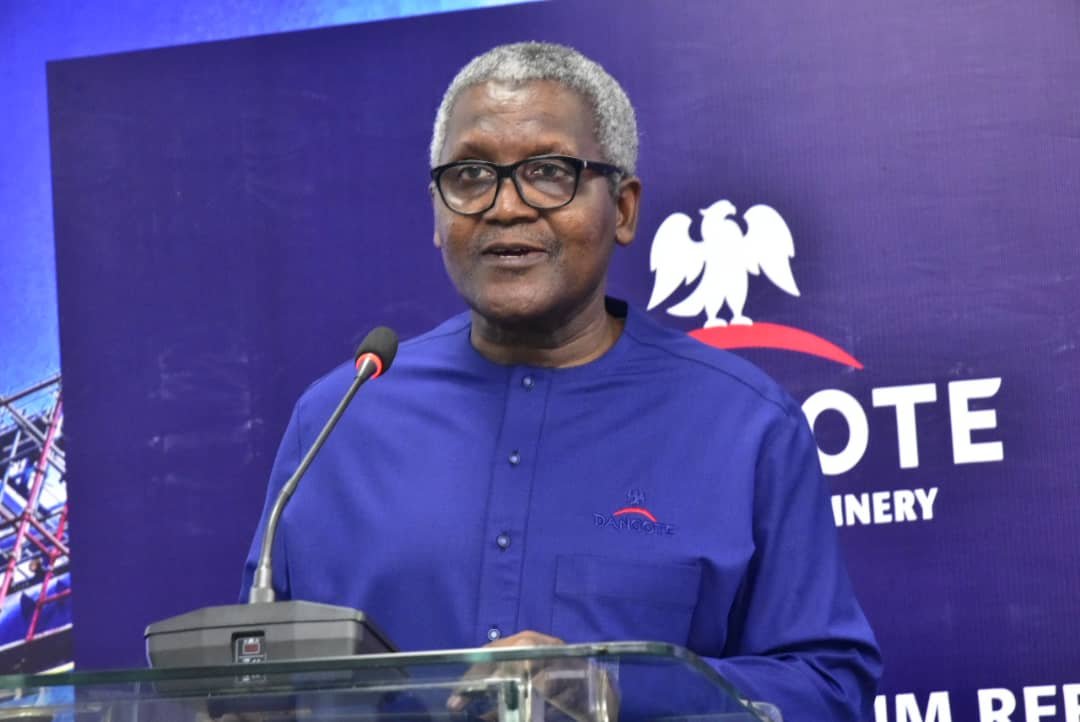
Nigerian businessman, Mr Aliko Dangote, has launched a $2.5 billion fuel storage and regional pipeline project in Walvis Bay, Namibia, aimed at strengthening fuel distribution and energy security across Southern Africa.
The project, launched on Wednesday in the presence of Namibian President Netumbo Nandi-Ndaitwah, is expected to establish Walvis Bay as a regional fuel logistics hub and improve energy supplies to six African countries.
The facility will have a storage capacity of approximately 600 million litres, equivalent to four million barrels, comprising 360 million litres of diesel, with the remainder allocated to petrol. Dangote said construction would be completed within 18 to 20 months.
The storage terminal will have eight times the capacity of Namibia’s existing 75 million-litre National Oil Storage Facility, operated by state-owned oil company Namcor.
The project also includes plans for a 1,700-kilometre pipeline that could connect landlocked countries, including Botswana, Zimbabwe, Zambia and potentially the Democratic Republic of Congo, to the facility.
Speaking at the launch, Mr Dangote said the project would reduce logistical vulnerabilities, lower shipping costs and address energy insecurity in Namibia while supporting regional fuel distribution.
The development forms part of Dangote’s broader expansion into Africa’s energy market as he seeks to build fuel storage and distribution networks across the continent.
Dangote already operates a 700,000-barrel-per-day refinery in Nigeria, which is undergoing expansion, and is planning another refinery with the same capacity in Lamu, Kenya.
The Namibian project would help Dangote diversify the markets for his refined petroleum products, particularly as the energy transition is expected to moderate long-term fuel demand in Europe and East Asia.
The hub also aligns with Mr Dangote’s strategy to develop regional distribution infrastructure for refined fuel exports as he targets his wider conglomerate valued at $100 billion before 2030.