Connect with us

Economy

Dangote Refinery Can Solve Nigeria’s FX Crisis, Revamp Economy—S&P Global

Published

on

Dangote Refinery Nigeria’s FX Crisis

By Aduragbemi Omiyale

If Dangote Refinery can be given the needed support, it can solve the foreign exchange (FX) crisis and catalyse economic development in Nigeria.

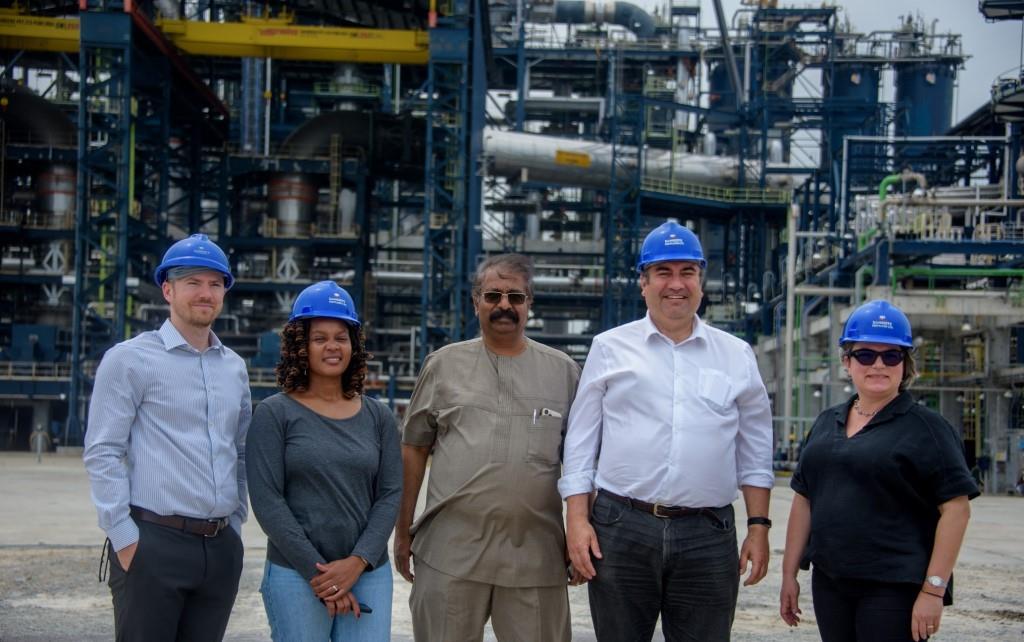
This was the submission of a respected rating company, S&P Global Ratings, during a tour of the Dangote Oil Refinery and Petrochemicals in Lagos.

The rating firm was at the 650,000 barrels per day (bpd) facility as part of its sovereign credit ratings assessment of Nigeria. The team from the international rating agency were accompanied by officials from the Federal Ministry of Finance.

The Director and Lead Analyst for Sovereign and International Public Finance Ratings at S&P Global, Mr Ravi Bhatia, who led the delegation to Lagos, said the Dangote refinery would transform Nigeria into a net exporter of petroleum products.

He added that this transformation is expected to boost revenue generation and alleviate the current pressure on the country’s foreign exchange reserves.

“It is a very impressive facility, able to process 650,000 barrels a day, when in full capacity. It is the largest single-train refinery complex in the world. It came out quite quickly.

“Nigeria is a big exporter of crude but has issues with importing refined fuels. So, there is a gap in the market where crude can be refined in Nigeria, save money that way, and potentially save some foreign exchange. This will be positive for the economy in the medium term. It looks positive from our assessment,” Mr Bhatia said after an over four-hour tour of the facility.

Also, in a chat with the media, the Vice President of Oil and Gas at Dangote Industries Limited (DIL), Mr Devakumar Edwin, who led the team during the tour of the facility, reiterated that by harnessing Africa’s abundant crude oil resources to produce refined products locally, the company aims to catalyse a virtuous cycle of industrial development, job creation, and economic prosperity.

He also revealed that, as earlier promised, the company will start the production of premium motor spirit (PMS), this month (July).

Noting that products from the $20 billion facility are of high quality and meet international standards, Mr Edwin said it could meet 100 per cent of Nigeria’s demand for petrol, diesel, kerosene, and aviation Jet, with surpluses available for export.

The S&P team commended the President of Dangote Industries Limited, Mr Aliko Dangote, for integrating advanced technologies and quality control measures, including a state-of-the-art Central Control Unit ensuring smooth automation of operations.

Other members of the team of the international rating agency include the Associate Director, Sovereign Ratings, Maxmillian McGraw; Director, Corporate Ratings, Omegu Collocott; Senior Analyst, Bank Ratings, Charlotte Masvongo, and Director, Financial Services, Samira Mensah.

Currently operating at 350,000 barrels per day capacity, Edwin said the refinery is slated to scale up to at least 500,000 barrels per day capacity by July/August, commencing the refining of petrol and ultra-low sulphur diesel.

He noted that the refinery, designed to process a wide range of crudes including various African and Middle Eastern crudes, as well as US Light Oil, conforms to Euro V specifications.

In addition, it is designed to comply with the US EPA, European Union (EU) emission norms, the Department of Petroleum Resources (DPR) emission/effluent norms, and the African Refiners and Distribution Association (ARDA) standards.

While noting that most refineries were built by foreign companies, he said it is a thing of pride that a Nigerian company designed and built the world’s largest single-train refinery complex while acting directly as its Engineering, Procurement, and Construction (EPC) contractor. The refinery also incorporates a self-sufficient marine facility capable of handling the world’s largest vessels.

“The refinery can produce the best quality products in the world, Euro V grade. It is one of the energy-efficient refineries and it is highly environmentally friendly.

“It is sophisticated with a high level of automation. The largest single train refinery in the world is 100 per cent designed, engineered, and constructed by a Nigerian company as an EPC contractor,” he said.

Nigeria, one of the world’s leading oil-producing countries, exports all its crude oil for refining and subsequently imports refined products due to a lack of operational refineries. It is estimated that Nigeria imports at least 50 million litres of petrol per day to meet domestic demand.

According to data from the National Bureau of Statistics (NBS) in its Foreign Trade Statistics for the Fourth Quarter of 2023, Nigeria spent approximately N12 trillion on the importation of petroleum products in 2023, including premium motor spirit (PMS), commonly known as petrol. This figure marks an 18.68 per cent increase compared to the N10 trillion spent on fuel imports in 2022.


Economy

Nigeria Approves Fiscal Plan Proposing N54.5trn 2026 Budget

Published

on

Finance 35% of 2024 Budget

By Adedapo Adesanya

The Federal Executive Council (FEC) has signed off on a medium-term fiscal plan that projects spending of around N54.5 trillion in 2026, as it approved the 2026-2028 medium-term expenditure framework (MTEF), outlining Nigeria’s economic outlook, revenue targets, and spending priorities for the next three years.

The Minister of Budget and National Planning, Mr Atiku Bagudu, said oil price was pegged at $64 per barrel, while the exchange rate assumption for the budget year is N1,512/$1.

He said while the council set an oil production benchmark of 2.06 million barrels per day for 2026, the fiscal planning is based on a cautious 1.8 million barrels per day.

Mr Bagudu stated the exchange rate projection reflects the fact that 2026 precedes a general election year, adding that all the assumptions were drawn from detailed macroeconomic and fiscal analyses by the budget office and its partner agencies.

According to the minister, inflation is projected to average 18 per cent in 2026.

Mr Bagudu said based on the assumptions, the total revenue accruing to the federation in 2026 was estimated at N50.74 trillion, to be shared among the three tiers of government.

“From this projection, the federal government is expected to receive N22.6 trillion, states N16.3 trillion, and local governments N11.85 trillion,” he said.

“When revenues from all federal sources are consolidated, including N4.98 trillion from government-owned enterprises, total Federal Government revenue for 2026 is projected at N34.33 trillion —representing a N6.55 trillion or 16 per cent decline compared to the 2025 budget estimate.”

The minister said statutory transfers are expected to amount to roughly N3 trillion, while debt servicing was projected at N10.91 trillion.

He said non-debt recurrent spending — covering personnel costs and overheads — was put at N15.27 trillion, while the fiscal deficit for 2026 is estimated at N20.1 trillion, representing 3.61 per cent of gross domestic product (GDP).

The MTEF also projected that nominal GDP will reach over N690 trillion in 2026 and climb to N890.6 trillion by 2028, with the GDP growth rate projected at 4.6 per cent in 2026.

The non-oil GDP is also expected to grow from N550.7 trillion in 2026 to N871.3 trillion in 2028, while oil GDP is estimated to rise from N557.4 trillion to N893.5 trillion over the same period.

Continue Reading

Economy

Operators Exploit Loopholes in PIA to Frustrate Domestic Crude Oil Supply—Dangote

Published

on

crude oil supply disruption

By Aduragbemi Omiyale

There seems to be a deliberate effort to starve local crude oil refiners from getting supply, foremost African businessman, Mr Aliko Dangote, has said.

He said loopholes in the Petroleum Industry Act (PIA) are being exploited to ensure private refiners like the Dangote Petroleum Refinery import the commodity, making consumers pay more for petroleum products.

Mr Dangote insisted that Nigeria has no justification for importing crude or refined petroleum products if existing laws were properly enforced.

Speaking during a visit by the South South Development Commission (SSDC) to the Dangote Petroleum Refinery and Fertiliser Complex in Lagos, he noted that the PIA already establishes a framework that prioritises domestic crude supply.

According to him, several oil companies routinely divert Nigerian crude to their trading subsidiaries abroad, particularly in Switzerland, forcing domestic refineries to buy from these offshore entities at a premium of four to five dollars per barrel.

“The crude is available. It is not a matter of shortage. But the companies move everything to their trading arms, and we are forced to buy at a premium. Meanwhile, we do not receive any premium for our own products,” he said.

He disclosed that he has formally written to the Federal Government, urging it to charge royalties and taxes based on the actual price paid for crude, to prevent revenue losses and to discourage practices that disadvantage local refiners.

Mr Dangote said the Nigerian National Petroleum Company (NNPC) remains the primary supplier honouring domestic supply obligations, providing five to six cargoes monthly. However, the refinery requires as many as twenty cargoes per month from January to operate optimally.

Describing the situation as “unsustainable for a country intent on genuine industrial growth,” Mr Dangote argued that Africa’s economic future depends on value addition rather than perpetual raw material export.

“It is shameful that while we exported one point five million tonnes of gasoline in June and July, imported products were flooding the country. That is dumping,” he said.

On report by the Nigerian Midstream and Downstream Petroleum Regulatory Authority (NMDPRA), that the refinery supplied only 17.08 million litres of the 56.74 million litres consumed in October 2025, Mr Dangote said that the refinery exports its products if regulators continue to permit dumping by marketers.

Addressing Nigeria’s ambition to achieve a $1 trillion economy, Mr Dangote said the target is attainable through disciplined policy execution, improved power generation and a revival of the steel sector.

“You cannot build a great nation without power and steel. Every bolt and nut used here was imported. That should not be the case. Nigeria should be supplying steel to smaller African countries,” he said.

He also underscored opportunities for partnership with the SSDC in agriculture, particularly in soil testing and customised fertiliser formulation, noting that misuse of fertiliser remains a major reason Nigerian farmers experience limited productivity gains.

“We are setting up advanced soil testing laboratories. From next year, we want to work with the SSDC to empower farmers by providing accurate soil assessments and customised fertiliser blends,” Mr Dangote said.

Continue Reading

Economy

Flex Raises $60m to Scale Finance Platform

Published

on

flex fintech $60m

By Aduragbemi Omiyale

A $60 million Series B equity round has been completed by a financial technology (fontech) company, Flex, to scale its all-in-one business and personal finance platform for high-net-worth middle-market business owners.

The funding round was led by Portage, with participation from CrossLink Capital, Spice Expedition, Titanium Ventures, Wellington, Companyon Ventures, Florida Funders, FirstLook Partners, Tusk Venture Partners and others, bringing its total equity funding to $105 million.

The company is building Artificial Intelligence (AI) agents across every product pillar to streamline both its internal operations and customer experiences—like credit underwriting agents to deeply understand every business, expense agents, payment workflows, cash management agents, and back-office ERP agents into a single “motherboard” for business owners.

Flex’s vision is to provide every business owner a team of high quality finance agents to run their backoffice like an enterprise. This AI-driven architecture not only improves customer experience but also drives a structurally lower cost base for Flex, enabling it to operate with a lean headcount.

In turn, Flex delivers AI-powered Owner Insights, transforming the data generated from customer activity into a beautiful, intuitive experience that positions Flex as their “AI CFO.”

“Our mission is to build the private bank ambitious business owners have always deserved.

“Middle-market business owners employ 40% of Americans, but the financial system has never been designed around their complex needs.

“Flex is the first platform that supports every step of their financial lives, from the moment they earn revenue to the moment they spend it personally.

“Unlike many of our FinTech peers who focus on saving large enterprises money, we focus on helping ambitious owners make more money,” the chief executive of Flex, Mr Zaid Rahman, said.

A Partner at Portage, Jake Bodanis, said, “Flex is building a category-defining financial institution. The company has proven that middle-market business owners are both massively underserved and extremely valuable customers when given the right financial infrastructure. Flex’s hypergrowth and best in class capital efficiency speaks to how powerful this model is.”

Flex was created to give these high net worth owners a single place to run both their business and personal finances.

Continue Reading

Trending